
Oil prices breaking above $100 fuel expectations of rate hikes! Will the Fed act next week?

Options Sir on Macro | Temporal Convergence: Will the 'Broadcom + NFP' script replay with 'Micron + PCE'?
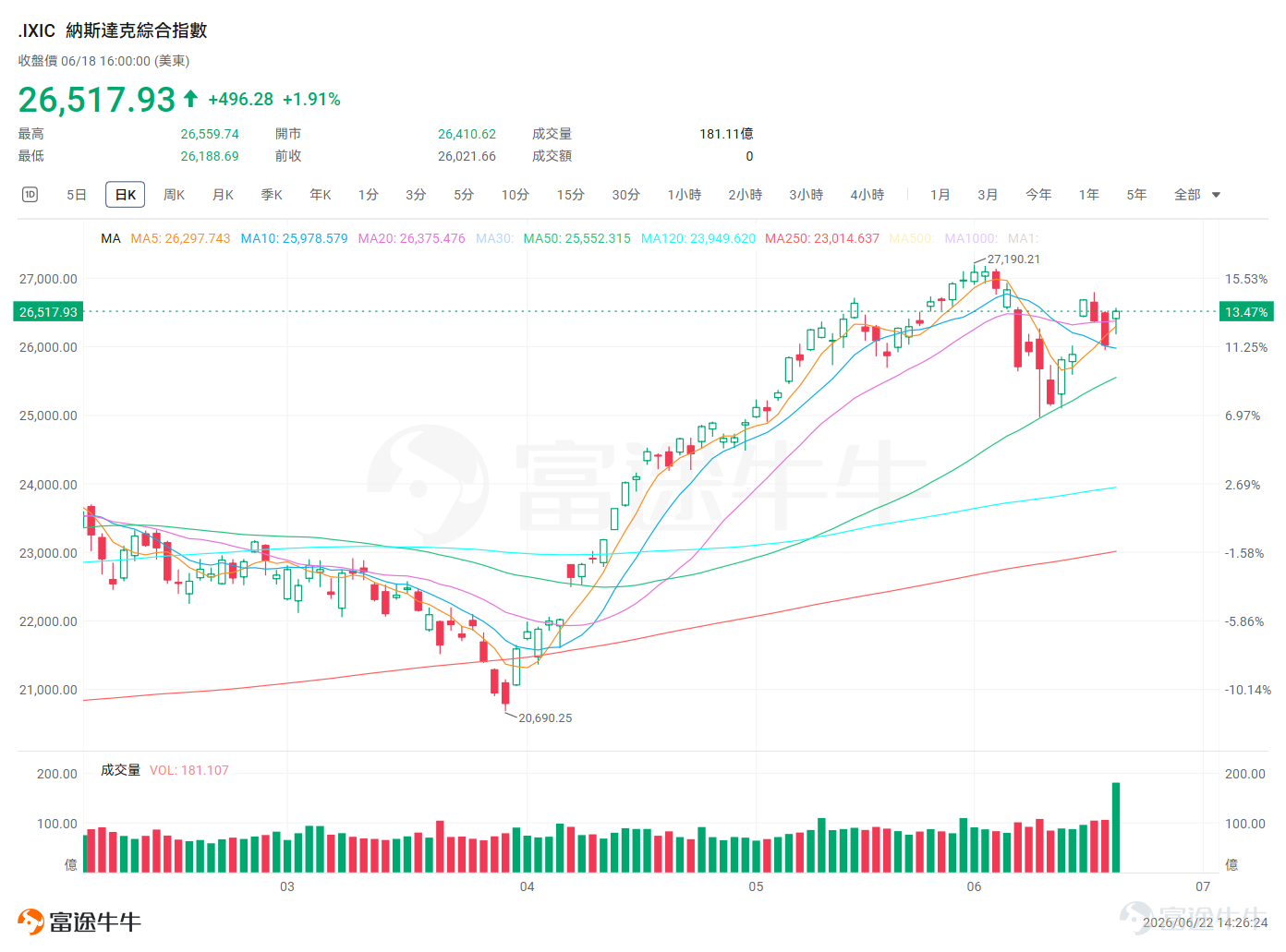
Last week’s macro drama was nothing short of breathtaking, as the Fed’s new chair, Waller, made his FOMC debut. During this high-stakes test filled with uncertainty, markets initially plunged due to a hawkish dot plot.Interestingly, however, the panic lasted only a single trading session—by the next day, capital had quickly recouped its losses and once again firmly poured into the AI theme.
However, it should be noted thatMarket resilience remains strong, and the fundamental thesis behind the AI theme remains intact. Yet, given historically elevated positioning, short-term volatility could erupt at any moment. A correction doesn’t require a collapse in fundamentals—it often just needs an 'excuse.'
This week’s “ $Micron Technology (MU.US)$ earnings reports + PCE data” combo may present another window where defensive preparations are warranted in advance.
The FOMC false alarm and the robust resilience of the AI theme
The key new information from last week’s FOMC meeting was that Waller adopted a more hawkish stance than expected. The dot plot hinted at potential additional rate hikes this year and even mentioned adjustments to the medium- to long-term policy framework. This would normally have been a heavy blow, as Waller has long been viewed by markets as an unpredictable factor capable of introducing 'forward guidance chaos.'
But the market’s reaction was rather dramatic. After a sharp intraday drop, U.S. equities quickly rebounded the next day, with capital continuing to flow steadily into the AI hardware and compute chain—represented by NVIDIA, Broadcom, and Micron. Why is this happening?
The core reason lies in the fact that the U.S.-Iran agreement has significantly reduced geopolitical tail risks, and falling oil prices have given the market hope that inflation could be brought under control.Against the backdrop of expectations that the macroeconomic 'worst moment' has passed, Waller’s hawkish remarks were instead interpreted by the market as 'bad news already priced in'—after all, he did not scrap the dot plot or completely upend market expectations. Since the most feared shoe hasn’t dropped, investors naturally see little reason to exit.
From a micro perspective, we are currently in the earnings realization phase of the AI industry boom, and demand along the compute chain continues to exceed expectations. With macro risks receding, investors are highly motivated to position themselves ahead of the upcoming earnings season. The strength of this bullish sentiment clearly demonstrates that the current market trend cannot be underestimated.
However, according to Bank of America’s Global Fund Manager Survey released in June,a striking 80% of surveyed fund managers consider 'going long global semiconductors' to be the most crowded trade right now—a record high since the survey began.It’s like every car on a highway is crammed into the innermost fast lane. As long as the road remains smooth, everyone speeds along; but if there’s even a small pebble ahead, it could trigger sudden braking and pileups.
This week’s preview: PCE is a known variable, but short-term turbulence driven by 'crowding' still warrants caution.
The U.S. May PCE data will be released pre-market on Thursday (20:30 Beijing time).Objectively speaking, since the prior CPI and PPI data have already been released, the component weights of the PCE can be reasonably estimated.The market currently broadly expects core PCE to remain around 3% year-over-year, with a slight month-over-month increase. Judging solely from the data itself, it is indeed difficult to exceed the range of expectations already priced in by the market.
But we need to pay attention to a structurally highly similar narrative:“Broadcom + Nonfarm Payrolls” and “Micron + PCE” exhibit a temporal convergence.
Let’s revisit the script from that week at the beginning of this month. What happened then?
A major AI-related stock released earnings: $Broadcom (AVGO.US)$ and reported its earnings after U.S. market hours on Wednesday (June 3).Although actual results beat expectations, its AI revenue guidance failed to meet the market’s extremely overheated expectations, triggering a short-term 'sell-the-fact' pullback sentiment.

An initially overlooked economic data point: The nonfarm payrolls data released before market open on the following Friday (June 5) significantly surpassed expectations. In prior months, nonfarm payrolls had limited market impact, as inflation transmission driven by oil prices was the central focus this year, not employment. Markets later normalized, and investors quickly moved on from discussing the nonfarm payrolls report.However, in an extremely crowded market environment at the time, it happened to become the catalyst for emotional unwinding.
ResultAmid the temporal confluence of these two seemingly unrelated factors, the extremely crowded AI sector experienced a short-term sell-off, causing the Philadelphia Semiconductor Index (SOX) to plunge sharply in a single day and triggering a brief liquidity squeeze. However, markets quickly stabilized and returned to normal, demonstrating that the core investment thesis remains intact.
Now shift focus back to this week—the timeline is strikingly similar:
A major AI stock reports earningsThis week, Micron also released its earnings after the U.S. market close on Wednesday (June 24). As a key player in memory chips and the AI computing supply chain, Micron had seen substantial gains ahead of the report, with market expectations for its HBM (High Bandwidth Memory) business already fully priced in.If its guidance contains even a minor flaw, it could easily replicate the short-term 'sell-the-fact' reaction seen previously with Broadcom.
An economic data release before Thursday’s market openThe PCE data will be released before the market opens on Thursday (June 25).Although CPI/PPI have already set the tone and markets have formed expectations, if certain services components within PCE unexpectedly come in strong, they could still be amplified by crowded trading positions.
Maintaining a degree of caution in this environment does not imply bearishness on the market, but rather reflects preparedness for potential short-term volatility.In a highly crowded market, momentum-driven quant funds can trigger a cascade of algorithmic trades once they encounter unexpected signals.
At this point, even a minor blemish in Micron’s earnings report, combined with stronger-than-expected PCE data, would be enough to trigger profit-taking in the short term.This does not mean the AI bull market is over—just as the market quickly returned to normal after the strong nonfarm payroll report early this month. However, such sharp, short-term shakeouts can easily erode profits for heavily positioned investors—or even prompt irrational selling—if they haven’t prepared contingency plans in advance.
How can you prepare defensive tools ahead of time?
In anticipation of potential 'crowded-trade-induced short-term volatility,' several options strategies are worth considering:
Strategy 1: Buy a naked put (protective put)—essentially purchasing insurance for your position
If you are heavily invested in U.S. tech ETFs (such as $Invesco QQQ Trust (QQQ.US)$ 、 $iShares Semiconductor ETF (SOXX.US)$ ) or individual stocks (such as $NVIDIA (NVDA.US)$ , Micron),and you remain bullish on the AI thesis over the long term and don’t want to sell your holdings, yet still wish to hedge against a potential short-term plunge similar to the one seen on June 5 triggered by the 'Micron + PCE' combination,
the simplest and most direct approach is to buy a naked put option. When market sentiment is still relatively calm and implied volatility (IV) hasn’t spiked yet, consider purchasing a slightly out-of-the-money or at-the-money put expiring this Wednesday or Thursday. $SPDR S&P 500 ETF (SPY.US)$ Major ETFs such as QQQ offer options expiring on every trading day, allowing flexible positioning around significant events.

(The design images displayed on the screen are for demonstration purposes only and do not constitute any investment advice or guarantee; market movements are frequent, and the illustrated option prices do not represent actual conditions)This is the most straightforward 'buying insurance' mindset. With the market currently trading at elevated levels with high volatility, purchasing a single-leg put option provides effective downside protection: if a sharp short-term decline occurs, your put will quickly gain value, offsetting losses in your underlying stock position. If the market remains calm or continues to rally strongly, you only lose the limited 'premium' paid for this insurance, while still fully capturing any upside gains from your stock holdings. In crowded trades, spending a small amount for peace of mind helps you stay committed to your long-term positions.
Avoid buying overly long-dated insurance—its purpose is to hedge against short-term event-driven shocks, and it should be put in place before the event occurs. The PCE data will be released pre-market on Thursday (8:30 PM Beijing time).If you intend to use options for hedging or speculative positioning, don’t wait until the U.S. market opens on Thursday—establish your position in advance.
Strategy Two: Covered Call – Collecting 'rent' at a congested crossroads
If you remain bullish on AI over the long term but acknowledge that the market’s near-term upside may be limited—likely entering a period of consolidation or mild pullback—you might be willing to forgo some potential explosive gains in exchange for collecting option premiums.A special reminder here::If you are long-term bullish on your underlying stock, avoid writing calls with excessively long durations or setting strike prices too low.
Why emphasize short duration? If you sell a long-dated call (e.g., expiring in six months) and the stock experiences a sharp short-term selloff—creating a deep dip—only to later recover and surge past your strike price, your high-quality shares could be called away at an unfavorable price, causing you to miss out on subsequent gains. Selling short-dated calls allows you to collect 'quick cash' during sideways markets. With sufficiently short maturities, even if assigned, you still profit from the short-term price appreciation; if a mild pullback occurs, the premium received acts as a cushion, lowering your effective cost basis. Note that covered calls do not protect against sharp declines—they are better suited for mitigating modest corrections or generating income in range-bound markets.

(The design images displayed on the screen are for demonstration purposes only and do not constitute any investment advice or guarantee; market movements are frequent, and the illustrated option prices do not represent actual conditions)
Strategy Three: Cash-Secured Put – Be ready to pick up shares during moments of panic
Applicable scenario: You missed the initial AI rally or hold a very light position, and have been waiting for a pullback to enter. You believe that even if a short-term shakeout occurs, the core AI investment thesis remains intact—and any decline would represent a golden buying opportunity.
Consider selling a put option below your desired entry price. For example, if you view a 10% drop in SOXX (the Philadelphia Semiconductor ETF) from its current level as your ideal buying point...You could sell a put option expiring next month with a strike price below the current market price, while setting aside sufficient cash collateral.
If a crowded-trade-induced selloff causes SOXX to plunge below your strike price, you’ll be assigned and acquire SOXX at your predetermined discounted price—allowing you to successfully buy the dip, with the premium collected further lowering your effective cost basis. If the feared drop doesn’t materialize and SOXX holds up, the option expires worthless, and you keep the premium as pure profit.

(The design images displayed on the screen are for demonstration purposes only and do not constitute any investment advice or guarantee; market movements are frequent, and the illustrated option prices do not represent actual conditions)
Key ConsiderationsCrucially, this strategy should only be applied to an asset you genuinely want to own and for which you’ve set aside adequate cash. In today’s extremely crowded market, any short-term shakeout could trigger a deeper-than-expected decline—you must ensure you have sufficient capital to absorb the position and the mental fortitude to stay calm.
In financial markets, what you should fear most isn’t bad news or good news—it’s being unprepared.When market consensus becomes overwhelmingly one-sided, maintaining clarity of thought isn’t weakness—it’s how you endure and go the distance.
History often repeats itself in strikingly similar ways. The 'Broadcom + Nonfarm Payrolls' event on June 5 already demonstrated the volatility potential of crowded trades over a short horizon. Will this week’s 'Micron + PCE' data trigger a replay? We refrain from speculation—but as disciplined investors, we must have contingency plans ready.
Finally, here's a small perk for fellow Futubull investors, welcome to claim it.Options Beginner Pack
*This event is exclusive to invited HK users. Click to learn more.Detailed event rules>>
Market conditions are complex and volatile,Options StrategyOverwhelmed by choices? Futubull helps you build a portfolio in three steps.Options Strategymaking investing simple and efficient!

Option Risk Warning:An option is a contract that grants the holder the right—but not the obligation—to buy or sell an underlying asset at a predetermined price on or before a specified date. Option prices are influenced by multiple factors, including the current price of the underlying asset, the strike price, time to expiration, and implied volatility. Implied volatility reflects the market’s expectation of future price fluctuations over the life of the option and is derived by reverse-engineering the Black-Scholes pricing model. It is commonly used as a gauge of market sentiment. When investors anticipate greater volatility, they may be willing to pay higher premiums for options to hedge risk, leading to elevated implied volatility. Traders and investors use implied volatility to assess the relative attractiveness of option prices, identify potential mispricings, and manage risk exposure.
Disclaimer:This content does not constitute any offer, solicitation, recommendation, opinion, or guarantee of any securities, financial products, or tools. The risk of loss in trading options can be substantial. In some cases, losses may exceed the initial margin deposited. Even if you set contingent orders such as 'stop-loss' or 'limit' orders, these may not prevent losses. Market conditions may make such orders unexecutable. You may be required to deposit additional margin within a short period. If you fail to provide the required amount within the specified time, your open positions may be liquidated. However, you will still be responsible for any shortfall in your account. Therefore, before trading, you should study and understand options and carefully consider whether such trading is suitable for you based on your financial situation and investment objectives. If you trade options, you should be familiar with the procedures for exercising options and the rights and obligations upon exercise and expiration. Options trading carries extremely high risks and is not suitable for all investors. Investors should carefully readCharacteristics and Risks of Standardized Options。
Risk Disclaimer: The above content only represents the author's view. It does not represent any position or investment advice of Futu. Futu makes no representation or warranty.Read more


Comments (6)
to post a comment
47
97