
BTC surpasses $75,000! Has the upward channel been fully opened?

The Endgame for DATs: Liquidation or Self-Salvage
Article author: Prathik Desai
Article compiled by: BitpushNews
Source: The Token Dispatch
More than a year ago, becoming a digital asset treasury seemed like an easy decision for many companies looking to boost their stock prices.
Some Microsoft shareholders are rallying to request that the board assess the benefits of including a portion ofBitcointhe benefits of including it in their balance sheet. They even mentioned Strategy (formerly MicroStrategy), the largest publicly listed Bitcoin DAT.
There was a financial flywheel at the time that attracted everyone to follow.
Buy large amounts of BTC/ETH/SOL. Watch the stock price rise above the value of these assets. Issue more shares at a premium. Use the proceeds to buy more cryptocurrency. Repeat. This financial flywheel supporting publicly traded stocks seemed almost perfect enough to entice investors. They were paying over two dollars just to gain indirect exposure to one dollar’s worth of Bitcoin. Those were wild times.
But time will test even the best strategies and flywheels.
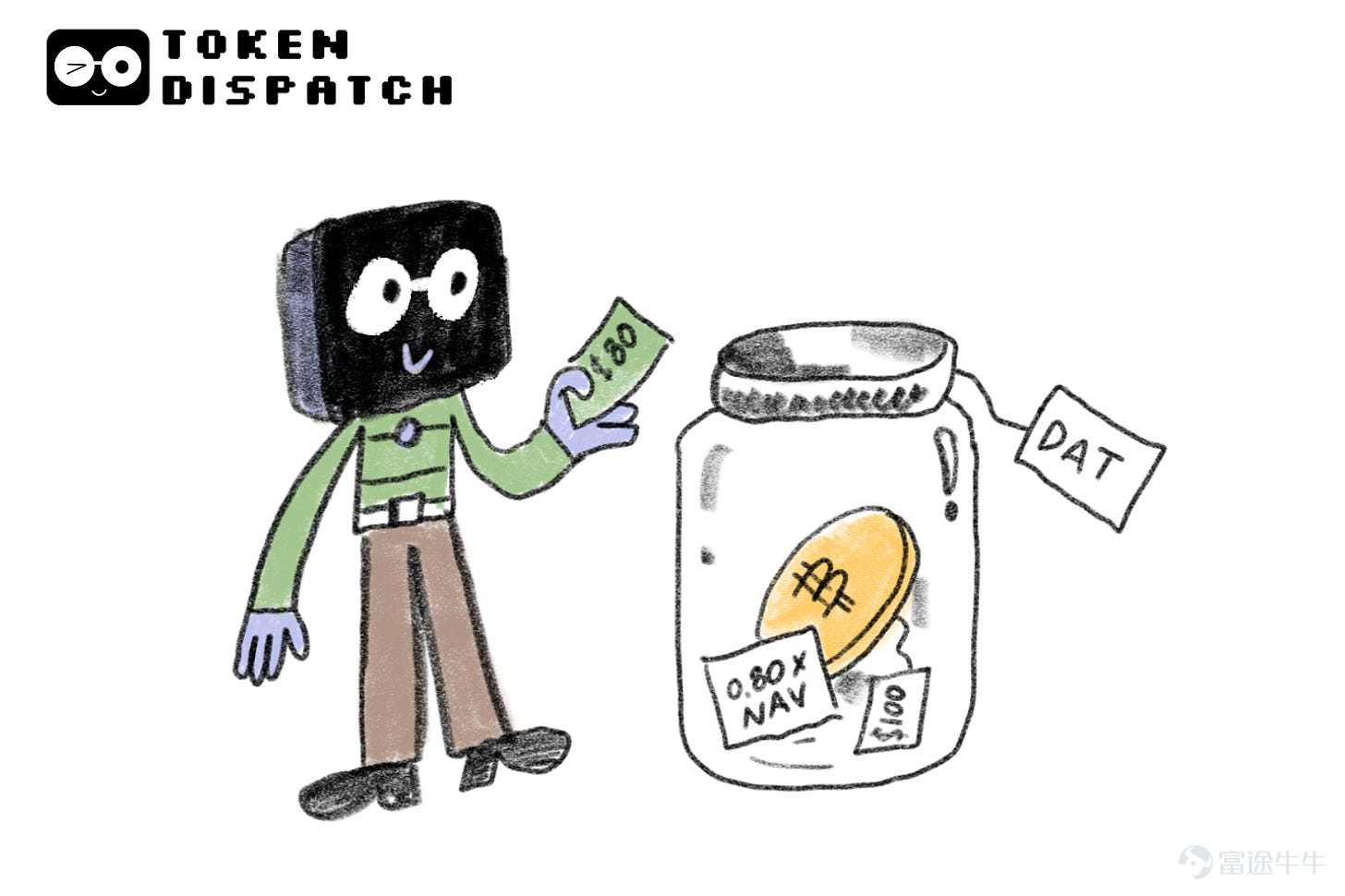
Now, as the total market capitalization of the crypto market has dropped by more than 45% over the past four months, the price-to-net asset value ratios of most of these packaged companies have fallen below 1. This indicates that the market is valuing these DATs at less than the worth of their crypto treasuries. This has altered how the financial flywheel operates.
Because a DAT is not just a wrapper for assets. In most cases, it's a company with operational overhead, financing costs, legal and operational expenses. In the era of mNAV premiums, DATs funded their cryptocurrency purchases and operating costs by selling more shares or raising more debt. However, in the mNAV discount era, this flywheel falls apart.
In today’s analysis, I will show you what a sustained mNAV discount means for DATs and whether they can survive in a crypto bear market.

Between 2024 and 2025, over 30 companies rushed to transform into DATs. They built treasuries around blue-chip coins like Bitcoin, Ethereum, and Solana, as well as meme coins.
At their peak on October 7, 2025, DATs held cryptocurrencies worth $118 billion, with a combined market cap of these companies exceeding $160 billion. Today, the cryptocurrencies held by DATs are worth $68 billion, while their total market cap at a discount is just over $50 billion.


The fate of all these companies hinges on one thing: their ability to package assets and craft stories that make the wrapped value higher than the underlying asset value. This difference becomes the premium.
The premium itself became the product. If the stock trades at 1.5 times the mNAV, the DAT can sell $1 worth of shares and then purchase $1.5 worth of crypto exposure, describing this transaction as 'value-added.' Investors were willing to pay the premium because they believed the DAT could continue selling shares at a premium and use the proceeds to accumulate more cryptocurrencies, thereby increasing the per-share value of crypto assets over time.

@Decentralised.Co
The problem is that premiums don’t last forever. Once the market stops paying extra for this packaging, the 'sell shares to buy more crypto' flywheel gets disrupted.
When shares no longer trade at 1.5 times their asset value, each newly issued share buys less cryptocurrency. What was once a tailwind from the premium turns into a headwind due to the discount.
Over the past year, the leading BTC, ETH, and SOL DATs saw their share prices fall more sharply than the cryptocurrencies themselves.

Once the premium of a stock relative to its underlying asset disappears, investors naturally ask why they can't purchase the cryptocurrency more cheaply elsewhere, such as on decentralized or centralized exchanges, or through exchange-traded funds.
Bloomberg's Matt Levine raised an important question: if DATs are trading below their net asset value, let alone at a premium, why aren’t investors forcing these companies to liquidate their crypto treasuries or buy back shares?
Many DATs, including the sector leader Strategy, are trying to convince investors that they will hold onto cryptocurrencies through bear markets and wait for the return of premium times. But I see a more critical issue. If DATs cannot raise additional capital in the foreseeable long term, where will they get the funding to sustain operations? These DATs have bills and salaries to pay.
Strategy is an exception for two reasons.
It reportedly holds $2.25 billion in reserves, enough to cover its dividend and interest obligations for approximately 2.5 years. This is significant because Strategy no longer relies solely on zero-coupon convertible bonds to raise funds; it has also issued preferred instruments that require substantial dividend payments.

It also has an operating business, small as it may be, that still generates recurring revenue. In Q4 2025, Strategy reported total revenue of $123 million and gross profit of $81 million. Although Strategy’s net income may fluctuate significantly each quarter due to mark-to-market changes in crypto asset prices, its business intelligence division remains its only tangible source of cash flow.
But this still doesn't make Strategy's approach foolproof. The market can still punish its stock — as it has over the past year — and undermine Strategy’s ability to continue raising funds at a low cost.
While Strategy may survive the crypto bear market, emerging DATs that lack sufficient reserves or operating businesses to cover their inevitable expenses will feel the pressure.
This distinction is even more pronounced among Ethereum-based DATs.
The largest Ethereum-basedEthereumDAT—BitMine Immersion, which has a marginal operational business to support its ETH treasury. For the quarter ended November 30, 2025, BMNR reported total revenue of $2.293 million, including consulting, leasing, and staking income.
Its balance sheet shows that the company holds digital assets worth $10.56 billion and cash equivalents of $887.7 million. BMNR's operations resulted in a net negative cash flow of $228 million. All of its cash requirements were met through the issuance of new shares.
Last year, it was relatively easy for BMNR to raise funds as its stock traded at a premium to mNAV for most of the year. However, in the past six months, its mNAV has dropped from 1.5 to around 1.
So, what happens when the stock no longer trades at a premium? Issuing more shares at a discount may reduce the corresponding ETH price per share, making it less attractive to investors compared to directly purchasing ETH from the market.
This explains why BitMine announced last month that it would invest $200 million to acquire shares in Beast Industries, a private company owned by YouTube blogger Jimmy "MrBeast" Donaldson. The company stated that it would "explore ways to collaborate on DeFi initiatives."
ETH and SOL DAT might also argue that staking income – something BTC DAT cannot boast – could help them sustain operations during a market crash. However, this still does not address the issue of meeting the company’s cash flow obligations.
Even with staking rewards (accumulated in cryptocurrencies like ETH or SOL), as long as these rewards are not converted into fiat currency, DATs cannot use them to pay salaries, auditing fees, listing costs, and interest. The company must either have sufficient fiat revenue or sell or re-mortgage its treasury assets to meet cash needs.
This is particularly evident in Forward Industries, the largest holder of SOL among DATs.
FWDI reported a net loss of $586 million in Q4 2025, despite receiving $17.381 million in staking and related income.
Management clearly stated that its "existing cash balance and working capital are sufficient to meet our liquidity needs for at least until February 2027."
FWDI also disclosed an aggressive capital-raising strategy, including issuing shares at market price, buybacks, and a tokenization experiment. However, if the mNAV premium remains absent over the long term, all these attempts may fail to successfully manage its wrapped price.

The core of last year's DAT boom lay in the speed of asset accumulation and the ability to raise funds by issuing shares at a premium. As long as the wrapper could trade at a premium, DATs could continue converting expensive equity into more per-share crypto assets and call it 'beta.' Investors also pretended that the only risk was the asset price itself.
But premiums do not last forever. Cryptocurrency cycles may turn them into discounts. I first wrote about this issue shortly after the October 10 liquidation event last year when I observed the premium starting to decline.
However, this bear market will force DATs to evaluate whether they should continue to exist once their wrappers no longer trade at a premium.
One way to resolve this dilemma is for companies to improve operational efficiency and supplement their DAT strategy with a business or surplus reserve capable of generating positive cash flow. This is because when the DAT narrative fails to attract investors during a bear market, a conventional corporate story will determine its survival.
If you’ve read the article Strategy & Marathon: Conviction and Power, you will recall why Strategy has remained resilient across multiple crypto cycles. However, a new group of companies, including BitMine, Forward Industries, SharpLink, and Upexi, cannot rely on the same strength.
Their current attempts at staking yields and weak operational businesses may collapse under market pressure unless they consider alternative options to meet real-world obligations.
We observed this with ETHZilla, an Ethereum treasury company that sold approximately $115 million worth of its ETH holdings last month and purchased twojet enginesSubsequently, the DAT leased the engine to a major airline and hired Aero Engine Solutions to manage it on a monthly fee basis.
Looking ahead, people will assess not only digital asset accumulation strategies but also the conditions under which they can survive. In the ongoing DAT cycle, only those companies capable of managing dilution, debt, fixed obligations, and trading liquidity will endure through market downturns.
Risk Disclaimer: The above content only represents the author's view. It does not represent any position or investment advice of Futu. Futu makes no representation or warranty.Read more

Comments
to post a comment
5