
Education Policy Settles; Industry Heavyweights Step In to Capitalize on Undervalued Opportunities
This year, China's 'Double Reduction' policy has been implemented, bringing far more than just stock-price fluctuations to the off-campus tutoring industry; it signals that the current round of regulatory focus is on de-industrializing the education sector. Education-sector stocks have plummeted to rock-bottom levels, and recently several education companies have simultaneously suspended K-9 or compulsory-education off-campus tutoring programs. At the same time, the policy is driving high-quality development of modern vocational education. With the policy now in place, it is clear that vocational education holds tremendous potential—and it is time for us to once again pay close attention to education-sector stocks.
Author: Benny
Implementation of the 'Double Reduction' Policy
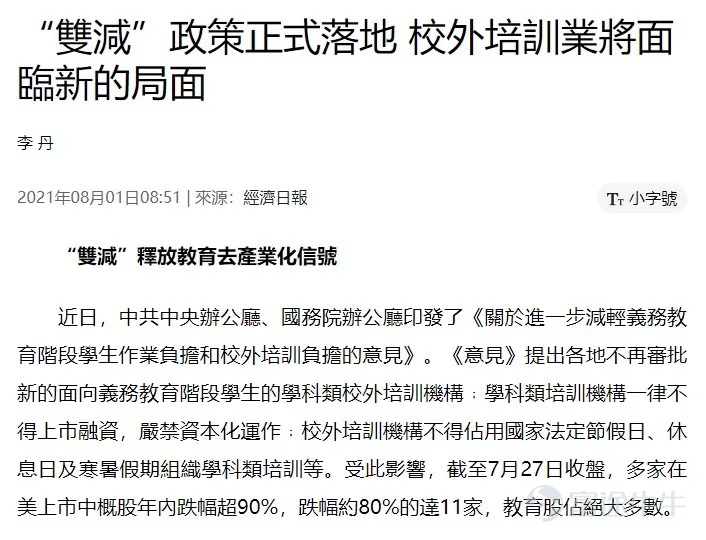
This year, China's 'Double Reduction' policy was implemented, stipulating that all academic-subject training institutions are prohibited from seeking public listings or raising capital through financing, and that capital-driven operations are strictly forbidden; furthermore, off-campus training institutions are not allowed to organize academic-subject courses during national statutory holidays, weekends, or winter and summer vacations. This policy has brought far more than just fluctuations in stock prices to the off-campus education sector—it signals that the primary focus of this round of regulation is to de-industrialize the education industry.

Previously, China also enacted the Family Education Promotion Law, which stipulates that people's governments at or above the county level shall strengthen supervision and management to reduce the homework burden and off-campus training burden of students in the compulsory education stage, thereby formally incorporating the "Double Reduction" policy into law.
On November 15, New Oriental issued an announcement on the Hong Kong Stock Exchange stating that, by the end of 2021, all of its learning centers nationwide will no longer offer subject-based tutoring services for students from kindergarten through ninth grade (K-9 academic tutoring). The company will shift its focus and resources to educational products and services unrelated to K-9 academic tutoring, such as exam preparation courses, adult language training programs, and instructional materials.
With New Oriental, a benchmark player in the education and training industry, ceasing its K-9 academic subject tutoring services, the academic education and training sector has officially come to an end. In fact, this policy is intended to ease the burden on parents and pave the way for the national implementation of the three-child policy.
Promoting High-Quality Modern Vocational Education
As previously noted, China has followed the German model by placing a high priority on manufacturing; however, to develop high-quality manufacturing, human capital is an indispensable component. Moreover, the declining birth rate in China is a common trajectory experienced by all developed countries, underscoring the urgent need to invest in the education and development of each new generation.
Has the policy allowing a third child this year had any effect? Young people are reluctant to have children, and both the costs of childbirth and child-rearing are currently quite high; only by bringing these costs down can the situation be changed. This is precisely why the "Double Reduction" policy was introduced—to ease the burden on parents and reduce the cost of raising children.
China has issued the "Opinions on Promoting the High-Quality Development of Modern Vocational Education" and circulated a notice stating that vocational education is an important component of the national education system and human resource development, entrusted with vital responsibilities. On the new journey of fully building a modern socialist country, vocational education holds vast prospects and great potential.

At the same time, vocational training institutions maintain close partnerships with employing enterprises, closely monitoring industry trends to ensure the relevance and effectiveness of their training programs. Tailored training courses are designed in response to specific enterprise needs, helping partner companies enhance the job skills of their employees. Moreover, these institutions offer advanced vocational education leading to higher-level technical qualifications for secondary vocational school graduates, thereby smoothing the pathway for further academic advancement and boosting students' motivation to pursue higher education.
The Implementation Regulations of the Private Education Promotion Law have been promulgated, yet they impose no restrictions on mergers and acquisitions, contractual control arrangements, or related-party transactions involving higher-education groups, thereby removing key risks that had previously hindered their outward expansion.
There is substantial room for growth in higher education.
With the policy now firmly in place, vocational education is poised for significant growth. In addition to the transformation of higher education institutions, major enterprises are also shifting their focus toward adult education—such as postgraduate entrance exams and civil service examinations—and holistic education, including areas like sports, programming, and image processing.
In 2020, the gross enrollment ratio for higher education in China reached 54.4%. According to the Outline of the 14th Five-Year Plan for National Economic and Social Development and the Long-Range Objectives for 2035, released in March 2021, the gross enrollment ratio for higher education is expected to rise to 60% during the 14th Five-Year Plan period.
Looking at the long term, in 2018 the higher education enrollment rate was 88% in the United States and 70% in Germany. Compared with other developed countries, even if the '14th Five-Year Plan' period manages to raise the rate to 60%, there will still be considerable room for further improvement.
At present, there are 39 vocational undergraduate institutions. Based on an average annual enrollment of 5,000 students per institution, the total enrollment in vocational undergraduate programs stands at 200,000, which still falls significantly short of the target of 600,000.
Major Players Step In to Increase Holdings in Education Stocks
Since the implementation of the 'Double Reduction' policy, many education stocks have fallen across the board, with companies such as New Oriental and TAL Education Group seeing their share prices plunge by as much as 90% from the beginning of this year—yet several investment firms remain optimistic about them.
According to the Q3 2021 holdings report, Goldman Sachs increased its positions in New Oriental and TAL Education Group in the third quarter. Jinglin Asset increased its positions in TAL Education Group and New Oriental in the third quarter while continuing to hold Gaotu Education.

Investment tycoon Duan Yongping has been snapping up shares of New Oriental and PDD Holdings. On December 8, Duan Yongping sold put options on New Oriental's US stocks, indicating his bullish outlook on the stock's price.

Due to adjustments in education policy, New Oriental has been one of the worst-performing Chinese stocks listed in the U.S. over the past year, with its market capitalization plunging by 90% in just 12 months. However, on the day Duan Yongping announced his purchase, the stock closed up 8%.
Which education stocks in the Hong Kong stock market are worth watching?
Recently, the Guangdong Provincial Department of Education released a public list of online subject-based after-school training institutions that have undergone "preparation-to-approval" review, marking the entry of the compliance process for online education into a substantive phase. Investment heavyweight Duan Yongping and major institutional investors have all increased their holdings in New Oriental (EDU) and TAL Education Group (TAL). Aside from New Oriental (9901) listed on the Hong Kong stock exchange, which other education stocks are worth paying attention to?
1. New Oriental Online (1797.HK)
New Oriental Online$EAST BUY (01797.HK)$It is an online education platform under New Oriental and one of the first professional online education websites in China. Earlier, it decided to cease offering subject-based after-school tutoring services for compulsory education students in mainland China.

New Oriental stated that it will not shut down; instead, it will shift its focus and reallocate resources, with future emphasis on its international and higher-education businesses. In addition, New Oriental previously announced that it could integrate upstream and downstream resources to establish a large-scale agricultural platform, under which several hundred of its teachers would conduct livestream sales of agricultural products, thereby helping to build a modern agricultural sector.
New Oriental Online and Tmall Genie have announced a partnership to pursue comprehensive collaboration in the education smart hardware sector, covering technology, content, and services. The company stated that this initiative marks a new frontier in the education smart hardware space and opens up fresh avenues for its proactive transformation, with a strong focus on developing and selling smart hardware solutions for education.
New Oriental Online's transformation is relatively simple: its live-streaming e-commerce operations are still in the early stages, with lower rental and labor costs, more modest advertising spending on its adult education business, and highly predictable profitability.
2. China Education Holdings (0839.HK)
China Education Holdings$CHINA EDU GROUP (00839.HK)$With nearly 30 years of extensive expertise in higher education, the group currently operates 14 institutions, including seven undergraduate colleges, five vocational and secondary vocational schools, and two international education programs. Enrollment is expected to reach 240,000 this year; following the integration of Sichuan Jincheng College, total enrollment will rise to 280,000, making it the largest private higher-education group in China.
China Education Holdings forecasts a 26% increase in fiscal 2022 revenue to RMB 4.65 billion. Assuming stable school profit margins, adjusted net profit for fiscal 2022 is projected to grow by 16% to RMB 1.8 billion.
Driven by the acquisition of Sichuan Jincheng College and the expansion of degree-program enrollment next year, the company’s higher-education business is expected to continue growing at a year-on-year rate of approximately 35%, while its K-12 educational equipment segment remains highly resilient.
3. China Hui Group (0382.HK)
Zhonghui Group$EDVANTAGE GROUP (00382.HK)$The newly merged Sichuan City Vocational College and Sichuan Technician College have been quickly integrated since January 2021. Located in the Chengdu-Chongqing Economic Circle, the institution features a large student population, high-quality education, and eligibility for upgrading to a bachelor's degree-granting institution.
China Hui Group announced its fiscal 2021 annual results: revenue surged 56.4% year-on-year to RMB 1.252 billion; adjusted net profit attributable to the company's shareholders increased by 48.7% year-on-year to approximately RMB 460 million; the number of enrolled students rose 74.4% year-on-year to 61,829; and basic earnings per share climbed 37.5% year-on-year to HK$0.3942. The Group also proposes a final dividend of HK$0.084 per share, resulting in a full-year payout ratio of 30%.
Zhonghui Group has achieved its best performance since going public, with the Sihui and Xinhui campuses commencing operations in the 2020/21 and 2021/22 academic years, respectively. Together with the existing Zengcheng campus, these facilities have the capacity to accommodate over 80,000 students, further expanding the group's scale. Earlier, amid policy-driven market conditions, Zhonghui took advantage of the undervaluation of higher education institutions, highlighting the company's robust growth potential and high level of certainty.
4. Neusoft Education (9616.HK)
Neusoft Education$NEUTECH GROUP (09616.HK)$After 21 years of development, it has become a leading provider of private IT higher education services in China. Dongsoft Education's full-time higher education business is expected to maintain steady growth.
Dongsoft Education's Dalian Dongsoft Institute of Information Technology, Chengdu Dongsoft College, and Guangdong Dongsoft College all offer more than 70% of their programs in the IT field, with a strong emphasis on cultivating IT talent.
Neusoft Education has formed partnerships with over 700 enterprises, including Neusoft Group, IBM, Lenovo, and Intel, providing students with internship and potential employment opportunities. In the 2019 academic year, the employment rates for higher education graduates from Neusoft Education's Dalian, Chengdu, and Guangdong campuses were 93%, 98%, and 92%, respectively—substantially higher than the industry average.
Conclusion
China aims to increase the higher education enrollment rate to 60% during the 14th Five-Year Plan period, a figure that still lags far behind the U.S. level of 88%, indicating significant room for growth in higher education moving forward. With policy measures now being implemented, vocational education is poised for substantial development, suggesting it is time to refocus on education-sector stocks. Moreover, major financial institutions have increased their holdings in education stocks, and recent support from investment heavyweight Duan Yongping for New Oriental highlights an important directional signal. Following the sharp decline in education stocks earlier due to policy headwinds, investors should seize the opportunity presented by these undervalued positions; among them, online education, which is relatively easy to transform, deserves particular attention.
——//////////——
Disclaimer:
Investing involves risks; the content of this article solely represents the author's personal views.
Please use this information for reference only and verify the relevant content yourself.
The content of this article does not constitute a recommendation to buy or sell any investment instrument or to enter into any transaction.
This does not constitute investment advice, investment consulting opinions, or any other opinions.
Risk Disclaimer: The above content only represents the author's view. It does not represent any position or investment advice of Futu. Futu makes no representation or warranty.Read more


Comments (3)
to post a comment
20
15