

Revenue and Net Profit Both Decline: Has Xiaomi Fallen into a "Davis Double Whammy"?
Model worker Lei Jun is destined not to "win without effort."
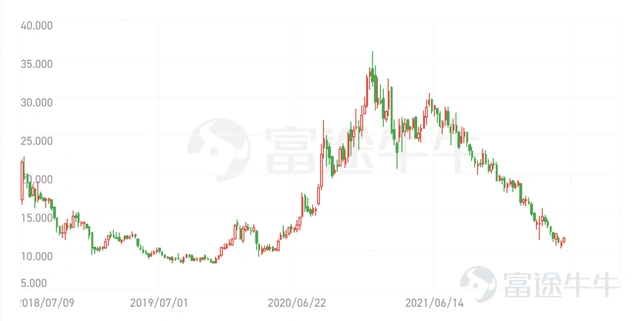
On July 9, 2018, Xiaomi's IPO price was immediately breached, and it did not regain the issue price of HK$17 until 2020. At the time, Lei Jun posted a Weibo message saying, "Just beat it," clearly conveying a sense of triumphant relief. However, in January of this year, Xiaomi once again fell below its IPO price. Yesterday, Xiaomi closed at HK$11.080, still well below its issue price.
Moreover, Xiaomi's recently released first-quarter earnings report brought a host of "bad news":
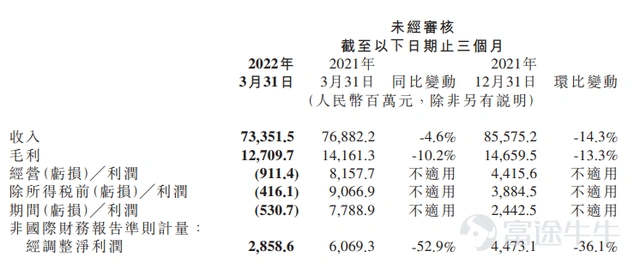
Q1 revenue totaled RMB 73.352 billion, down 4.6% year on year; of which, mobile phone business revenue was RMB 45.8 billion, a year-on-year decline of 11.1%.
Q1 adjusted net profit was RMB 2.859 billion, down 52.9% year on year;
Q1 gross profit amounted to RMB 12.71 billion, down 10.2% year on year.
Xiaomi's current situation can be summarized as a "Davis double whammy": both revenue and net profit have declined, and the resulting earnings slump has led to lower market valuations and a drop in the stock price.
That said, Xiaomi's current challenges are largely driven by both internal and external factors—even Tencent saw its Q1 net profit decline by 23%. Still, Lei Jun has weathered plenty of storms, and Xiaomi continues to hold third place in global smartphone shipments. Its "take life and death in stride—fight if you don't agree" spirit, coupled with years of deep roots in users, market insights, and technological expertise, will serve as key assets for Xiaomi to stage another comeback.
Mobile phones under pressure
Undoubtedly, the most closely watched segment in this earnings report remains Xiaomi's core business: smartphones.
Smartphones remain Xiaomi's largest revenue driver, accounting for 62.4% of total revenue this quarter—though this share has declined by nearly 5 percentage points year over year. This businessGross margin declined from 12.9% in Q1 2021 to 9.9% this quarter, with the earnings report attributing the drop primarily to promotional activities in the first quarter.
The decline in Xiaomi's mobile phone business revenue is closely linked to the broader industry trend.
In the first quarter, the smartphone market remained sluggish, with supply-side SoC availability still in a period of adjustment and demand suppressed by the pandemic and geopolitical tensions.
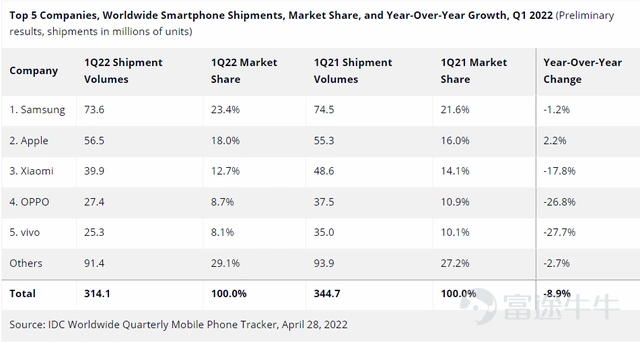
According to data from third-party market research firm IDC, global smartphone shipments in Q1 2022 declined by 8.9% year on year, marking the third consecutive quarterly decline and falling to 314.1 million units.Notably, Xiaomi shipped 39.9 million units globally, maintaining its third-place position with a 12.7% market share; however, shipments declined by 17.8% year over year, and its market share fell by 1.4 percentage points.
"The primary impact in the first quarter stemmed from the shortage of entry-level chips. Entry-level smartphones enjoy strong demand in India and many other regions. While supply eased in the second quarter, macroeconomic and geopolitical uncertainties persist."Xiaomi President Wang Xiang stated during the earnings call.
This is not just Xiaomi's predicament. The domestic smartphone market has entered a deep-water phase, with innovation hitting a bottleneck. Coupled with recurring COVID-19 outbreaks in major Chinese cities that are influencing consumer purchasing decisions, multiple factors continue to weigh heavily on the overall smartphone market.
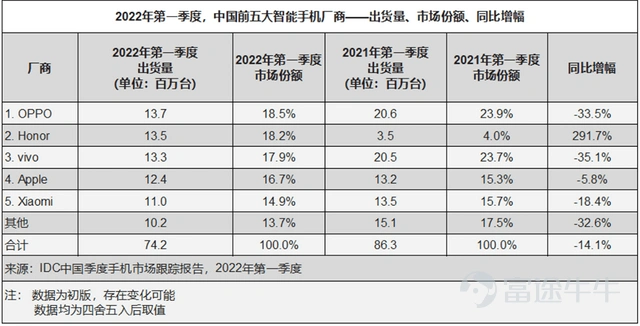
According to IDC data, smartphone shipments in the Chinese market totaled approximately 74.2 million units in Q1, down 14.1% year on year. Among them, Xiaomi shipped about 11 million units, a year-on-year decline of 18.4%, securing the fifth-largest market share at 14.9%.
According to data from Counterpoint, the average smartphone replacement cycle among Chinese consumers has now exceeded 31 months, compared with about 22 months in 2017.
From a competitive perspective, only Honor, with its low base, continues to maintain high growth, achieving a year-on-year increase of 291.7% in its recovery efforts, while Apple firmly holds the high-end market stronghold thanks to its strong brand influence.
"The domestic epidemic has had a very significant impact on our production and logistics operations,""The COVID-19 outbreak in Shanghai has placed significant strain on our sales and store operations there, with many stores essentially forced to close. Moreover, the pandemic has had a substantial negative impact on consumers' purchasing appetite, resulting in overall demand that is far from robust and exerting a considerable drag on sales. At the same time, rising logistics costs and supply-chain disruptions caused by lockdown measures have affected not only the Chinese domestic market but also global markets," said Wang Xiang.
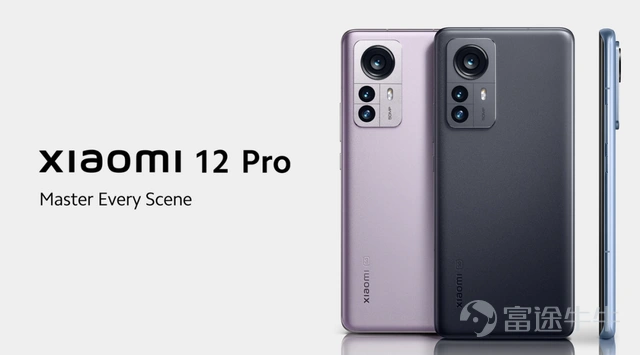
Xiaomi's smartphone business has entered a "volume-for-price" phase, aiming to boost ASP.(Average Selling Price, average selling price)This is the pressing priority, and Lei Jun's characterization of the push into the high-end market as "a battle for Xiaomi's very survival" is entirely consistent with this logic.
Centered on its premiumization strategy, Xiaomi is making rapid strides to capture the top spot in China's high-end smartphone market within three years by expanding its offline presence, ramping up overseas operations, developing proprietary chips, and building smart manufacturing facilities.
According to smartphone sales data, the latest financial report shows that Xiaomi shipped nearly 4 million high-end smartphones globally, with prices of RMB 3,000 or more in mainland China and EUR 300 or more overseas. In the RMB 4,000–6,000 price segment—the premium market—Xiaomi holds the largest market share among Android manufacturers.
This also drove an increase in Xiaomi's smartphone ASP (average selling price): in Q1 2022, Xiaomi's global smartphone ASP rose 14.1% year on year to RMB 1,189. For the full year last year, Xiaomi's smartphone ASP was RMB 1,097.5, up 5.6% from 2020.
However, the difficulty of Xiaomi breaking free from its "value-for-money" inertia in the short term cannot be overlooked. According to Counterpoint data, in 2021 the global average selling price (ASP) of smartphones rose 12% year on year to US$322—roughly RMB 2,178—while Xiaomi's ASP of RMB 1,189 still lags far behind.
Overall, Xiaomi's smartphone business is under short-term pressure amid the industry's downturn. Analysts and manufacturers view the 618 shopping festival as a key catalyst for boosting upgrade demand. According to Guotai Junan, "We expect the domestic 618 shopping festival to usher in a new round of consumption recovery once the pandemic is brought under control." Xiaomi CFO Lin Shiwei also highlighted during the earnings call the positive impact of the 618 promotion on smartphone shipments.
However, for the smartphone market, which has been sluggish for many years, a single shopping festival may amount to little more than a drop in the bucket. Wang Xi, an analyst at IDC China, noted in a report:"Without the emergence of additional positive catalysts, China's smartphone market size in 2022 could fall below the 300 million-unit threshold."
Setbacks Abroad
Uncertainty in the global geopolitical landscape has posed challenges to Xiaomi's overseas operations. In Q1 2022, Xiaomi's international market revenue reached RMB 37.5 billion, accounting for more than half of its total revenue. Notably, the Indian market stood out in particular.
India was once a source of pride for Xiaomi as a key overseas market, with the company surpassing Samsung to become the top smartphone vendor in India by the end of 2017. However, over the past two years, that honeymoon period has come to an end.
According to reports, Indian authorities have conducted multiple tax audits of Xiaomi over the past six months, and in April they froze US$725 million in Xiaomi's bank accounts in India, citing "illegally remitting funds overseas under the guise of royalty payments."
On the issue of the Indian market, Wang Xiang stated: "We are a fully lawful and compliant company. All our tax payments and expenditures strictly adhere to the laws and regulations of the host country, and all our financial data have been subject to third-party audits. Therefore, we believe there has been no violation of any regulations. While maintaining open and candid communication with the relevant Indian authorities, we are also pursuing legal remedies through established channels."
Although the Indian court lifted the asset freeze on May 6, the rift in relations is unlikely to be mended anytime soon.
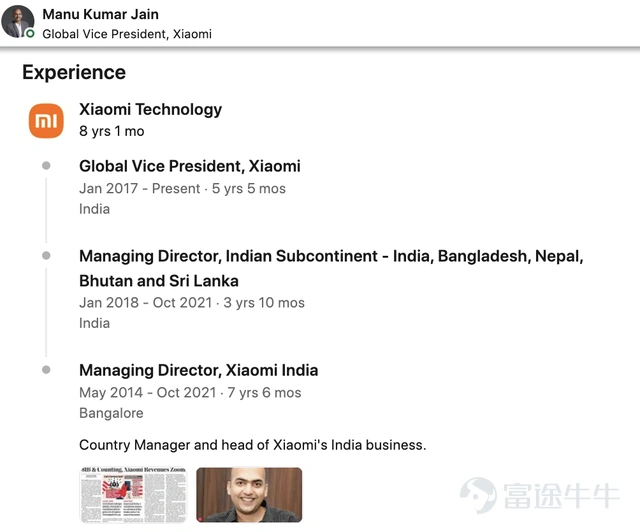
Xiaomi has also undergone personnel changes within its Indian operations. According to India Today, Xiaomi's Global Vice President and head of its Indian business, Manu Kumar Jain, has been summoned by a court to cooperate with an investigation into the company's foreign-exchange compliance. One speculation is that he is now based in Dubai and will no longer lead Xiaomi's Indian operations. Neither Xiaomi nor Manu himself has made any official statement on this development; however, his LinkedIn and Twitter profiles have now removed the "Head of India" designation, retaining only his title as Global Vice President.
During the conference call, Wang Xiang announced personnel adjustments, stating that several "energetic and capable colleagues" had been assigned to manage India-related affairs.
Notably, Xiaomi has begun emphasizing the value of the Latin American market this quarter—Wang Xiang described it as "one of our primary growth drivers."In the Latin American market, our Q1 market share increased from 12% last year to 15%, and we have already risen to the top spot in Colombia.
Where is the new device?
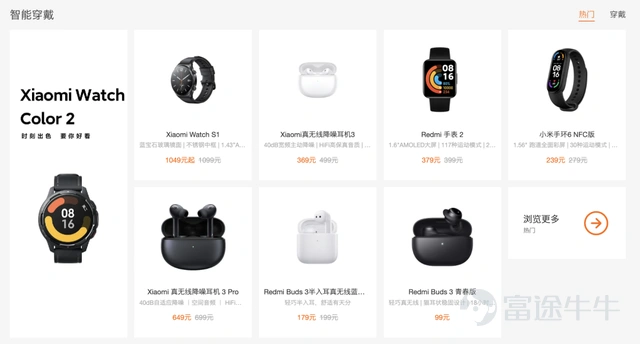
In addition to its smartphone business, Xiaomi's other two major revenue streams are IoT and consumer lifestyle products, as well as internet services.
Q1: Xiaomi's IoT and lifestyle consumer products revenue reached RMB 19.48 billion, up 6.8% year on year;
The gross margin increased from 14.5% in Q1 2021 to 15.6% in Q1 2022, reaching a new single-quarter record high. This was primarily driven by declining prices for core components such as display panels.
As of March 31, 2022, the number of AIoT-connected devices (excluding smartphones, tablets, and laptops) exceeded 478 million, representing a year-on-year increase of 36.2%.
Xiaomi continues to advance its "Smartphone + AIoT" strategy. Compared with other domestic smartphone brands, Xiaomi leverages its first-mover advantage and the strength of its ecosystem to maintain a leading position in both brand equity and market share for IoT devices.
During the earnings call, Wang Xiang stated that the IoT business's gross margin will continue to benefit from declining component prices in the second quarter; however, overseas, due to factors such as logistics challenges, the Russia-Ukraine conflict, exchange-rate fluctuations, and inflation, it is difficult to make reliable forecasts.
In fact, the foundation of the IoT business remains the smartphone sector, and the sluggish performance of the smartphone business will undoubtedly weigh on the growth rate of the IoT segment. Meanwhile, within the ecosystem's vertical categories, issues such as severe product homogeneity, low profit margins, and a ceiling on scale reach are beginning to surface.
Xiaomi's internet business primarily encompasses mobile game operations, e-commerce, financial technology, advertising, and other services. This quarter:
Internet services revenue reached RMB 7.1 billion, up 8.2% year-over-year; although it accounts for a small share of total revenue,Gross profit margin was as high as 70.8%;
Of this, advertising revenue reached RMB 4.5 billion, up 16.2% year-over-year; gaming revenue was RMB 1.1 billion, up 3.0% year-over-year; and overseas internet business revenue totaled RMB 1.6 billion, up 71.1% year-over-year.
As of March 2022, global MIUI monthly active users totaled 529 million, up 24.5% year-over-year; in mainland China, MIUI monthly active users reached 136 million, an increase of 14.3% year-over-year.
Based on MIUI daily active users and internet revenue, Q1 ARPU stood at RMB 13.4, continuing its downward trend—a pattern that highlights the growing difficulty of monetizing traffic.
The highly anticipated vehicle manufacturing business remains in the investment phase, with few new updates disclosed this quarter.
In March 2021, Xiaomi announced its entry into the automotive industry and pledged to invest USD 10 billion over the next decade, a move widely regarded as the company's most critical second growth driver. In last year's annual report, Xiaomi stated that it would ramp up R&D and expansion in areas such as autonomous driving and intelligent cockpits, while also outlining a specific timeline."The vehicle will enter formal mass production in the first half of 2024."
"We will continue to invest this year, and we expect our spending to increase further. We currently have 1,200 engineers, and we plan to keep expanding that number going forward," said Lin Shiwei during the earnings call.
Xiaomi's R&D expenditure this quarter totaled RMB 3.5 billion, up 16% year-over-year but down 9.3% quarter-over-quarter, with an R&D expense ratio of 4.7%. Xiaomi's R&D spending has previously drawn criticism; in 2018, R&D investment was only RMB 5.8 billion, accounting for 3.3% of that year's revenue. Since then, the ratio has risen steadily, reaching RMB 13.2 billion in 2021 and representing 4% of revenue.
However, this quarter's R&D spending still lagged behind its sales and marketing expenses. Compared with Huawei's RMB 142.7 billion in R&D investment in 2021, which represented an R&D expense ratio of 22.4%, Xiaomi's R&D outlay falls significantly short both in absolute terms and as a percentage of revenue.
For the second quarter, Xiaomi did not provide a clear outlook; the word "uncertainty" was repeatedly emphasized during the earnings call. Factors such as the pandemic, the macroeconomic environment, the Russia-Ukraine conflict, and geopolitical dynamics have made it difficult for Xiaomi—and other companies—to make accurate forecasts about the future.
$XIAOMI-W (01810.HK)$$Apple (AAPL.US)$
$XIAOMI-W (01810.HK)$$Apple (AAPL.US)$

Author | Chen Wenqi
Risk Disclaimer: The above content only represents the author's view. It does not represent any position or investment advice of Futu. Futu makes no representation or warranty.Read more


Comments (6)
to post a comment
19
168