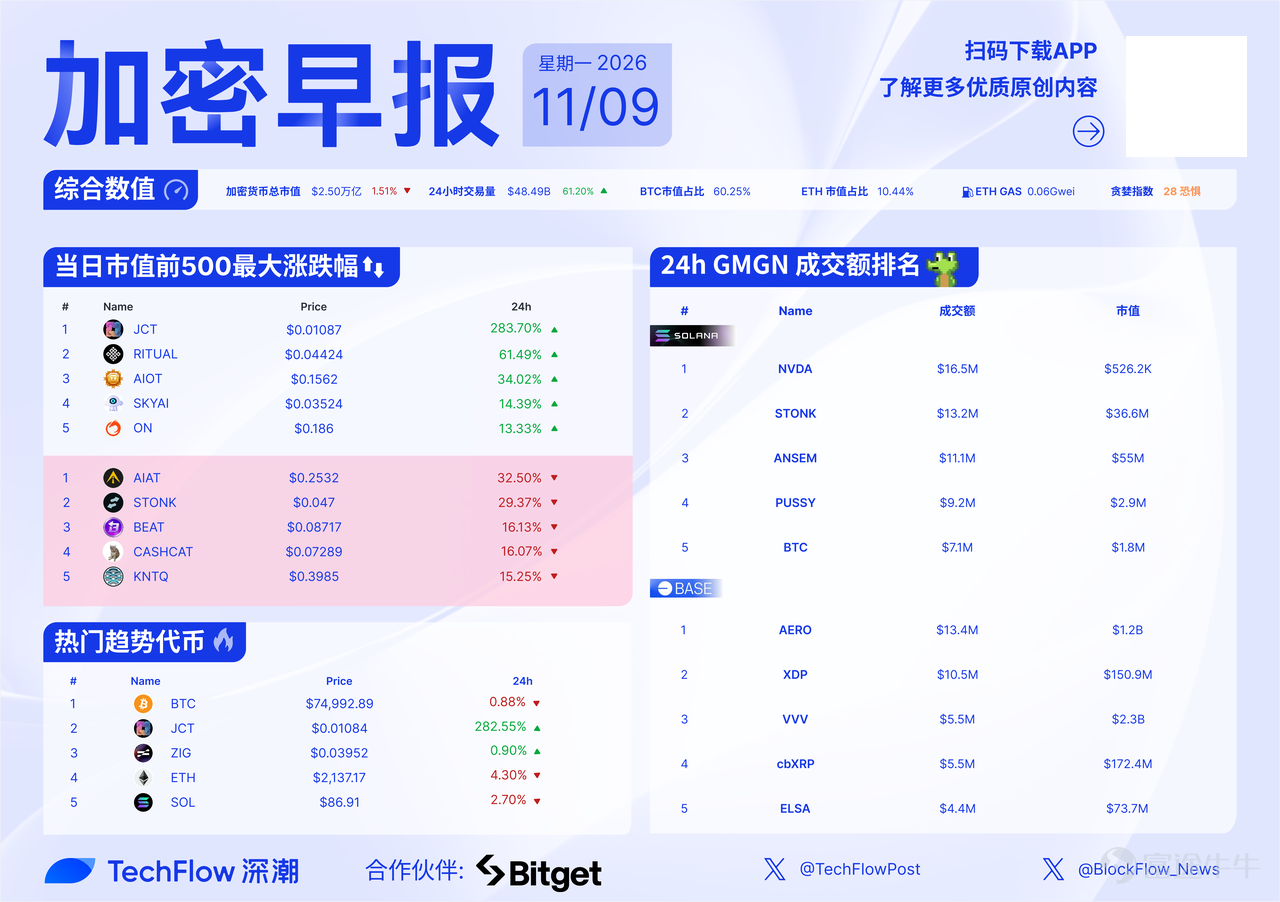

Crypto Morning Brief: Jensen Huang admits to infidelity and apologizes in letter to employees; Taiwan Semiconductor plans to enter advanced memory chip manufacturing
Author: Deep Tide TechFlow
Jensen Huang admits to infidelity and apologizes in letter to employees
On November 9, according to NVIDIA's official website, NVIDIA founder and CEO Jensen Huang admitted in an email to employees that he had been unfaithful to his wife, causing harm to her and their children. He stated there was no excuse, and apologized to his family and all employees. He expressed willingness to take full responsibility, accept criticism, and hopes to repair family relationships and gradually regain trust.
Jensen Huang told colleagues, the Board of Directors, partners, and shareholders that he had failed to fulfill his responsibilities and would devote himself fully to NVIDIA to strive to regain trust. He emphasized that his family should not be held responsible for his choices and requested privacy for them.
Addressing national security concerns raised in reports, Jensen Huang stated that the board has launched an independent investigation, which he supports and will fully cooperate with. He expressed his love for the United States and NVIDIA, emphasizing his commitment to protecting the company, supporting U.S. national security, and his pride and gratitude as an American.
Justin Sun responds to property dispute case involving Jing: Prepared to apply for the case to be heard by the Shaanxi Provincial High People's Court
On November 8, Sun Yuchen posted on Weibo in response to a property dispute case involving Jing. He stated that he is preparing to apply for the case to be heard by the Shaanxi Provincial Higher People's Court. It is reported that Sun Yuchen filed a civil lawsuit against Jing and her parents over a property dispute involving more than 30 million yuan, and the case has been officially registered in accordance with the law. In response to netizens commenting that "there are plenty of people willing to pay for Jing Tian," Sun Yuchen replied: "Who exactly are these 'plenty of people'? I can add them all to the indictment."
Codex Lead: AI controlling computers will still take a few years to surpass Faker
OpenAI employee @jxnlco reposted a video of Faker playing League of Legends published by LoL Esports on X, stating, "Computer use will eventually become faster than this."
Tibo (@thsottiaux), head of OpenAI Codex and ChatGPT, replied: "I think it will still take a few years, but one can always dream."
OKX Founder Star: Cross-site UIDs should be globally unique, or transfers based solely on UID should be prohibited
According to OKX founder Star, UIDs across different platforms under the OKX brand must either remain globally unique, or users should not be allowed to conduct cross-platform internal transfers based solely on UID.
Star stated that UID is an account identifier. If identical UIDs exist across different platforms under the same brand and cross-platform transfers via UID are permitted, it could lead to misidentification of recipient accounts and erroneous fund transfers.
Binance appoints Justin Yek as new Chief Financial Officer
According to The Defiant, Binance has appointed Justin Yek as its new Chief Financial Officer, while current Head of Finance Kaiser Ng will depart.
Binance Co-CEO He Yi stated that Ng decided to pursue new career opportunities after more than five years with the company. The handover plan had been in progress for six months, predating the asset theft incident at Binance on October 29.
Yek previously handled finance at Airwallex and served as a technology investment banker at Morgan Stanley and Citi. Binance stated that the previous theft incident involved approximately $6.34 billion in digital assets.
US approves NVIDIA sales of AI chips to Chinese companies with vacant office addresses
According to The Verge, the US government approved the sale of NVIDIA H200 AI chips to the Chinese company New Matrix, but the company's registered office address was vacant, raising concerns about the adequacy of scrutiny for chip sales.
Citing The New York Times, the report stated that New Matrix was established about 17 months ago, has scarce public information, is not listed in the corporate directory at its registered address, and property management personnel at the industrial park confirmed having no records of the company. The company's owner is linked to a Chinese private equity firm that has been on the US blacklist since 2024.
The report also noted that it is not an isolated case for entities affiliated with organizations subject to US national security-related trade restrictions to be approved to purchase NVIDIA chips.
Monitoring: Wintermute address accumulates approximately $222 million in profits on Hyperliquid
According to OnchainLens monitoring, the Wintermute address has accumulated approximately $222 million in profits from spot and perpetual contracts on Hyperliquid, with $18.83 million in profits over the past 30 days.
The notional value of open positions at this address is $125.87 million, including $115.76 million in short positions, with unrealized profits of $3.46 million. Major short positions include $26.16 million in ETH, $19.79 million in BTC, $15.23 million in HYPE, and $12.72 million in SOL.
Musk debunks rumors: Never criticized Binance's 80% market share; related claims are fabricated
On November 7, Elon Musk responded to a rumor about Binance on X, stating, "I never wrote anything like that; it is fabricated."
Previously, X user @MartiniGuyYT posted that Musk had criticized Binance for holding an 80% share of the crypto market and stifling industry development, urging users to move their funds to other exchanges to restore competition and create conditions for a bull market.
Binance founder CZ subsequently replied to the post, warning against spreading misinformation and attaching a screenshot from Grok showing that Musk had never made such remarks. Musk confirmed in his reply to CZ that the alleged comments were fabricated.
SpaceX CEO Musk: This quarter's revenue will far exceed NASA's annual budget
According to a post by Elon Musk, SpaceX CEO stated that SpaceX's revenue for this quarter will significantly surpass the full-year budget of the National Aeronautics and Space Administration (NASA).
Taiwan Semiconductor plans to enter advanced memory chip manufacturing, laying out 3D DRAM production at NVIDIA's request
On November 6, The Information reported, citing two sources, that Taiwan Semiconductor (TSM.N) is considering expanding into advanced memory chip manufacturing, a move that would allow the world's largest chipmaker to capture a larger share of the AI hardware supply chain. Taiwan Semiconductor has recently begun formulating plans to produce a specific type of advanced memory chip, 3D DRAM, in response to requests from its largest customer, NVIDIA (NVDA.O).
DRAM, or Dynamic Random Access Memory, stores data while it is being used by processors. Unlike traditional DRAM, which places memory cells in a single layer, 3D DRAM stacks cells vertically to accommodate more memory. The memory chip manufacturing sector is currently dominated by Samsung Electronics, SK Hynix, and Micron Technology. These three companies are also developing 3D DRAM technology, competing in the race for next-generation memory manufacturing.
The severe shortage of memory chips, triggered by the AI hardware boom, has led to soaring prices and prompted chip design companies such as NVIDIA and Apple to seek additional supply sources. Earlier this year, Apple raised prices on its devices due to rising memory costs.

The AI Bill for US Stocks' "Magnificent Seven": Who Can Still Afford It?
This article analyzes the valuation pressure on the US stock market's "Magnificent Seven" amidst the AI investment frenzy, as well as the funding challenges behind the expansion of AI infrastructure. On November 5, the Magnificent Seven saw approximately $1.04 trillion wiped off their combined market capitalization in a single day, with NVIDIA falling 9.26% and losing over $440 billion in market value. Notably, the operating cash flows of Microsoft, Google, Amazon, and Meta in the third quarter were insufficient to cover capital expenditures, resulting in a combined funding gap of approximately $26.4 billion, compared to a surplus of about $61.7 billion a year earlier. Giants like Google and Amazon are increasingly relying on debt financing, while AI data center construction faces challenges such as high interest rates, regulatory approvals, and prolonged return-on-investment periods. The article points out that while AI demand has not disappeared, the market is shifting from chasing computing power growth to scrutinizing who can truly convert massive investments into profits. If cloud giants begin to slow down capital expenditure, NVIDIA, which is highly dependent on downstream procurement, may be the first to feel the pressure.
Could changes to Gas pricing cause smart contracts to fail? Ethereum urgently halts the Hoodi fork to investigate eight major security risks.
Ethereum has urgently paused the Hoodi testnet fork due to potential smart contract compatibility issues triggered by the upcoming Glamsterdam upgrade. The concerns center on two proposals, EIP-8037 and EIP-8038, which recalibrate gas pricing rules for state creation and access, breaking the fixed gas assumptions that many smart contracts have long relied upon. Security firm ChainSecurity noted that this could affect eight categories of technical invariants, including hardcoded gas limits, cross-contract calls, exception handling, and proxy contracts. In severe cases, it could lead to transaction reverts or fund lockups in multi-signature wallets, cross-chain bridges, and DeFi protocols. The Ethereum Foundation has opened a dedicated detection repository, providing code samples and prompts for scanning tools, urging developers to conduct self-checks. This incident highlights that underlying protocol upgrades must not only consider performance and cost but also evaluate compatibility across the entire application ecosystem; otherwise, even a single adjustment to gas rules could trigger cascading failures.
The Biggest Gamble, The Biggest Loser: Where Is Musk’s Business Empire Headed After the Midterm Elections?
This article analyzes the political and operational pressures facing Elon Musk's business empire following the Republican Party's defeat in the U.S. midterm elections. Although Musk previously invested over $470 million to support the Republicans, the Democratic Party's capture of both the Senate and the House of Representatives led markets to quickly reassess the political risks associated with his companies. On November 5, Tesla's stock fell 11% in a single day, SpaceX's secondary market shares dropped 9%, and Musk's personal net worth shrank by approximately $74 billion in one day. Greater risks stem from policy changes: the new government in Texas may pause data center approvals and cancel tax incentives, hindering SpaceX's plan to expand its computing power capacity from 3GW by year-end to 13GW next year. Additionally, Democrats are preparing to investigate layoffs at DOGE, restrictions on Starlink's use in the Russia-Ukraine conflict, as well as government procurement and subsidies for Tesla and SpaceX. The article argues that while Musk's business empire will not collapse as a result, the valuation premium previously gained through political connections may turn into a political risk discount over the coming years.
Podcast Notes | In Conversation with Sam Altman: Not Taking a Single Share of OpenAI Was My Biggest Mistake
This article summarizes OpenAI CEO Sam Altman's nearly 70-minute interview on the Indian podcast 'Figuring Out.' He admitted that deciding not to hold any equity in OpenAI was a practical misstep, as the business world struggles to understand choices not driven by wealth accumulation, leading to external speculation about his motives for power. Discussing OpenAI's development, he recalled the decision to bet on ultra-large-scale computing power after completing GPT-4 training, and the persistence in publicly launching the initial ChatGPT despite its second-week retention rate being only 5% during internal testing. He believes that scaling can deliver superlinear returns, and that a small number of fervent users may demonstrate product value more effectively than a large base of ordinary users. Furthermore, he addressed the trust and technical roadmap conflicts behind the split in OpenAI's core team, as well as AI's potential to evolve from assisting engineering to enabling autonomous scientific discovery. What Altman values most is the courage to bet on non-consensus directions before they are widely understood, achieving long-term compounding by continuously stepping out of his comfort zone.
Risk Disclaimer: The above content only represents the author's view. It does not represent any position or investment advice of Futu. Futu makes no representation or warranty.Read more
Comments
to post a comment