

[Options Practical Camp | Key Highlights Review No.4] How to Pair Stock Holdings with Options? Practical Guide to Covered Calls and Protective Puts
Besides waiting for stock prices to rise, how else can you use options to collect additional premiums on your stock holdings? If you are bullish on a stock in the long term but worried about a short-term pullback, how can you use options to manage risk?
In this issue of "Options Practical Camp Highlights," we revisit the third beginner session: "Sitting on Stocks Is Costly; Options Create Extra Income." Futu Securities Senior Analyst Bevis starts with option contract multipliers, focusing on two stock-holding options strategies: Covered Call and Protective Put, and provides live demonstrations of Bull/Bear probability analysis and smart order features.

🔥 Sneak Peek! 3 Key Highlights from the Lectures
① How to collect additional premiums on stock holdings?
Breakdown of the mechanics, potential returns, and risks of Covered Calls.
② How to use Protective Puts?
Understand how buying puts provides downside protection for your underlying stock positions.
③ Bull Tools in Action: Probability Analysis + Smart Orders
How to select strike prices based on price distribution, and set take-profit and stop-loss conditions.
✨ Quick Quote Delivery
"For every options strategy... you need to know when maximum profit can be achieved and what the maximum loss would be after executing the strategy."
Instructor Bevis reminds us that before using options strategies, besides understanding the mechanics, it is crucial to clearly understand the profit/loss characteristics and the potential maximum loss.

1. Covered Call: How to collect additional premiums while holding underlying shares?
Instructor Bevis first introduces the Covered Call, which is one of the common strategies combining stock holdings with options.
Strategy Logic:Investors hold the underlying shares and sell a corresponding number of call options to collect premiums.
For example, assume you hold a stock with a cost basis of $100 and originally planned to sell at $120. You could consider selling call options with a strike price of $120.
If the stock price does not exceed the strike price at expiration, the calls will not be exercised, allowing the investor to keep the underlying shares and the collected premium; if the calls are exercised, the investor may need to sell the underlying shares at $120 while retaining the collected premium.
The instructor pointed out that Covered Calls are generally more suitable for scenarios where the underlying stock is expected to trade sideways or rise slightly. When the stock price falls, the premium received can offset part of the loss on the underlying stock.
However,Covered Calls not only offer the benefit of collecting premiums but also limit the potential upside of the position.
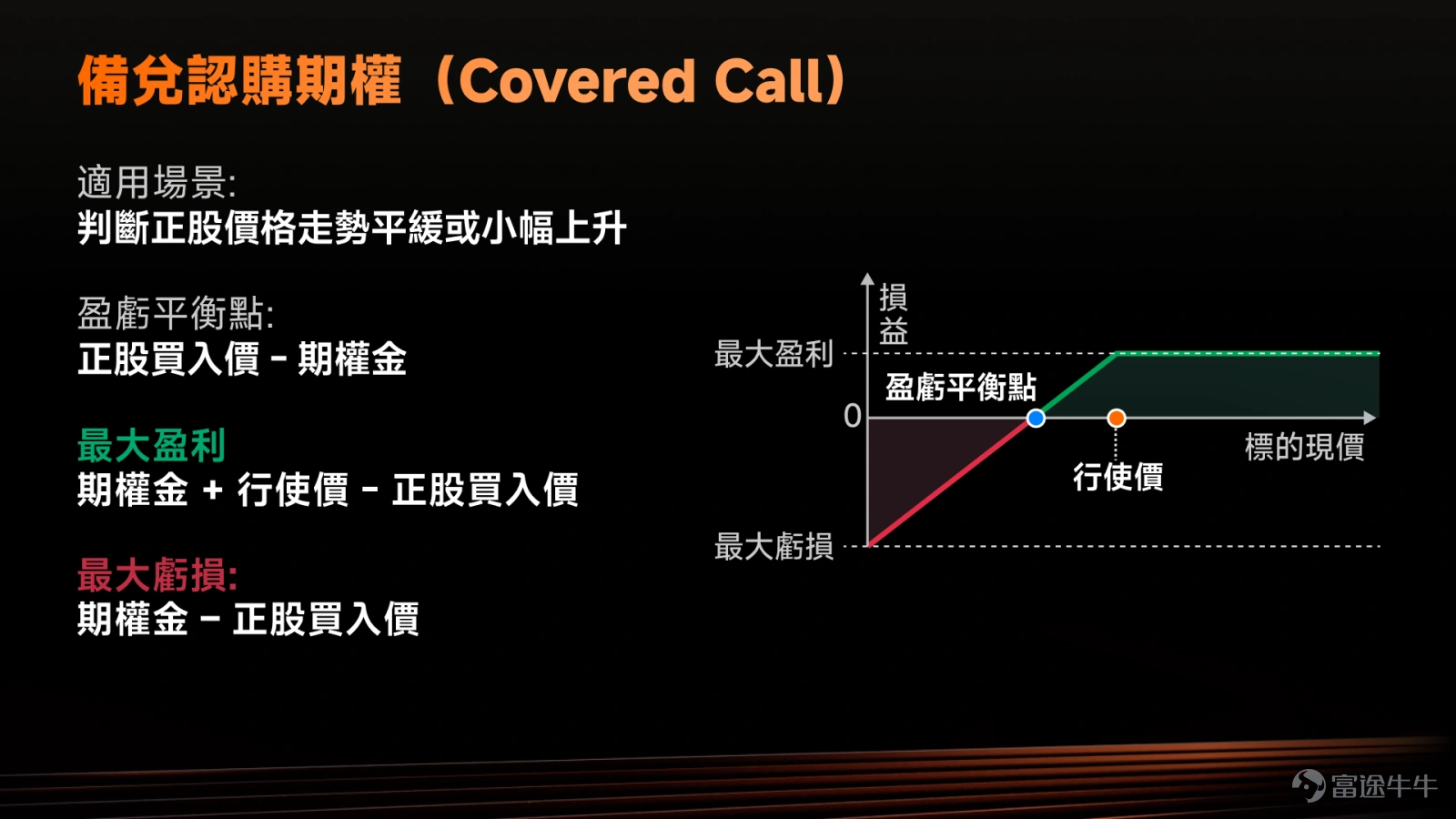
The instructor used $NVIDIA (NVDA.US)$ as an example to explain that even if the stock price rises significantly later, investors who are assigned must still sell the stock at the agreed strike price and cannot fully enjoy the subsequent gains.
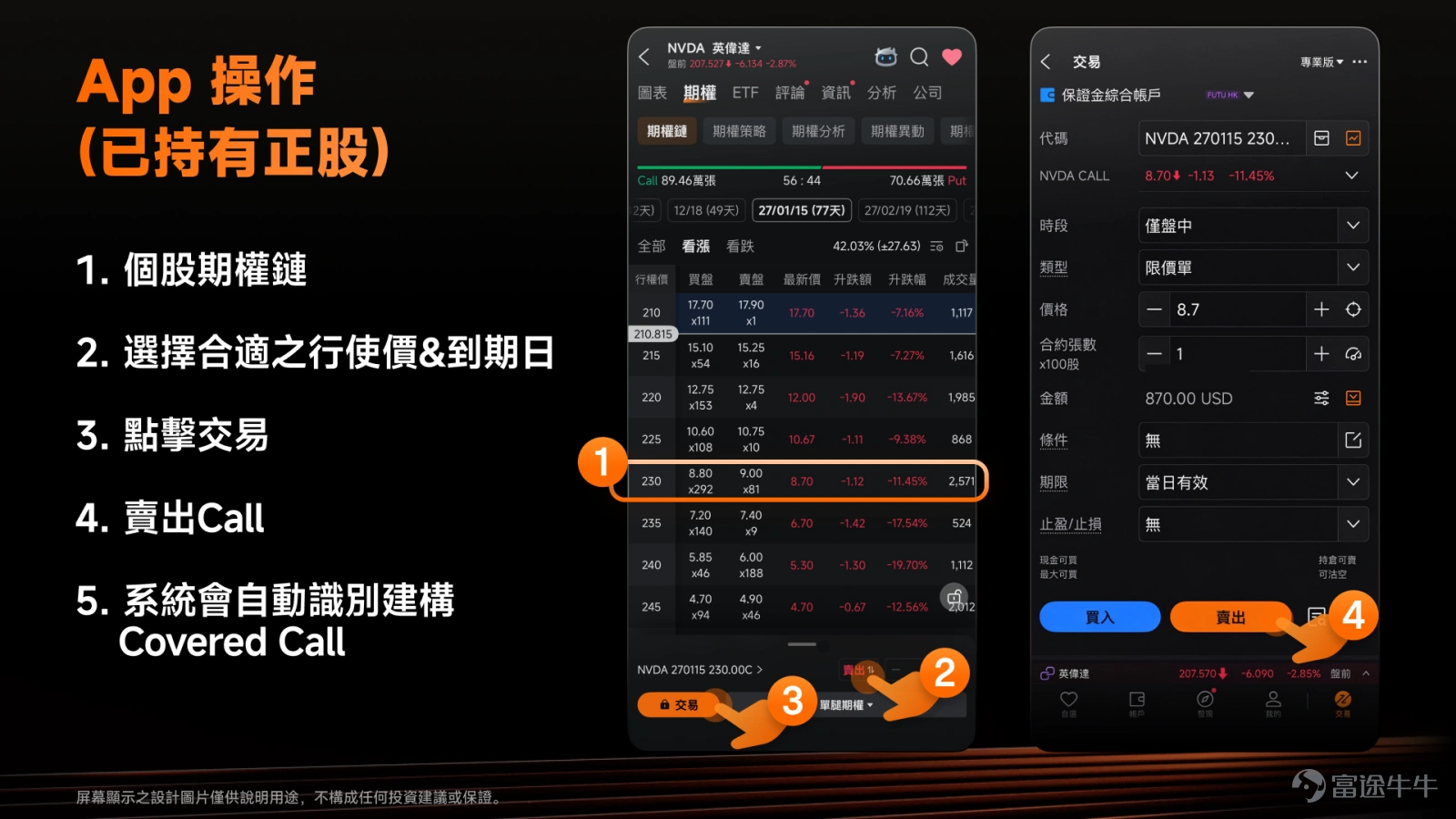
Instructor Bevis specifically reminded everyone that standard US stock options usually correspond to 100 shares of the underlying stock per contract, whereas the contract units for HK stock options may differ.
For example, one lot of Sun Hung Kai Properties' underlying stock consists of 500 shares, while the option contracts shown in the lecture correspond to 1,000 shares. To establish a fully covered Covered Call, one needs to hold the corresponding number of underlying shares.
On the Niuniu App, investors can access the option chain, select specific contracts, and view the strike price, expiration date, and contract multiplier.
2. Protective Put: How to provide protection when worried about a short-term drop in stock price?
In addition to Covered Calls, the instructor also introduced another stock-holding strategy—the Protective Put.
The strategy involves holding the underlying stock while simultaneously buying a Put option.
Instructor Bevis gave an example: Suppose an investor is bullish on a specific stock in the long term but is concerned about a short-term price drop following an earnings announcement scheduled in two days. In this case, they could consider buying a Put option to hedge their underlying stock position.
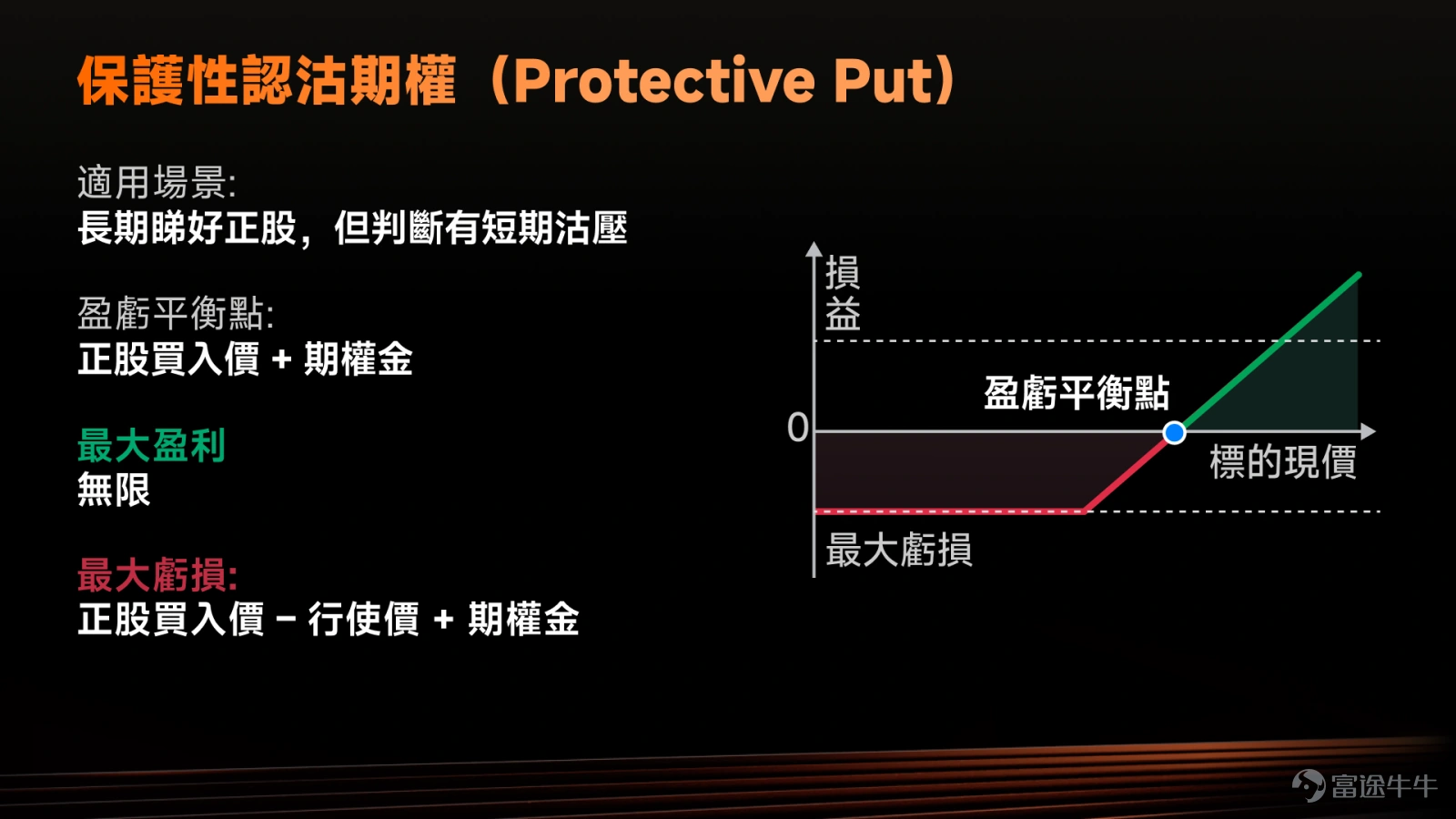
With$NVIDIA (NVDA.US)$ For example, assume the purchase price of the underlying stock is $215, and the investor buys one Put option with a strike price of $200.
If held until expiration and the stock price falls below $200, the intrinsic value of the Put can offset part of the decline in the underlying stock. In this example, the maximum loss at expiration would be approximately the $15 difference in the stock price, plus the premium paid for the Put and any associated fees.
If the underlying stock continues to rise, the investor can still benefit from the price appreciation, although the overall return must deduct the cost of the Put.
The instructor also shared that if the stock price falls first and then rises, investors might profit from the Put during the downturn while retaining the opportunity for the underlying stock to participate in the subsequent rebound.
However, the instructor emphasized thatthe primary function of a Protective Put is to provide protection for existing holdings when there is concern about a short-term decline in the stock price.
3. Bull/Bear Probability Analysis: How to Use Model Data to Select Strike Prices?
Another key highlight of the seminar was the "Options Analysis" feature of the NiuNiu App.
Instructor Bevis used $NVIDIA (NVDA.US)$ Using this as an example, we guided the audience to the individual stock page, clicked on "Options" and "Options Analysis," and demonstrated how to use probability distribution charts to assist in understanding the selection of different strike prices.
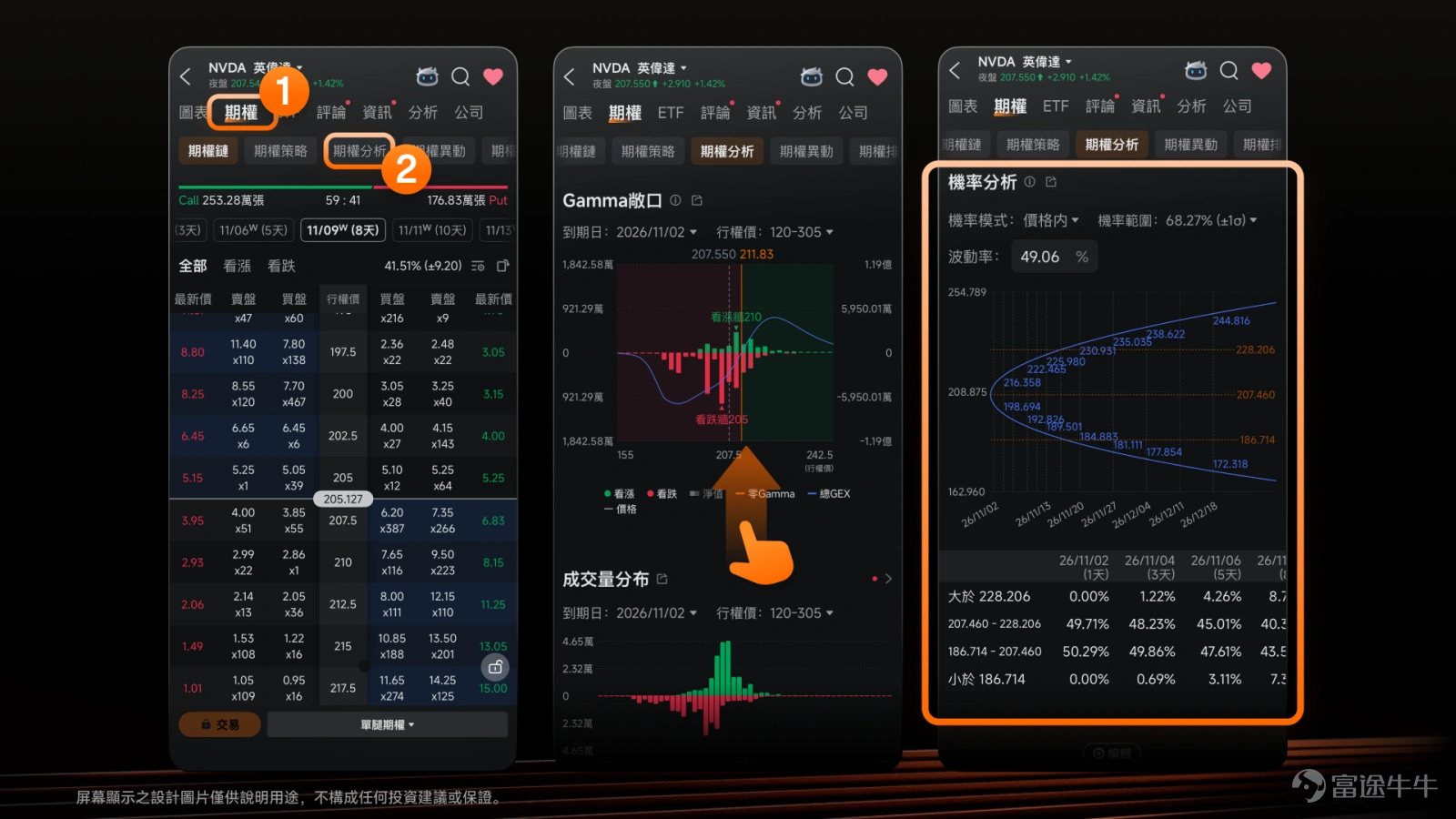
So, how can probability analysis tools be applied in daily trading?
① View price ranges for a specific expiration date
The instructor first demonstrates selecting an option expiration date and then viewing the probability distribution chart.
For example, the 68.27% shown on the chart represents the estimated probability, under specific model assumptions, that the stock price will fall within the corresponding range on the specified date.
The instructor points out that when investors are unsure which strike price to choose, they can use these price ranges as a reference.
② View probabilities for different percentage gain/loss ranges
The second method involves checking the estimated probabilities for various ranges, such as the stock price rising or falling more than 10% from the current price.
The instructor demonstrates that after selecting an expiration date, the tool displays the model-based probabilities of the stock price falling into different ranges, allowing viewers to compare the distribution across various price levels.
③ Query the probability for a specific price
If investors already have a target strike price in mind, they can select that specific price level on the chart to view the model-estimated probability of the stock price being above or below that level at expiration. The instructor also demonstrates adjusting the Implied Volatility (IV) to observe how the probability distribution changes.
Please note that these probabilities are based on statistical models and related parameter assumptions, and do not guarantee that the actual market will necessarily follow the model's outcomes.
The speaker also reminded the audience not to treat such data as definitive stock price predictions.
4. Smart Orders: How to Set Take-Profit and Stop-Loss Simultaneously?
At the end of the session, the speaker introduced the Smart Order feature on the NiuNiu App, demonstrating how to pre-set take-profit and stop-loss conditions for existing positions.
For investors with existing positions, you can use the corresponding Smart Order feature to set both take-profit and stop-loss prices simultaneously. When one side of the order is executed, the other side will be automatically canceled.

How to operate:
1. Go to the Positions page in the NiuNiu App and select your existing stock or options position.
2. Enter the trading page and select the appropriate Smart Order type under "Combo Orders."
3. Set the take-profit price and stop-loss price separately, and confirm the order conditions.
For example,Once the stop-loss order is executed, the system will cancel the originally set take-profit order to prevent duplicate execution of both orders.
The instructor pointed out that since US stock options trading hours may coincide with late night in Hong Kong, investors may not be able to monitor market changes continuously. Therefore, smart order features can be helpful for position management.
However,Smart orders do not guarantee successful take-profit or stop-loss execution.。Especially during periods of rapid market volatility or insufficient liquidity, actual execution prices and outcomes may still differ from expectations.
The instructor also shared that there is no one-size-fits-all answer to whether one should stop loss. Investors need to consider their financial situation, risk tolerance, and whether they clearly understand the trading logic behind their positions.
Want to learn more about options knowledge and how to use Futu tools? Stay tuned to "Options Practical Camp Highlights" to revisit more lecture content!
This article is compiled based on the lecture subtitles, with some colloquial content edited and condensed. Individual stocks and prices mentioned are for educational case studies only and are not real-time quotes. Covered Calls cannot fully offset the downside risk of the underlying stock; Protective Puts require payment of premiums; probability analysis results are based on model predictions; and smart orders do not guarantee execution. Options trading involves risks such as price volatility, time value, liquidity, and exercise/settlement. This article is for educational and informational purposes only and does not constitute investment advice.
Risk Disclaimer: The above content only represents the author's view. It does not represent any position or investment advice of Futu. Futu makes no representation or warranty.Read more

Comments
to post a comment
18
27