AMD's market cap breaks $1 trillion! Is the US stock AI rally staging a full-scale comeback?

AMD and Intel are both raising prices! Meta Muse has sparked new demand. Who is sitting at the table for this round of the "CPU Renaissance"?
Over the past two years, market attention on AI computing power has been almost exclusively focused on GPUs.
However, a subtle shift that is easily overlooked is currently underway:As AI evolves from merely "answering questions" to "autonomously executing tasks," the importance of CPUs is making a comeback.
On one hand, Meta’sMuseagent-based products are beginning to move AI out of chatboxes and into real-world workflows; on the other, AMD and Intel have seen news or implementation of a new round of chip price hikes. The CPU industry, previously viewed by the market as relatively mature, is now simultaneously facinga triple catalyst: structural changes in demand, tight supply, and rising prices.
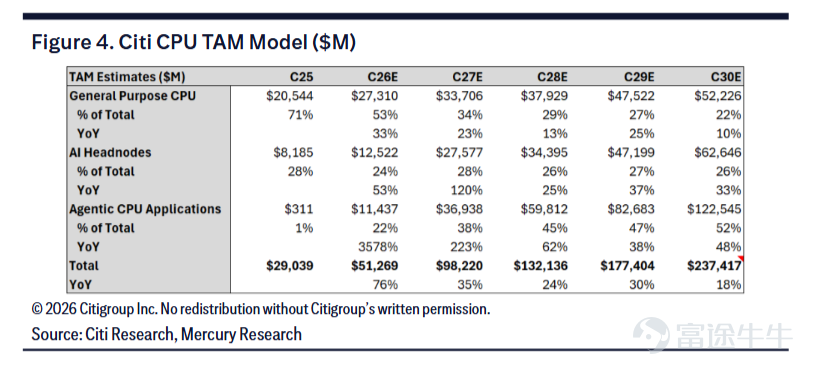
Citi has even significantly raised its forecast for the CPU market size in 2030 from the previous $137 billion to$237 billion, compared to $29 billion in 2025, implying a CAGR of approximately 52%. The fastest growth is not coming from traditional PC CPUs, but from the new generation of server CPUs designed for Agentic AI.

Source: Citi
The key question is:In the AI era, why is there a growing demand for CPUs? Which companies are worth watching?
Meta's Muse reveals incremental CPU demand in the Agentic AI era
Meta's recently launched Muse provides a representative case study for analyzing computing power demands in the Agentic AI era.
Unlike traditional chatbots that primarily focus on model inference,the core of an Agent lies in continuous task execution and computational resource scheduling. Reportedly,Muse creates a dedicated Linux cloud virtual machine for each user to run browsers, code compilation, scheduled tasks, databases, security checks, and multiple parallel sub-Agents.These workloads involve extensive task scheduling, data processing, and system I/O, resulting in a significantly higher reliance on CPU resources compared to traditional large model inference scenarios.
Currently, Muse is seeing rapid download growth, but its long-term activity and retention rates remain to be validated. Therefore, a single product is not yet sufficient to prove that Agent demand has entered a phase of full-scale explosion. More noteworthy is the infrastructure paradigm it represents: as AI shifts from one-off Q&A to continuous task execution, each additional Agent may require not just a single model inference, but an entire suite of continuously running computing environments.
This also implies that the demand logic for CPUs within AI infrastructure is undergoing a shift.
In traditional AI training and inference architectures, CPUs primarily handle task management, data preparation, and GPU scheduling, while large-scale matrix computations are mainly performed by GPUs. However, in Agentic AI scenarios, AI systems need to continuously execute operations such as task planning, tool invocation, file reading, code execution, database queries, security controls, and multi-agent coordination.The workload on CPUs for orchestration, control, data processing, and I/O has increased significantly.
Based on this, Citi believes that as AI evolves from model training to inference, and further to Agentic AI, the configuration ratio between CPUs and GPUs is changing noticeably:During the model training phase, the CPU-to-GPU ratio is approximately 1:8; this rises to 1:4 during the inference phase, and in Agentic AI scenarios, this ratio could further increase to 1:1 or even higher. As the scale of Agentic AI expands, future system configurations are expected to tilt further towards CPUs.

In other words, as the scale of agents continues to expand, CPUs may gradually transition from their previous role of primarily supporting computation to becoming one of the new bottlenecks in AI infrastructure.
In fact, the industry has already begun to respond to this trend. NVIDIA's next-generation Vera CPU is designed specifically for Agentic AI workloads, with a focus on enhancing single-core agent performance, data processing capabilities, and I/O throughput; AMD, Intel, and the Arm camp are also continuing to advance their next-generation server CPUs.
Following the Hot Chips conference, Citi further upgraded its outlook for the server CPU market,terming this round of demand expansion driven by Agentic AI as the 'CPU Renaissance.'
From this perspective, what truly deserves attention regarding Meta Muse is not the download volume of a single product, but the shift in computing power structure behind it:As AI evolves from merely "generating answers" to "autonomously executing tasks," both the configuration density and value contribution of CPUs in AI data centers are expected to rise.
Why are AMD and Intel raising prices at this particular time?
If it were just an AI agent narrative, the market might still be concerned that demand realization would take a long time.
However, another more realistic signal has already emerged:CPU prices have risen multiple times.
According to the latest supply chain news, due to rising wafer manufacturing costs at Taiwan Semiconductor, $Advanced Micro Devices (AMD.US)$ some partners have been notified of plans to increase prices for certain chips by approximately 10% starting in Q4 2026.
AMD is not an isolated case. $Intel (INTC.US)$ Prices have been adjusted multiple times this year. Data shows that prices for some products were raised by about 10% in Q1, server CPU prices were adjusted in April, and some Arrow Lake Refresh products saw price increases of 15% to 17% in July.Recent supply chain reports indicate that Intel plans to raise prices for certain PC CPUs by approximately 10%.
Therefore, the simultaneous price increases from both AMD and Intel warrant attention. Behind this round of price hikes, there are actually two distinct yet converging logical drivers.
The first is cost:As a fabless manufacturer, AMD relies heavily on Taiwan Semiconductor's advanced process nodes. Rising wafer prices directly lead to higher manufacturing costs, prompting AMD to pass on a portion of these costs downstream.
The second is supply and demand:Demand for server CPUs is also growing rapidly, while the supply chain remains tight. In a recent fireside chat at an industry summit, Intel CEO Lip-Bu Tan stated that with the rapid expansion of AI agents,CPU demand has far exceeded Intel's current supply capacity, which can currently meet only about 50% of the demand from leading-edge customers.
Overall, from an industry development perspective, the incremental CPU demand driven by AI is colliding with already constrained supplies of advanced process nodes and packaging, while rising upstream costs further act as a catalyst for price increases.
Who is seated at the table for this "CPU Renaissance"?
From the current industrial landscape, this shift does not mean that any single CPU company will take all; rather, both x86 and Arm architectures are benefiting from expanding demand. NiuNiu has also compiled a list of CPU-related companies:

--
--
--
Overall,Citi believes that $Arrow Minerals Ltd (AMD.AU)$It is the primary beneficiary of this round of the "CPU Renaissance."Key reasons include performance leadership, higher core counts, the x86 ecosystem, broader SKU coverage, and simultaneous support for multi-threading and single-threading. Citi is particularly bullish on the next generationVenice, believing it holds advantages over Intel's Diamond Rapids in terms of core count, thread count, and overall performance.
Meanwhile, Citi projects that AMD's server CPU shipments will achieve a compound annual growth rate (CAGR) of approximately31%by 2030, surpassing Intel's 14% and Arm/Others' 26%; server CPU market share is expected to rise further from current levels to around37%。

$Intel (INTC.US)$: Citi views it as the second beneficiary of the CPU renaissance,Although Citi believes Diamond Rapids may lag behind AMD's Venice in multi-threading, time-to-market, and overall performance, it remains optimistic about Intel's manufacturing capabilities, supply improvements, and mid-to-long-term product roadmap. Citi expects Intel to maintain a server CPU market share of approximately46%by 2030.
$NVIDIA (NVDA.US)$: It is poised to secure a position in Agentic AI CPUs, but CPUs are not its primary growth driver.Citi believes the Vera CPU is designed for Agentic AI and inference servers, featuring strong single-core agent performance, data processing, and I/O capabilities; however, due to NVIDIA's limited wafer resources, Citi judges that the company will prioritize GPU shipments, making standalone CPU shipments a lower priority.
$Arm Holdings (ARM.US)$: Benefiting from the penetration of AI server architecture, but more so from "ecosystem benefits."Citi points out that Arm's share in AI Host CPU platforms has exceeded 60%, with its new generation AGI CPU adopting Taiwan Semiconductor's N3P process and featuring up to 136 cores; however, a significant portion of Citi's forecast for future Arm server CPU shipments actually stems from NVIDIA's Arm-based CPUs.
Is the CPU transitioning from an AI "supporting role" to a new computational bottleneck?
Currently, GPUs remain the most expensive and core component of AI computing investment. However, Agentic AI may be changing another aspect:AI is no longer just about single-model inference but is evolving into a comprehensive, long-running computational workflow.
The scenario demonstrated by Meta Muse—"one user, one virtual environment, multiple Agents continuously executing tasks"—is a microcosm of this shift; consecutive price hike signals from AMD and Intel are beginning to provide new validation for the CPU industry from the perspectives of pricing and supply-demand dynamics.
If Agents truly enter a stage of mass adoption in the future, the market's understanding of AI infrastructure may need to shift from"How many GPUs are there?"to"How much computing power is required for the entire AI factory, including GPUs + CPUs + networking + storage?"
In this process, the CPU, which has been dormant for years, may be transforming from a mature semiconductor category back into a key component of the AI industry chainIncremental computing power assets。
Risk Disclaimer: The above content only represents the author's view. It does not represent any position or investment advice of Futu. Futu makes no representation or warranty.Read more


Comments (18)
to post a comment
115
648