
Tempus AI surged nearly 15% overnight! Novo-Nordisk A/S partners with Anthropic, accelerating the AI healthcare revolution—who will become the next-generation infrastructure?
AI is evolving from an "auxiliary tool" into "infrastructure for new drug R&D."
September 16,Global pharmaceutical giants and the AI supply chain have continuously released significant signals: Danish pharmaceutical giant $Novo-Nordisk A/S (NVO.US)$Novo-Nordisk A/S announced a partnership with Anthropic,integrating the latter's Claude Science platform, built for scientific research, to accelerate the drug discovery and development process; on the same day, $GENSCRIPT BIO (01548.HK)$Eli Lilly and Co announced a collaboration with $Eli Lilly and Co (LLY.US)$ Lilly's TuneLab: An AI/Machine Learning Collaborative Platform for Drug Discovery™Through this collaboration, wet lab validation services are provided to relevant companies.
Meanwhile,Anew Labs, the AI-driven drug discovery company spun off from ByteDance, completed a $290 million financing round,with participation from institutions such as Sequoia Capital China, Hillhouse Capital, and IDG Capital, further signaling that tech giants are increasing their bets on the AI + life sciences sector.
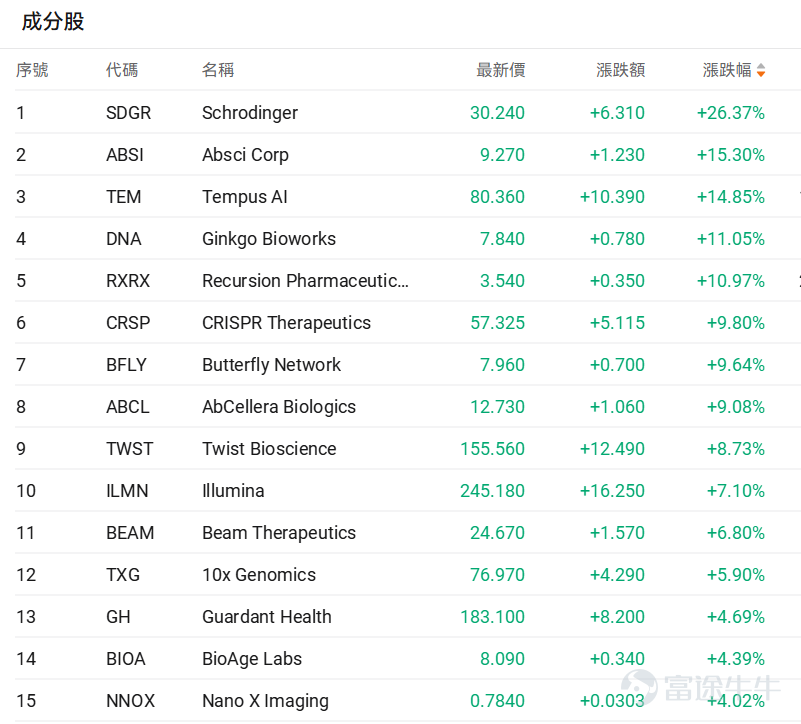
Driven by multiple catalysts, market attention toward the AI drug discovery supply chain is heating up, leading to a noticeable reaction in related stock prices. Overnight, AI healthcare stocks in the US market rallied broadly, with AI drug design company $Absci Corp (ABSI.US)$ surging over 15%, and the stock backed by Cathie Wood and Nancy Pelosi $Tempus AI (TEM.US)$ jumping nearly 15%; Hong Kong-listed healthcare stocks also rose in sync today, with $GENSCRIPT BIO (01548.HK)$ gaining more than 5%, bringing its cumulative surge to over 260% since June 24.

--
--
--
Amid multiple catalysts, the market is beginning to reassess the AI healthcare supply chain: in the future, AI will not only change 'how drugs are made,' but may also transform 'how diseases are discovered, diagnosed, and treated.'So, how exactly is AI penetrating the pharmaceutical industry? Which segments stand to benefit?
How exactly is AI penetrating the pharmaceutical industry? Why are major pharmaceutical companies embracing AI?
Traditional drug R&D has long faced two core pain points: first, lengthy cycles,from target discovery and candidate screening to clinical trials and final market launch, often taking many years;second, high costs,as a large number of candidate molecules ultimately fail experimental validation, leading to significant uncertainty in R&D investment.
The emergence of AI offers a new pathway for drug R&D: Data → AI Model Prediction → Candidate Molecule Design → Experimental Validation → Clinical Development.
Specifically, AI can participate in target discovery, protein structure prediction, molecular screening, drug design, and clinical trial optimization. The R&D process, which previously relied heavily on trial and error, is shifting towards a "computational prediction + experimental validation" model.
The most notable development this time is the partnership between Novo-Nordisk A/S and Anthropic,As a global leader in diabetes and weight-loss medications, Novo-Nordisk A/S is introducing the Claude Science platform with the aim of leveraging AI capabilities to enhance drug discovery and R&D efficiency. Meanwhile, Eli Lilly and Co continues to build out its AI-driven drug R&D ecosystem.
For large pharmaceutical companies, the greatest value of AI is not to replace R&D personnel, but rather:1) Boost early-stage R&D efficiency,AI can help scientists rapidly analyze vast amounts of biomedical data to identify potential targets and candidate molecules;2) Reduce R&D trial-and-error costs,Traditional R&D requires extensive experimental screening, whereas AI can narrow down the exploration scope in advance;3) Accelerate the expansion of innovative drug pipelines,In the future, large pharmaceutical companies with access to data, computing power, and R&D capabilities are expected to enhance R&D efficiency through AI.
Therefore, AI is becoming the new infrastructure for competition among global pharmaceutical companies.
Which segments stand to benefit?
Previously,"Moderna Surges 177%! A Paradigm Shift in Cancer Treatment: Which of the Six Major AI Healthcare Tracks Will Benefit the Most?"As previously discussed in an article, when viewed through the lens of the industry chain, AI in healthcare primarily covers six major areas:

--
--
--
1. AI in Drug R&D: Shifting from "Trial-and-Error" to "Computation-Driven"
Traditional drug development is characterized by long cycles and high costs. From target discovery and candidate molecule screening to animal studies and clinical trials, developing an innovative drug often takes years, with a large number of candidates ultimately failing to reach commercialization.
AI is transforming this model. Leveraging large language models, biological data, and computing power, AI can participate in target discovery, protein structure prediction, molecular design, drug screening, and clinical trial optimization, driving the shift in drug R&D from experimental exploration → data analysis → AI prediction → experimental validation.
Among these, AI-driven drug design companies have become the focal point of market attention.Key players in the industry chain include:
1) AI drug discovery platforms:$Absci Corp (ABSI.US)$ 、 $Tempus AI (TEM.US)$ 、 $Recursion Pharmaceuticals (RXRX.US)$、$Schrodinger (SDGR.US)$、 $Recursion Pharmaceuticals (RXRX.US)$ ;
2) AI + Biocomputing: $Moderna (MRNA.US)$ 、 $BioNTech (BNTX.US)$ 、 $Beam Global (BEEM.US)$ 、 $CRISPR Therapeutics (CRSP.US)$ 。
In the future, large pharmaceutical companies possessing data, computing power, and R&D capabilities may leverage AI to enhance innovation efficiency.
2. AI in Early Screening and Precision Diagnosis & Treatment: Enabling Earlier Disease Detection
Beyond R&D, AI is entering the disease detection phase. Fields such as medical imaging, genetic testing, and liquid biopsy generate vast amounts of structured data, making them highly suitable for AI analysis.
Companies focused on AI-powered early screening and precision diagnostics include: $Guardant Health (GH.US)$ 、 $Tempus AI (TEM.US)$ 、 $Natera (NTRA.US)$ 、 $Exact Sciences (EXAS.US)$ 、 $GeneDx Holdings (WGS.US)$ 。
Among them, Guardant Health focuses on liquid biopsy and early cancer screening; Tempus AI leverages its medical data platform combined with AI to support precision medicine.
One of the key directions for future healthcare competition is shifting from "treating diseases" to "predicting diseases in advance."
3. AI in Drug Manufacturing and Computational Biology: Data as a New Factor of Production
The core of AI development in healthcare is not just the models, but the data. Genomic data, clinical data, and biological experimental data are becoming new foundational resources for the healthcare industry.
Therefore, multi-omics and clinical database platforms have also become critical infrastructure. The industry chain includes multi-omics and clinical data platforms. $Illumina (ILMN.US)$ 、 $10x Genomics (TXG.US)$ 、 $Veeva Systems (VEEV.US)$ 、 $Twist Bioscience (TWST.US)$ 。
These companies provide gene sequencing, biological data collection, clinical data management, and R&D software support. Future enhancements in AI model capabilities will require training on more high-quality medical data.
4. AI Surgical Robots and Medical Devices: From Assisted Operations to Intelligent Healthcare
AI is not only changing "drug discovery" but also transforming "treatment methods."
Surgical robots, combining AI vision, automated navigation, and precise control, are expected to improve the efficiency of complex surgeries. The industry chain includes surgical robots, instruments, and monitoring systems, including: $Intuitive Surgical (ISRG.US)$ 、 $Stryker Corp (SYK.US)$ 、 $Medtronic (MDT.US)$ 、 $Zimmer Biomet Holdings (ZBH.US)$ 、 $MEDBOT-B (02252.HK)$ , with Intuitive Surgical being a representative company in the field of robot-assisted surgery.
5. AI Healthcare Service Platforms: Redefining Doctor-Patient Interactions
AI healthcare applications are not limited to hospitals; they are also expanding into online medical services. AI assistants may participate in health consultations, chronic disease management, medical information organization, and personalized health plans.
The digital healthcare and service platform industry chain includes: $Hims & Hers Health (HIMS.US)$ 、 $Teladoc Health (TDOC.US)$ 、 $Doximity (DOCS.US)$ 、 $Omada Health (OMDA.US)$ 、 $JD HEALTH (06618.HK)$ 、 $ALI HEALTH (00241.HK)$ 、 $PA GOODDOCTOR (01833.HK)$ 。
AI has the potential to improve the efficiency of healthcare services and reduce the costs of certain basic medical services.
6. AI Medical Imaging and Assisted Diagnosis: One of the Earliest Commercial Application Scenarios for Medical Data
Medical imaging features highly standardized data formats, making it one of the earlier directions for AI commercialization. AI can be applied in: CT/MRI assisted analysis, radiology diagnosis, lesion identification, and image screening.
The AI medical imaging and assisted diagnosis industry chain includes: $GE HealthCare Technologies (GEHC.US)$ 、 $RadNet (RDNT.US)$ 、 $Heartflow (HTFL.US)$ 、 $Butterfly Network (BFLY.US)$ 。
Among them, major medical equipment manufacturers are embedding AI capabilities into their traditional equipment systems.
Conclusion
From Novo-Nordisk A/S partnering with Anthropic, to Eli Lilly and Co laying out its strategy in AI drug discovery, and ByteDance-affiliated AI pharmaceutical companies securing funding, global tech giants and pharmaceutical leaders are accelerating their entry into the AI + life sciences sector.
Future competition in AI-driven drug discovery will not just be about model capabilities, but a comprehensive contest involving data, computing power, biological experimental capabilities, and industrial resources.
As AI evolves from an "R&D assistance tool" to "R&D infrastructure," the new industry chain formed around AI-driven drug discovery is poised to become a key direction for pharmaceutical innovation.
Risk Disclaimer: The above content only represents the author's view. It does not represent any position or investment advice of Futu. Futu makes no representation or warranty.Read more


Comments (11)
to post a comment
46
160