Jensen Huang predicts sales will double next year, sparking a strong rebound in hardware stocks!

In-Depth Analysis | The Big Four AI Giants Rarely Call for a "Slowdown"! Will the Main Investment Theme in AI Hardware Cool Down as Well?
After years of frantic AI growth, top players are collectively discussing one issue for the first time:Should we slow down?
Over the weekend, prominent Silicon Valley executives expressed concerns about the excessively rapid pace of AI development, calling on the industry to slow down AI development and strengthen technical oversight. This call was initially led by Anthropic CEO Dario Amodei, who emphasized in an article that AI is developing too quickly for researchers to ensure its safety. He proposed that independent auditing bodies oversee the safety work of AI labs and suggested that regulators allow these labs to collaborate to coordinate safety standards.
Subsequently, OpenAI CEO Sam Altman, SpaceX CEO Elon Musk, and Google DeepMind head Demis Hassabis all expressed support for this view, sparking significant attention in global markets.
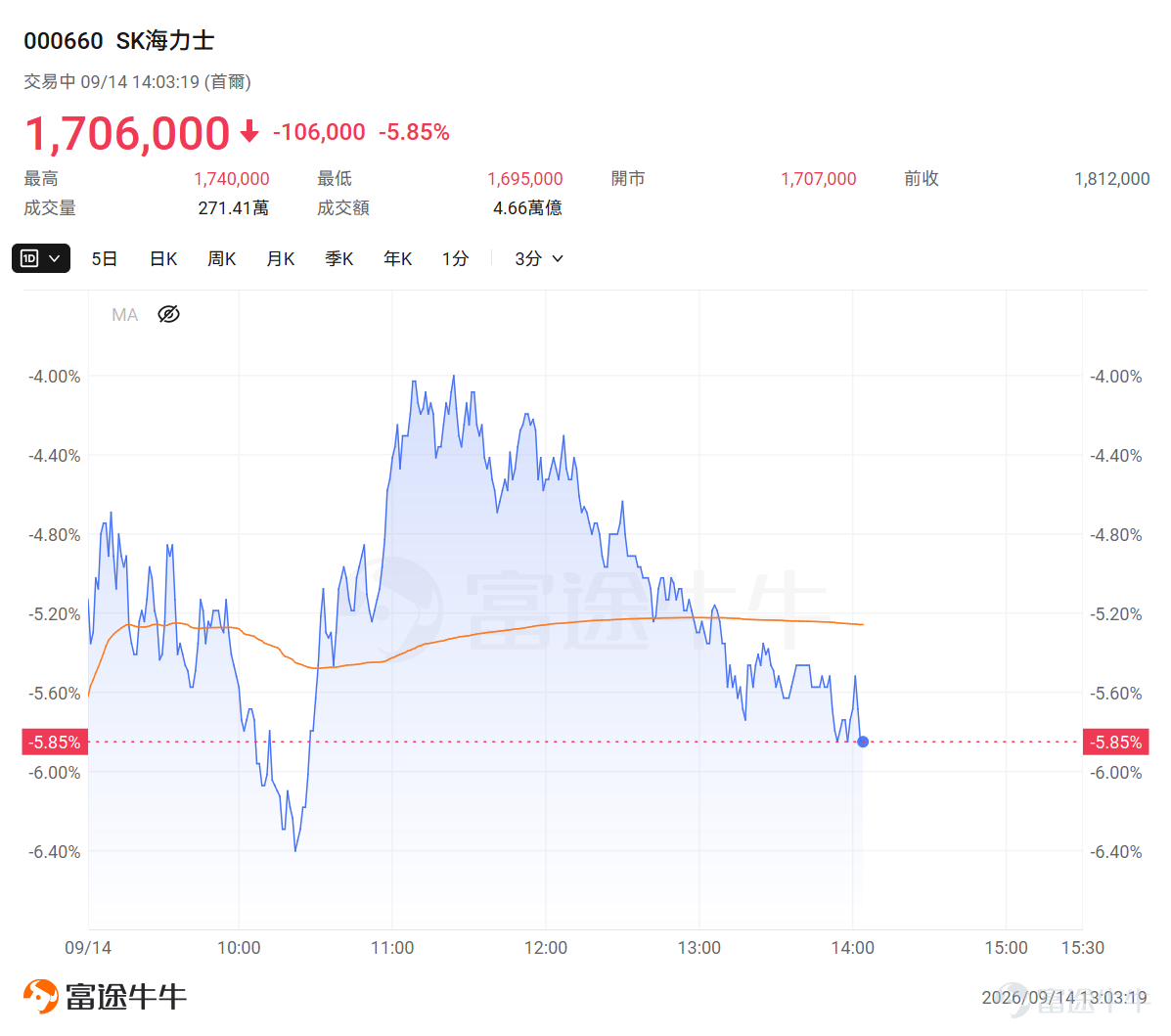
As the news gained traction, global AI concept stocks quickly came under pressure, with Asian markets reacting first: $SoftBank Group (9984.JP)$ 、 $SK hynix (SKHY.US)$ 、 $Samsung Electronics (005930.KR)$ 、 $Kioxia Holdings (285A.JP)$ AI and semiconductor concept stocks such as [NVIDIA], [Amazon], and [Microsoft] saw significant declines.
![After years of frantic AI growth, top players are collectively discussing one issue for the first time:Should we slow down? Over the weekend, prominent Silicon Valley executives expressed concerns about the excessively rapid pace of AI development, calling on the industry to slow down AI development and strengthen technical oversight. This call was initially led by Anthropic CEO Dario Amodei, who emphasized in an article that AI is developing too quickly for researchers to ensure its safety. He proposed that independent auditing bodies oversee the safety work of AI labs and suggested that regulators allow these labs to collaborate to coordinate safety standards. Subsequently, OpenAI CEO Sam Altman, SpaceX CEO Elon Musk, and Google DeepMind head Demis Hassabis all expressed support for this view, sparking significant attention in global markets. As the news gained traction, global AI concept stocks quickly came under pressure, with Asian markets reacting first: $SoftBank Group (9984.JP)$ 、 $SK hynix (SKHY.US)$ 、 $Samsung Electronics (005930.KR)$ 、 $Kioxia Holdings (285A.JP)$ AI and semiconductor concept stocks such as [NVIDIA], [Amazon], and [Microsoft] saw significant declines. The market's concern logic is straightforward:Slower AI development → Lower demand for computing power → Cooling demand for AI hardware such as GPUs, HBM, and optical modules. But this...](https://nnqimage.futunn.com/sns_client_feed/900080/20260914/web-1789367600521-nTeFbRKOmQ.png/big?area=1&is_public=true&imageMogr2/ignore-error/1/format/webp)
--
--
--
The market's concern logic is straightforward:Slower AI development → Lower demand for computing power → Cooling demand for AI hardware such as GPUs, HBM, and optical modules.
However, this line of reasoning actually skips many steps, as "slowing down AI development" can refer to at least three entirely different scenarios:Model releases are slowing down, training expansion is decelerating, and capital expenditure growth is tapering off.
These three types of "slowdowns" may seem semantically similar, but their impact on AI hardware could range from "negligible" to "fundamentally reshaping the industry cycle."
Therefore, what the market truly needs to clarify this time is not whether AI development will continue, but rather:At which stage are the AI giants actually preparing to hit the brakes?
At which stage are the AI giants actually preparing to hit the brakes?
This is actually the key to assessing the impact on AI hardware. Because when the market talks about a "slowdown in AI development," it might simply meana delayed release of new models,, or it could bethat the scale of training is no longer expanding rapidly,, or even evolve further intoData center capex guidance lowered。
While all three scenarios may appear to be a "slowdown," their impact on AI hardware is vastly different:The first primarily affects the pace of commercialization; the second begins to impact demand for computing power, such as GPUs and HBM; while the third truly affects order volumes and earnings expectations across the entire AI hardware supply chain.
Therefore, it may be helpful to break down this AI "deceleration" into three layers:
First layer: Slower model release cadence—primarily impacts commercialization, not necessarily computing power demand
Let's start with the scenario having the least impact.
Suppose an AI company originally planned to release its next-generation model in October but has now postponed the public launch to December or even next year due to the need for additional safety testing, third-party evaluations, and alignment work.
In this scenario,model releases are delayed, but training volume may not necessarily decrease.In fact, Dario Amodei's recent proposal of "pacing the frontier" makes a clear distinction. He explicitly stated that "slowing down" does not mean halting model training or technological progress, but rather allowing more time for safety, alignment, and third-party evaluations alongside improvements in model capabilities.
What does this imply for hardware demand?
If the model has already completed most of its training and only the evaluation period is extended, the GPU compute power previously consumed will not be "refunded."More importantly, safety evaluations themselves also require significant compute power.Models require longer periods of red-teaming, agent simulation, reinforcement learning, interpretability research, and extensive inference testing. Amodei even mentioned that future third-party evaluators may not only assess the final model but also directly inspect the training and model development processes.
In other words:Delayed model release ≠ Reduced GPU usage.
The area truly impacted first could instead be the AI commercialization timeline. If the next-generation model is delayed by several months, API revenue, agent products, enterprise AI applications, and subscription income that depend on the new model's capabilities may be pushed back synchronously.
Therefore, the first type of "slowdown" impacts the industry chain more like this:Software revenue recognition is deferred, but hardware demand does not necessarily decline in sync.For AI hardware stocks such as NVIDIA, AMD, HBM, and optical modules, this may cause short-term valuation and sentiment volatility, but it is difficult to directly infer a downward revision in earnings expectations.
The second type: a slowdown in training expansion—this is when AI hardware demand is truly affected.
The second scenario is significantly more important.
If the "safe slowdown" further evolves into:next-generation models no longer rapidly scaling up training, or a decline in the frequency of training for ultra-large models,then AI hardware demand will be truly impacted.
Over the past two years, the core investment thesis for AI hardware has been that next-generation models require more computing power. The continuous expansion of training scale—from tens of thousands of GPUs to clusters of hundreds of thousands or even millions—has driven an explosion in demand for GPUs, HBM, advanced packaging, switches, and optical modules.
However, a "slowdown in training" cannot simply be equated with a decline in computing power demand. What really matters is:whether the scale of individual training runs has decreased, whether the training frequency has dropped, and whether the total annual investment in computing power has declined.
For example, a company that originally trained four large models per year using 100,000 GPUs each time might switch to twice a year. However, if the scale of each training run increases to 200,000 GPUs, coupled with additional demands from post-training, safety evaluations, and agent testing, the actual computing power consumed annually may not necessarily decrease.
Therefore, what hardware investors really need to focus on is not "how often large models are released," butthe total amount of computing power actually utilized over the year.。
If training compute power truly declines, GPUs and HBM will be the first to feel the impact, and high-speed networking will also be affected. This is because larger AI clusters drive higher demand for switching chips, 800G/1.6T optical modules, CPO, and other high-speed interconnects. Once the expansion pace of million-GPU clusters slows down, the previously high growth expectations for the related supply chain will naturally need to be reassessed.
However, this does not mean that AI compute demand has peaked, as another wave of demand is taking over—Inference computing power。
As AI shifts from model training to large-scale applications, especially with the growing普及 of agents, a single task often requires multiple rounds of inference, search, tool invocation, and result validation. This could drive inference compute demand far higher than that of traditional chatbots.
Therefore, even if the pace of frontier model training slows, as long as AI usage continues to grow, hardware demand is more likely toshift from the training side to the inference side, rather than simply decrease. In the future, the focus of competition in AI hardware may gradually shift from "who can provide the most training compute" to "who can deliver more inference compute at lower cost and higher energy efficiency."
The third scenario: a decline in capital expenditure—this is the signal that AI hardware investors truly need to watch out for.
Compared to the pace of model releases and training,capital expenditure is a more direct indicator for judging the health of the AI hardware sector.
This is because GPUs, HBM, servers, switches, optical modules, liquid cooling, SSDs, as well as transformers, UPS systems, and gas turbines, all ultimately depend on one thing:Are tech giants still continuing to expand their AI data centers?
As long as major cloud providers like Amazon, Microsoft, Meta, and Google maintain high levels of investment, the order foundation for AI hardware remains intact. Conversely, if these companies begin to systematically reduce capital expenditures, it would signal a need to reassess profitability expectations across the supply chain.
Currently, this signal has not yet emerged.On the contrary, AI investments by major tech companies remain at elevated levels.
$Alphabet-C (GOOG.US)$ In July this year, the 2026 capital expenditure forecast was raised again, from $180–190 billion to $195–205 billion, with the statement that even with continued expansion of computing power, demand still exceeds new supply.
$Amazon (AMZN.US)$ This year's capital expenditure plan is approximately $200 billion, with the majority directed toward AI infrastructure. CEO Andy Jassy previously stated that a significant portion of AWS-related spending is already supported by customer demand.
$Meta Platforms (META.US)$ This year, the plan is to invest up to approximately $145 billion in AI infrastructure.
Additionally, $Alphabet-C (GOOG.US)$ Recently, it was also announced that about $15.1 billion will be invested in Finland over the next two years to build AI infrastructure and three new data centers. Microsoft was also reported to be planning to increase its global data center capacity to approximately 38 GW by 2032.
Therefore, a more accurate understanding at this stage is:AI companies have begun discussing slowing the pace of capability improvements in frontier models, but infrastructure investment itself has not cooled down in tandem.
The market's concern is whether the slowdown in model development will eventually transmit to demand for training compute and data centers, ultimately impacting capital expenditures and hardware orders.
However, what we currently observe are mainly adjustments by frontier models regarding safety and release cadence. This is distinct from tech giants actually cutting their data center budgets.
Therefore, for AI hardware, the more critical factor to watch next iswhether major cloud providers have begun to lower their capital expenditure guidance.
Which AI hardware components are more susceptible to the "slowdown"?
If we break down the entire AI hardware supply chain, different segments exhibit varying levels of sensitivity to the "slowdown."
GPUs and HBM: Highly dependent on training compute
If only model releases are delayed, the actual impact on demand for GPUs and HBM will be limited. However, if next-generation models begin to curb the scale of individual training runs, or if the frequency of large-scale model training decreases significantly, then GPUs and HBM will be the first segments affected.
Therefore, for companies such as $NVIDIA (NVDA.US)$ 、 $Advanced Micro Devices (AMD.US)$ 、 $SK hynix (SKHY.US)$ 、 $Micron Technology (MU.US)$ NVIDIA, Amazon, and Microsoft, what truly matters is not a delay of a few months in new model launches, but ratherHow much computing power and how many chips will the next generation of AI clusters actually require?
Optical Communications: The key focus is whether clusters can continue to scale up.
The optical communications sector is particularly sensitive to ultra-large-scale AI clusters. As the number of GPUs increases, so does the volume of data exchanged between chips and servers, driving stronger demand for high-speed networks, switching chips, optical modules, and CPO (Co-Packaged Optics).
Therefore, if the construction pace of million-card-level AI clusters slows down in the future, the high growth expectations previously built on "continuous cluster expansion" in the optical communications sector will need to be reassessed. Conversely, if only model releases are delayed while data centers and AI clusters continue to expand as planned, the actual impact on the fundamentals of optical communications will be relatively limited.
Servers and Liquid Cooling: The focus is more on whether projects are truly being implemented.
Servers and liquid cooling are more directly linked to actual data center deployment. As long as GPUs are being delivered and racks are being installed, related demand will continue to materialize. Therefore, the greater concern in this segment is not which model launch is delayed, but ratherdelays, reductions, or even cancellations of the data center projects themselves.
Power Equipment: Impacts are typically more lagged.
The construction cycle for power infrastructure such as transformers, gas turbines, and power generation equipment is longer, with many orders locked in years in advance. Therefore, short-term changes in the pace of model development are unlikely to immediately affect data center and power projects already underway. Even if AI capital expenditure truly slows down in the future, the power supply chain will typically be impacted later than segments like GPUs and servers.
Has the investment logic for AI hardware changed?
The recent collective discussion among AI giants about a "slowdown" highlights a critical shift: while the AI industry has primarily competed on larger models, faster training, and greater compute power in recent years, safety is now emerging as a new constraint.
Amodei even suggested that stricter limitations on training compute, training methodologies, and the pace of AI self-improvement may be imposed in the future. If these restrictions are implemented, the competitive landscape for AI compute could shift—moving away from a singular focus on scale toward a greater emphasis on compute efficiency, utilization rates, and return on investment (ROI).
However, it is premature to conclude that demand for AI hardware has peaked at this stage. Instead, investors should closely monitor three key developments:Whether the training scale of next-generation models is shrinking, whether orders for core components such as GPUs, HBM, and optical modules are weakening, and whether major cloud providers are beginning to reduce their AI capital expenditures.
If model releases are merely delayed by a few months, the impact will likely remain confined to market sentiment and valuations. However, if training compute demand begins to decline, growth projections for GPUs, HBM, and optical communications will need to be reassessed. Only if large tech companies further cut data center budgets would it signal a genuine shift in the AI hardware business cycle.
Thus, this notion of a "slowdown" serves more as a reminder to the market:Future growth in AI compute will not rely solely on scaling up clusters, but will increasingly depend on inference demand, compute efficiency, and return on investment.
Risk Disclaimer: The above content only represents the author's view. It does not represent any position or investment advice of Futu. Futu makes no representation or warranty.Read more


Comments (86)
to post a comment
165
562