Micron expands share buybacks! Will the memory chip rebound gain momentum?

Hot Topics in 5 Minutes | Memory chips emerge as the strongest AI sub-sector again; is it still worth chasing SanDisk and SK Hynix?
Memory stocks are back in the spotlight.
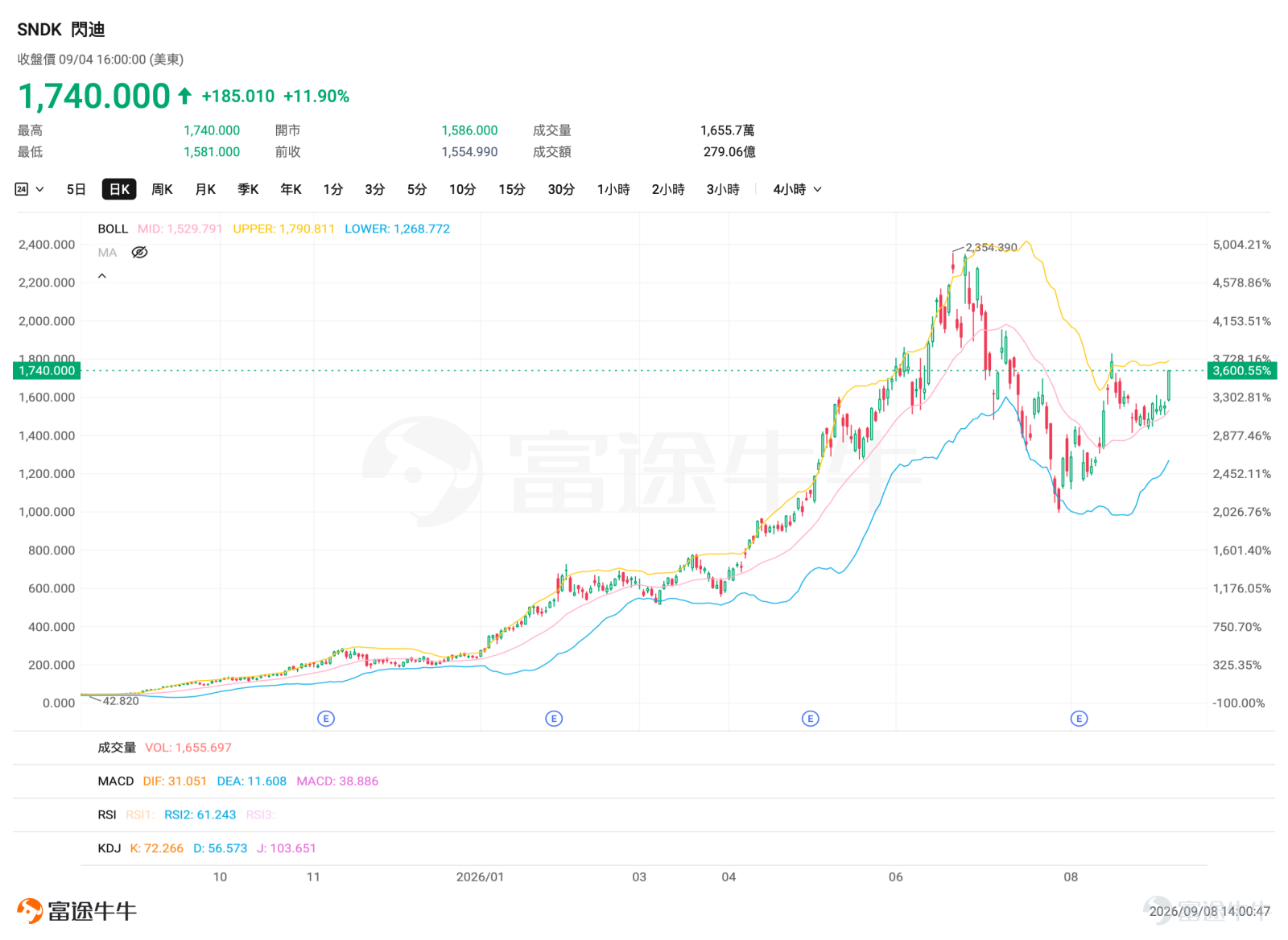
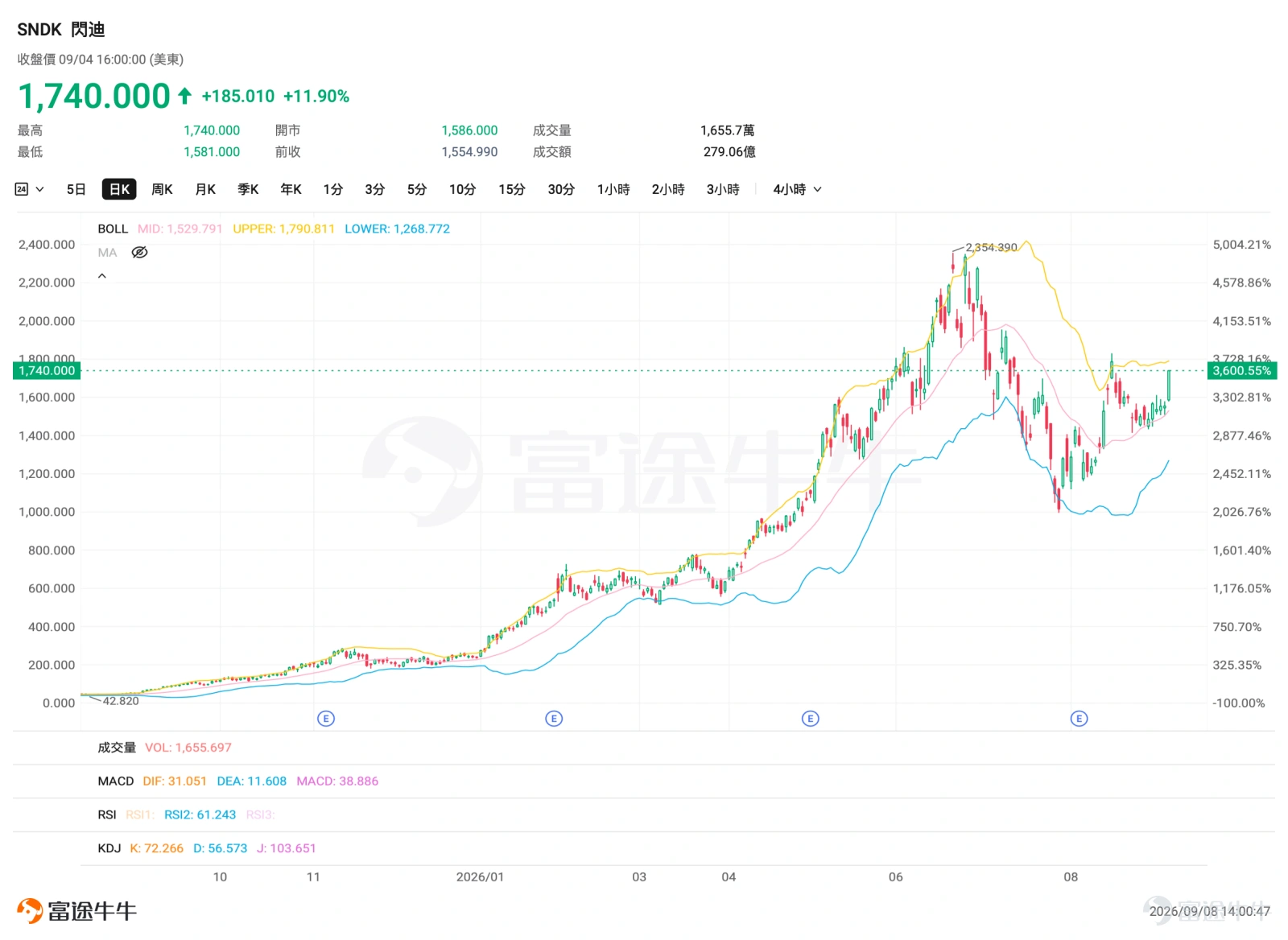
On September 4, $SanDisk (SNDK.US)$Surged 11.9% against the trend to $1,740; On September 7,SK Hynix rose another 8.26% to KRW 178,300, with memory chips once again becoming one of the strongest sub-sectors within AI hardware.
However, over a longer timeframe, both industry leaders have not yet fully recovered from the sharp declines seen in June and July. Looking ahead, the more pertinent question is: What expectations is the memory sectorcurrently repricing? Will this rebound return to previous highs?
From the plunge to the rebound, what is the market repricing?
The recent sharp decline was not driven by a sudden reversal in memory fundamentals, but rather because the market had already fully priced in HBM shortages, rising DRAM/NAND prices, and surging AI demand.As the market began to worry that the pace of price hikes was peaking and earnings upgrades were slowing, combined with crowded positions, chip structure issues, and macro headwinds, stock prices naturally underwent severe deleveraging.
However, as time progresses, the pricing landscape for memory in Q3 is becoming clearer. TrendForce expects traditional DRAM contract prices to continue rising quarter-over-quarter in Q3 by 13% to 18%, while NAND Flash prices rise 10% to 15%; AI demand is also expanding beyond HBM to Server DRAM, enterprise SSDs, and NAND.
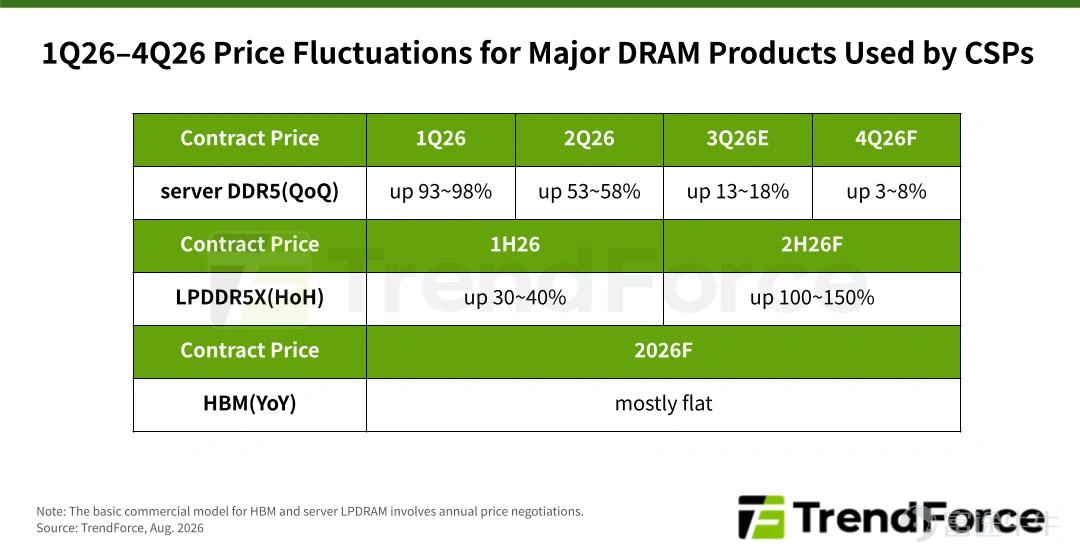
In simple terms:In June and July, the market sold off due to "excessively high expectations"; recently, it has started re-pricing based on the view that "the memory upcycle may last longer than previously imagined."
This cycle has also added an important variable—Memory leaders are starting to use significant cash reserves to buy back their own shares.
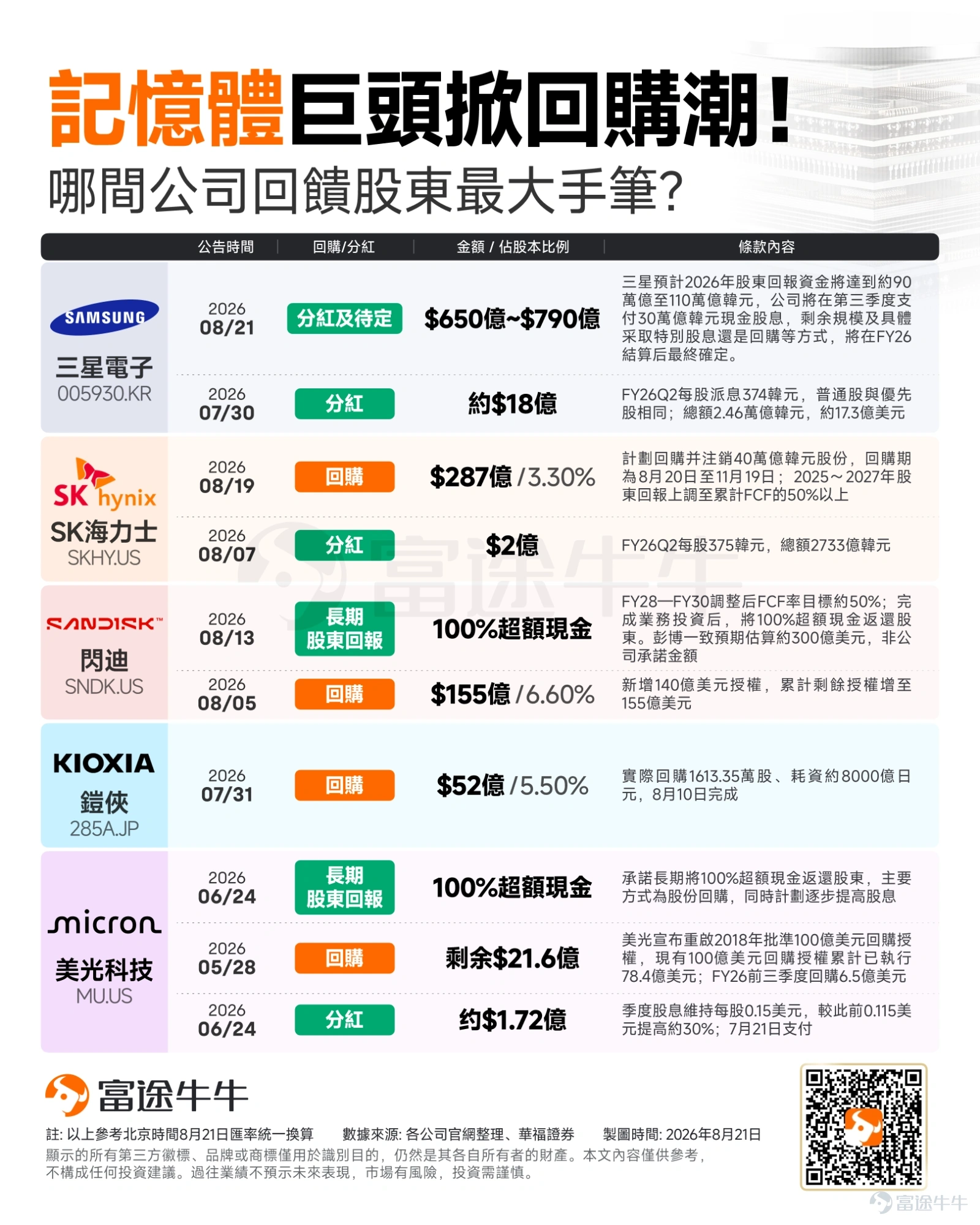
How substantial is SanDisk's $15.5 billion buyback?
SanDisk further increased its buyback in August $14 billionstock buyback authorization, with approximately $15.5 billionremaining. In Q4 FY26, the company actually repurchased about $4.5 billion worth of shares, indicating that these buybacks will be primarily funded by operating cash flow.
A simple calculation based on recent market capitalization shows that $15.5 billion is roughly equivalent to Around 6%of the company's market cap. Assuming all repurchases are completed at current price levels, the share count could theoretically decrease by about 6%; in a simplified scenario where earnings remain unchanged, EPS would mechanically increase by approximately 6% to 7%。
Of course, this does not guarantee a 6% to 7% rise in the stock price. The true impact of buybacks operates on three levels:
First, reducing the share count to boost earnings per share; second, the company itself becomes a consistent buyer; and third, most importantly, management is signaling to the market with real capital that the current strong cash flow is not solely intended for capacity expansion.
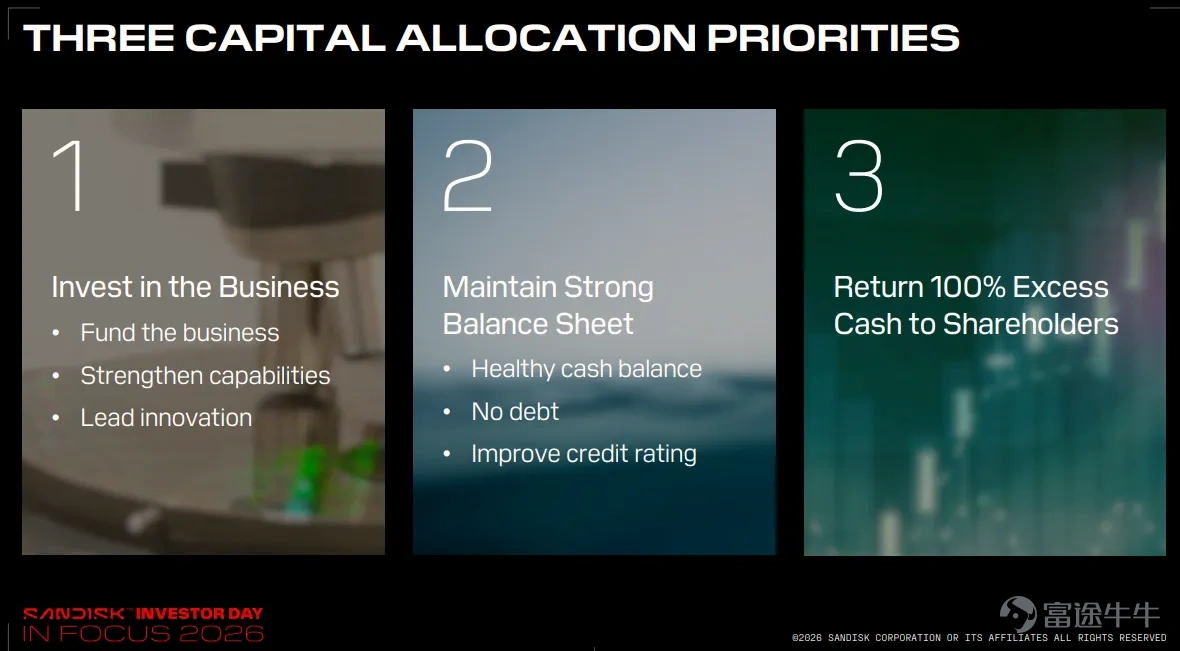
SanDisk also stated at its Investor Day that, after completing necessary business investments, it plans to return 100% of its remaining excess cash to shareholdersMeanwhile, the company has signed new long-term commercial agreements with eight clients, covering approximately 50% of FY27 bit shipments and about two-thirds of FY28 bit shipments, aiming to enhance the visibility of future revenue and cash flows.
SK Hynix's KRW 40 trillion buyback sends a more direct signal.
$SK hynix (SKHY.US)$$SK Hynix (000660.KR)$ Announced on August 19 that it will repurchase and cancel all KRW 40 trillionworth of shares, and raise its shareholder return target for 2025–2027 from the previous "within 50% of cumulative FCF" to Exceeding 50%。
Based on the company's disclosed plan, the buyback size is equivalent to approximately 3.3%of total share capital. If earnings remain unchanged, EPS could theoretically see a mechanical increase of approximately 3.4%。
after full cancellation of the shares. However, what the market truly cares about is not this 3.4%.
The biggest issue with the traditional memory cycle has always been:Price hikes → Surge in profits → Massive capacity expansion → Supply glut → Price declines.
What the market is looking for now is:Surge in earnings → Disciplined capacity expansion → Long-term contracts to lock in demand → Share buybacks with excess cash.
Therefore, share buybacks will not eliminate the cyclical nature of the memory sector. However, if capital discipline truly improves, the market has reason to reassess the valuation that memory leaders should command.
Is it still worth chasing? The market is currently trading on "how long the peak can last."
Looking at memory stocks, we can use a simplified framework to understand them:
Stock Price ≈ Peak EPS × Duration of Peak × Valuation Multiple the Market is Willing to Assign to Peak EPS
This is not a strict valuation formula, but it is well-suited to explain the current pricing of memory stocks.
First variable: How much higher can Peak EPS go?
This depends onStorage pricing, product mix, and AI demand。
The outlook remains positive for now. DRAM and NAND prices are still rising in Q3, while demand for HBM, server DRAM, and enterprise SSDs continues to be supported by AI infrastructure build-outs. This means there is still room for further upward revisions to earnings peak expectations for 2026–2027.
However, at current valuation levels, simply hitting new EPS highs is no longer sufficient. The real question has become:
Second variable: How long can peak EPS be sustained?
This could be the most critical pricing variable in the next phase.
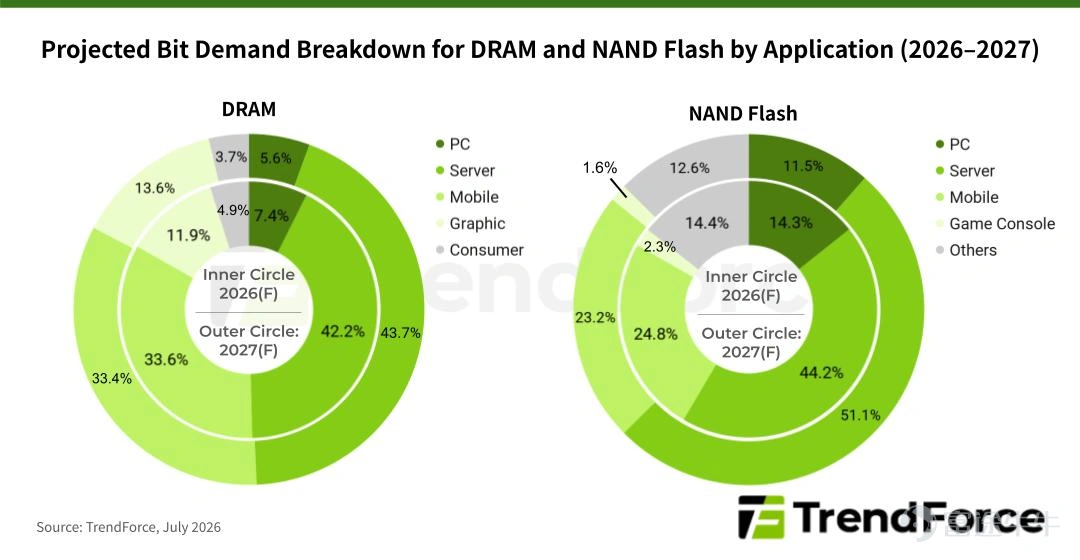
TrendForce currently expects the DRAM market to remain tight through 2027. HBM continues to absorb wafer capacity, and it will take time for new fabs to ramp up significant effective output. This implies that the DRAM supply-demand gap may persist until 2027, with more substantial new supply coming online only becoming apparent in 2028.
The situation for NAND is different, however.
TrendForce predicts that as the industry transitions to higher-layer NAND processes and new capacity gradually comes online,the NAND supply-demand balance may begin to ease in the second half of 2027.。
Therefore, the core contradictions in the respective sub-sectors behind these two stocks are not entirely the same:
– $SK hynix (SKHY.US)$ The key focus is whether the shortage cycle for HBM and server DRAM can persist. At this stage, the visibility of the peak duration is relatively higher.
– $SanDisk (SNDK.US)$ Beyond NAND prices, it is crucial to monitor whether long-term contracts for enterprise SSDs, AI inference, and NBM can absorb future supply increases, thereby sustaining profit highs for longer than in traditional NAND cycles.
However, it is important to note that current expectations regarding the persistence of industry supply tightness are largely speculative. Whether reality unfolds as expected will depend on multiple factors. Nevertheless, against the backdrop of NVIDIA projecting a 70% revenue growth in FY28, the certainty of overall industry demand is relatively high.
The third variable: How many times earnings (multiple) is the market willing to assign to peak EPS?
This is precisely where share buybacks and long-term contracts matter most.
Even if peak EPS is high for traditional cyclical stocks, the market is usually unwilling to assign a high valuation, because investors know:Today's peak EPS could mark the starting point for tomorrow's earnings decline.
However, if long-term supply agreements enhance earnings visibility, manufacturers maintain CapEx discipline, and allocate substantial free cash flow to share buybacks, the market may perceive that:
This peak will be more prolonged, with lower earnings volatility.
In that case, it is not just the EPS itself that gets revalued,Valuation multiples may also increase.
The reverse is also true. Once storage prices peak and manufacturers resume aggressive capacity expansion, the market is likely to simultaneously lower its expectations for:
Peak EPS expectations + Peak duration + Valuation multiples.
This is why, once the cyclical outlook for memory stocks reverses, the pullback in share prices often far exceeds the change in current earnings.
Therefore, the key focus now is no longer "how much money memory companies will make this year," but rather:Whether this earnings peak will last for just one year or can be sustained for two to three years.
This will determine whether memory stocks are merely experiencing a rebound in the next phase or can challenge their previous highs again.
Technical analysis: The trend is repairing, but it is no longer a comfortable zone for bottom-fishing.
SNDK closed at $1,740There has been a significant rebound from the late-July lows, with prices now back above key medium-term moving averages. The technical pattern is gradually shifting from an "oversold bounce" to trend repair.
In the short term, first observe whether effective support can form near the $1,550–$1,600 range;on the upside, it will face the previous dense trading zone and the June highs.
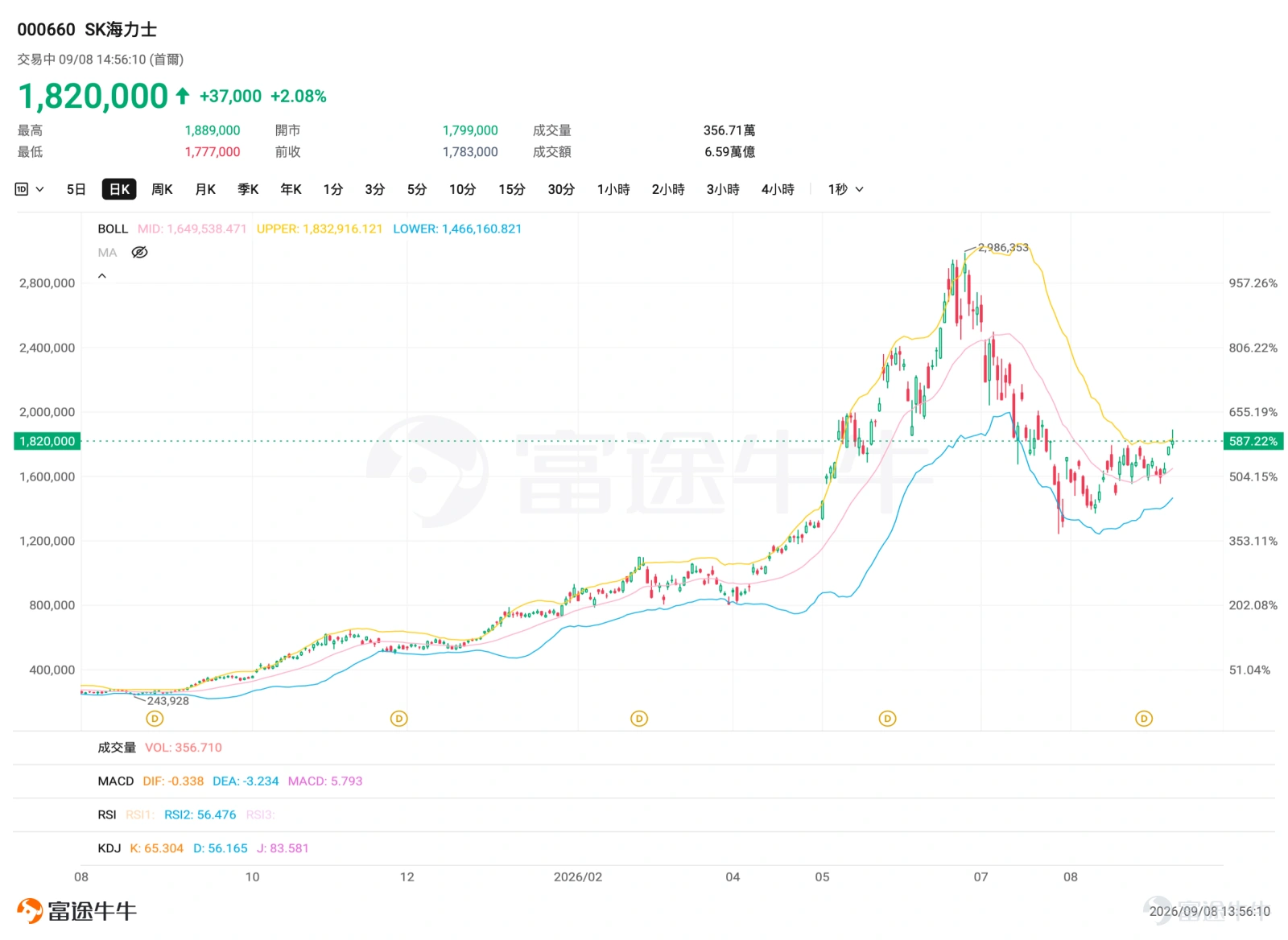
SK Hynix closed at KRW 178,300 on September 7,having consecutively recovered previous losses, but it is also re-entering the dense trading zone left behind in July.
Therefore, a more reasonable approach at present is:The medium-term trend remains strong, but in the short term, waiting for a pullback or confirmation of an effective breakout offers better risk-reward than chasing prices after a sharp rally.
How should you select stocks if you want to participate in the memory chip sector rally?
If you prefer to trade directly based on different storage logic, they can be categorized into four types.
$SanDisk (SNDK.US)$ : Highest elasticity in NAND
Key trading themes:NAND price hikes + Enterprise SSDs + AI Flash + Significant share buybacks.
High elasticity during upturns, but if NAND supply begins to loosen in 2027, cyclical risks warrant close attention.
Key trading themes:HBM + Server DRAM + Enterprise SSDs + Share buyback and cancellation.
If the core thesis is that the shortage cycle for HBM and DRAM will last longer than expected, SK Hynix offers a more direct play.
$Micron Technology (MU.US)$ : The most comprehensive memory leader in US stocks
Simultaneous coverage:HBM + DRAM + NAND.
Its product mix is more balanced than SNDK's, with significant market share in both HBM and DRAM.
$Roundhill Memory ETF (DRAM.US)$ : A storage ETF for those who don't want to bet on a single company
If you are bullish on the overall storage cycle but uncertain which company will ultimately outperform, you can diversify individual stock risk through a storage-themed ETF.
Looking to amplify short-term elasticity: There are also 2x leveraged long products for individual stocks.
For advanced traders, the market now offers numerous daily 2x leveraged products directly linked to storage industry leaders.
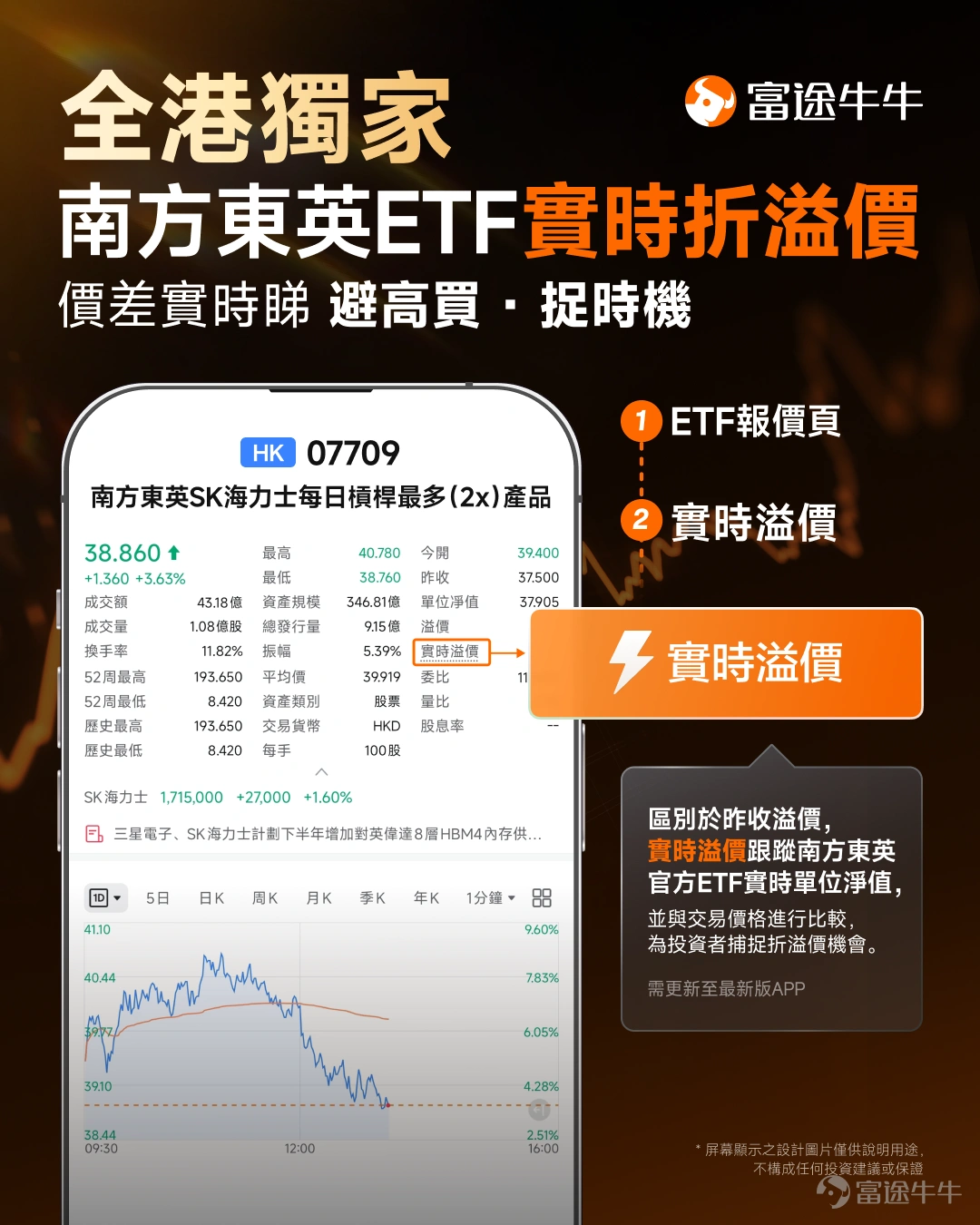
Listed on the HKEX, tracking SK Hynix, aiming to provideup to 2x itsdaily performance before fees.
If you are bullish on SK Hynix in the short term, 7709 offers greater directional flexibility than the underlying stock and is traded in HKD, making it more convenient for Hong Kong stock investors.
$Samsung Electronics (005930.KR)$ There are also ETF products that track it. $CSOP Samsung Electronics Daily Max (2x) Leveraged Product (07747.HK)$ 。
The US market also has 2x leveraged ETF products linked to related stocks:
– $Leverage Shares 2X Long SNDK Daily ETF (SNDG.US)$$Tradr 2X Long SNDK Daily ETF (SNXX.US)$ etc.: Price target provided for SNDK 2x daily;
– $Direxion Daily MU Bull 2X Shares (MUU.US)$$GraniteShares 2x Long MU Daily ETF (MULL.US)$ etc.: Price target provided for MU 2x daily;
However, please pay special attention:"2x Daily" does not mean that holding it for one month will necessarily yield twice the one-month return of the underlying stock.
These products reset their leverage daily. In highly volatile and choppy markets, they are subject to compounding path effects and volatility decay, making them more suitable asShort-term, tactical trading instrumentsshould not be simply treated as a long-term 2x leveraged position.
Overall, if the DRAM/HBM shortage persists and enterprise SSD demand continues to grow, coupled with manufacturers maintaining capital discipline and executing significant share buybacks, the market may simultaneously raise peak EPS, the duration of the peak, and valuation multiples.。
However, if supply ramps up quickly again in 2027, especially with NAND loosening first, these three variables could simultaneously contract in the opposite direction, prompting the market to price in the cyclical downturn in advance.
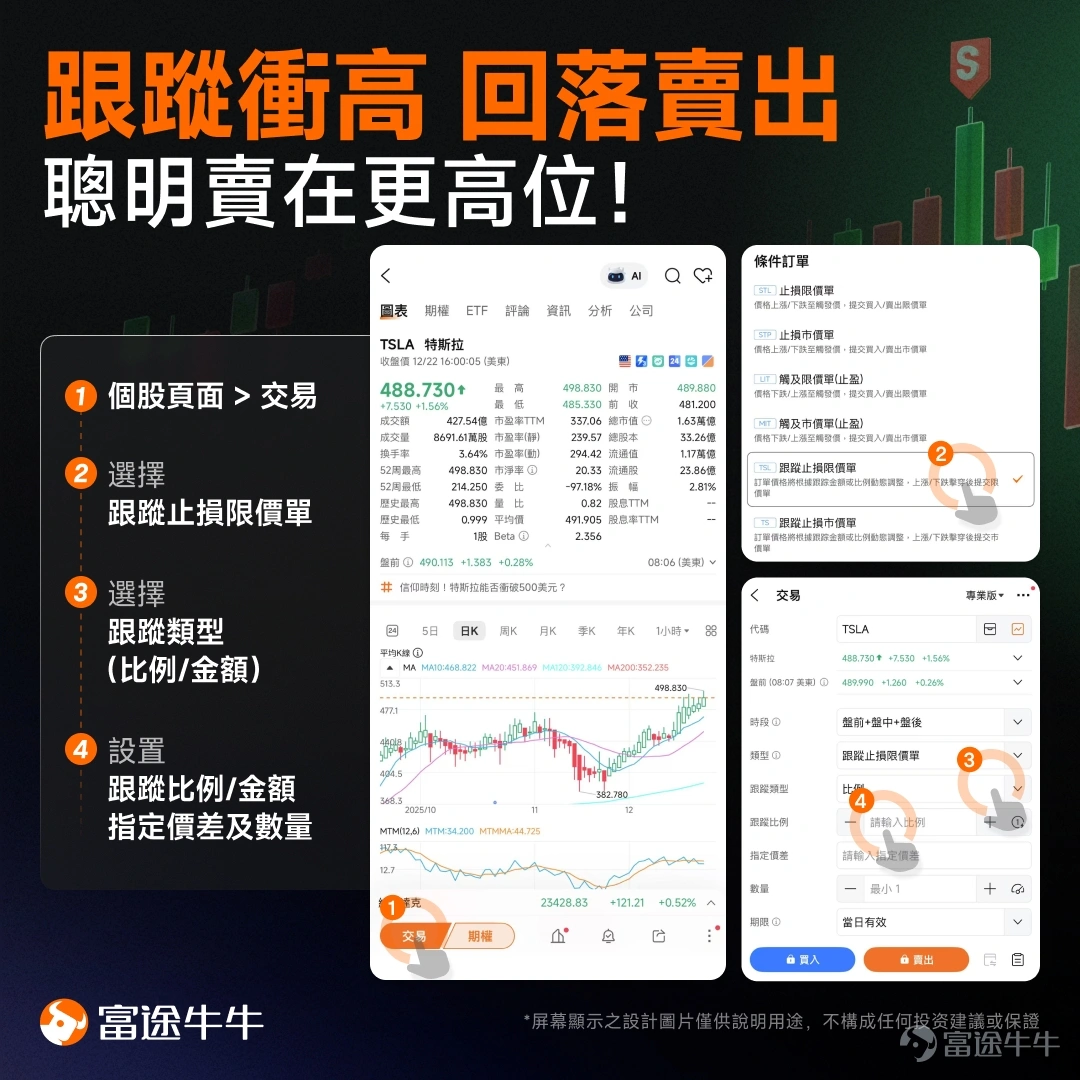
Smart enough to sell at higher levels? Trailing stop-limit orders can help!
Risk Disclaimer: The above content only represents the author's view. It does not represent any position or investment advice of Futu. Futu makes no representation or warranty.Read more


Comments (17)
to post a comment
72
121