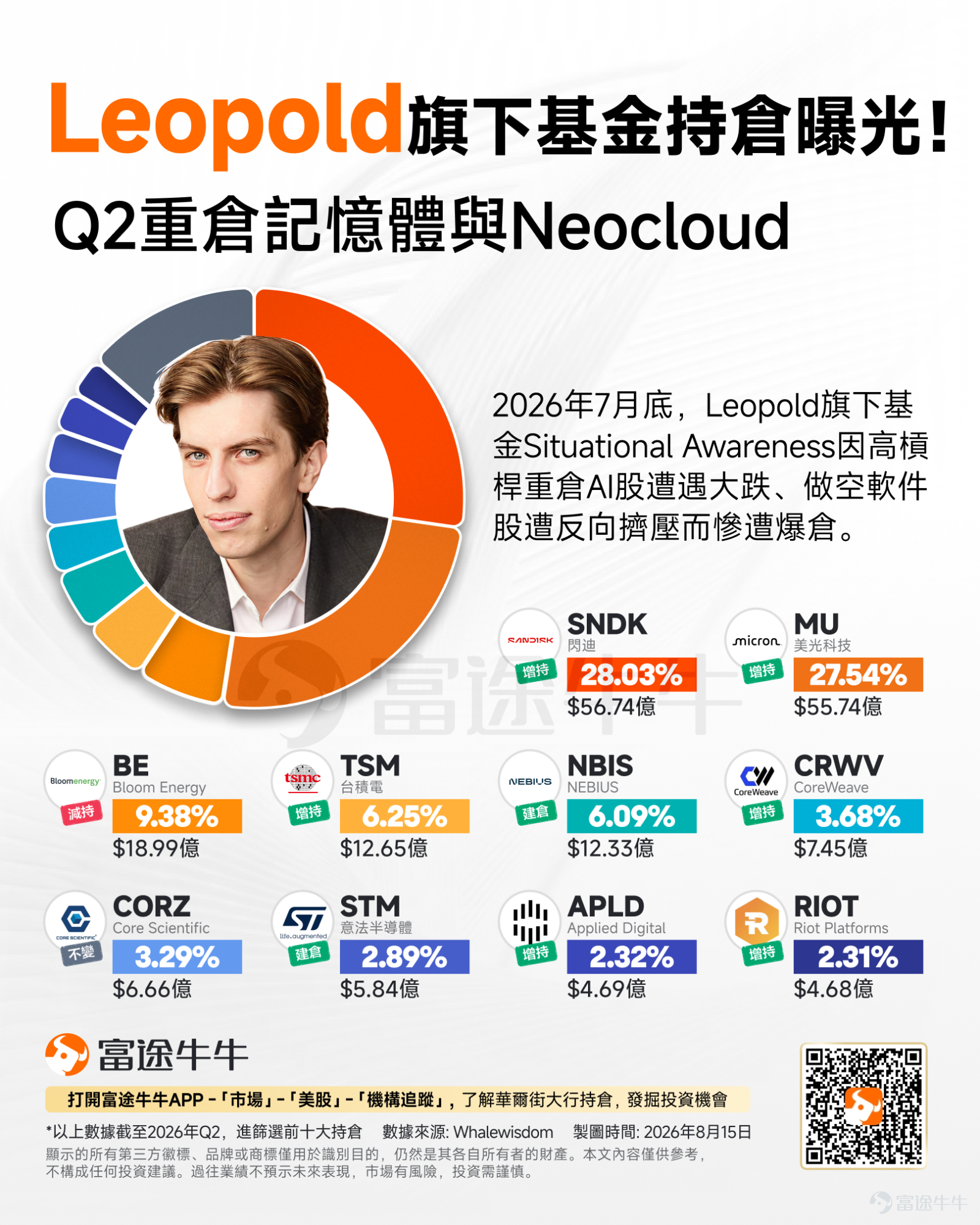
Institutional Q2 Holdings Revealed! What Is "Smart Money" Buying?

13F Secrets Revealed | Leopold's Pre-Liquidation Holdings Exposed: Over Half of Portfolio Bet on SanDisk and Micron, New Position in NEBIUS, Increased Stake in CoreWeave
Two weeks ago, Leopold Aschenbrenner, who rose to fame with a single successful AI investment bet, suffered the most devastating blow of his career.
His hedge fund, Situational Awareness, faced a sharp decline due to highly leveraged heavy positions in AI stocks and was squeezed by short positions in software stocks, ultimately forcing it to sell most of its equity portfolio to Citadel to meet margin calls.
Now, the last holdings snapshot before this "forced deleveraging" event has finally come to light.
On August 14 (Eastern Time), Situational Awareness filed its Q2 13F document with the U.S. Securities and Exchange Commission. The filing shows that as of June 30, the fund's reported 13F holdings were valued at $20.242 billion, an increase of approximately 48% from $13.677 billion in Q1. However, it is crucial to emphasize:This does not reflect Leopold's latest holdings after the liquidation, but rather the portfolio composition just before the blow-up.
--
--
--
In other words, this 13F filing truly reveals where Situational Awareness had concentrated its risk prior to suffering severe losses in July.
Over half of the portfolio was bet on SanDisk and Micron
In the second quarter,Situational Awareness heavily concentrated its portfolio into two memory chip stocks—SanDisk and Micron.
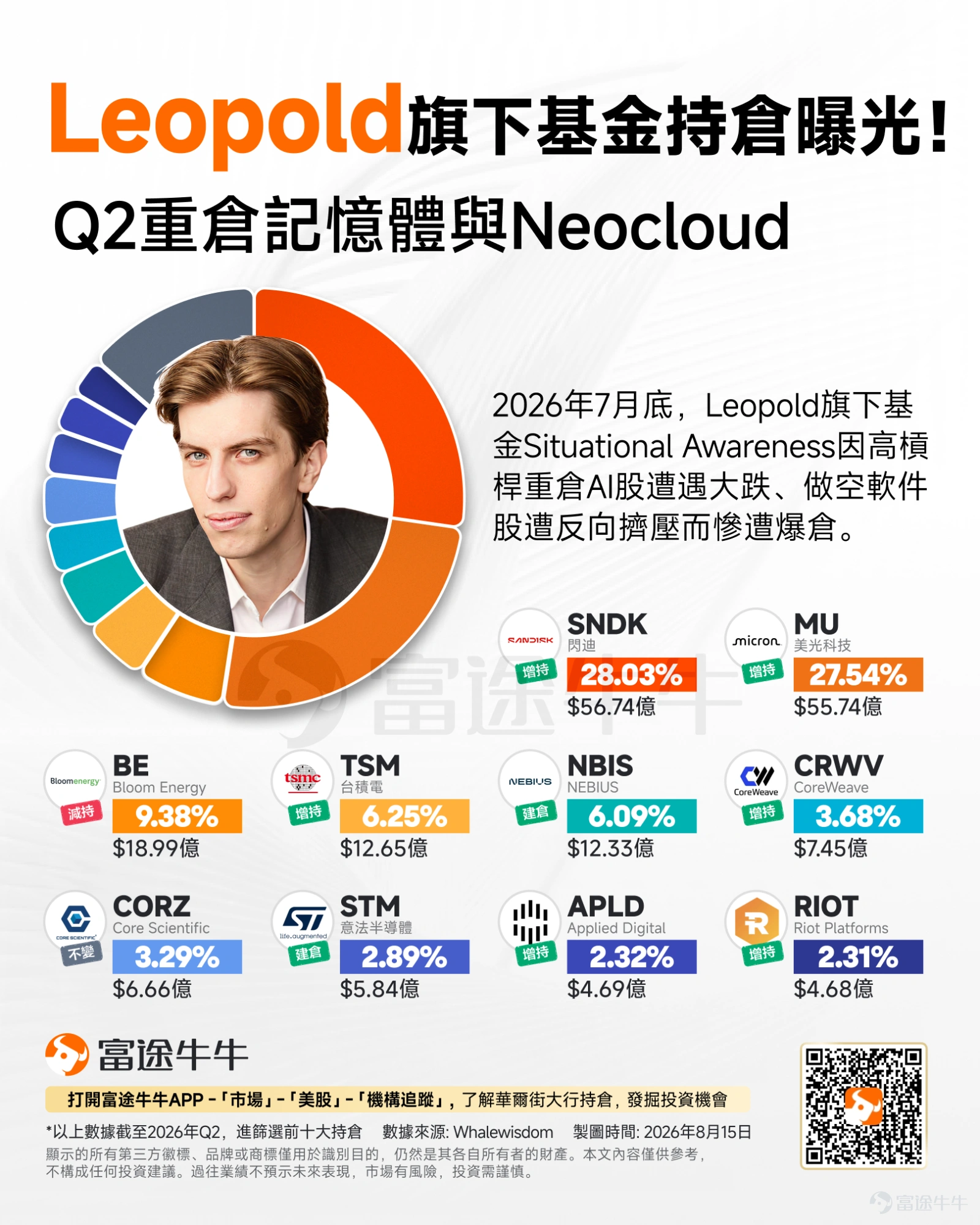
Breakdown:$SanDisk (SNDK.US)$ A position of approximately 2.495 million shares, with a quarter-end market value of about $5.674 billion, accounting for 28.03% of the portfolio; $Micron Technology (MU.US)$ The position stands at approximately 4.829 million shares, with a market value of around $5.574 billion, accounting for 27.54% of the portfolio.
The combined weight of these two stocks reaches 55.57%, meaning that more than half of the fund's holdings are bet on the memory chip sector rally.Judging by the changes in holdings, this concentration was not formed passively, but is the result of Leopold actively increasing positions.
SanDisk common stock holdings increased from approximately 1.14 million shares in Q1 to about 2.495 million shares, a rise of nearly 119%; Micron common stock holdings surged dramatically from approximately 17,400 shares to 4.829 million shares.
In addition to SanDisk and Micron, $Bloom Energy (BE.US)$ 、 $Taiwan Semiconductor (TSM.US)$ and $NEBIUS (NBIS.US)$ they rank as the third to fifth largest heavy-weight positions, respectively. The top five holdings account for a combined 77.3%, while the top ten holdings reach an even higher proportion of approximately 91.8%, indicating a remarkably high level of concentration.
Initiated a new position in NEBIUS, continuing to heavily invest in Neocloud
Another clear theme in Q2 is Leopold's continued increase in exposure to the Neocloud and AI data center supply chain.
Established a new position worth approximately $1.233 billion in Situational Awareness $NEBIUS (NBIS.US)$ position, instantly becoming the fifth largest heavy-weight holding; meanwhile, continuing to hold $CoreWeave (CRWV.US)$ 、 $Core Scientific (CORZ.US)$ 、 $Applied Digital (APLD.US)$ 、 $Riot Platforms (RIOT.US)$ and $IREN Ltd (IREN.US)$ ...and other companies. The combined market capitalization of the aforementioned six stocks is approximately $4.013 billion, accounting for nearly 20% of the entire portfolio.
If we include the two major memory stocks, SanDisk and Micron,the combined weight of the six core holdings in memory and Neocloud has exceeded 75%.
In addition, Leopold established new positions in $STMicroelectronics (STM.US)$ 、 $Vishay Intertechnology (VSH.US)$ and $Cerebras Systems (CBRS.US)$ ...and significantly increased holdings in $Taiwan Semiconductor (TSM.US)$ ,The entire portfolio is largely centered around AI data center infrastructure, including memory, foundry services, power, and computing capacity.
From a 439% surge in half a year to a 67% plunge in one month
As of the end of June, Situational Awareness had once surged 439% year-to-date, leading to rapid growth in assets under management. This performance was driven not only by gains in AI holdings but also by leverage amplification.
However, entering July, trading dynamics reversed completely. Several core AI holdings dropped by nearly half in a short period, while the fund's short positions in software stocks faced upward pressure, causing previously effective long-short spreads to reverse rapidly. As public markets began trading heavily against Leopold's concentrated positions, liquidity deteriorated further, ultimately triggering margin pressures and forced deleveraging.
Situational Awareness plummeted 67% in July alone and sold most of its equity portfolio to Citadel.In his letter to investors, Leopold admitted that the fund had once come "closer to permanent capital loss than was acceptable," and subsequently closed all short positions and deleveraged.
Strictly speaking, Situational Awareness did not fully liquidate. Despite the sharp decline in July, the fund is still up approximately 80% year-to-date and has retained private market assets such as Anthropic.
What does this 13F filing truly reveal?
This turmoil does not simply prove that Leopold’s judgment on AI industry trends was wrong.
The fundamentals of his bets on memory chips, Neocloud, and AI data centers are even continuing to improve. What truly broke the fund was the simultaneous occurrence of high concentration, leveraged financing, and declining liquidity.
With over 75% of the public portfolio concentrated in two highly correlated AI themes, combined with leverage, a short-term disconnect between market prices and fundamentals could cause the fund to lose its ability to maintain positions before its thesis is validated.
Therefore, this delayed Q2 13F filing is no longer a list of holdings to copy, but rather a post-mortem reconstruction of the July liquidation crisis. Leopold’s lesson is:Being right on the direction does not guarantee profits. When leverage is too high and positions are overly concentrated, the market may not even give you time to wait for your investment thesis to play out.
 Understand institutional holdings and stay up to date with the latest investment trends, Market > US Stocks > Institutional Tracking
Risk Disclaimer: The above content only represents the author's view. It does not represent any position or investment advice of Futu. Futu makes no representation or warranty.Read more


Comments (21)
to post a comment
64
139