Is the food delivery war coming to an end? Meituan's Q2 profits exceed expectations

[Comment to Earn Points] Tencent's earnings are about to drop! Can the big wave of AI application monetization still lead the era?
If the core themes driving Hong Kong tech stocks over the past two years have been gaming, advertising, and share buybacks, the market is now reassessing another equally critical narrative:How AI can truly transition from the 'investment phase' to the 'monetization phase.'
Training large models requires continuous investment in computing power, while inference applications are already generating massive and ongoing usage volumes. New scenarios—such as AI agents, multimodal systems, AI-powered search, and intelligent agent workflows—are further amplifying AI usage frequency within billion-user platforms like WeChat, QQ, and gaming ecosystems. In other words, the competition among internet platforms is no longer just about who has the largest model parameters, but also about who can embed AI into apps that users open daily—and turn it into real revenue and profit.
Within this AI application value chain,$TENCENT (00700.HK)$attention is rising ahead of its second-quarter 2026 earnings release scheduled for August 12 Beijing time.$BABA-W (09988.HK)$which leans more toward cloud computing and AI infrastructure,Tencent’s key focus areas center more on WeChat ecosystem AI integration, intelligent ad targeting, game longevity strategies, and tangible AI commercialization.
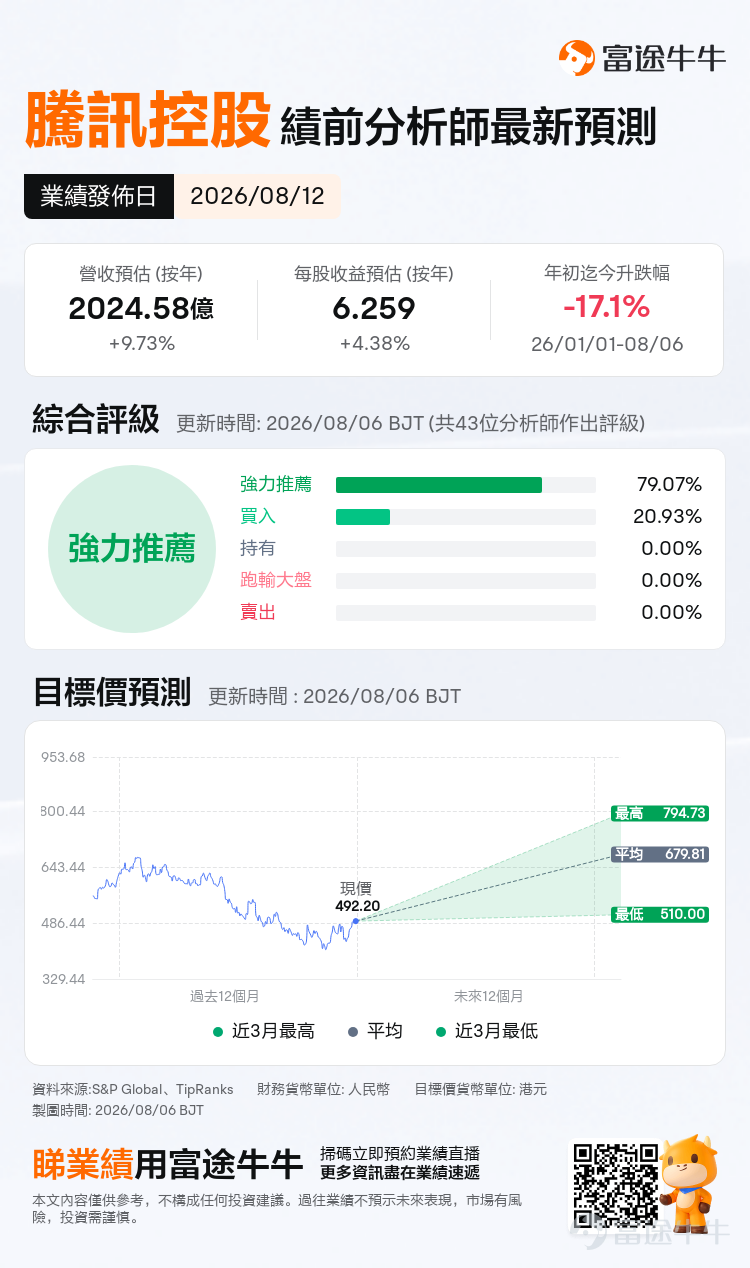
Analyst expectations$TENCENT (00700.HK)$Revenue for Q2 2026 is expected to reach RMB 202.458 billion, an increase of 9.73% year-over-year; earnings per share are forecast at RMB 6.259, up 4.38% year-over-year.
![If the core themes driving Hong Kong tech stocks over the past two years have been gaming, advertising, and share buybacks, the market is now reassessing another equally critical narrative:How AI can truly transition from the 'investment phase' to the 'monetization phase.' Training large models requires continuous investment in computing power, while inference applications are already generating massive and ongoing usage volumes. New scenarios—such as AI agents, multimodal systems, AI-powered search, and intelligent agent workflows—are further amplifying AI usage frequency within billion-user platforms like WeChat, QQ, and gaming ecosystems. In other words, the competition among internet platforms is no longer just about who has the largest model parameters, but also about who can embed AI into apps that users open daily—and turn it into real revenue and profit. Within this AI application value chain,$TENCENT (00700.HK)$attention is rising ahead of its second-quarter 2026 earnings release scheduled for August 12 Beijing time.$BABA-W (09988.HK)$which leans more toward cloud computing and AI infrastructure,Tencent’s key focus areas center more on WeChat ecosystem AI integration, intelligent ad targeting, game longevity strategies, and tangible AI commercialization.[OK] Analyst expectations$TENCENT (00700.HK)$Revenue for Q2 2026 is expected to reach RMB 202.458 billion, an increase of 9.73% year-over-year; earnings per share are forecast at RMB 6.259, up 4.38% year-over-year. Recently, sentiment across the Hong Kong tech sector has shown some volatility, with the market simultaneously optimistic about AI applications and...](https://nnqimage.futunn.com/sns_client_feed/999982/20260810/web-1786332377650-wXbO4CYFrN.png/big?area=2&is_public=true&imageMogr2/ignore-error/1/format/webp)
Recently, sentiment toward the Hong Kong-listed tech sector has been volatile. On one hand, the market is optimistic about the earnings upside from monetizing AI applications; on the other, concerns persist over how surging AI-related capital expenditures and sales expenses might erode profit margins, as well as slower-than-expected macroeconomic consumer recovery. Against this backdrop, whether Tencent can benefit in the next phase of the AI application rally through AI-driven upgrades to its WeChat ecosystem warrants close market attention.
🔎 This analysis focuses on Tencent, with three key points of interest:
First, can the AI narrative shift from 'compute arms race' to 'application monetization'?
In the past, when discussing Chinese AI, the immediate reaction was often centered on computing power and chips, as large model training and inference rely heavily on GPUs and cloud infrastructure. However, as AI moves into broader deployment phases, the market is beginning to reprice companies based on who owns user-facing scenarios and who can effectively turn AI into revenue. Since launching its self-developed HunYuan 3 (Hy3) model, Tencent has consistently ranked among the top in token consumption on OpenRouter and has already deployed the model across over 100 internal products for collaborative iteration. Management further believes that WeChat, QQ, and WeCom represent natural control interfaces for Agentic AI—if mini-program capabilities can be transformed into AI Skills, Tencent could establish a differentiated ecosystem moat. For Tencent, the value of AI lies not in burning cash for DAU growth, but in high-value user scenarios where customers are willing to pay.
Second, can the ad engine scale new heights through AI-powered recommendations?
AI-driven advertising recommendation models continue to advance and have now been fully deployed for ad conversion rate prediction tasks, significantly boosting transaction volumes across channels such as Channels, Official Accounts, Mini Programs, and Moments. The intelligent bidding system AIM+ is also continuously iterating and has already empowered roughly 30% of advertisers’ budgets. Meanwhile, commercialization of WeChat Search is accelerating. Analysts expect ad revenue in Q2 to still achieve low double-digit growth. If AI recommendation efficiency and Channels inventory continue to expand, advertising could become Tencent’s most direct near-term window for AI monetization.
Third, how long can the longevity of gaming franchises and shareholder returns continue?
Honor of Kings has hit a new all-time high in gross billing, while Peacekeeper Elite has seen a significant year-over-year acceleration in revenue. The newly launched game Luoke Kingdom: World delivered strong dual-platform daily active user performance in its launch month. Combined with deferred revenue recognition due to the Lunar New Year timing shift, analysts expect domestic gaming revenue this quarter to sustain solid growth. At the same time, Tencent continues its aggressive share buybacks. With the current share price having meaningfully corrected from recent highs and analyst target prices implying ample upside potential, valuation remains at historically low levels—offering considerable room for optimism from both earnings elasticity and valuation safety margin perspectives.
This time, the market may be watching not just Tencent’s interim results, but whether AI application monetization can underpin the next chapter of its growth narrative.
💾 Will the sharp increase in AI-related capital expenditures and sales expenses continue to erode profit margins?
💾 Is the high growth in advertising revenue approaching a ceiling?
💾 Can the recovery in consumer and commercial payment growth continue?
💾 Can valuation recovery spread from AI hardware leaders to AI application leaders?
Now, it’s up to fellow investors’ judgment! Join this rewarded discussion, share your views on Tencent, and earn points! 👇👇🏆 Activity 1: Bull Circle Opinion Leader ✨
Tencent’s earnings report is here—can monetization of AI applications continue to deliver? With advertising and gaming driving growth together, can its post-earnings performance further boost confidence in Hong Kong’s tech sector?
Share your thoughts in the comments section:
✅ Minimum 30 words ✅ Original viewpoint ✅ Complies with community guidelines
All eligible participants will share 10,000 points!
Note: All activities above will end at 12:00 PM Beijing time on August 12; rewards will be distributed collectively after the conclusion of this earnings season.
Click to reserve:Earnings Flash Insights: Futubull AI cuts through the noise—build your options strategy in three steps!![If the core themes driving Hong Kong tech stocks over the past two years have been gaming, advertising, and share buybacks, the market is now reassessing another equally critical narrative:How AI can truly transition from the 'investment phase' to the 'monetization phase.' Training large models requires continuous investment in computing power, while inference applications are already generating massive and ongoing usage volumes. New scenarios—such as AI agents, multimodal systems, AI-powered search, and intelligent agent workflows—are further amplifying AI usage frequency within billion-user platforms like WeChat, QQ, and gaming ecosystems. In other words, the competition among internet platforms is no longer just about who has the largest model parameters, but also about who can embed AI into apps that users open daily—and turn it into real revenue and profit. Within this AI application value chain,$TENCENT (00700.HK)$attention is rising ahead of its second-quarter 2026 earnings release scheduled for August 12 Beijing time.$BABA-W (09988.HK)$which leans more toward cloud computing and AI infrastructure,Tencent’s key focus areas center more on WeChat ecosystem AI integration, intelligent ad targeting, game longevity strategies, and tangible AI commercialization.[OK] Analyst expectations$TENCENT (00700.HK)$Revenue for Q2 2026 is expected to reach RMB 202.458 billion, an increase of 9.73% year-over-year; earnings per share are forecast at RMB 6.259, up 4.38% year-over-year. Recently, sentiment across the Hong Kong tech sector has shown some volatility, with the market simultaneously optimistic about AI applications and...](https://nnqimage.futunn.com/sns_client_feed/999982/20260807/web-1786086799200-rM0bYNGueD.webp/big?area=2&is_public=true&imageMogr2/ignore-error/1/format/webp) Futubull AIInstant Q&A to clarify doubts, smart stock selection to lock in promising upside, and portfolio analysis to seize opportunities while avoiding risks!
Futubull AIInstant Q&A to clarify doubts, smart stock selection to lock in promising upside, and portfolio analysis to seize opportunities while avoiding risks!![If the core themes driving Hong Kong tech stocks over the past two years have been gaming, advertising, and share buybacks, the market is now reassessing another equally critical narrative:How AI can truly transition from the 'investment phase' to the 'monetization phase.' Training large models requires continuous investment in computing power, while inference applications are already generating massive and ongoing usage volumes. New scenarios—such as AI agents, multimodal systems, AI-powered search, and intelligent agent workflows—are further amplifying AI usage frequency within billion-user platforms like WeChat, QQ, and gaming ecosystems. In other words, the competition among internet platforms is no longer just about who has the largest model parameters, but also about who can embed AI into apps that users open daily—and turn it into real revenue and profit. Within this AI application value chain,$TENCENT (00700.HK)$attention is rising ahead of its second-quarter 2026 earnings release scheduled for August 12 Beijing time.$BABA-W (09988.HK)$which leans more toward cloud computing and AI infrastructure,Tencent’s key focus areas center more on WeChat ecosystem AI integration, intelligent ad targeting, game longevity strategies, and tangible AI commercialization.[OK] Analyst expectations$TENCENT (00700.HK)$Revenue for Q2 2026 is expected to reach RMB 202.458 billion, an increase of 9.73% year-over-year; earnings per share are forecast at RMB 6.259, up 4.38% year-over-year. Recently, sentiment across the Hong Kong tech sector has shown some volatility, with the market simultaneously optimistic about AI applications and...](https://nnqimage.futunn.com/sns_client_feed/999982/20260807/web-1786086799367-fQ6RfjYZFG.webp/big?area=2&is_public=true&imageMogr2/ignore-error/1/format/webp)
Risk Disclaimer: The above content only represents the author's view. It does not represent any position or investment advice of Futu. Futu makes no representation or warranty.Read more


Comments (90)
to post a comment
42
10