
SpaceX's second wave of lock-up expirations is here; how should investors position themselves in spa

SpaceX's First Quarterly Report Since IPO: Strong Results but Capital Expenditures Have Not Yet Peaked

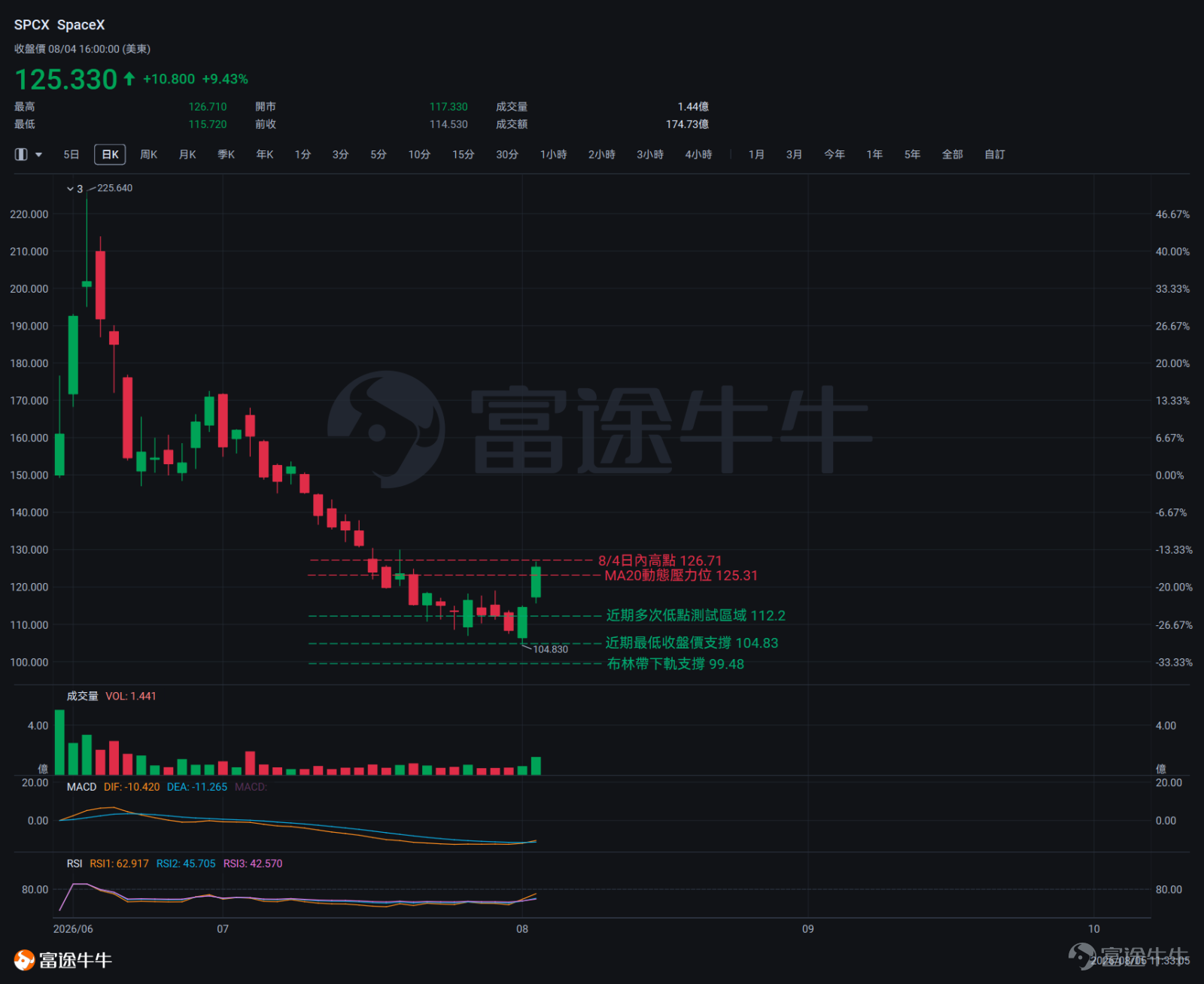
$SpaceX (SPCX.US)$ Released its first quarterly earnings report since going public after market close on August 4—All key financial metrics significantly beat expectations.The stock initially rose more than 1% in after-hours trading, then reversed and turned negative.As of the time of writing, SpaceX shares are trading at $116, down more than 7% from the previous session's closing price.
Key Financial Metrics Explained


Nearly every metric in the Q2 2026 earnings report exceeded market estimates: total revenue reached $7.814 billion,up nearly twofold (+92%) year-over-year, surpassing Bloomberg consensus estimates by approximately 13%;Adjusted EBITDA reached $3.5 billion,Up sharply by 192% year-over-year, exceeding market expectations by 75%;Net loss of $541 million,nearly halving compared to the $1 billion loss in the same period last year.Capital expenditures totaled approximately $18.4 billion, in line with market expectations, of which $15.8 billion was invested in AI computing infrastructure.
Across its three major business segments,revenue from all segments exceeded market estimates.Starlink is currently the only segment generating consistent profits,with quarterly revenue of $4.291 billion and operating profit of $1.66 billion, serving as the company's primary cash flow driver.The AI segment generated $2.561 billion in revenue this quarter, butremains in an investment phase, reporting an operating loss of $1.26 billion.Revenue from space launch operations was $962 million, similarlystill in the construction and investment phase, with an operating loss of $542 million.The overall structure is clear:Starlink is profitable, while space and AI are still burning cash—but the spending is purposeful.
The earnings themselves aren't the issue. The problem lies inthe fact that, given SpaceX's current sky-high valuation, the market demands more than just 'fast growth.'
There are three specific pressure points:
1. Capital expenditures show no sign of peaking. Management clearly stated thatcapital expenditures in the third and fourth quarters will remain at a level similar to this quarter,implying full-year 2026 capital expenditures of approximately $70 billion.The company's free cash flow remains negative, with no signs of narrowing in the near term.
2. Lock-up expiration pressure is imminent. The first batch of lock-up shares expires this Thursday, and SpaceX’s share price has already fallen roughly 50% from its post-listing high,creating real selling pressure on the supply side of the market.
3. The path for the AI business to achieve positive cash flow still requires time to validate.The newly signed $14.1 billion contracts represent contract sales, not recognized revenue for the current period; the $60 billion acquisition of Cursor has not yet closed. The market has accepted the narrative that 'AI losses were better than expected,' but remains cautious about when the AI segment will actually make a positive contribution to the company's free cash flow.
Three key points worth close attention

Image source: Kevin Dietsch/Getty Images
1. Starlink’s Profitability Quality Matters More Than the Numbers
This quarter, net new subscribers reached 1.7 million,marking Starlink’s strongest single-quarter subscriber growth in its history. Average monthly revenue per user remains stable at $66, with no price cuts used to fuel expansion. More importantly,revenue from enterprise and government customers grew 108% year-over-year;the military-grade Starlink (Starshield)has secured over $6 billion in multi-year contracts with the U.S. government, providing strong revenue visibility for the coming years.
During the earnings call, management directly challenged the three traditional telecom giants—AT&T, Verizon, and T-Mobile, stating theywill enter the $600 billion annual U.S. mobile communications market—specifically by leveraging Starlink’s already globally deployed antenna network and adding small-cell base station capabilities, thereby bypassing the traditional carriers’ need to spend tens of billions on spectrum acquisition.
II. Expectation Gap Correction in the AI Segment
The market had previously been most concerned about the AI business continuing to burn cash, expecting an operating loss of approximately $23.9 billion this quarter—but the actual figure was only $12.6 billion,nearly half lower than expected.
Even more noteworthy is a key detail: the CFO disclosed that the AI segment’s adjusted EBITDA turned positive for the first time this quarter, reaching $11 billion, and the current payback period for compute capacity deployment is 'less than one year'—indicating the company is rapidly converting idle compute resources into revenue,and $Alphabet-C (GOOG.US)$with cloud compute contracts from leading firms such as Anthropic serving as the primary driver.New cloud service contracts signed this quarter totaled $14.1 billion, and in the first few weeks of Q3, an additional $6.7 billion in contracts were signed, underscoring the ongoing supply-demand imbalance in compute capacity.
III. Technical Inflection Point Signal for Starship
During the earnings call, Musk confirmed that the thermal protection system—the most challenging engineering hurdle—has 'been resolved.' The company will attempt its first simultaneous recovery of both the first-stage booster and the spacecraft by the end of this month, with an expected launch cadence of at least once per day within a year.
The commercialization progress of Starship directly determines the deployment speed of the next-generation Starlink V3 satellites. V3 satellites offer 10 times the bandwidth capacity of the current V2 satellites, and once mass-launched into orbit,Starlink's revenue ceiling will be redefined.
Management's core forward-looking guidance
During the earnings call, management provided three specific targets:
1. Achieve annualized recurring revenue exceeding $100 billion by year-end,described as 'clearly achievable';
2. Reach $1 trillion in annual revenue by 2030,one year earlier than previously forecast, with Musk stating 2029 is 'not impossible';
3. Computational capacity is expected to reach 5 to 10 gigawatts by the end of 2027,Musk’s personal goal is 20 gigawatts.
Conclusion
SpaceX’s first earnings report since going public was actually quite impressive, but given the current highly sensitive timing,the market is being extremely stringent regarding tech giants’ AI-related capital expenditures and return on investment.—It hasn't addressed the two issues that markets truly care about: when capital expenditures will peak, and when the company as a whole will enter a phase of positive free cash flow. Until these questions are answered, SpaceX's valuation will continue to require investors to remain patient with its long-term narrative.
The pace of Starship launch cadence acceleration, scaled deployment of Starlink V3, and revenue recognition from AI computing contracts—progress on these three milestones will be the decisive variables for SpaceX's stock performance over the next two quarters.
Risk Disclaimer: The above content only represents the author's view. It does not represent any position or investment advice of Futu. Futu makes no representation or warranty.Read more


Comments (10)
to post a comment
37
60