Hong Kong stocks are rebounding—what sectors deserve attention?

Both have surged sharply—should you favor Tencent’s momentum continuation or Alibaba’s breakout strength?
On August 3, big tech stocks returned to the spotlight in the market.
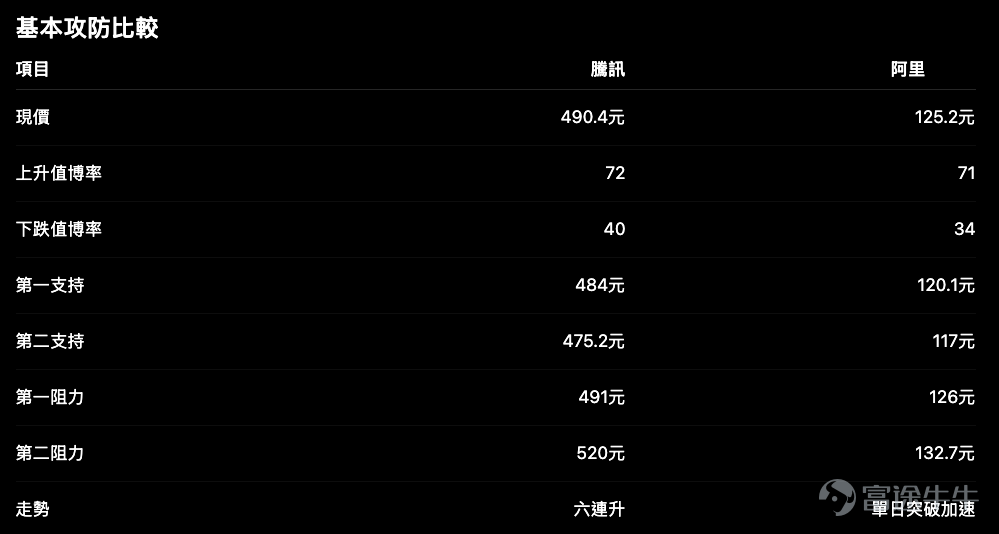
Tencent rose 3.2%, marking its sixth consecutive gain and approaching the upper Bollinger Band; Alibaba jumped 7.01%, posting its second straight gain and breaking above both the 60-day moving average and the upper Bollinger Band.
Both stocks are strong, but their strength manifests very differently:
– Tencent shows steady, consecutive gains with a more stable trend;
– Alibaba exhibits strong breakout power with a single-day acceleration.
If investors can only pick one to position in, they shouldn’t just compare which stock rose more on the day, but rather assess:
1. How far the current price is from resistance;
2. Whether support levels are clearly defined;
3. How much room remains after the breakout;
4. If long positions turn out wrong, where to exit.

Both have nearly identical upside reward-to-risk ratios, but Alibaba has a lower downside risk and a clearer directional bias; Tencent holds a slight edge in price continuity and support structure.
Tencent is currently trading at HK$490.4, with the first resistance at HK$491—just HK$0.6 away.
Further upside, bearish warrant heavy positions are concentrated between HK$495 and HK$499.8.
In other words, Tencent currently faces two layers of consecutive resistance:
1. Technical resistance at HK$491;
2. Dense zone of bearish warrants between HK$495 and HK$499.8.
Six consecutive gains reflect solid buying momentum, but the immediate upside room from current levels is limited.
There are two relatively reasonable setups:
– Wait for a breakout and sustained hold above HK$491;
– Wait for the share price to pull back to HK$484 and stabilize.
If HK$484 is breached, the next support level is at HK$475.2; if HK$475.2 is also broken, bullish positioning for this rally should be halted.
Tencent product strategy
For bullish exposure, consider comparing:
– UBS Group bull certificates 69404
– Guojun call warrants 13627
If investors are concerned about resistance in the HK$491–500 range, they can use UBS Group put warrants 15003as a bearish instrument; consider UBS Group bear certificates only if seeking higher short-term leverage. 61880。
Bull certificates are suitable for short-term positioning after a confirmed breakout; call warrants are better suited for longer holding periods, but time decay and implied volatility must be closely monitored.
Alibaba $BABA-W (09988.HK)$ : The breakout momentum is stronger, but it has already entered the resistance zone directly.
Alibaba rose 7.01% in a single day, breaking above its 60-day moving average and the upper Bollinger Band, showing noticeably stronger momentum than Tencent.
However, with the current price at HK$125.2, the first resistance level is at HK$126; meanwhile, a significant concentration of bear certificates lies precisely between HK$125 and HK$129.9.
In other words, Alibaba isn’t 'about to enter' a resistance zone—it’s already within one.
This is also Alibaba’s greatest paradox:
– Its technical momentum is stronger than Tencent’s;
– It has more nominal upside potential post-breakout, up to HK$132.7;
– However, the stock has already surged 7% in a single day, so buying in at the current price risks exposure to a normal pullback.
Alibaba’s support levels are much lower than Tencent’s:
– First support at HK$120.1;
– Second support at HK$117.
Therefore, the more ideal strategy for Alibaba is not to blindly chase above HK$125, but rather:
1. Confirm stabilization after breaking above HK$126; or
2. Wait for a pullback near HK$120.1 and observe whether a new support level forms.
Alibaba Product Strategy
For bullish exposure, consider comparing:
– UBS Group bull certificates 67425
– HSBC call warrant 27506
For a bearish view or hedging, consider:
– UBS Group put warrant 15134
– UBS Group bear certificate 55416
If choosing a bull certificate, investors must be prepared for potentially significant intraday volatility following a sharp rally in Alibaba. If opting for a call warrant, note that if implied volatility declines after the sharp rise, the warrant’s gain may not fully track the underlying stock’s performance.
Whose breakout conditions are more complete?
Tencent wins on stability
Tencent has risen for six consecutive sessions, with support at HK$484 close to the current price, making it easier for investors to set stop-loss levels. Even in the event of a pullback, as long as HK$484 holds, the overall uptrend may remain intact.
The issue is that resistance levels at HK$491 and HK$495–499.8 are very close, limiting short-term upside potential.
Alibaba wins on room to move
If Alibaba breaks above HK$126, the next resistance level is HK$132.70, offering more complete upside potential compared to Tencent’s move from HK$491 to HK$495.
The issue is that chasing in after a single-day 7% rally results in a clearly unfavorable entry point, and the HK$125–HK$129.90 range itself already presents dense resistance.
My choice
If I must pick one of these two stocks to monitor for a breakout:
I would slightly favor Alibaba.
The reason isn’t that Alibaba has risen more, but rather that the upside from a breakout above HK$126 to HK$132.70 is more complete than Tencent’s scenario, where it immediately faces resistance at HK$495–HK$499.80 after breaking above HK$491.
However, this doesn’t mean you should chase Alibaba at the current price.
A more ideal execution would be:
– Consider taking a long position only after Alibaba breaks above HK$126 and stabilizes there;
– Or wait for a pullback near HK$120.10 to assess support.
Tencent is more suitable for relatively conservative investors:
– Watch for support holding above HK$484;
– Consider initiating positions only after a breakout above HK$491;
– Abandon bullish positions if HK$475.2 is breached.
Therefore, the final conclusion is not that 'Alibaba is definitely better than Tencent,' but rather:
Alibaba offers better breakout potential, while Tencent has stronger support structures; at current prices, neither stock represents an ideal entry point.
Recently, would you prefer to position in Tencent or Alibaba? Are you more interested in comparing the underlying stocks’ price trends or the terms of their respective derivative products?
Risk Disclaimer: The above content only represents the author's view. It does not represent any position or investment advice of Futu. Futu makes no representation or warranty.Read more

Comments
to post a comment
1