
HK Warrants Note: After the Hang Seng Index’s five consecutive gains, what truly matters isn’t how much further it can rise, but how to allocate risk before reaching the 26,100 level
The Hang Seng Index rose another 0.1% on July 31, closing at 25,884 points—a seemingly modest gain, yet the trend has already becomefive straight sessions of gains, and it has moved back above all moving averages. The Hang Seng Tech Index rose 0.53% to 4,829 points, moving closer to the upper Bollinger Band.
On the surface, the market remains relatively strong; however, from a risk-reward perspective, conditions now differ from those just two or three days ago.
The Hang Seng Index has rebounded from a low of 22,518 points to 25,884 points—representing a substantial short-term gain—and its 9-day RSI is already approaching 78. In other words, the question is no longer ‘Is the trend upward?’ but rather:
Ahead of the resistance zone between 25,900 and 26,150 points, is it still worth chasing with high leverage?
Hang Seng Index $Hang Seng Index (800000.HK)$ : direction remains upward, but conditions for chasing prices are starting to tighten
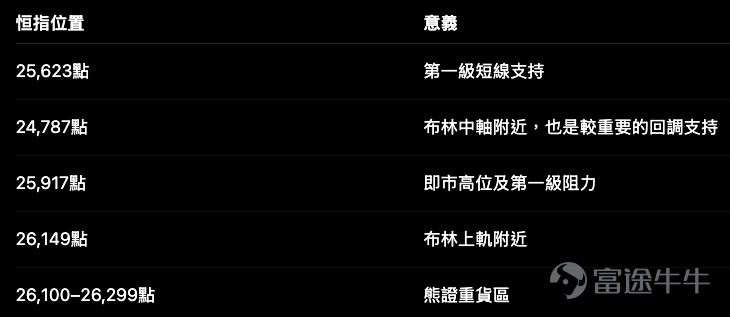
Key price levels can currently be viewed as follows:

Data on outstanding callable bull/bear certificates (CBBCs) shows that Hang Seng Index bear CBBCs are heavily concentrated between 26,100 and 26,299 points, while the bull CBBC zone is much lower, between 24,100 and 24,299 points.
These street holding levels shouldn’t be interpreted as guaranteed price targets or reversal points, but they do at least tell us:The area around 26,100 points coincides with both technical resistance and a dense cluster of lagging positions.
Therefore, for bullish positioning at this stage, it’s best to consider two scenarios:
– If the Hang Seng Index first pulls back to around 25,600 points and holds firm, then consider call warrants or bull CBBCs with wider knock-out buffers;
– Only if the Hang Seng Index directly breaks above 26,150 points—confirming that the resistance zone has been absorbed—should one consider following the trend.
The least ideal approach is to suddenly chase into highly leveraged bull certificates that are extremely close to being called back, just as the index rises into the range of 25,900 to 26,100 points.
Hang Seng Tech Index $Hang Seng TECH Index (800700.HK)$ : appears to have more room, but hasn’t truly broken out yet
The Hang Seng Tech Index is currently trading at 4,829 points, having rebounded above its Bollinger Bands midline at 4,714 points. Near-term support can first be seen at 4,764 points, followed by 4,714 points; resistance lies in the range of 4,872 to 4,896 points.
Product choices for the Hang Seng Tech Index can be more clearly categorized by directional bias:

Open interest in Hang Seng Tech Index call warrants increased by 29.82% in a single day, while open interest in bull certificates rose by 21.60%; conversely, open interest in bear certificates decreased by 33.54%. This suggests capital is repositioning for an upward move, but open interest remains a lagging indicator—the real key still lies in whether the index can break through 4,895 points.
This market rally is actually centered on sector rotation.
Financial stocks remain strong, with HSBC breaking above its Bollinger Band upper band and hitting a record high since listing; meanwhile, large-cap tech stocks are also starting to improve—Tencent has gained for five consecutive sessions, and Alibaba has broken above its 60-day moving average.
This suggests the market may not simply be about 'the index continuing to rise,' but could gradually shift from banks sustaining gains at elevated levels to tech stocks taking the lead.
However, the positioning logic differs across these three types of underlying assets:
– Hang Seng IndexThe trend remains strong, but it's approaching resistance; the key is to manage the distance to the knock-in level.
– Hang Seng Tech IndexWait for a breakout above 4,895 points to confirm that upside room has opened up.
– individual stocksDon’t just look at price gains or losses—compare the current price against support/resistance levels, product leverage, and the distance to the knock-in price.
Key points to remember
The Hang Seng Index remains relatively strong, but that doesn’t mean buying bull certificates at any level offers good value. 25,600 is the defensive level, and around 26,100 will be a test; until a breakout occurs, it’s better to choose products with a larger safety cushion rather than those with the highest leverage.
In the 'Warrants and CBBC Product Overview,' what’s truly useful isn’t the product code itself, but placing the product back into context with support, resistance, and knock-in conditions. If the direction hasn’t been confirmed, even the cheapest product may not be suitable; once the direction is confirmed, don’t ignore time decay or knock-in risk just because you’ve correctly anticipated the market direction.
Risk Disclaimer: The above content only represents the author's view. It does not represent any position or investment advice of Futu. Futu makes no representation or warranty.Read more

Comments
to post a comment
3