
Options Plaza: Fed rate decision and mega earnings week—how to position options for bullish or beari

$100 Options Quick Recap | Storage Stocks Stage a Massive Rally—10x Gains in a Day! Meta Got the Direction Right but Still Lost Money? The Two Faces of Options
Hello, fellow investors! This week’s market was a textbook example of 'half ocean, half flame.'
On one side, the AI hardware sector staged an epic rebound after days of sharp declines, handsomely rewarding those brave enough to buy the dip. On the other side, Meta delivered a surreal earnings report—revenue hit an all-time high, yet its stock plunged 8%. But adding insult to injury, traders who correctly bet on the downside found their put options losing value instead of gaining.
In this episode, we’ll use two real-world examples to clarify the two most counterintuitive phenomena in the options world: Why can a cheap call option multiply tenfold in a single day? And why might a put option lose money even when you’ve correctly predicted the direction?
Let’s break them down one by one.
$Tradr 2X Long SNDK Daily ETF (SNXX.US)$ : AI Hardware Rebounds Violently—A One-Day Miracle from $0.10 to $1.17
To understand this option, we first need to clarify what SNXX is.
Many fellow investors may be unfamiliar with $SanDisk (SNDK.US)$ More familiar—it’s a veteran memory chip company that was acquired by Western Digital and later spun off as an independent public company. It now has a market cap of nearly $190 billion, with its share price as high as $1,279.One share of SanDisk costs enough to buy a high-end iPhone.
For retail investors with limited capital, this share price is practically 'visible but unattainable.'A single board lot costs $128,000; even buying just one share requires $1,279.
But SNXX is different. It’s a 2x leveraged ETF tracking the semiconductor sector, and after a recent 1-for-8 reverse split, its share price has been brought down to a very accessible level.In other words, it’s a low-barrier entry point for participating in the AI hardware sector’s sharp rallies and pullbacks.
After the market closed on Wednesday (July 30), Microsoft and Meta both released their earnings reports. Although Meta’s results disappointed the market somewhat (more on that shortly), Microsoft’s cloud business beat expectations and its AI-related capital expenditure plans alleviated concerns about a potential slowdown in AI investment.On Thursday’s open, the entire AI supply chain staged a long-awaited major rally.
The Philadelphia Semiconductor Index posted its biggest single-day gain since April during trading hours, with data centers and power infrastructure stocks surging across the board. Memory stocks led the charge, $Micron Technology (MU.US)$ jumping more than 18%, $SK hynix (SKHY.US)$ up more than 17%,Even more dramatic was that SanDisk’s common stock surged 26% in a single day, while the 2x leveraged ETF SNXX jumped over 50%—and that’s just the story at the underlying stock level.
In the options market, this rebound was amplified to an astonishing degree.
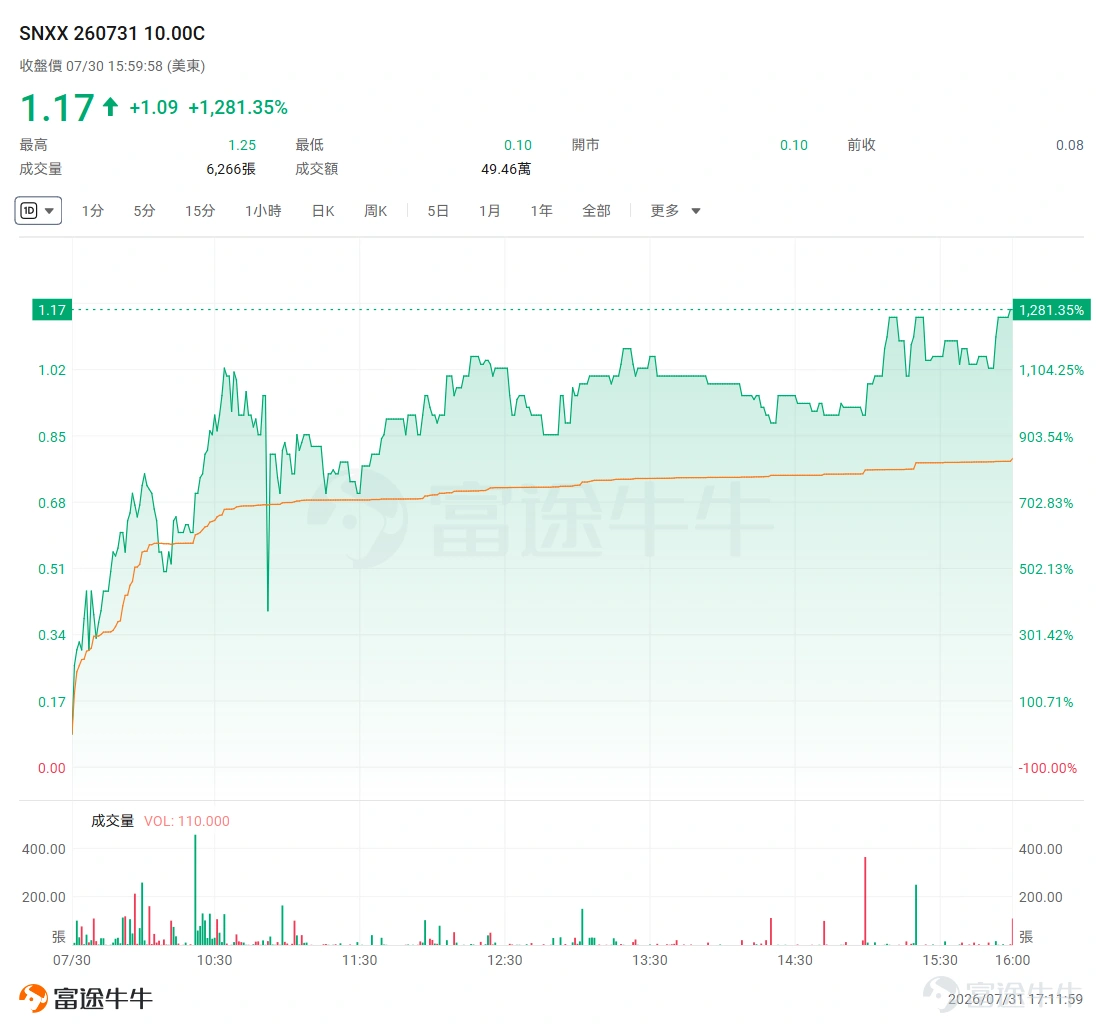
(The design image shown on screen is for illustrative purposes only and does not constitute any investment advice or guarantee. Market conditions change frequently; the displayed option prices do not reflect real-time data. Options shown are filtered based on an initial price below $3 per contract.)
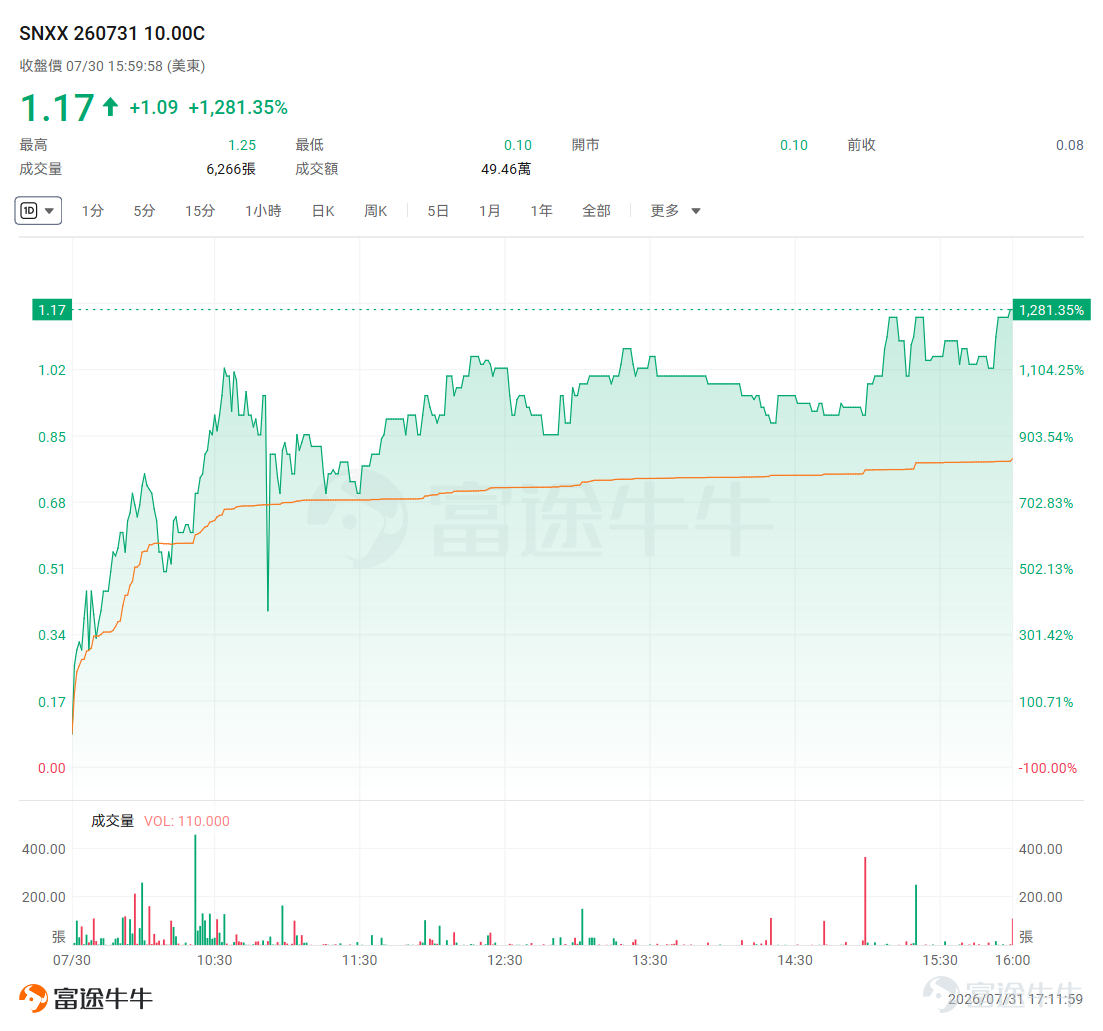
Take a look at this contract:SNXX 260731 10.00C—a call option expiring on July 31 with a $10 strike price.
The numbers are staggering:
Opening price: $0.10
High: $1.25
Closing price: $1.17
Single-day gain: +1,281.35%!
In actual dollar terms: If you bought one contract at Thursday's market open for $10 (one options contract corresponds to 100 shares, so $0.10 × 100 = $10), that contract was worth $117 by market close.$10 turned into $117 in just one day—more than a 10x return.
And if you were luckier and sold near the intraday high of $1.25, you’d have gotten $125—12.5x。
That’s the allure of weekly (or 'doomsday') options: a single contract costs just $10—the price of a fast-food meal. Get the direction and timing right, and your returns can be dozens of times higher than those of the underlying stock.
But there are three key questions fellow investors need to consider carefully:
Question 1: Why can such a cheap contract surge so dramatically?
The answer lies in the word 'doomsday' (i.e., expiration).
This contract expires on July 31, and the screenshot shows prices from July 30. In other words,this is an options contract with only one day left until expiration.。
The time value of an expiring option is nearly zero, leaving only pure directional speculation. With a strike price of $10, if the underlying stock is below $10 at expiration, the option becomes worthless; if the stock rises to $11, the option is worth at least $1 (or $100 per contract).
Expiring options are like lottery tickets: either you win big or you tear them up. Precisely because the chance of it becoming worthless is so high, the starting price can be as low as $0.10.
But once the direction is right, this 'extreme cheapness' can translate into explosive percentage gains—because the base is so low, a 1% move in the underlying stock might drive a 10% or even greater increase in the option's price.
Question 2: Why SNXX instead of SNDK?
This relates to the unique characteristics of leveraged ETFs.
SNXX is a 2x leveraged ETF, meaning its daily moves are approximately twice those of its underlying index. When the semiconductor sector rebounds more than 10% in a single day, SNXX could surge by over 20%.
In the world of options, leverage layered on top of leverage results in exponential amplification.
And more importantly,After its 1-for-8 reverse stock split, SNXX now trades at just a few to a dozen dollars per share, far below SanDisk’s (SNDK) price of $1,279.This means its options contracts are naturally very cheap—one end-of-day call option might cost just a few dollars or even mere cents.
For investors with a $100 budget, SNXX is like a 'buffet ticket to the semiconductor feast': low entry barrier, gets you a seat at the table, but comes with high risk.
Question three: Can this opportunity be replicated?
Yes, but at the cost of being mentally prepared to 'buy ten and have nine expire worthless.'
A loud and clear warning must be issued here to fellow investors:Options on leveraged ETFs carry double leverage risk.。
First, the leveraged ETF itself amplifies volatility. A 2x ETF means that if the underlying index drops 10%, the ETF could drop 20%. Moreover, due to daily rebalancing, holding a leveraged ETF over the long term incurs 'decay'—even if the underlying index eventually returns to its starting point, the ETF’s net asset value may have already eroded.
Second, options add another layer of leverage. The time decay of end-of-day options is measured by the hour or even by the minute. If your directional bet is wrong or the price move isn’t large enough, the option expiring worthless is the norm.
Here’s an analogy: buying an end-of-day call on SNXX is like playing 'high-low' at a casino—each bet is small, but you need to be ready to win only once out of ten tries. That one winning trade might return 12x, but the previous nine likely went to zero.
This week's sharp rally in this contract was driven by an unexpectedly strong rebound in AI hardware stocks following a prolonged sell-off, shifting market sentiment instantly from extreme pessimism to extreme optimism.This 'V-shaped reversal' is the ideal scenario for deep out-of-the-money calls—but it doesn't happen every day.
$Meta Platforms (META.US)$ : Stock plunged 8% after earnings—why did puts that correctly bet on a decline still lose money?
Now, let’s tell a completely opposite story.
After the market close on Wednesday (July 30), Meta released its Q2 2026 earnings report:
Revenue of $60.8 billion, up 28% year-over-year, hitting a record high
Advertising revenue of $59.4 billion, up 27% year-over-year, with both volume and pricing rising
Sounds great, right? Yet Meta’s stock plummeted on Thursday, closing at $539.03,down nearly 8% in a single day。
Why? The issue lies in two areas:
First, the capital expenditure guidance has been raised again. Meta revised its full-year capital expenditure range upward from "$125 billion to $145 billion" to "$135 billion to $145 billion"—raising the lower end by $10 billion. On the earnings call, Zuckerberg stated bluntly: 'Selling compute capacity for short-term profit is foolish; spending aggressively on compute isn't gambling—it's a necessity.'
In plain English:Profits will keep being poured into AI—don’t expect increased dividends or share buybacks anytime soon.
Second, free cash flow disappointed Wall Street. Revenue hit a record high, but all the cash went straight into buying GPUs. One analyst bluntly described the earnings report as showing 'persistent free cash flow leakage.'
The result? The market voted with its feet. On the same day, $Microsoft (MSFT.US)$ Microsoft reported earnings—its cloud business beat expectations, sending its stock up over 8% after hours; Meta’s revenue also beat expectations, yet its stock dropped 7% after hours.Investors’ logic is clear: profitability isn’t the issue—it’s the breakneck pace of spending, with no end in sight.
Right thesis, wrong trade: the counterintuitive journey of a single put option
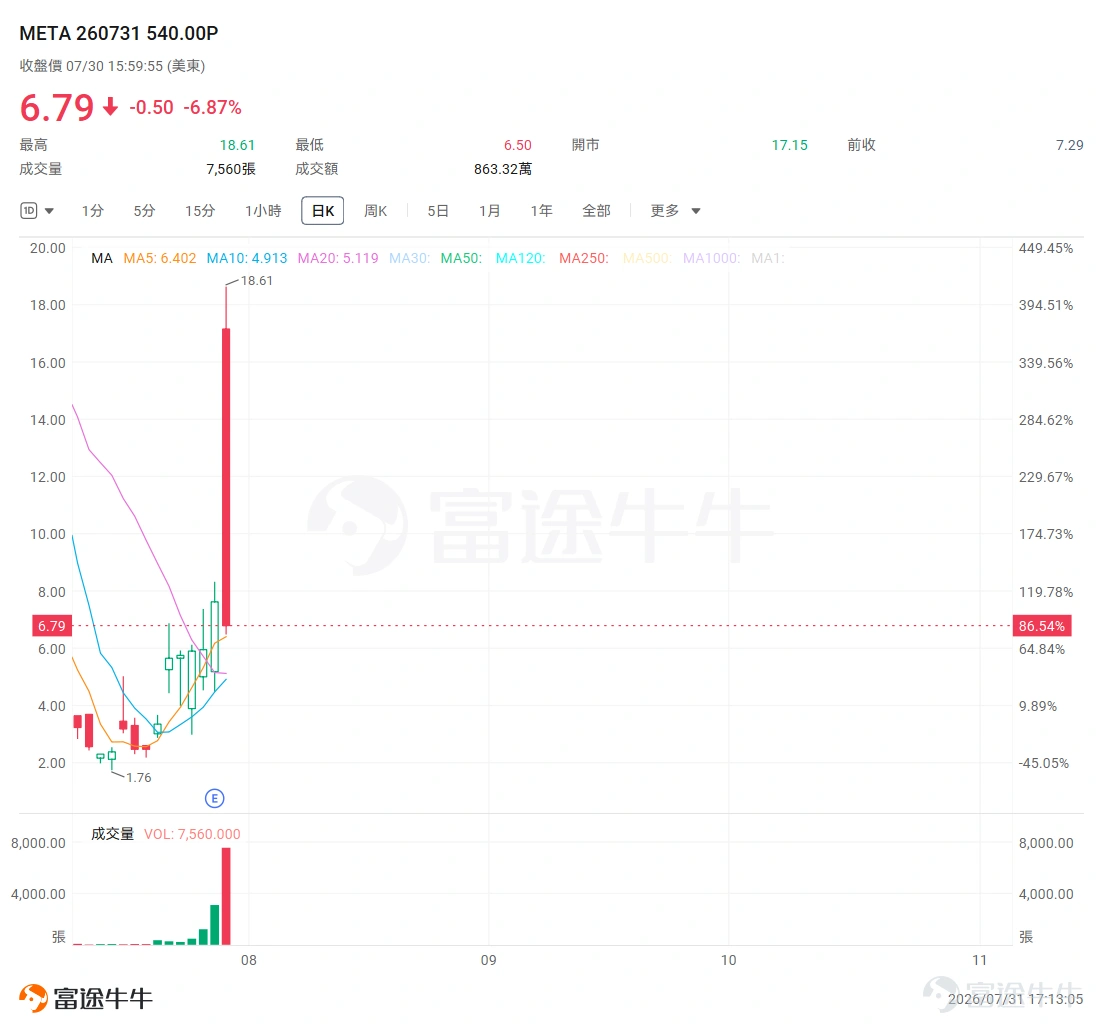
(The design image shown on screen is for illustrative purposes only and does not constitute any investment advice or guarantee. Market conditions change frequently; the displayed option prices do not reflect real-time data. Options shown are filtered based on an initial price below $3 per contract.)
Now let's look at this option:META 260731 540.00P—a put option expiring on July 31 with a strike price of $540.
The screenshot shows a confusing picture:
First, evidence that the directional bet was correct:
Meta’s underlying stock plunged from around $585 in pre-market trading to close at $539,a drop of nearly 8%
This put has a strike price of $540, and the underlying closed at $539—making it an in-the-money option(since the underlying price is below the strike price)
Intraday high reached $18.61,nearly 10x higher than the low before earnings
but looking at the closing price:
Closing price: $6.79, down 6.87% from the previous close
This is puzzling:I clearly bet Meta would drop, and it actually fell 8%, but why is my put option cheaper now than at yesterday’s close?
The answer lies in three letters:IV Crush。
IV stands for 'Implied Volatility,' which you can think of as 'the market’s expectation of future price volatility.'
Before earnings were released, no one knew whether the results would be good or bad—the market was in a state of high uncertainty.That uncertainty itself carries value.—Because the stock could surge or plunge, the option’s 'potential profit range' widens.
This is reflected in price: options ahead of earnings are much more expensive than usual. For the same strike price and expiration date, an option might trade at $3 a week before earnings but jump to $10 the day before.
But once earnings are released, the uncertainty disappears.
Regardless of whether the stock rises or falls, the 'suspense' is gone. The market no longer pays for 'what might happen'—it only prices in 'what has already happened.'
This is IV Crush—the automatic drop in option prices after uncertainty is resolved.
Here’s an analogy: Imagine you buy a lottery ticket at a casino that pays out based on 'guessing tomorrow’s weather.' Before the draw, the ticket is valuable because it represents many possible outcomes; after the draw, regardless of whether it’s sunny or rainy, the ticket’s value drops to just its payout amount—all the premium paid for 'speculation' vanishes instantly.
That’s exactly what happened with this Meta put.The directional bet was correct, but the collapse of the 'uncertainty premium' outpaced the gains from being right on direction.
So how can you actually profit from earnings-related puts?
Here are a few practical lessons:
First, options around earnings season are best traded with a 'quick in, quick out' approach.
If you're truly bearish on Meta, the optimal strategy isn't holding until market close—it'staking profit decisively during the initial post-earnings drop.This put reached an intraday high of $18.61; selling near that level would yield a 3x–5x return, even if your entry price was $3–$5.
But if you 'wait to see if it drops further,' IV crush will erase most of your unrealized gains.
Second, the closer you get to expiration, the more severe the IV crush becomes.
This contract expires on July 31, and Meta reports earnings after market close on July 30. By July 31, the option retains only its intrinsic value (the amount by which the stock price is below the strike price); all time value and volatility premium go to zero.
With a $540 put and the underlying stock at $539, the intrinsic value is $1 per share—or $100 per contract. Why did it settle at $6.79 ($679 per contract)? Because it hadn’t expired yet and still retained a small amount of time value—but compared to its intraday peak of $18, most of its value had already evaporated.
Third, if you genuinely want to bet on the earnings direction, consider options with a longer-dated expiration.
The farther the expiration date, the greater the time value, and the impact of IV crush is spread out over more days. Of course, longer-dated contracts are also more expensive and require higher capital—a trade-off you’ll need to consider.
This week's lesson: Even when you're 'right' on direction, outcomes can be worlds apart.
The two cases in this issue form a perfect contrast:
The success of the SNXX call resulted from a triple convergence of 'low base + correct direction + right timing.'Weekly options are inherently cheap, and AI hardware staged a violent rebound—amplifying gains across all leverage simultaneously.
The META put困境 is a classic example of 'IV crush eroding directional gains.'The direction was right, but the entry price already paid too much premium for 'uncertainty.' Once earnings were released, that premium evaporated, and directional gains weren't enough to cover the loss.
This is the two-faced nature of options:They can turn $10 into $117—or make a trader who got the direction right still lose money. The difference isn't about how smart you are—it's about whether you truly understand what you're buying, what’s priced in, and what disappears under which conditions.
Entering with $100 and walking away with $1,000—options do offer the possibility of leveraging small capital into big opportunities. But in this episode, we also saw the other side of the coin: the dual risks of leveraged ETF options, the high probability of near-term options expiring worthless, and the IV crush trap around earnings season.
High reward potential never comes for free. Getting the direction right, timing it correctly, and understanding the price structure are all essential—missing any one of them can be costly.
Understand first, then act. Get your timing right, and opportunities will never be in short supply. See you in our next recap~
Not familiar with options basics? Study up before jumping in.
If, while reading this recap, you’re still fuzzy on concepts like 'What is a long call?' or 'How do I read strike prices?', don’t rush into placing orders—take some time first to solidify your fundamentals. We’ve compiled practical beginner resources below; consider bookmarking them:
Finally, we’ve got a little perk for our fellow investors—feel free to claim it!Options Starter Pack
This event is exclusively open to invited HK users. Click to learn more.Detailed terms and conditions of the promotion >>

Disclaimer
This content does not constitute an offer, solicitation, recommendation, opinion, or any guarantee regarding any securities, financial products, or instruments. The risk of loss in trading options can be substantial. In certain circumstances, your losses may exceed the initial margin deposit. Even if you place contingent orders, such as 'stop-loss' or 'limit' orders, there is no assurance that losses will be avoided. Market conditions may prevent these orders from being executed. You may be required to deposit additional margin on short notice. If you fail to meet the required margin within the specified time, your open positions may be liquidated. Nevertheless, you remain liable for any deficit balance in your account resulting from such events. Therefore, you should thoroughly research and understand options before trading, and carefully consider whether such trading is suitable for you based on your financial condition and investment objectives. If you trade options, you should familiarize yourself with the procedures for exercising options and handling expiration, as well as your rights and obligations upon exercise or expiration.
Risk Disclaimer: The above content only represents the author's view. It does not represent any position or investment advice of Futu. Futu makes no representation or warranty.Read more


Comments (216)
to post a comment
223
34