
What's trending in US stocks? Another busy week of earnings reports—what’s the outlook for the AI se

In the same AI spending test, why has the market given Microsoft and Amazon a vote of confidence while punishing Meta?
In the same high-stakes AI spending test, why did the market reward Microsoft and Amazon with trust but punish Meta?
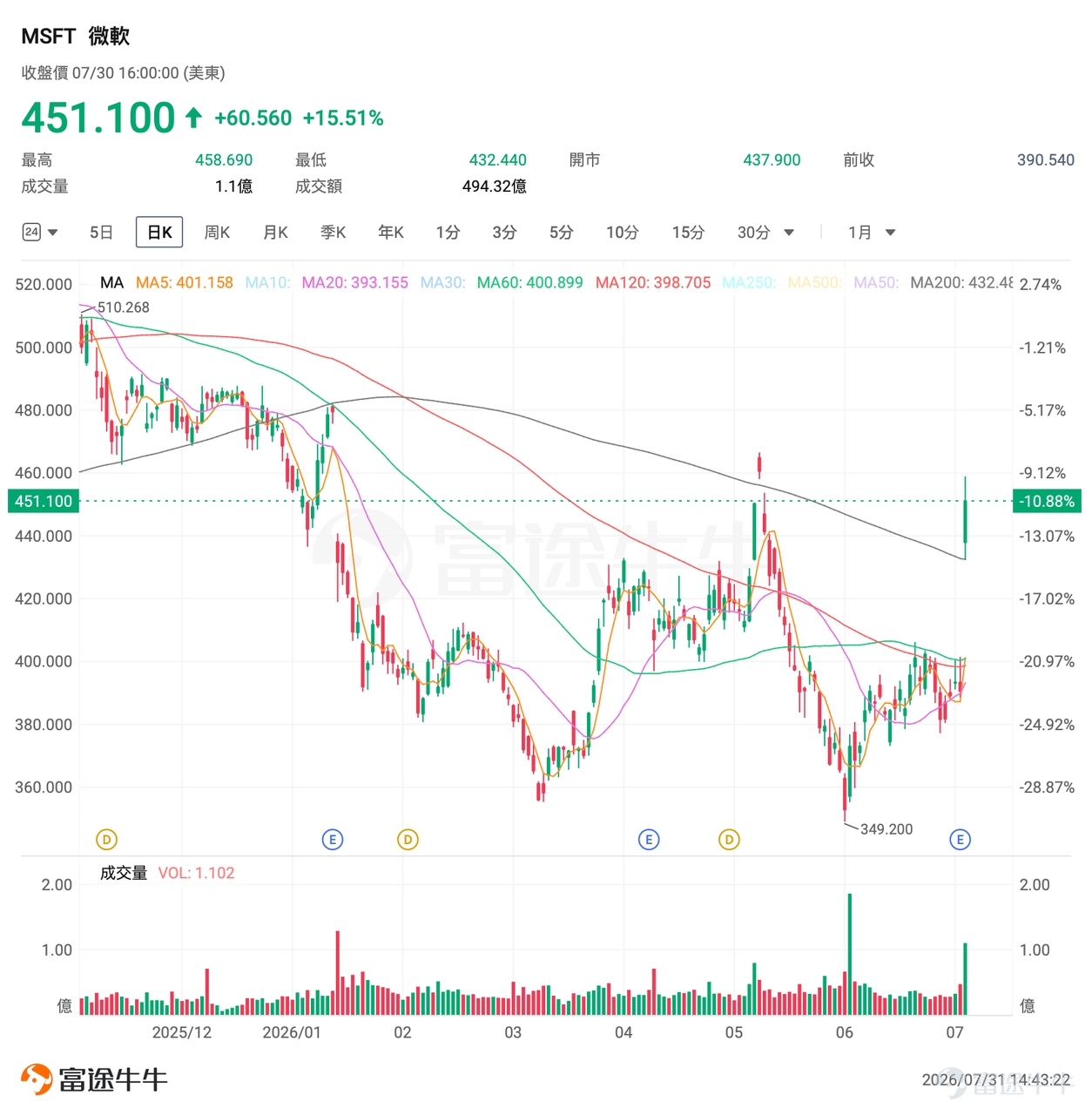
On July 29 and 30, earnings reports from tech giants were released in quick succession. $Microsoft (MSFT.US)$ After releasing its earnings report, the stock soared more than 15% in a single day;紧接着 on July 30, $Amazon (AMZN.US)$ After the earnings report was released, the after-hours stock price jumped nearly 10%. On the same day, $Meta Platforms (META.US)$ The stock continued to decline after the earnings release, closing down nearly 8%.
Same AI narrative, same cash-burning logic—why has the market cast such drastically different votes?
In essence, the market isn’t blindly buying into the AI story; it’s repricing based on the visibility of AI returns.
In the same capital expenditure stress test, $Microsoft (MSFT.US)$ 、 $Amazon (AMZN.US)$ two cloud providers answered the same question via two different paths: after spending the money, can investors actually see the returns in the financial statements?
I. Where Microsoft Won: The Transmission Chain from Capex to Azure Was Clearly Drawn
$Microsoft (MSFT.US)$ After the earnings release, the stock jumped over 15% in a single day, reclaiming levels above the 200-day moving average.

Where did Microsoft win this time? It showed the market a clear transmission chain converting AI investments into revenue.
Microsoft’s earnings report showed that Azure and other cloud services revenue grew 43% year-over-year, significantly outperforming the market’s prior expectation of around 40%; management guided for approximately 45% Azure growth next quarter.For investors, this means AI-related demand isn’t just perceived as strong—it’s already reflected in verifiable growth rates and forward-looking guidance.
Remaining Performance Obligations (RPO) climbed to $678 billion, up approximately 84% year-over-year.More importantly, management specifically emphasized that new contracts are primarily coming from enterprise customers outside of AI model developers. In other words, the market’s prior concern about overreliance on OpenAI is at least beginning to ease in terms of order composition.Azure’s AI monetization is expanding beyond a handful of mega-customers to a broader base of enterprises.
Visibility is also evident on the product side.Paid seats for Microsoft 365 Copilot have surpassed 30 million—a significant jump from over 20 million in April—and GitHub Copilot now has 50 million users. Growth in cloud infrastructure is aligning with rising paid adoption on the productivity and developer fronts, creating a short closed loop from underlying compute capacity to upper-layer software subscriptions. Investors no longer need to speculate about narratives three years out—they can track progress directly through seat counts, cloud growth rates, and the order book.
What had the market most worried previously? That tech giants’ relentless capital spending was eroding cash flow.
Microsoft has now sent a subtle signal—revising its fiscal year 2027 capital expenditure guidance downward from the previously stated $190 billion to approximately $175 billion.
But a closer look reveals this isn’t a true pullback. Microsoft’s CFO provided a clear explanation:This is primarily due to changes in accounting treatment.—The estimated useful life of data centers and office buildings has been extended from 15 to 25 years, and more future data center leases will shift from finance leases to operating leases; finance leases count toward Capex, while operating leases do not.She explicitly stated that excluding this impact, actual investment expectations remain 'unchanged,' and Capex for fiscal year 2027 will still grow year-over-year.
Why isn’t the market worried? Because Microsoft has demonstrated with data that every dollar it spends delivers visible returns in Azure’s growth rate and RPO orders.
II. Amazon’s Moat: Burning Cash Has Been Rewritten as a Competitive Moat
$Amazon (AMZN.US)$ After the earnings release, shares rose nearly 10% in after-hours trading.

If Microsoft’s edge lies in software velocity, Amazon is charting a different course: instead of racing to monetize software quickly, it’s betting on infrastructure certainty.
AWS reported Q2 revenue of $42.2 billion, up approximately 37% year-over-year, exceeding market expectations of around $40.6 billion and marking its fastest growth rate in 18 quarters.AWS’s AI business has already surpassed $25 billion in annualized revenue and continues to grow at triple-digit rates. Meanwhile, its custom chip business has also crossed the $25 billion annualized revenue threshold;Custom chips like Trainium have secured over $225 billion in long-term compute commitments from clients including Anthropic and OpenAI.The implication of these figures is clear: customers are willing to lock in multi-year, multi-gigawatt-scale orders to secure AWS’s compute and chip capacity well in advance.
Notably, AWS’s operating profit margin improved from 32.9% a year ago to 39.4%.During the peak of AI infrastructure investment, operating margins have risen rather than declined, indicating that high-value AI cloud demand is improving the business mix—not merely diluting returns.
Turning to the capital expenditure guidance most closely watched by the market, Amazon has raised its 2026 capex guidance from $200 billion to $220 billion, resulting in a negative free cash flow of $7.6 billion.
Under a traditional cash flow framework, this would be sufficient grounds to sell—but the market has chosen to buy instead.On what basis?This is because Amazon CEO Andy Jassy provided certainty around the timeline, stating during the earnings call that the imbalance between AI compute supply and demand will persist through 2028.,"Even at this level of spending, we still won’t be able to meet all of our compute demand in 2026."He also boldly asserted that AWS ultimately has the potential to become a $1 trillion annual revenue business.
Massive backlog orders, a moat built on in-house chips, and long-term demand visibility—these three factors combined make Amazon’s heavy spending appear less like burning cash and more like constructing an insurmountable competitive moat.
III. The market is now pricing in 'AI visibility.'
When placing all three companies on the same coordinate system, the divergence becomes clear.
$Microsoft (MSFT.US)$ Microsoft’s advantage lies in its short monetization chain formed by Copilot + Azure: seat counts are quantifiable, cloud growth is measurable, and order structures are transparent.
$Amazon (AMZN.US)$ Amazon’s advantage lies in its Trainium in-house chips and ultra-long-term commitments from large customers: its spending is effectively locked into capacity and customer retention, thereby building a moat.
Meanwhile, $Meta Platforms (META.US)$ On the same day, it came under pressure—not merely because it’s also spending heavily, but because its path to returns is harder for outsiders to quantify.Meta is not lacking in AI investment. The company raised its full-year capital expenditure guidance to $130–145 billion, with a single-quarter capital expenditure as high as $31.08 billion. The issue lies in Meta’s inherent weakness in its AI return pathway:It lacks a cloud business that sells computing power externally, so all AI investments can only be recouped through improved internal advertising ROI.
This return pathway is far less quantifiable than those of Microsoft and Amazon.In Q2, Meta’s free cash flow plummeted 91% year-over-year to $784 million. Thus, while the same AI capex narrative is validated as a growth engine for cloud vendors, at Meta it is more readily interpreted as high spending, low visibility, and uncertain payback period.
Capital no longer rewards companies merely telling AI stories; it now rewards those capable of converting AI spending into auditable revenue and margins.
IV. Options Perspective: After the vote of confidence lands, how should volatility be managed?
Following earnings release, stock price volatility often remains elevated. Taking $Microsoft (MSFT.US)$ as an example, its implied volatility (IV), although notably lower than before earnings, still sits at a high 81st percentile—favoring seller strategies.

However, $Meta Platforms (META.US)$ ’s options IV, after the stock price decline, stands at the 67th percentile historically and is below historical volatility (HV), making long options strategies worth considering within controlled position sizes.

1. Cash-Secured Put
If an investor is $Microsoft (MSFT.US)$ 、 $Amazon (AMZN.US)$ a medium- to long-term bull on the stock but concerned that chasing the current price entails excessive risk, they may consider selling cash-secured puts (Cash-Secured Put) after the event concludes and implied volatility declines: using idle cash as collateral to sell out-of-the-money put options, thereby reducing the potential cost basis at an acceptable strike price through the premium received. If the stock price drops to near the strike price and the option is assigned, it effectively means acquiring the shares as planned. This approach assumes the investor genuinely wants to hold the underlying stock at that strike price; however, losses could occur if the stock price falls further below the strike.

(The illustrative graphics shown on screen use Microsoft options as an example for demonstration purposes only and do not constitute any investment advice or guarantee; market conditions change rapidly, and displayed prices do not reflect real-time data.)
2. Covered Call
If an investor already holds $Microsoft (MSFT.US)$ 、 $Amazon (AMZN.US)$ the underlying stock and is worried about giving back short-term gains, they may consider a covered call (Covered Call): selling out-of-the-money call options near resistance levels above the current price to enhance portfolio returns via the premium received. If the stock price rises further toward the strike price, the sale of shares upon assignment effectively locks in profits at the resistance level. This strategy suits investors who remain bullish but are comfortable taking partial profits, and is not appropriate for those strongly bullish who do not want to miss out on further upside.

(The illustrative graphics shown on screen use Microsoft options as an example for demonstration purposes only and do not constitute any investment advice or guarantee; market conditions change rapidly, and displayed prices do not reflect real-time data.)
3. Long Call
For stocks like $Meta Platforms (META.US)$ those that have just undergone valuation compression following earnings, it’s better to first observe whether the stock price and volatility have stabilized before considering aggressive positions. If the goal is simply to participate in a potential rebound with limited capital at risk, buying calls (Long Call)—which offer defined downside risk—should be prioritized, with position sizing kept within a range where losing the entire premium would still allow for a good night’s sleep. Avoid taking large directional bets on a rebound while market sentiment remains unsettled.

(The design images displayed on screen use Meta options as an example for illustrative purposes only and do not constitute any investment advice or guarantee; market prices fluctuate frequently, and the prices shown in the image do not reflect actual market conditions.)
Summary
Microsoft and Amazon saw significant post-earnings stock price rallies—not because the market suddenly fell in love with AI companies that keep burning cash, but because it validated a more fundamental pricing principle:AI-related capital expenditures themselves are not inherently problematic—it’s the lack of a visible path to returns that poses the real risk.
Microsoft demonstrated speed by rapidly monetizing through its software layer, while Amazon demonstrated certainty through long-term infrastructure-layer contracts. Meta, meanwhile, reminded everyone that when investments cannot be clearly measured as external revenue, trust becomes expensive and fragile.
For investors, the key focus in the next phase may no longer be which company reports higher Capex figures, but rather which can consistently deliver verifiable AI-related revenue, profit margins, and order quality.
 Fellow investors, among Microsoft, Amazon, and Meta, which tech company do you favor more?
Finally, we have a small treat for our fellow investors—please feel free to claim it.Options Beginner Pack
*This event is exclusively for invited HK users. Click to learn moreDetailed event terms >>

Disclaimer
This content does not constitute an offer, solicitation, recommendation, advice, opinion, or any form of guarantee regarding any securities, financial products, or instruments. The risk of loss in trading options can be substantial. In certain circumstances, your losses may exceed the initial margin deposit. Even if you set contingent instructions such as stop-loss or limit orders, these may not necessarily prevent losses. Market conditions may render such instructions unexecutable. You may be required to deposit additional margin on short notice. If you fail to meet the required margin within the specified time, your open positions may be liquidated. Nevertheless, you remain fully liable for any resulting deficit in your account. Therefore, you should thoroughly research and understand options before trading and carefully consider whether such transactions are suitable for you based on your financial situation and investment objectives. If you trade options, you should be familiar with the procedures for exercising options and handling expiration, as well as your rights and obligations upon exercise or expiration.
Risk Disclaimer: The above content only represents the author's view. It does not represent any position or investment advice of Futu. Futu makes no representation or warranty.Read more


Comments (17)
to post a comment
83
369