English
Back
Open Account
End of the ghost story? Zuckerberg denies Meta has excess computing capacity
南方东英资产管理
joined discussion ·

KOSPI 200 Covered Call ETF: A New Korean Equity Income Option Targeting Monthly Distributions [New CSOP ETF Launch]

Summary - A covered call ETF is an 'income-generating ETF' that primarily holds a long position in the underlying assets while simultaneously selling call options on those assets to collect option premiums, positioning itself as an investment vehicle designed to provide stable cash flow. - Covered call ETFs offer three core advantages:Monthly distributions for cash flow generation and volatility resistance,and simple, convenient ETF investing. - The covered call strategy is best suited forrange-bound, sideways markets.。 In today’s volatile and uncertain market environment, are you struggling with market timing and missing out on upside opportunities? Do you wish for some extra pocket money to cover daily expenses and flexible spending? Are you looking to supplement your retirement income to maintain your lifestyle? As a ‘cash flow generator,’ covered call ETFs are gaining popularity—they offer exposure to quality equities while delivering monthly ‘rental’ income through distributions. 1。  $CSOP HSCEI Covered Call Active ETF (02802.HK)$Aims to pay monthly dividends since its listing, targeting an annualized dividend yield of approximately 25% 2,Provides an effective allocation tool for investors seeking stable income. $CSOP KOSPI 200 Covered Call Active ETF (03537.HK)$ Listed on the Hong Kong Stock Exchange on July 31, 2026, further enriching the lineup of covered call ETFs and income-focused products in the Hong Kong market. What is a covered call strategy ETF? Covered Call Strategy (C...
Summary
- A covered call ETF is an 'income-generating ETF' that primarily holds a long position in the underlying assets while simultaneously selling call options on those assets to collect option premiums, positioning itself as an investment vehicle designed to provide stable cash flow.
- Covered call ETFs offer three core advantages:Monthly distributions for cash flow generation and volatility resistance,and simple, convenient ETF investing.
- The covered call strategy is best suited forrange-bound, sideways markets.
In today’s volatile and uncertain market environment, are you struggling with market timing and missing out on upside opportunities? Do you wish for some extra pocket money to cover daily expenses and flexible spending? Are you looking to supplement your retirement income to maintain your lifestyle?
As a ‘cash flow generator,’ covered call ETFs are gaining popularity—they offer exposure to quality equities while delivering monthly ‘rental’ income through distributions. 1
$CSOP HSCEI Covered Call Active ETF (02802.HK)$Aims to pay monthly dividends since its listing, targeting an annualized dividend yield of approximately 25% 2Provides an effective allocation tool for investors seeking stable income.
$CSOP KOSPI 200 Covered Call Active ETF (03537.HK)$ Listed on the Hong Kong Stock Exchange on July 31, 2026, further enriching the lineup of covered call ETFs and income-focused products in the Hong Kong market.
What is a covered call strategy ETF?
Covered Call StrategyA covered call strategy is an options trading approach where an investor holds a long position in an underlying asset while simultaneously selling call options on that same asset.
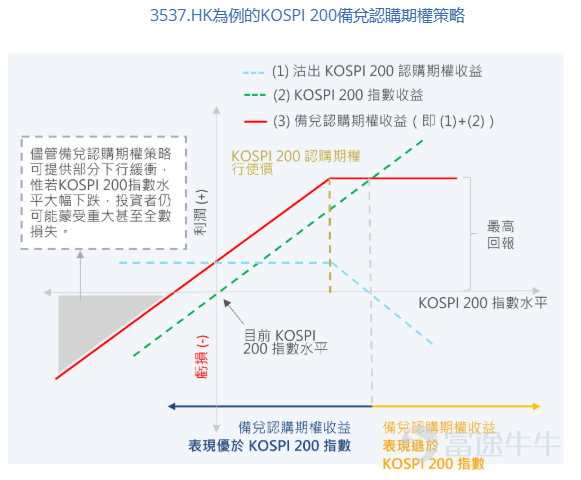
atTake CSOP Hang Seng TECH Covered Call Active ETF (3537.HK) as an example, 3537.HK employs a KOSPI 200 covered call strategy, primarily holding a long position in the KOSPI 200 Index while simultaneously selling KOSPI 200 call options to collect option premiums.
Compared to holding a single asset class such as equities, a covered call strategy maygenerate stable income to enhance returns, maintain capital appreciation potential, and provide a buffer against potential downside moves,while the ETF structure offers investorsa simple and efficient investment vehicle, making it suitable for income-oriented investors.
Summary - A covered call ETF is an 'income-generating ETF' that primarily holds a long position in the underlying assets while simultaneously selling call options on those assets to collect option premiums, positioning itself as an investment vehicle designed to provide stable cash flow. - Covered call ETFs offer three core advantages:Monthly distributions for cash flow generation and volatility resistance,and simple, convenient ETF investing. - The covered call strategy is best suited forrange-bound, sideways markets.。 In today’s volatile and uncertain market environment, are you struggling with market timing and missing out on upside opportunities? Do you wish for some extra pocket money to cover daily expenses and flexible spending? Are you looking to supplement your retirement income to maintain your lifestyle? As a ‘cash flow generator,’ covered call ETFs are gaining popularity—they offer exposure to quality equities while delivering monthly ‘rental’ income through distributions. 1。  $CSOP HSCEI Covered Call Active ETF (02802.HK)$Aims to pay monthly dividends since its listing, targeting an annualized dividend yield of approximately 25% 2,Provides an effective allocation tool for investors seeking stable income. $CSOP KOSPI 200 Covered Call Active ETF (03537.HK)$ Listed on the Hong Kong Stock Exchange on July 31, 2026, further enriching the lineup of covered call ETFs and income-focused products in the Hong Kong market. What is a covered call strategy ETF? Covered Call Strategy (C...
The triple advantages of the covered call strategy
Amid global market volatility, covered call ETFs stand outwith their “targeted monthly distributions + downside protection + ease of investment” triple advantages, distinguishing themselves among income-generating assets.
Advantage 1: Designed for monthly distributions—a rare income-generating option
A covered call ETF is an income-oriented ETF designed to distribute dividends monthly (dividend yield is not guaranteed and may include returns of capital). It generates consistent option premium income through a flexible covered call strategy and returns a portion of this income to investors in the form of monthly dividends.
Taking 3537.HK as an example, this ETF can simultaneously capture KOSPI 200 option premium income and partial capital gains from the KOSPI 200.
Summary - A covered call ETF is an 'income-generating ETF' that primarily holds a long position in the underlying assets while simultaneously selling call options on those assets to collect option premiums, positioning itself as an investment vehicle designed to provide stable cash flow. - Covered call ETFs offer three core advantages:Monthly distributions for cash flow generation and volatility resistance,and simple, convenient ETF investing. - The covered call strategy is best suited forrange-bound, sideways markets.。 In today’s volatile and uncertain market environment, are you struggling with market timing and missing out on upside opportunities? Do you wish for some extra pocket money to cover daily expenses and flexible spending? Are you looking to supplement your retirement income to maintain your lifestyle? As a ‘cash flow generator,’ covered call ETFs are gaining popularity—they offer exposure to quality equities while delivering monthly ‘rental’ income through distributions. 1。  $CSOP HSCEI Covered Call Active ETF (02802.HK)$Aims to pay monthly dividends since its listing, targeting an annualized dividend yield of approximately 25% 2,Provides an effective allocation tool for investors seeking stable income. $CSOP KOSPI 200 Covered Call Active ETF (03537.HK)$ Listed on the Hong Kong Stock Exchange on July 31, 2026, further enriching the lineup of covered call ETFs and income-focused products in the Hong Kong market. What is a covered call strategy ETF? Covered Call Strategy (C...
In the current interest rate environment, traditional fixed-income assets are offering lower yields, whereasthe covered call strategy, with its stable monthly distribution mechanism, offers investors a more attractive cash flow alternative. The target annualized distribution yield of 3537.HKexceeds the dividend yields of traditional income-generating assets such as time deposits, government bonds, and REITs, which typically range between 4% and 10%.
Advantage 2: A choice for volatility—a downside buffer in turbulent markets
During market turbulence, the option premiums generated from writing (selling) call options provide additional cushioning during market downturns.
Moreover, option premiums are highly correlated with market volatility, meaning thatthe higher the market volatility, the greater the option premiums collected from writing call options.Compared to simply holding an index, a covered call strategy often demonstrates superior downside protection and return resilience in volatile markets, helping investors reduce losses and volatility.
Recently, as volatility in the Korean equity market has intensified, the KOSPI 200 VIX surged to 72.91, driving the monthly call option premium yield on the KOSPI 200 to 6.12%, significantly enhancing portfolio returns and serving as a crucial cushion in choppy markets.
Summary - A covered call ETF is an 'income-generating ETF' that primarily holds a long position in the underlying assets while simultaneously selling call options on those assets to collect option premiums, positioning itself as an investment vehicle designed to provide stable cash flow. - Covered call ETFs offer three core advantages:Monthly distributions for cash flow generation and volatility resistance,and simple, convenient ETF investing. - The covered call strategy is best suited forrange-bound, sideways markets.。 In today’s volatile and uncertain market environment, are you struggling with market timing and missing out on upside opportunities? Do you wish for some extra pocket money to cover daily expenses and flexible spending? Are you looking to supplement your retirement income to maintain your lifestyle? As a ‘cash flow generator,’ covered call ETFs are gaining popularity—they offer exposure to quality equities while delivering monthly ‘rental’ income through distributions. 1。  $CSOP HSCEI Covered Call Active ETF (02802.HK)$Aims to pay monthly dividends since its listing, targeting an annualized dividend yield of approximately 25% 2,Provides an effective allocation tool for investors seeking stable income. $CSOP KOSPI 200 Covered Call Active ETF (03537.HK)$ Listed on the Hong Kong Stock Exchange on July 31, 2026, further enriching the lineup of covered call ETFs and income-focused products in the Hong Kong market. What is a covered call strategy ETF? Covered Call Strategy (C...
Advantage #3: Easy Investment – Simple Tools for Options Strategies
Higher dividends, lower volatilityWhile the covered call strategy certainly offers advantages in asset allocation, it is not easy for retail investors to construct and maintain this strategy on their own. In contrast,investing via a covered call ETF is significantly simpler and more efficient.
CSOP Asset Management is Hong Kong’s largest ETP issuer. CSOP’s 3537.HK enables investors to easily access a covered call strategy. Investors do not need complex expertise or a dedicated margin account—trading is as simple as using a regular stock account.
In contrast, if investors manage a covered call strategy themselves, they must open a dedicated margin account and consider numerous complex factors such as option roll frequency, strike price, and expiration date. Poor position management may even trigger margin calls.
Overall, 3537.HK aims to distribute monthly dividends, offering stable cash flow and downside protection in a low-rate and volatile environment. Professional management eliminates the need for complex investor operations, making it a convenient and efficient choice for income-focused strategies.
In what market conditions does the covered call strategy deliver its greatest advantage?
Through market scenario analysis, we find that the covered call strategy performs best in a sideways, range-bound market:
Range-bound market (optimal scenario)When the underlying asset’s price neither rises significantly nor falls sharply, this is the 'ideal stage' for the covered call strategy. Specifically, there are two cases: 1) When the underlying asset’s price is at or below the strike price, the covered call strategy continuously earns option premium income. 2) When the underlying asset’s price is slightly above the strike price, but the cash payment due to the option buyer at expiration is less than the premium received, the strategy still generates a positive return.
Bull market When the market enters an upward trend and the call option is exercised at expiration, the strategy incurs an obligation to make a cash payment to the option buyer. Therefore, the upside potential of the covered call strategy is capped at the sum of the strike price of the sold call option and the premium received. Investors can still earn income from the premium in this scenario.
Bear market The covered call strategy earns option premium income, acting as a 'shock absorber' during market declines and offsetting part of the potential loss. However, it should be noted that this 'shock absorption' effect has an upper limit; in the event of a sharp market downturn, it may not fully cover all losses.
1. Distribution yield is not guaranteed and may be paid out of capital.
2. The calculation method is based on rounding the average of the fund's monthly distribution per unit since inception in the first year, multiplied by 12, divided by the net asset value (NAV) per unit as of the last ex-dividend date of June 30, 2026. The distribution yield is not guaranteed. The fund manager determines distributions at its discretion each month. Distributions may be paid from capital or effectively paid from capital, which is equivalent to returning or withdrawing a portion of the investor’s original investment or capital gains attributable to that original investment, and may result in an immediate reduction in the fund’s NAV. A positive distribution yield does not imply a positive total return.
3. The fund manager intends to declare and distribute dividends monthly; however, there is no guarantee that dividends will actually be paid, nor is there a target distribution yield. The fund manager may, at its discretion, pay dividends from capital or from total income. Paying dividends from capital—or effectively paying them from the principal amount—is equivalent to returning or withdrawing a portion of the investor’s original investment or capital gains attributable to that original investment. Any dividend payment made from capital (or effectively from capital) with respect to a sub-fund may result in an immediate reduction in the sub-fund’s NAV per unit and reduce any capital appreciation for unitholders of the sub-fund.
4. Bloomberg, as of May 14, 2026.
5. Bloomberg, HKEX, CSOP, as of July 16, 2026. Based on the total assets under management across all categories of Hong Kong-domiciled ETPs (including leveraged and inverse products).
Disclaimer and Important Notes
The product(s) mentioned in this document have been authorized by the Securities and Futures Commission of Hong Kong ('SFC'). Such authorization does not imply official recommendation by the SFC.

This document is for general reference only and does not constitute investment advice or any form of recommendation, nor should it be construed as an offer or solicitation to invest in any investment product. For investment advice, please consult your professional legal, tax, and financial advisors.

Investing involves risks. Past performance is not indicative of future results. Investors should carefully read the offering documents and key facts statement of the fund for further information, including product features and all risk factors contained therein. Investors should not make investment decisions based solely on this document. This document is not intended for distribution or dissemination in any jurisdiction where such action is prohibited.

This document is not legally binding. CSOP Asset Management Limited assumes no responsibility for this document and expressly disclaims any liability for any losses arising from or in reliance on the whole or any part of its contents. This document does not grant the recipient any copyright or intellectual property rights—whether directly, indirectly, or by implication—in the information contained herein. No portion of this document may be copied, distributed, or reproduced without the prior written consent of CSOP Asset Management Limited.

The product(s) described in this document may be subject to concentration risk with respect to geography, market, sector, or investment instruments. Compared to funds with more diversified portfolios, the value of the product(s) described herein may experience greater volatility.

The product described in this document employs a covered call strategy, which involves writing call options on the underlying index. While the covered call strategy provides a degree of downside protection, it also caps the potential upside. The product will take long positions in KOSPI 200 swaps, KOSPI 200 futures, and KOSPI 200 ETFs, and as the seller of covered KOSPI 200 call options against these long positions, the product remains exposed to the risk of declines in the market value of the underlying index.

This document is prepared by CSOP Asset Management Limited and has not been reviewed by the Securities and Futures Commission.

Issuer: CSOP Asset Management Limited
$CSOP FTSE US Treasury 20+ Years Index ETF (03433.HK)$$iShares 20+ Year Treasury Bond ETF (TLT.US)$$CSOP Hang Seng TECH Index Daily (2x) Leveraged Product (07226.HK)$$CSOP HANG SENG INDEX DAILY (-2X) INVERSE PRODUCT (07500.HK)$$CSOP HANG SENG INDEX DAILY (2X)LEVERAGED PRODUCT (07200.HK)$$CSOP Hang Seng China Enterprises Index Daily (-2x) Inverse Product (07588.HK)$$CSOP Hang Seng TECH Index Daily (2x) Leveraged Product (07226.HK)$$CSOP Hang Seng TECH Index Daily (-2x) Inverse Product (07552.HK)$$JPMorgan Nasdaq Equity Premium Income ETF (JEPQ.US)$$Global X Nasdaq 100 Covered Call ETF (QYLD.US)$$JPMorgan Equity Premium Income ETF (JEPI.US)$$Global X S&P 500 Covered Call ETF (XYLD.US)$$SPDR S&P 500 ETF (SPY.US)$$COSCO SHIP HOLD (01919.HK)$$CSOP Samsung Electronics Daily (2x) Leveraged Product (07747.HK)$$CSOP Samsung Electronics Daily (-2x) Inverse Product (07347.HK)$$CSOP NVIDIA Daily (2x) Leveraged Product (07788.HK)$$CSOP NVIDIA Daily (-2x) Inverse Product (07388.HK)$$CSOP Tesla Daily (2x) Leveraged Product (07766.HK)$ $CSOP Tesla Daily (-2x) Inverse Product (07366.HK)$$CSOP Coinbase Daily (2x) Leveraged Product (07711.HK)$$Hang Seng Index (800000.HK)$$Hang Seng TECH Index (800700.HK)$$SSE Composite Index (000001.SH)$$CSI 300 Index (000300.SH)$$Dow Jones Industrial Average (.DJI.US)$$Nikkei 225 (.N225.JP)$$USD (USDindex.FX)$$Semiconductors (LIST2015.US)$$Semiconductor (LIST20742.JP)$$Semiconductors (LIST0002.SH)$$CATL (03750.HK)$$Taiwan Semiconductor (TSM.US)$$GraniteShares 2x Long TSM Daily ETF (TSMU.US)$$SK Telecom (SKM.US)$$KB Financial (KB.US)$$Korea (LIST20855.HK)$$iShares MSCI South Korea ETF (EWY.US)$$Korea Composite Index (.KOSPI.KR)$$South Korea (LIST20030.AU)$$SanDisk (SNDK.US)$$SK Hynix (000660.KR)$$Samsung Electronics (005930.KR)$$Samsung Electro-Mechanics (009150.KR)$$Direxion Daily MSCI South Korea Bull 3X ETF (KORU.US)$
Risk Disclaimer: The above content only represents the author's view. It does not represent any position or investment advice of Futu. Futu makes no representation or warranty.Read more
Heart
2
Thumbs Up
3
Lol
1
87K Views
Report
Comments
Write a Comment...
6
6