
Apple and Amazon reported starkly contrasting earnings— which one are you bullish on?

Hot Topics in 5 Minutes | Does the market drop right after you buy and surge right after you sell? Is someone really watching your account?
Recently, many investors may have felt this way: “Could it be that institutional money is monitoring my account and trading against me?” Especially since July, global financial markets have seen significantly heightened volatility, with the hot AI sector frequently experiencing roller-coaster price swings.One day sees a sharp plunge triggering a circuit breaker, and the next witnesses a violent rebound. Such extreme volatility has left many investors feeling lost.
In reality, no one is monitoring your account. The feeling of being ‘hit from both sides’ fundamentally stems from the interplay of market structure, capital dynamics, and human behavioral biases. Today, we’ll break down the underlying logic using recent real-market examples and discuss how retail investors can respond.
Why is market volatility so intense?
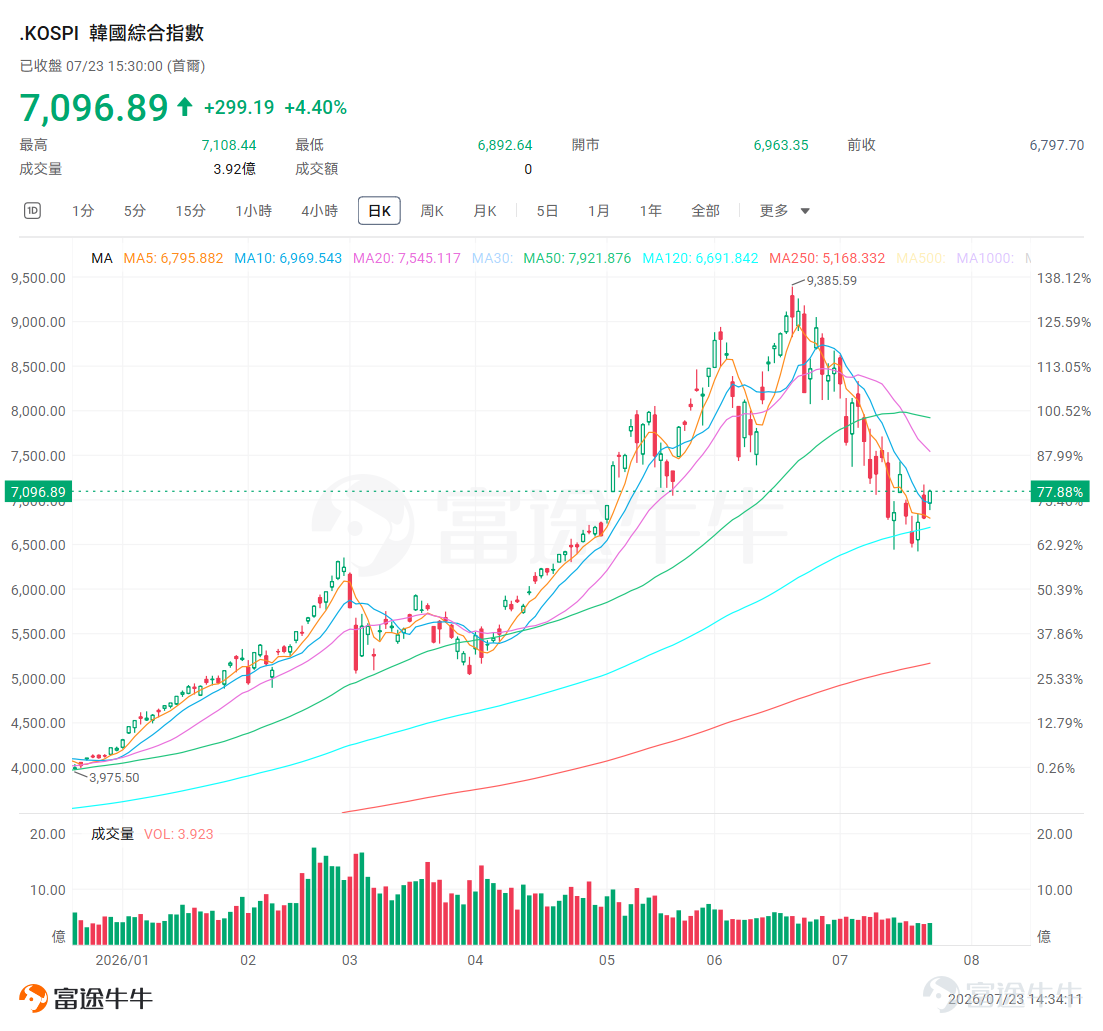
If you’ve been following global financial markets recently, you’ll notice that fluctuations in the AI and semiconductor sectors have been nothing short of surreal. Take South Korea’s stock market as an example: during the first half of the year, $Korea Composite Index (.KOSPI.KR)$ fueled by a boom in AI memory chips, it surged dramatically, at one point rising more than 100% in six months and pushing the index to a record high of 9,385 points. However, since mid-June, the trend reversed sharply, with the index frequently triggering circuit breakers and large intraday swings becoming the norm.

U.S. tech stocks haven’t been spared either. In the first half of 2026, U.S. memory chip, semiconductor equipment, and materials sectors posted astonishing cumulative gains, $PHLX Semiconductor Index (.SOX.US)$ rising more than 100% over six months. Yet between June and July, U.S. tech stocks repeatedly suffered sharp single-day selloffs. For instance, on June 23, the Philadelphia Semiconductor Index plunged 7.87%, with major names like NVIDIA, Micron, and Taiwan Semiconductor all posting significant losses.By July, although the three major U.S. indices ended the month higher overall, internal divergence was pronounced. Tech-sector volatility remained extremely high, prompting capital rotation from tech into blue-chip stocks. The Dow Jones showed relatively strong performance, while defensive sectors like healthcare and financials also began gaining traction.
Why, within the same bull market, do we keep seeing such sharp pullbacks and massive swings? The core reasons are as follows:
First, the rapid short-term price surge led to overheated sentiment and profit-taking.Take South Korean stocks as an example— $SK hynix (SKHY.US)$ they rose by more than 300% at one point this year, with 2x leveraged products posting even more dramatic gains. When stock prices surge sharply in a short period, short-term market trading is no longer driven solely by 'AI demand growth,' but increasingly fueled by substantial leveraged capital and momentum-chasing sentiment.
Although the long-term valuation suggests that demand prospects for the memory sector remain strong and forward-looking valuations have not been significantly overextended, such massive short-term gains inevitably accumulate large unrealized profits. If actual developments or near-term earnings guidance fall short of market expectations, it can easily trigger concentrated profit-taking, leading to sharp price volatility and repricing.
Second, a 'death spiral' caused by leveraged capital exacerbated the sell-off.Retail participation in the South Korean stock market is extremely high, with many investors using margin accounts and 2x or 3x leveraged products to chase leaders like NVIDIA and SK Hynix. $Samsung Electronics (005930.KR)$ During rallies, leverage creates a positive feedback loop; however, during declines, leveraged products must sell assets indiscriminately to maintain their fixed exposure ratios, while margin accounts face margin calls or even forced liquidation. This flood of liquidation orders pours into the market, further driving down share prices and creating a vicious cycle of selling amid falling prices.
Third, the market structure is highly concentrated. The South Korean equity market is heavily reliant on Samsung Electronics and SK Hynix, whose combined market capitalization once accounted for over 40% of the entire KOSPI index. Similarly, recent gains in U.S. stocks have become increasingly dependent on a handful of mega-cap tech and semiconductor companies. When a few key heavyweight stocks correct simultaneously, the broader market suffers significant drag. Moreover, U.S. and South Korean equities are not isolated from each other—AI-related positions are often spread across multiple countries, and during panic episodes, investors tend to unwind these positions in unison.
Finally, the tug-of-war over macro interest rate expectations.A significant portion of tech stocks’ market capitalization comes from expectations of profits years into the future. When interest rates rise, the present value of those future earnings declines, putting pressure on highly valued tech stocks. Stronger-than-expected U.S. inflation or employment data, along with the recent resurgence of U.S.-Iran tensions, have shifted market sentiment from 'expecting rate cuts' to 'fearing rate hikes,' potentially triggering sharp corrections in tech stocks.
After such sharp sell-offs, markets often rebound quickly. This repeated cycle of violent swings essentially reflects a pendulum effect between extreme optimism and extreme panic, as well as the result of different types of capital博弈 (strategizing against each other) amid high volatility. Quantitative algorithmic trading further amplifies this chaotic volatility: these systems automatically trigger trades based on key index levels—concentrated selling during downturns and rapid buying during rebounds—thereby magnifying short-term market swings.
In the short run, the market is a voting machine; in the long run, it’s a weighing machine: frequent back-and-forth trading is a big mistake.
In this type of market—plummeting one day and surging the next—many investors start engaging in frequent short-term trading, often ending up 'getting hit on both sides'—selling at a loss just before a rebound, or chasing highs right before a drop.
Why is this happening?Because in an extremely volatile market, short-term price movements have already significantly diverged from companies’ underlying fundamentals.There’s a famous saying on Wall Street: 'In the short run, the market is a voting machine; in the long run, it’s a weighing machine.' In the short term, prices are driven by the collective votes of fear and greed—entirely unpredictable—but over the long term, prices ultimately revert to the true profits and intrinsic value generated by businesses.
Faced with the current market conditions, investors’ strategies tend to diverge. Some capital seeks to take profits or adjust positions during rebounds, while others panic-sell at the lowest point and then blindly chase rallies on the way up.
In this short-term博弈 (strategic interaction) dominated by liquidity flows and sentiment, undisciplined, frequent traders are often at a disadvantage. Constantly jumping in and out of positions and engaging in high-frequency trading not only increases transaction friction costs but also causes you to perfectly miss the real recovery rally.For retail investors, panic-selling quality assets without leverage due to just two days of volatility often results in selling at the point of worst liquidity and heaviest forced selling pressure.
Many investors feel lost during sharp market swings because they lack sufficient confidence in the fundamentals of the sectors and individual stocks they hold, making them easily spooked by short-term price movements. A sharp sell-off doesn’t necessarily mean the underlying industry thesis has vanished—it may simply reflect an earlier overextension of optimistic expectations (valuation adjustment) or forced deleveraging and trend-following funds exiting positions, causing prices to temporarily deviate from fundamentals (liquidity-driven selloff).A true fundamental reversal will only occur when AI-related capital expenditures are cut, HBM demand weakens, and corporate earnings forecasts begin to be consistently revised downward.Currently, the AI-driven market rally is transitioning from pure 'concept speculation' and 'liquidity-driven momentum' toward a 'profit-driven' phase. What’s now genuinely propelling the market upward isn’t just rate-cut expectations, but companies actually beginning to deliver real profits from AI.
Going forward, key focus areas include: whether U.S. mega-cap tech firms continue their AI-related capital spending, earnings and order guidance from industry leaders, and whether HBM and memory chip prices stabilize. If corporate earnings forecasts continue to be revised upward, sharp pullbacks are likely just adjustments in price and positioning.
If you still can’t get a handle on it, consider investing in broad-market ETFs instead.
If, after thoroughly researching the supply chain, you still find individual stock volatility too difficult to manage or worry about single-market risk, then allocating to broad-market index ETFs is a more prudent choice for retail investors.
A major reason Korean retail investors have recently suffered widespread losses is their tendency to crowd into highly similar, popular sectors, creating overcrowded trades.If you simultaneously hold $NVIDIA (NVDA.US)$、 $Micron Technology (MU.US)$、 $Taiwan Semiconductor (TSM.US)$, Samsung Electronics, and SK Hynix, it may appear as though you own five companies, but in reality, you’re essentially betting on just one theme: 'AI capital expenditure.' In contrast, broad-based index ETFs encompass leading companies across multiple sectors, effectively smoothing out the impact of any single stock’s sharp decline on your portfolio.
Regarding specific tickers, the ETF tracking the S&P 500 $Vanguard S&P 500 ETF (VOO.US)$ 、 $SPDR S&P 500 ETF (SPY.US)$ and $iShares Core S&P 500 ETF (IVV.US)$ has nearly identical holdings; the difference lies in expense ratios and liquidity. If you want broader coverage, $Vanguard Total Stock Market ETF (VTI.US)$ you can use an ETF that provides exposure to the entire US equity market (including small- and mid-cap stocks) in one go; for those favoring tech growth, consider pairing it with $Invesco QQQ Trust (QQQ.US)$ but note that its top holdings remain heavily concentrated among AI-related mega-cap companies, offering less diversification than the former.
The core idea is: select a low-cost broad-market ETF as your core holding, maintain it long-term, and invest regularly—avoid putting all your chips on a single thematic赛道.

In today’s highly volatile market, the most important things are reducing leverage, preserving cash, and making decisions in stages.Don’t go all-in trying to catch the bottom just because prices have pulled back significantly—'cheaper than the peak' doesn’t necessarily mean truly cheap.You can divide your planned investment capital into several portions and gradually increase your position after the market stops making new lows and corporate earnings are confirmed. The purpose of dollar-cost averaging isn’t to buy at the absolute bottom, but to avoid letting a single timing decision determine your entire outcome.
Market volatility has never existed to deliberately target any specific individual—it’s always the result of the interplay among capital flows, sentiment, and institutional mechanisms.The recent sharp decline in thematic stocks is also a process of unwinding excessively high valuations, overly optimistic sentiment, concentrated positions, and elevated leverage.
As investors, we cannot change market rules or predict tomorrow's ups and downs, but we can control ourselves: avoid borrowing to leverage positions, stay clear-headed about extremely crowded hot topics, establish trading discipline, return to fundamental research, or achieve diversification through broad-market ETFs.Don’t reject all long-term theses during every sharp sell-off, nor treat each plunge as a risk-free buying opportunity. What truly enables you to navigate volatility in a bull market isn’t accurately calling every bottom—it’s having a portfolio that won’t force you out of the market even if your judgment is temporarily wrong.
Risk Disclaimer: The above content only represents the author's view. It does not represent any position or investment advice of Futu. Futu makes no representation or warranty.Read more


Comments (6)
to post a comment
28
45