Apple and Amazon reported starkly contrasting earnings— which one are you bullish on?

NVIDIA steps on the accelerator: Vera Rubin officially enters full-scale production—who will capture the next wave of gains?
Just ahead of AMD’s AI-related event, NVIDIA preemptively released a major signal.
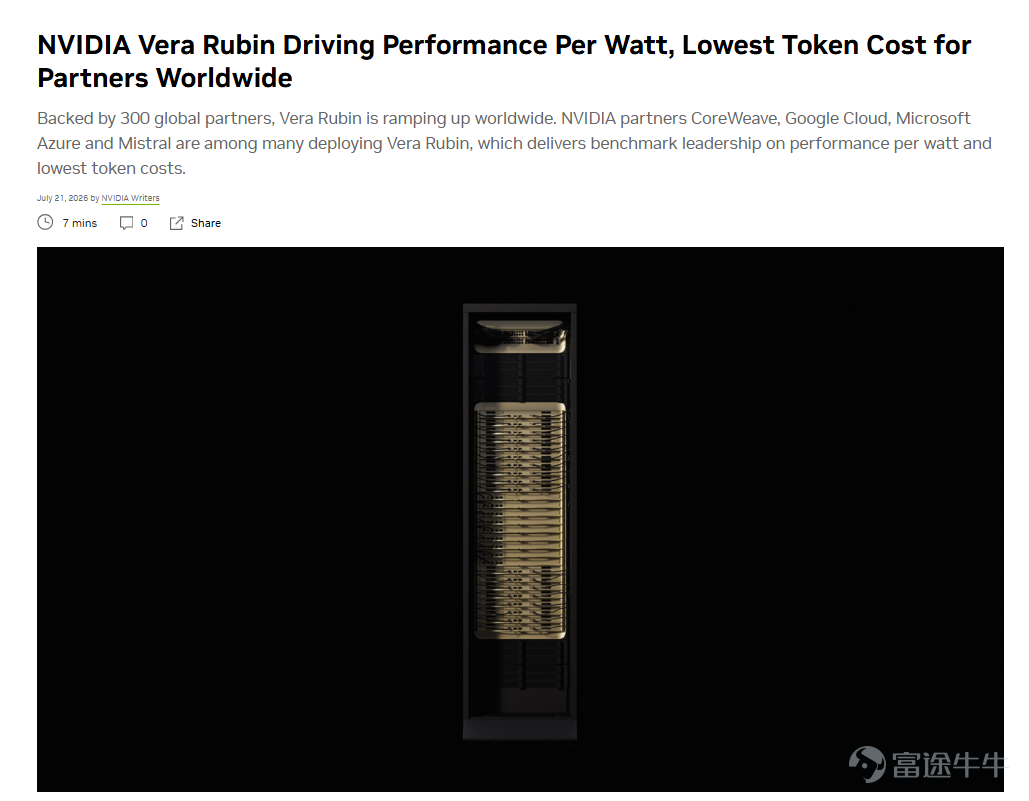
On July 21 Eastern Time, $NVIDIA (NVDA.US)$ provided an update on the progress of its next-generation Vera Rubin platform:Vera Rubin NVL72 has officially entered the production ramp-up phase, with relevant racks already deployed at $CoreWeave (CRWV.US)$ 、 $Alphabet-C (GOOG.US)$ Google Cloud, $Microsoft (MSFT.US)$ Microsoft Azure and $Oracle (ORCL.US)$ Oracle Cloud Infrastructure and other partner platforms.
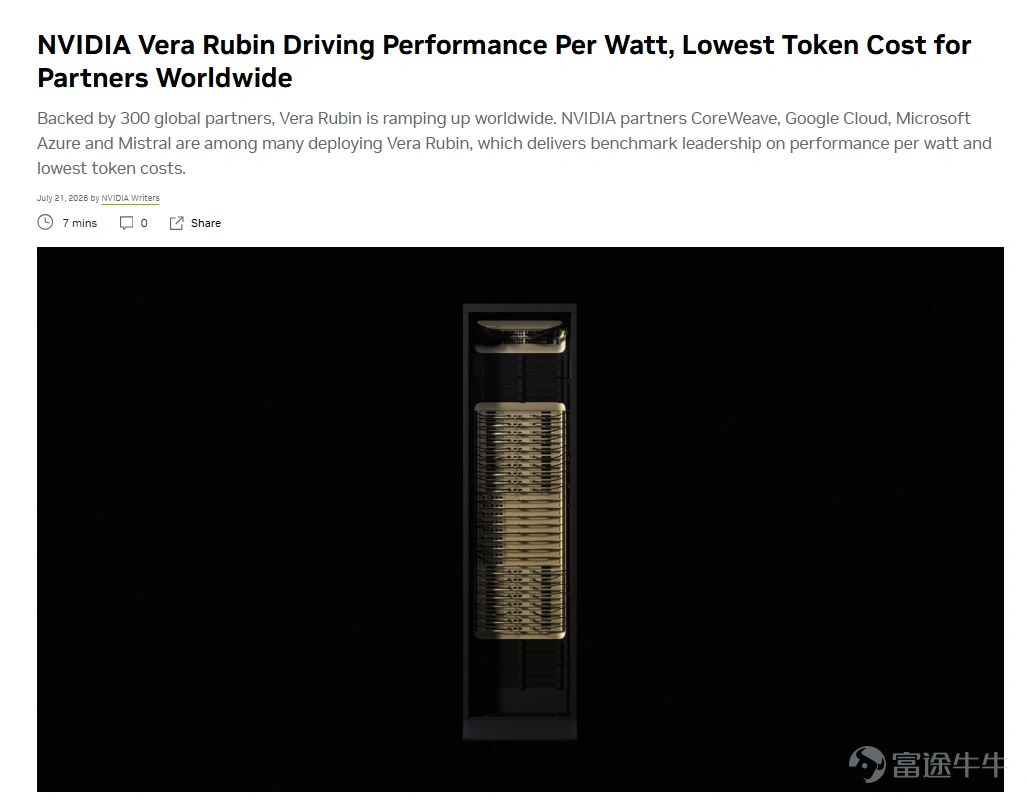
This is not merely a simple product announcement. As early as the end of May, NVIDIA announced that Vera Rubin had entered full production;The true significance of this update lies in the platform’s shift from 'production commitment' to 'customer deployment and real-world validation.'
NVIDIA revealed that behind Vera Rubin is already a supply chain network spanning 30 countries globally, with over 350 factory nodes and approximately 300 partners. Such a massive scale of industrial collaboration means NVIDIA is no longer selling just a single GPU, but an entire replicable and scalable 'AI factory.'
Shifting focus from peak compute performance to how many tokens can be produced per megawatt
The Vera Rubin NVL72 integrates 72 Rubin GPUs and 36 Vera CPUs into a single rack-scale system, accompanied by NVLink 6, ConnectX-9 SuperNIC, BlueField-4 DPU, and Spectrum-6 switching systems.
But this time, NVIDIA deliberately downplayed the traditional narrative around peak compute performance, instead focusing on a metric closer to commercial returns—how many tokens can be generated per megawatt.
Initial real-world tests by CoreWeave using DeepSeek-R1 showed that, under the same interactive response target,the Vera Rubin NVL72 achieves approximately 10 times the token throughput per megawatt compared to the Grace Blackwell NVL72.
These results stem from a specific model and test environment and cannot be simply extrapolated to all workloads. Nevertheless, they reveal a shift in the competitive logic of AI infrastructure: as power becomes the core constraint on data center expansion, customers care less about how fast GPUs are and more about how much effective computation—and how much token-based revenue—they can generate per megawatt of power.
Computing power is transitioning from a 'hardware performance metric' into a business measured by power consumption, utilization efficiency, and cost per token.
Why is Rubin seen as a system-level inflection point?
Galaxy Securities notes that Vera Rubin is NVIDIA’s first platform integrating HBM4, CPO (co-packaged optics), and full liquid cooling technologies, marking a shift in next-generation AI infrastructure competition—from single-accelerator performance toward cluster interconnect efficiency, power management, and system-level delivery capabilities. As Rubin scales horizontally to million-GPU clusters, the limitations of traditional copper interconnects in bandwidth, reach, and power consumption become increasingly pronounced, further solidifying the commercial viability of optical interconnects.
Therefore, the core competition in the Rubin era has evolved beyond 'who has the faster chip' into three key dimensions:
First is high-speed interconnects within a rack.NVLink 6 provides Vera Rubin NVL72 with up to 260 TB/s of fully connected bandwidth, enabling an entire rack to function more like a unified super accelerator.
Second is optical interconnects between racks.The Spectrum-6 switch chip delivers 102.4 Tbps of switching capacity—double that of the previous generation—and its CPO-based product form factor, Spectrum-X Ethernet Photonics, has already entered production, targeting even larger-scale horizontal scaling.
Third is the power delivery and cooling system.Vera Rubin adopts a liquid-cooling design and supports higher inlet water temperatures, aiming to reduce reliance on traditional chillers. At this stage, liquid cooling, power management, and industrial power distribution equipment are no longer just auxiliary components of data centers—they have become critical infrastructure determining whether GPUs can operate stably. Looking further ahead, as NVIDIA’s next-generation Kyber and Rubin Ultra architectures adopt 800V DC power delivery, AI data centers’ power supply systems will undergo another round of upgrades.
Which companies are expected to benefit?
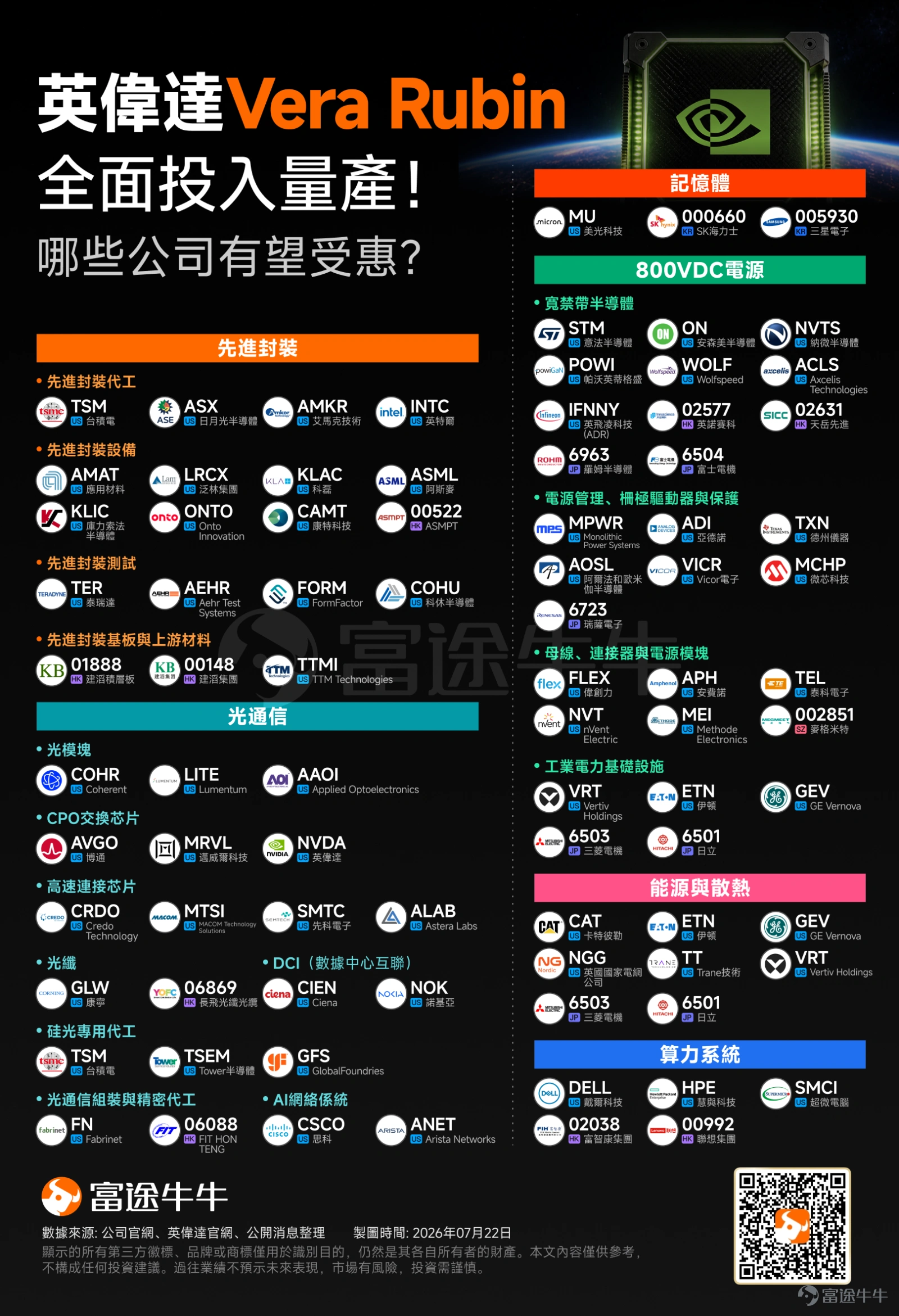
The investment themes arising from Vera Rubin can be broadly categorized into five areas:
--
--
--
First is HBM4 and advanced packaging.Rubin imposes higher demands on memory capacity, bandwidth, and packaging complexity, primarily benefiting memory suppliers such as $Micron Technology (MU.US)$ 、 $SK hynix (SKHY.US)$ 、 $Samsung Electronics (005930.KR)$ , and further extending to $Taiwan Semiconductor (TSM.US)$ 、 $ASE Technology (ASX.US)$ 、 $Amkor Technology (AMKR.US)$as well as$Applied Materials (AMAT.US)$ 、 $Lam Research (LRCX.US)$ 、 $KLA Corp (KLAC.US)$ 、 $ASML Holding (ASML.US)$ companies specializing in packaging and semiconductor equipment.
Second is optical communications and high-speed interconnects. $Coherent (COHR.US)$ 、 $Lumentum (LITE.US)$ 、 $Applied Optoelectronics (AAOI.US)$ Optical module and photonic component manufacturers such as $Broadcom (AVGO.US)$ 、 $Marvell Technology (MRVL.US)$ , switch chip companies like $Credo Technology (CRDO.US)$ 、 $Astera Labs (ALAB.US)$ 、 $MACOM Technology Solutions (MTSI.US)$ 、 $Corning (GLW.US)$ 、 $Ciena (CIEN.US)$ , and firms across the high-speed connectivity and fiber optic supply chain may all benefit from the rising proportion of optical interconnects within data centers.
Third is high-power-density power delivery and power semiconductors.In the near term, this benefits from the increased rack power density of Vera Rubin, while 800V DC power delivery aligns more closely with next-generation Kyber and Rubin Ultra architectures. $STMicroelectronics (STM.US)$ 、 $ON Semiconductor (ON.US)$ 、 $INFINEON TECHNOLOG (IFNNY.US)$ 、 $Navitas Semiconductor (NVTS.US)$ 、 $Wolfspeed (WOLF.US)$ 、 $INNOSCIENCE (02577.HK)$ wide-bandgap semiconductor companies such as $Monolithic Power Systems (MPWR.US)$ 、 $Analog Devices (ADI.US)$ 、 $Texas Instruments (TXN.US)$ 、 $Vicor (VICR.US)$ power management vendors such as will face incremental demand driven by continuously rising AI rack power density.
Fourth is power infrastructure and liquid cooling. $Vertiv Holdings (VRT.US)$ 、 $Eaton (ETN.US)$ 、 $GE Vernova (GEV.US)$ and $Mitsubishi Electric (6503.JP)$ 、 $Hitachi (6501.JP)$ companies such as address power distribution, UPS, thermal management, and industrial power equipment. The successful deployment of future AI data centers increasingly hinges on timely availability of grid connectivity, power supply equipment, and cooling systems.
Fifth is servers and system delivery. $Dell Technologies (DELL.US)$ 、 $Hewlett Packard Enterprise (HPE.US)$ 、 $Super Micro Computer (SMCI.US)$ 、 $LENOVO GROUP (00992.HK)$ ODMs such as will play a critical role in integrating components, assembling racks, and handling testing and delivery.
It should be noted that not all the aforementioned companies are direct suppliers to Vera Rubin; their ultimate earnings elasticity will depend on their share of supply, per-unit value, capacity utilization, and profit margins.
How will Rubin impact NVIDIA's next-phase revenue?
NVIDIA reported $81.6 billion in revenue for its most recent fiscal quarter, of which $75.2 billion came from its Data Center segment; the company has provided revenue guidance of $91 billion for the next fiscal quarter, with a +/- 2% margin.
The mass production ramp-up pace of the Vera Rubin rack will decisively influence NVIDIA's future revenue.Based on maximum production capacity estimates, the potential revenue scale significantly exceeds NVIDIA’s current quarterly results, and market attention to its commercial prospects continues to intensify.
However, from the time an AI rack order is placed until it generates revenue, multiple stages must be completed—including component supply, system assembly, system testing, customer acceptance, and data center power-on. What truly needs to be tracked going forward are Vera Rubin’s actual shipment cadence, cloud providers’ capital expenditures, power infrastructure approvals, key component yields, and system delivery capabilities.
AI competition has entered the 'entire factory' era
The most significant signal of Vera Rubin’s mass production is not merely NVIDIA launching a new generation of GPUs or rack systems, but rather its further expansion from a chip supplier into a comprehensive AI infrastructure platform provider.
This signifies a paradigm shift in the AI computing industry: previously, the focus was on single-card performance; moving forward, the competition will center on whether an entire AI factory can continuously produce tokens at lower power consumption, higher utilization, and reduced unit costs.
This also explains why HBM4, advanced packaging, CPO optical interconnects, liquid cooling, 800V power delivery, and power infrastructure are all simultaneously taking center stage.
From this perspective, the full-scale mass production of Vera Rubin marks not only the beginning of NVIDIA’s next product cycle but may also represent the true inflection point where AI infrastructure transitions from a 'chip cycle' to a 'factory cycle.'
Risk Disclaimer: The above content only represents the author's view. It does not represent any position or investment advice of Futu. Futu makes no representation or warranty.Read more


Comments (23)
to post a comment
104
357