
Mech Mind and SHEIN are in the midst of hot IPOs! Approximately 80% of new listings saw first-day ga

Olymvax: The Pain of Chongqing Brewery Is Still Fresh in the Market's Memory
Author | Huang Yida
Editor | Zhang Fan
Olymvax is a leading domestic player in the vaccine sector. Backed by its highly scarce pipeline of innovative superbug vaccines and its steadily growing tetanus vaccine business, its A-share price has surged since 2024, with a peak gain exceeding 500%. Amid this heated market sentiment, the company submitted an updated prospectus to the Hong Kong Stock Exchange on June 30, reigniting its plan to list in Hong Kong, aiming to secure a higher valuation based on strong expectations and the scarcity of its innovative vaccine pipeline.
Moreover, to facilitate a smooth listing on the Hong Kong stock market, the company recently paid approximately RMB 87.41 million in previously disclosed tax arrears and penalties—about four times its projected 2025 net profit attributable to shareholders—to resolve historical tax compliance issues and clear regulatory hurdles for its Hong Kong IPO.
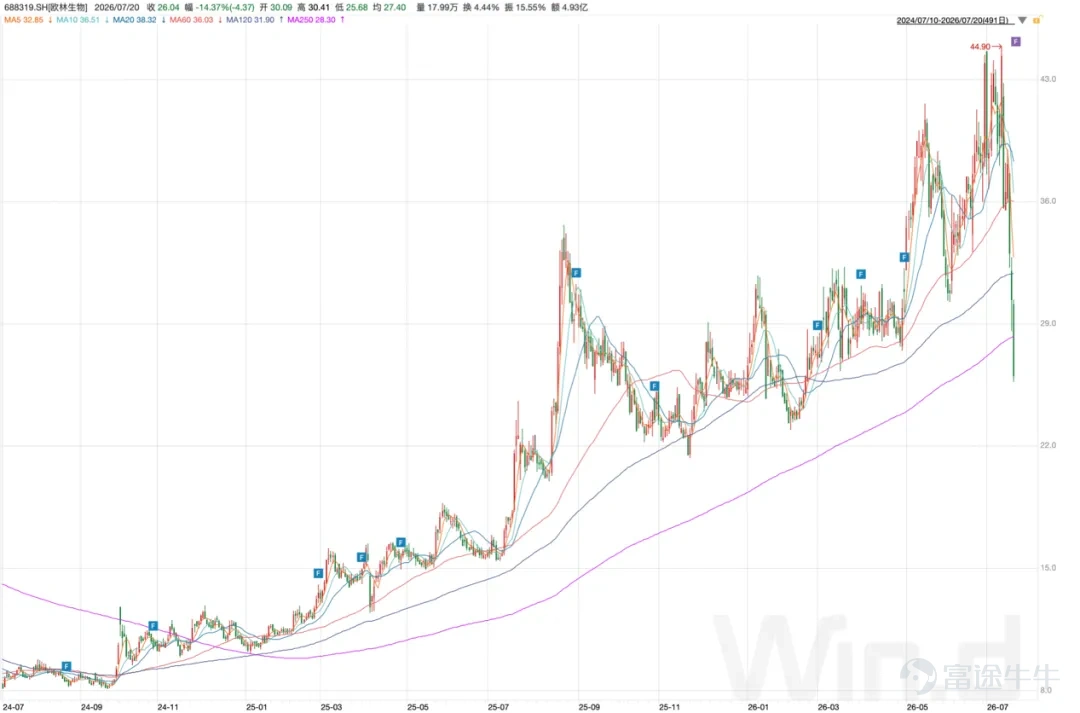
On July 11, Olymvax unveiled unblinded Phase III clinical trial data for its lead Staphylococcus aureus vaccine candidate, which demonstrated efficacy far exceeding the trial’s design target and showed strong safety—bringing it just one step away from commercialization. However, before the market could fully absorb this positive news, rumors alleging data falsification in the clinical trial began circulating widely. Despite the company issuing a clarification statement and filing a police report, its share price plunged sharply: from July 13 to July 20, over just six trading days, the stock dropped more than 40%, including a single-day decline of nearly 20% on July 13.

Figure: Olymvax A-share price trend; Source: Wind, 36Kr
During the critical window for its Hong Kong IPO, a mere rumor triggered a sharp collapse in Olympharm’s A-share price, sparking intense market debate. What, then, was the core driver behind this short-term stock plunge? And how might this abrupt and severe correction impact the company’s Hong Kong IPO?
A-Share Price Soars as Core Pipeline Demonstrates Outstanding Value
The company’s R&D pipeline focuses primarily on vaccines targeting superbugs, centered around four Class 1.1 innovative vaccines: recombinant Staphylococcus aureus vaccine, oral recombinant Helicobacter pylori vaccine, recombinant Pseudomonas aeruginosa vaccine, and recombinant Acinetobacter baumannii protein vaccine.
In terms of clinical progress,The Phase III clinical data for the Staphylococcus aureus vaccine was unblinded on July 11, demonstrating efficacy above the pre-specified target and a strong safety profile, positioning it on the cusp of commercialization.; The Helicobacter pylori vaccine has currently advanced to Phase I clinical trials; the other two key projects are both in preclinical research stages.The company's focus on superbug vaccines aligns with industry trends. Superbugs, represented by multidrug-resistant and antibiotic-resistant bacteria, have become a global public health challenge.。
According to WHO data, in 2019, antibiotic resistance caused 1.27 million deaths globally and contributed indirectly to another 4.95 million deaths. This has also imposed a massive economic burden: World Bank projections estimate that by 2050, antimicrobial resistance could result in an additional USD 1 trillion in global healthcare expenditures annually, with potential annual losses to global GDP reaching up to USD 3.4 trillion. Clearly, there is strong global demand for effective prevention and treatment of superbugs.
Specifically, surgical incisions, indwelling catheters, burn wounds, and similar sites are highly susceptible to bacterial invasion after surgery, often leading to common hospital-acquired infections such as wound suppuration, sepsis, and osteomyelitis. Superbugs—particularly multidrug-resistant strains—pose significant challenges due to their high resistance levels, forcing patients to extend hospital stays and rely on expensive specialized antibiotics, substantially increasing costs related to diagnosis, treatment, monitoring, and nursing care. Additionally, patients forced into extended recovery periods and unable to return to work incur substantial direct and indirect economic losses.
The company’s lead pipeline candidate, a Staphylococcus aureus vaccine, targets Staphylococcus aureus—a typical antibiotic-resistant bacterium already resistant to multiple common antibiotics—and ranks high on the WHO’s list of priority bacterial pathogens, classified as a high-priority threat.Given that no Staphylococcus aureus vaccine has yet been approved globally, there remains a significant unmet need for prevention and treatment.According to the company’s prospectus, global cases of Staphylococcus aureus infection are projected to reach 7.4 million by 2035, representing a market opportunity of approximately USD 1.8 billion.
The primary clinical application of the Staphylococcus aureus vaccine is to prevent post-surgical acquired bacterial infections.Moreover, Staphylococcus aureus infections are highly prevalent across multiple medical departments. Publicly available data indicate that Staphylococcus aureus is frequently detected in ICUs, respiratory medicine, pediatrics, obstetrics and gynecology, outpatient clinics, and dental departments. In China, the detection rate of Staphylococcus aureus infections is projected to reach 29% by 2025, representing a vast patient population. Although the company’s current clinical trials primarily focus on patients undergoing orthopedic surgery, the vaccine may eventually be expanded to other high-risk and vulnerable populations susceptible to Staphylococcus aureus infections.

Figure: Market size of Staphylococcus aureus vaccines in China and globally; Source: Company prospectus, 36Kr
In terms of the competitive landscape, Olymvax’s Staphylococcus aureus vaccine leads by a wide margin in clinical development: its Phase III trial results have already been unblinded, and commercialization is imminent. Meanwhile, Staphylococcus aureus vaccine programs from pharmaceutical giants such as Pfizer, Merck, and GSK have all failed, and aside from Olymvax, all other global research efforts related to Staphylococcus aureus vaccines remain in preclinical exploration stages.
Therefore,As the company’s Staphylococcus aureus vaccine enters its commercialization phase in the near future, it will enjoy a monopoly in the market for an extended period, and this substantial first-mover advantage will significantly boost the company’s earnings.In fact, even before the unblinding of trial results, market expectations were already high that the vaccine would ultimately succeed, primarily due to the company's multiple technical and R&D advantages—including optimized immunization regimens, adjuvant-enhanced immune response levels, and strategic antigen grouping in clinical trials—combined with the compelling commercial logic of securing a monopoly post-launch. Consequently, the company’s A-share price has surged by over 500% since the beginning of 2024.
On the valuation front, sustained price increases earlier this year drove the company’s valuation sharply higher, with its peak trailing P/E ratio exceeding 570x. Following a continuous decline over the past six trading days (as of July 20), during which the share price dropped by 40%, the company’s valuation remains elevated at around 180x.
The scale and earnings elasticity of the company’s existing business alone clearly cannot justify such a high valuation. Moreover, aside from the Staphylococcus aureus vaccine, all of the company’s other core pipeline assets are still in early-stage or preclinical development, which typically receive little to no valuation credit from the market. Therefore,the core valuation logic for the company centers primarily on market expectations for its lead asset—the Staphylococcus aureus vaccine.。
Following the recent release of positive unblinded data for the Staphylococcus aureus vaccine, the company’s A-share price has experienced consecutive sharp declines, driven mainly by two key factors:
1. The primary reason is negative market sentiment stemming from rumors of clinical data fabrication for the Staphylococcus aureus vaccine. Although Olymvax issued a clarification statement and has filed a police report, investors have nonetheless opted to sell off their holdings;
2. Another group of investors who exited recently had accumulated substantial unrealized gains during the prior rally and chose to lock in profits amid the news catalyst.
In secondary markets, investor sell-offs triggered by unexpected negative news are extremely common: market participants are inherently highly sensitive to any adverse information, and even if such rumors lack factual basis, most capital will prioritize risk avoidance and exit positions before the truth emerges—this 'run-first' behavior is essentially standard practice.
The unique characteristics and stringent regulation of the vaccine industry have further amplified market risk-aversion tendencies.In particular, biosafety incidents exhibit strong sector-wide contagion effects—risk at a single company can trigger valuation corrections across the entire sector. Taking the Changsheng Bio incident as an example, in the year following the outbreak, China’s total vaccine batch release volume shrank significantly under heightened regulatory scrutiny. Vaccine companies faced earnings pressure, and the sector entered a prolonged period of sharp volatility and adjustment.
On the other hand, due to the sector’s substantial growth potential, it has also produced numerous short-term 'star stocks.' For instance, Chongqing Brewery’s share price soared years ago on the back of its hepatitis B vaccine concept, only to plunge sharply soon after when its R&D efforts failed—its stock even hit nine consecutive daily trading limits down. Between December 8 and December 20, 2011, its share price dropped by 60% over just nine trading days.
Therefore, reviewing historical blow-up cases alongside concurrent market performance makes it clear that, whether due to biosafety incidents or R&D failures, the resulting shocks have inflicted deep, visceral pain on investors in the vaccine sector. At the first sign of risk, investors quickly flee to safety—this explains why Olymvax has recently suffered such a severe valuation de-rating.
Looking ahead over the short to medium term, after unblinding, the Staphylococcus aureus vaccine must still complete the full regulatory review and approval process before it can be launched commercially. During this approval cycle, the company’s A-share listing will continue to face pressure from its currently high valuation. Absent any new major positive catalysts, its A-share price could enter a period of heightened volatility.
The current market environment primarily impacts Hong Kong IPOs through valuation levels and corresponding fundraising scale. For companies pursuing both A+H listings, A-share valuations serve as one of the key anchors for pricing their Hong Kong offerings. Olymvax’s recent sharp drop in A-share price, significant valuation contraction, and ongoing valuation pressures will all lead the market to revise downward its IPO valuation expectations for the Hong Kong listing, with fundraising size consequently scaling back in tandem.
The undisputed leader in tetanus vaccines
Olymvax’s existing business includes three currently marketed vaccine products: tetanus vaccine, AC conjugate vaccine (hereinafter referred to as 'AC'), and Hib vaccine (hereinafter referred to as 'Hib'). All three are non-EPI Category II vaccines. Among them,the tetanus vaccine is the company’s flagship product—not only contributing the vast majority of its revenue and profit, but also serving as the core driver of its current earnings growth.。
This is reflected in the financial statements: in 2025, the company generated revenue of RMB 704 million, an increase of approximately 20% year-over-year. By business segment, the tetanus vaccine contributed RMB 614 million in revenue during the same period, accounting for a staggering 87% of total company revenue and growing by about 15% year-over-year. Over a longer time horizon, the tetanus vaccine has consistently represented over 80% of total revenue, meaning its growth rate has largely dictated the pace of the company’s overall top-line expansion.

Figure: Olymvax revenue and revenue composition; Source: Wind, 36Kr
Since its approval and market launch in 2021, AC has gradually become a significant marginal driver of the company's performance growth. Financial reports show that AC generated RMB 65 million in revenue in 2025, an increase of 147% year-over-year; its revenue contribution rose from 4.5% in 2024 to 9.3% in 2025. Hib has consistently contributed a low share of revenue, generating only RMB 19 million in 2025—less than 3% of total revenue—and has posted negative revenue growth for the past three consecutive years, making its contribution to overall company performance nearly negligible.
Olymvax's tetanus vaccine has maintained steady growth in recent years, largely due to a relatively favorable competitive landscape.This favorable competitive landscape comprises two key aspects:
1. Among different types of tetanus immunizing agents, the tetanus vaccine holds distinct advantages across three dimensions: efficacy, safety, and cost-effectiveness;
2. Within the tetanus vaccine segment, the company’s product maintains the leading market share by a wide margin over competitors.
Tetanus is a classic bacterial infection typically occurring after trauma. Severe cases often lead to life-threatening complications such as asphyxia, pulmonary infections, and multi-organ failure, with an extremely high potential fatality rate—approaching 100% for severe cases.
Currently, there are four main types of immunizing agents available on the market for tetanus:tetanus antitoxin, equine tetanus immune globulin, human tetanus immune globulin, and tetanus vaccine.The first three products are primarily used for emergency prophylaxis but offer only short-term protection, lasting approximately 10 days. According to publicly available data, there are roughly 1 million tetanus cases globally each year, resulting in 300,000 to 500,000 deaths.
Compared with tetanus antitoxin and equine-derived tetanus immune globulin, the tetanus vaccine, although slower to take effect, offers clear advantages in terms of safety—it is less likely to cause allergic reactions and typically provides protection for 5–10 years. Compared with human tetanus immune globulin, the tetanus vaccine’s main advantages lie in greater accessibility, better cost-effectiveness, and longer duration of protection.Therefore, in non-emergency scenarios—and especially with supportive policy measures in place—tetanus vaccination is the mainstream approach to prevention.
Olymvax is the undisputed market leader in the tetanus vaccine segment.To date, there are seven tetanus vaccines available in the domestic market. The company’s product was approved for commercialization in 2016, making it the earliest such vaccine launched by a private enterprise and granting it a significant first-mover advantage. According to data from the company’s prospectus, its market share in 2025 reached 86.5% in terms of batch release volume and 98.8% in terms of revenue, solidifying its dominant position in the tetanus vaccine industry.

Figure: Competitive Landscape of the Tetanus Vaccine Market; Source: Company Prospectus, 36Kr
Leveraging its undisputed leadership in the tetanus vaccine segment, the company’s overall growth in operating expenses has closely matched its revenue growth. Over the past three years, its sales expense ratio ranged between 52% and 54%, general and administrative expenses between 11% and 16%, and R&D expenses between 19% and 23%. As a biologic, vaccines carry an extremely high gross margin, which has remained stably above 90%. Given the relatively stable level of total operating expenses, the company’s net profit margin over the past three years has been in the range of 2% to 3%. From a performance driver perspective, with a relatively stable cost structure, revenue growth remains the core engine behind the company’s earnings expansion.
In the medium to long term, the current penetration rate of tetanus vaccines is far from saturation. In post-injury prophylaxis settings, emergency immunizing agents such as tetanus antitoxin and tetanus immune globulin are still widely used. Compared with these emergency formulations, the tetanus vaccine demonstrates compelling advantages across multiple dimensions—including safety, accessibility, duration of protection, and cost-effectiveness—further reinforced by the company’s dominant market position.The substitution logic—replacing emergency immunizing agents with vaccines—is expected to continue gaining traction. The company’s related business revenue is projected to grow steadily, enabling this cash-cow segment to support R&D reinvestment and thereby providing a meaningful underpinning to the company’s overall financial performance.
*Disclaimer:
The content of this article represents the author’s views only.
Investing involves risks, and caution is advised. Under no circumstances does the information or opinions expressed herein constitute investment advice for any individual. Investors should consult qualified professionals and exercise due diligence before making any investment decisions. We do not intend to provide underwriting services or any services that require specific qualifications or licenses.
Risk Disclaimer: The above content only represents the author's view. It does not represent any position or investment advice of Futu. Futu makes no representation or warranty.Read more
Comments
to post a comment