
Hong Kong stocks are rebounding—what sectors deserve attention?
Market Weekly Report | July 13–19, 2026
Global risk assets came under significant pressure this week amid liquidity shocks in the tech/semiconductor sector and escalating U.S.-Iran tensions: the Nasdaq fell-2.90%, China's STAR Market 50 Index plunged-16.93%, and the Taiwan Weighted Index tumbled sharply in a single day-6.47%, but Hong Kong stocks held up relatively well, supported by southbound net inflows ofHK$36.982 billionfor the week, allowing the Hang Seng Index to post a weekly gain despite the broader downturn+1.60%, with market structure clearly rotating toward 'selling tech, buying consumer/high-dividend/bank defensive plays'**
1. Overview of the Global Macroeconomy
The core theme in global markets this week was"Unwinding of crowded tech trades + marginally easing inflation but still hawkish Fed rhetoric + elevated geopolitical risks pushing oil prices higher"。
On the U.S. front,, macroeconomic data showed a combination of "declining prices and resilient growth." The year-on-year PPI in June+5.5%, lower than the previous reading6.0%and expectations6.2%, down from the previous quarter-0.3%; CPI also came in below expectations, indicating marginal easing of inflation, which directly led to a rapid cooling of market bets on another rate hike at the July meeting, with the probability of a July rate hike dropping to approximately9.6%, significantly down from around45%at the start of the week. On the other hand, retail sales rose month-over-month in June+0.2%, and initial jobless claims for the week ended July 11 fell to208,000, the lowest level since May, showing continued resilience in employment and consumption, keeping expectations for another rate hike in September25 basis pointsin relatively balanced territory, with CME Group's measure showing approximately48.6%Against this backdrop, Federal Reserve officials continued to emphasize inflation control as their top priority. The President of the Kansas City Fed stated that inflation remains too hot, while the President of the Dallas Fed advocated for moderate rate hikes to curb inflation. This suggests that although markets have scaled back near-term rate hike expectations, they have not yet entered a clear easing cycle.
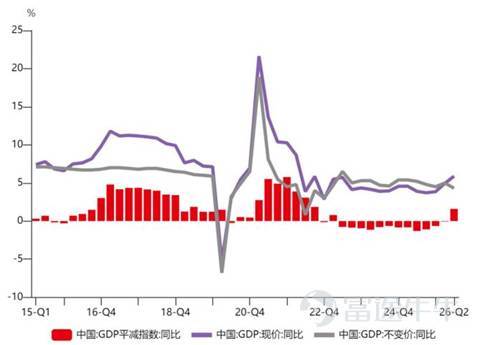
In China,, data released on July 15 for the second quarter and June overall showed a pattern of 'slowing real growth but improving nominal growth.' Real GDP year-on-year in Q2+4.3%, lower than the previous reading5.0%, with H1 cumulative year-on-year growth at+4.7%; however, nominal GDP grew year-on-year by+5.89%, and the GDP deflator rose year-on-year by+1.53%, marking its first positive print after 12 consecutive quarters, indicating price-level recovery has already begun. Industrial production rose year-on-year in June by+5.3%, slightly higher than the previous reading4.5%, showing improvement; total retail sales of consumer goods increased year-on-year by+1.0%, slightly higher than the previous reading-0.6%, rebounding; however, fixed asset investment from January to June grew cumulatively year-on-year by-5.7%, suggesting domestic demand recovery remains fragile, with the property and investment sectors still weak. In terms of market implications, domestic fundamentals were not the main driver behind this week’s sharp equity volatility—external tech-related risk sentiment shocks played a larger role. Nevertheless, the improvement in nominal growth and price indicators implies relatively more stable earnings expectations for cyclical and high-dividend defensive assets.

(Source: Chengtong Securities Research Institute, "Commentary on June Economic Data | Economy Operating Within a Reasonable Range, High-Quality Development Progressing Toward Innovation and Optimization," published on July 17, 2026
Figure 1: China's nominal GDP and GDP deflator have rebounded, with price-side recovery providing some support to pro-cyclical assets
In terms of geopolitics, as U.S. forces launched a new round of strikes against Iran on July 16, further reducing shipping volumes through the Strait of Hormuz and rapidly pushing up risk premiums in the crude oil market. The market transmission mechanism of this chain is relatively clear:Escalating geopolitical tensions → crude oil rebound → weakening global risk appetite → pressure on high-valuation tech assets. Given that the current vulnerability in global equities was already concentrated in highly crowded sectors such as AI computing power and semiconductors, the rise in oil prices did not trigger typical broad-based safe-haven gold buying. Instead, it coincided with a contraction in growth stock valuations, reflecting a market dynamic dominated by liquidity squeeze.
II. Performance of Global Asset Classes
Methodology note: Weekly performance of major asset classes in this section is calculated from the close on July 10 to the close on July 17.
The defining feature of asset performance this week was a marked decline in risk appetite, with global equities—particularly technology stocks and the Asian semiconductor supply chain—facing concentrated selling pressure; crude oil surged on geopolitical drivers, while gold declined; U.S. Treasury yields edged slightly lower, and the dollar remained broadly flat to slightly weaker.
Structurally,growth significantly underperformed value, the Asian tech supply chain lagged behind traditional U.S. mega-cap stocks, and Hong Kong equities showed weakness in tech but strength in defensive sectors. Among U.S. equities, the Nasdaq fell for the week-2.90%significantly greater than that of the Dow Jones-0.93%, with consecutive declines on July 16 and July 17-1.47%、-1.40%, indicating that the market impact was primarily concentrated in the technology growth sector. In Asia-Pacific markets, South Korea and Taiwan equities—due to their high semiconductor weightings and elevated trading congestion—became focal points for risk unwinding in this round. Concerns over SK Hynix's earnings triggered Korea’s SIDECAR mechanism, while Taiwan Semiconductor’s earnings, although beating expectations, led to a decline rather than a rally in its share price, further reinforcing the market view that 'earnings can no longer drive valuation higher.'
On the commodities front, Brent and WTI crude oil prices rebounded noticeably, rising by4.59%and4.48%on July 17, driven not by improved demand but by heightened geopolitical risk premiums related to the Strait of Hormuz. Meanwhile, gold posted a weekly decline of-2.31%, signaling that current market dynamics reflect not a typical recession-driven safe-haven trade, but rather a combination of 'deleveraging in risk assets plus portfolio rebalancing to hedge against inflation and geopolitical risks.'
In bonds, U.S. 2-year and 10-year Treasury yields declined by3 basis points、1 basis point, while the long-end 30-year yield remained flat, resulting in an overallMild bull flatteningThis pattern reflects that market expectations for near-term rate hikes have cooled somewhat, but there has been no significant downward revision to medium- to long-term nominal growth and inflation expectations. The US Dollar Index declined only slightly.0.17%The RMB central parity rate appreciated modestly, indicating that exchange rate dynamics have not yet imposed additional pressure on Hong Kong stocks and Chinese assets. The relative resilience of Hong Kong equities continues to be primarily driven by southbound capital flows.
III. Weekly Review of the Hong Kong Market
Hong Kong’s trading days this week areJuly 13–17, totaling five trading days.Against the backdrop of sharp global tech stock corrections,Hong Kong is one of the few markets that achieved “relatively resilient index performance with a pronounced structural rotation.”The Hang Seng Index rose for the week despite adverse global sentiment, but gave back significant gains on Friday due to spillovers from overseas tech weakness—exhibiting the classic pattern of “index support from fund flows, with tech dragging on upside elasticity.”
1) Index performance: Hang Seng Index gained against the trend, while Hang Seng Tech significantly underperformed.
The most notable aspect at the index level isDivergent market rhythms: Although the Hang Seng Index posted a weekly gain,+1.60%butit fell by -1.78% on July 17 alone,and the Hang Seng Tech Index declined even more sharply,-4.37%indicating that Hong Kong equities have not decoupled from the global tech sector correction. The market was merely supported in recent days by sustained net inflows from southbound capital, allowing it to retain a positive return on a weekly basis. Structurally, the Hang Seng and H-share indices outperformed the Hang Seng Tech Index, meaning Hong Kong stocks did not show broad-based strength this week, but ratherwere underpinned by defensive and consumer heavyweights, while tech growth stocks faced pressure。
In terms of valuation,The AH premium index declined slightly from 124.50 to 124.02,narrowing modestly. This suggests that, against the backdrop of sharper corrections in China’s A-share growth and small/mid-cap segments, Hong Kong equities are showing marginal relative valuation appeal.
2) Sector rotation: Selling tech/semiconductors; buying consumer, high-dividend, and bank stocks for defense
Sector performance clearly validated this week’s main theme:"Sell tech, buy consumer staples, buy banks, buy high-dividend stocks". The electronics sector plunged sharply in a single week,-9.60% resonating with the sharp decline in the STAR Market 50 Index on the A-share market,-16.93% the Taiwan Weighted Index's single-day drop,-6.47% and the KOSPI’s single-day fall in South Korea,-6.37% reflecting a synchronized global deleveraging across the semiconductor and AI hardware supply chain. In contrast, sectors such as banking, food and beverages, and beauty and personal care posted positive returns, indicating that southbound and local capital prioritized flowing back into assets offering earnings certainty + low valuations + high dividends amid the market turmoil.
3) Individual stocks and thematic drivers: Tech catalysts remain, but they are outweighed by sector-wide deleveraging
Alibaba’s AI capabilities and integration into Apple’s smart ecosystem, JD.com Industrial’s growth narrative, and Xiaomi’s new vehicle launch expectations remain key thematic drivers for Hong Kong-listed tech and discretionary consumption stocks. This suggests that the weakness in Hong Kong tech stocks stems not from deteriorating fundamentals, but rather fromValuation compression at the short-term trading level is outpacing fundamental improvements.Therefore, near-term sector performance hinges more on overseas tech giants’ earnings reports reaffirming AI-related capital expenditure and monetization pathways than on isolated company-specific events.
4) Fund flows: Sustained and substantial southbound inflows are the core support underpinning Hong Kong equities' relative resilience.
This week, the most critical variable for Hong Kong stocks is not overseas risk appetite, butthe 'liquidity cushion' formed by four consecutive days of net southbound inflows.From July 13 to July 16, net inflows amounted toHK$9.038 billion, HK$10.997 billion, HK$13.364 billion, and HK$5.039 billion,respectively, turning into net outflows only on July 17 when the global tech supply chain shock fully spread,with outflows reaching HK$1.457 billion,demonstrating that southbound flows have played a decisive role in stabilizing the Hong Kong equity index. Year-to-date, cumulative net southbound inflows have reachedHK$379.644 billion, indicating that pricing power in the Hong Kong market continues to tilt toward mainland China-based capital.
Meanwhile, the average daily turnover across the entire Hong Kong market this week stood atHK$231.047 billion, down week-over-week.8.44%. This suggests the market did not experience broad-based panic selling on elevated volume this week; instead, it resembledstructural reallocation within a stock-constrained market: active funds reduced positions in highly crowded tech names and increased allocations to consumer, banking, and high-dividend sectors, resulting in notably stronger Hang Seng Index performance relative to the Hang Seng Tech Index.
All things considered,This week, Hong Kong equities outperformed most global markets with significant tech exposure—not because the tech sector was strong, but because southbound-driven defensive heavyweights absorbed capital flows, imparting stability at the index level while driving structural rotation beneath the surface.。
IV. Outlook for the Market Ahead
1) Key Calendar (July 20–24)

2) Core assessment
In the near term (next week), Hong Kong equities will most likely remain in a state of“index supported, high tech volatility, and defensive style bias”. There are three reasons for this:
First,Southbound capital flows remain the key determinant of the downside floor for Hong Kong stocks. As long as southbound flows do not turn significantly negative, the Hang Seng Index’s relative resilience compared to global equity markets is likely to persist. Second,the upcoming week of overseas tech earnings reports will serve as a critical test for the AI investment narrative. The essence of the recent global tech stock correction lies in growing market skepticism over whether the “high capex–high momentum–high valuation” loop can remain self-sustaining; thus, earnings results and guidance from Tesla, Google, Intel, Microsoft, and Meta will determine whether valuations in the AI hardware and application segments continue to contract or experience a temporary rebound. Third,the unchanged LPR indicates that domestic policy support for economic stabilization will continue advancing at a measured pace, it will not create strong near-term trading momentum, but it also reduces the additional market disruption from unmet policy expectations.
Medium term (next 1–2 weeks), if overseas tech giants’ earnings reports confirm sustained high AI-related capital expenditures and show improvement in cloud businesses and ad monetization, the Hong Kong tech sector could see an oversold rebound. However, if earnings broadly trigger a 'solid results but stagnant share price' reaction similar to Taiwan Semiconductor, the market will continue to compress valuation anchors across the AI supply chain, and Hong Kong equities will remain tilted toward high-dividend, consumer, and centrally owned state enterprise defensive plays.
3) Portfolio positioning strategy
First pillar: Maintain high-dividend stocks and banks as core defensive holdings. The banking sector rose this week,+2.75%demonstrating its stabilizing role amid sharp volatility in the tech segment; if global risk appetite remains volatile, such assets will still offer relative return advantages.
Second pillar: Seek relative return opportunities in consumer sectors. Food & beverage and beauty & personal care segments rose respectively,+3.70%、+3.50%indicating that capital has started rotating from highly volatile growth names into undervalued consumer stocks; if domestic economic data continues to show 'nominal recovery with underlying stability,' consumer stocks could emerge as a defensive-yet-offensive choice within the Hong Kong market.
Third theme: A second entry window for Hong Kong tech stocks awaits confirmation from earnings reports. It is currently inadvisable to simply buy the dip across the entire tech sector; instead, investors should wait for clearer signals from U.S. tech giants’ earnings on AI-related capital expenditures, cloud business performance, and advertising monetization. Once overseas leaders confirm that their medium-term investment intensity has not been significantly scaled back, valuation recovery could emerge among Hong Kong-listed internet platforms and select AI application segments.
Fourth theme: Focus on valuation recovery opportunities in Hong Kong equities driven by southbound capital flows. Net southbound inflows year-to-date have reachedHK$379.644 billion, indicating that marginal pricing power in the Hong Kong market continues to strengthen. If, following adjustments in A-share tech stocks, capital continues seeking offshore Chinese assets with low valuations and better liquidity, large-cap blue chips and central SOE leaders listed in Hong Kong will remain the preferred allocation targets.
4) Risk Warnings
⚠️ Further escalation of U.S.-Iran tensions and unexpected disruptions in the Strait of Hormuz could drive a sharp rise in oil prices and dampen global risk appetite. ⚠️ Disappointing earnings from U.S. tech giants—particularly if AI-related capital spending or commercialization proves weaker than expected—could trigger a second wave of valuation compression across the global tech supply chain. ⚠️ A shift in southbound flows from sustained net inflows to significant net outflows would erode a key pillar supporting Hong Kong equities’ relative resilience. ⚠️ Continued deleveraging in A-share growth sectors could transmit negative sentiment to Hong Kong tech and China-concept stocks. ⚠️ If the pace of domestic pro-growth policy implementation falls short of expectations, the sustainability of the recovery in consumer and cyclical sectors remains uncertain.
Disclaimer: This report is for internal discussion purposes only and does not constitute investment advice.
Data source: AlphaPai Database; Chart source: Chengtong Securities Research

Risk Disclaimer: The above content only represents the author's view. It does not represent any position or investment advice of Futu. Futu makes no representation or warranty.Read more

Comments
to post a comment
2
2