
English
Back
Open Account
深潮 TechFlow
wrote a column · Jul 14 12:01

Robinhood launches its own L2 chain, enabling 24/7 trading of tokenized stocks; 140 major institutions jointly issue a stablecoin to challenge USDT

Author: Artemis Analytics
Compiled by: DeepTide TechFlow
Deep Tide Summary:On its launch day, Robinhood Chain integrated DeFi protocols like Uniswap, making tokenized shares of Apple and NVIDIA tradable globally. Google, Visa, BlackRock, and 137 other institutions jointly launched the Open USD stablecoin, directly targeting USDT’s $260 billion market. This marks a pivotal week for traditional finance’s blockchain-driven reinvention.
Global risk assets rose during the first week of July, but beneath the calm surface of steady indices, capital flows shifted dramatically. The Dow Jones Industrial Average breached 53,000 for the first time, setting a new record—capping a strong first half with gains of 8.9% for the Dow, 9.6% for the S&P 500, 12.8% for the Nasdaq, and 22% for the Russell 2000 (its best first half since 1991). Macroeconomic conditions warmed: weak June employment data combined with Federal Reserve Chair Kevin Warsh’s comments that inflation risks are receding reignited market hopes for rate cuts, reversing months of 'higher for longer' expectations. Offsetting this was geopolitical tension: attacks in the Strait of Hormuz and the U.S. revocation of Iran sanctions waivers pushed oil prices and 30-year Treasury yields back above 5%, just as Q2 earnings season began—raising discount rates for long-duration growth stocks. By late in the week, this tension triggered an actual semiconductor selloff: even Samsung’s record-breaking quarterly guidance on July 7 failed to halt the sell-off in chip stocks, leaving the Nasdaq wobbling while broader markets barely held their ground.
Author: Artemis Analytics Compiled by: DeepTide TechFlow Deep Tide Summary:On its launch day, Robinhood Chain integrated DeFi protocols like Uniswap, making tokenized shares of Apple and NVIDIA tradable globally. Google, Visa, BlackRock, and 137 other institutions jointly launched the Open USD stablecoin, directly targeting USDT’s $260 billion market. This marks a pivotal week for traditional finance’s blockchain-driven reinvention. Market Overview Global risk assets rose during the first week of July, but beneath the calm surface of steady indices, capital flows shifted dramatically. The Dow Jones Industrial Average breached 53,000 for the first time, setting a new record—capping a strong first half with gains of 8.9% for the Dow, 9.6% for the S&P 500, 12.8% for the Nasdaq, and 22% for the Russell 2000 (its best first half since 1991). Macroeconomic conditions warmed: weak June employment data combined with Federal Reserve Chair Kevin Warsh’s comments that inflation risks are receding reignited market hopes for rate cuts, reversing months of 'higher for longer' expectations. Offsetting this was geopolitical tension: attacks in the Strait of Hormuz and the U.S. revocation of Iran sanctions waivers pushed oil prices and 30-year Treasury yields back above 5%, just as Q2 earnings season began...
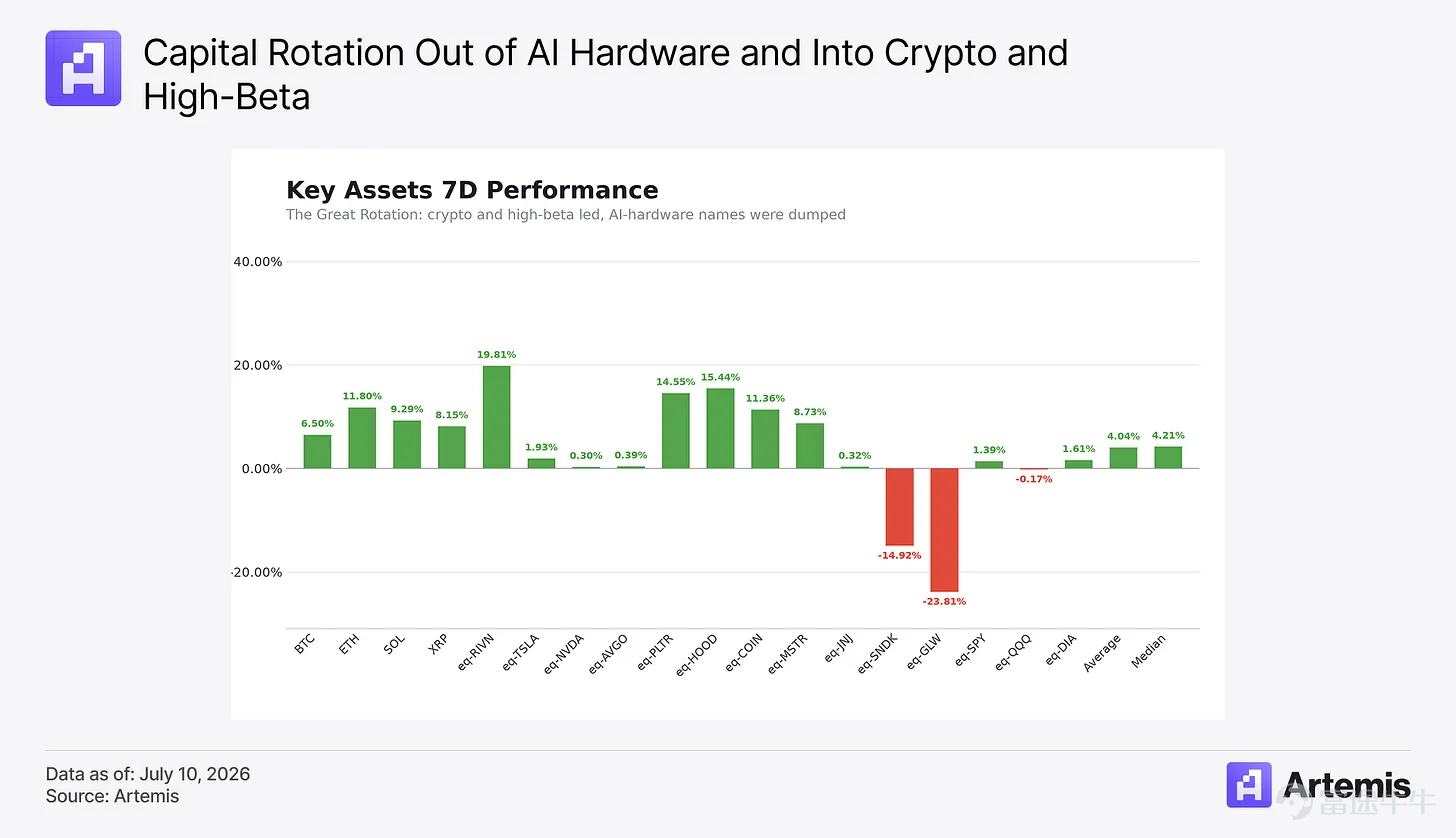
This week’s leaderboard tells the rotation story in one chart. The biggest single-stock winners weren’t AI hardware leaders, but high-beta recovery plays and crypto-related names: Rivian +19.8%, Robinhood +15.4% (benefiting from the Robinhood Chain launch), Palantir +14.6%, Coinbase +11.4%, and Strategy +8.7%—all riding a strong crypto rebound (Ethereum +11.8%, Bitcoin +6.5%). Benchmark indices posted only modest gains (Dow +1.6%, S&P 500 +1.4%, Nasdaq 100 -0.2%). The hardest-hit segment was the AI capex supply chain: Corning fell 23.8%, SanDisk dropped 14.9%, while mega-cap AI names traded flat (NVIDIA +0.3%, Broadcom +0.4%)—a textbook case of 'selling crowded leaders and rotating into everything else.'
The most significant market narrative this week is capital rotating from AI hardware into value and defensive sectors that missed out on the 2025 rally. The immediate trigger is investors’ growing demand for tangible evidence of returns on record-breaking AI capital expenditures. Big Tech’s AI capex is projected to rise another ~50% in 2026, exceeding $600 billion, and the gap between investment and revenue now surpasses that of the 2001 telecom bubble, as capex is growing roughly 46% faster than sales. With U.S. tech/AI valuations approaching 25x EV/EBITDA, the market is penalizing spending—even when operational results beat expectations—due to fears that delayed monetization will compress margins.
Author: Artemis Analytics Compiled by: DeepTide TechFlow Deep Tide Summary:On its launch day, Robinhood Chain integrated DeFi protocols like Uniswap, making tokenized shares of Apple and NVIDIA tradable globally. Google, Visa, BlackRock, and 137 other institutions jointly launched the Open USD stablecoin, directly targeting USDT’s $260 billion market. This marks a pivotal week for traditional finance’s blockchain-driven reinvention. Market Overview Global risk assets rose during the first week of July, but beneath the calm surface of steady indices, capital flows shifted dramatically. The Dow Jones Industrial Average breached 53,000 for the first time, setting a new record—capping a strong first half with gains of 8.9% for the Dow, 9.6% for the S&P 500, 12.8% for the Nasdaq, and 22% for the Russell 2000 (its best first half since 1991). Macroeconomic conditions warmed: weak June employment data combined with Federal Reserve Chair Kevin Warsh’s comments that inflation risks are receding reignited market hopes for rate cuts, reversing months of 'higher for longer' expectations. Offsetting this was geopolitical tension: attacks in the Strait of Hormuz and the U.S. revocation of Iran sanctions waivers pushed oil prices and 30-year Treasury yields back above 5%, just as Q2 earnings season began...
Corning fell 23.8% for the week, SanDisk dropped 14.9%, while NVIDIA and Broadcom traded flat, and Samsung was sold off despite posting a record quarterly report. This pattern reflects typical position unwinding rather than a collapse in demand: market breadth remained positive, equal-weighted indices outperformed market-cap-weighted ones, and leadership rotated toward financials, insurance, healthcare, consumer staples, and midstream energy. The Dow hit a new all-time high while the Nasdaq 100 declined.
Author: Artemis Analytics Compiled by: DeepTide TechFlow Deep Tide Summary:On its launch day, Robinhood Chain integrated DeFi protocols like Uniswap, making tokenized shares of Apple and NVIDIA tradable globally. Google, Visa, BlackRock, and 137 other institutions jointly launched the Open USD stablecoin, directly targeting USDT’s $260 billion market. This marks a pivotal week for traditional finance’s blockchain-driven reinvention. Market Overview Global risk assets rose during the first week of July, but beneath the calm surface of steady indices, capital flows shifted dramatically. The Dow Jones Industrial Average breached 53,000 for the first time, setting a new record—capping a strong first half with gains of 8.9% for the Dow, 9.6% for the S&P 500, 12.8% for the Nasdaq, and 22% for the Russell 2000 (its best first half since 1991). Macroeconomic conditions warmed: weak June employment data combined with Federal Reserve Chair Kevin Warsh’s comments that inflation risks are receding reignited market hopes for rate cuts, reversing months of 'higher for longer' expectations. Offsetting this was geopolitical tension: attacks in the Strait of Hormuz and the U.S. revocation of Iran sanctions waivers pushed oil prices and 30-year Treasury yields back above 5%, just as Q2 earnings season began...
The Federal Reserve and renewed U.S.-Iran tensions acted as catalysts. After a hawkish June (PCE around 4.1%, with Goldman Sachs pushing the next rate cut to 2027), a dovish pivot in early July prompted a repricing higher for rate-sensitive value stocks. Additionally, escalating risks in the Strait of Hormuz pushed up oil prices and long-end yields, mechanically raising the hurdle rate for long-duration AI winners—at the worst possible time.
On July 1, Robinhood launched the mainnet of Robinhood Chain, an Ethereum Layer-2 built on the Arbitrum stack, specifically designed for 24/7 trading of tokenized real-world assets directly integrated with DeFi. Its flagship offering is stock tokens: on-chain exposure to equities like NVIDIA, Apple, and Google, structured as tokenized debt securities (economic exposure without legal ownership), available via the Robinhood Wallet in over 120 countries—but not the U.S. Unlike typical corporate blockchain announcements, it launched day one with a full DeFi stack: Uniswap (a dedicated AMM as primary liquidity venue), Lighter, 1inch, Rialto, and Arcus (from the dYdX team), with Chainlink as the official oracle. Robinhood also introduced Earn, a Morpho-based lending product offering a target annual yield of approximately 7% on USDG.
Author: Artemis Analytics Compiled by: DeepTide TechFlow Deep Tide Summary:On its launch day, Robinhood Chain integrated DeFi protocols like Uniswap, making tokenized shares of Apple and NVIDIA tradable globally. Google, Visa, BlackRock, and 137 other institutions jointly launched the Open USD stablecoin, directly targeting USDT’s $260 billion market. This marks a pivotal week for traditional finance’s blockchain-driven reinvention. Market Overview Global risk assets rose during the first week of July, but beneath the calm surface of steady indices, capital flows shifted dramatically. The Dow Jones Industrial Average breached 53,000 for the first time, setting a new record—capping a strong first half with gains of 8.9% for the Dow, 9.6% for the S&P 500, 12.8% for the Nasdaq, and 22% for the Russell 2000 (its best first half since 1991). Macroeconomic conditions warmed: weak June employment data combined with Federal Reserve Chair Kevin Warsh’s comments that inflation risks are receding reignited market hopes for rate cuts, reversing months of 'higher for longer' expectations. Offsetting this was geopolitical tension: attacks in the Strait of Hormuz and the U.S. revocation of Iran sanctions waivers pushed oil prices and 30-year Treasury yields back above 5%, just as Q2 earnings season began...
Strategically, this marks the culmination of Robinhood’s 2025 acquisition spree (Bitstamp, WonderFi, and a European tokenized equities pilot), assembling a vertically integrated on-chain brokerage—assets tokenized on its own network, traded via its own wallet, financed through integrated lending, and custodied on its own tech stack. The market liked it: HOOD was one of the week’s top performers, rising 15.4%. The unresolved question is regulation; the line between compliant synthetic instruments and unregistered securities varies widely across jurisdictions, and multiple regulators—including the SEC, which just added crypto rulemaking to its July agenda—are actively drawing boundaries.
Author: Artemis Analytics Compiled by: DeepTide TechFlow Deep Tide Summary:On its launch day, Robinhood Chain integrated DeFi protocols like Uniswap, making tokenized shares of Apple and NVIDIA tradable globally. Google, Visa, BlackRock, and 137 other institutions jointly launched the Open USD stablecoin, directly targeting USDT’s $260 billion market. This marks a pivotal week for traditional finance’s blockchain-driven reinvention. Market Overview Global risk assets rose during the first week of July, but beneath the calm surface of steady indices, capital flows shifted dramatically. The Dow Jones Industrial Average breached 53,000 for the first time, setting a new record—capping a strong first half with gains of 8.9% for the Dow, 9.6% for the S&P 500, 12.8% for the Nasdaq, and 22% for the Russell 2000 (its best first half since 1991). Macroeconomic conditions warmed: weak June employment data combined with Federal Reserve Chair Kevin Warsh’s comments that inflation risks are receding reignited market hopes for rate cuts, reversing months of 'higher for longer' expectations. Offsetting this was geopolitical tension: attacks in the Strait of Hormuz and the U.S. revocation of Iran sanctions waivers pushed oil prices and 30-year Treasury yields back above 5%, just as Q2 earnings season began...
The biggest fintech headline this week was the launch of Open USD, a new stablecoin from Open Standard backed by approximately 140 partners—a veritable who’s who of tech and finance: Google, Samsung, IBM, Coinbase, Solana, BlackRock, Standard Chartered, Bank of America, American Express, BBVA, Visa, MasterCard, and BNY Mellon, led by former Coinbase product head Zach Abrams. Positioned as “a new stablecoin for global money movement… built for the internet economy,” it’s slated to go live later this year.
The ambition is enormous—but so is the incumbent advantage it must overcome. Stablecoin supply remains highly concentrated: according to Artemis, USDT (~$185 billion) and USDC (~$76 billion) together dominate the tracked supply of over $295 billion. Even well-capitalized fintech entrants remain small—PYUSD near $2.8 billion, Ripple’s RLUSD around $1.6 billion, and USD1 close to $4.2 billion. Open USD will start from the lower end of this spectrum. Its differentiation lies in distribution: a consortium spanning card networks, banks, and big tech could channel real-world payment flows into the stablecoin from day one—the very “monetization model” fintech firms have long envisioned. This is also the clearest signal yet that stablecoins have become essential infrastructure: in the same week, Standard Chartered enabled institutional clients to mint/redeem USDC directly via Circle, and PayPal migrated PYUSD to native issuance on Polygon.
Author: Artemis Analytics Compiled by: DeepTide TechFlow Deep Tide Summary:On its launch day, Robinhood Chain integrated DeFi protocols like Uniswap, making tokenized shares of Apple and NVIDIA tradable globally. Google, Visa, BlackRock, and 137 other institutions jointly launched the Open USD stablecoin, directly targeting USDT’s $260 billion market. This marks a pivotal week for traditional finance’s blockchain-driven reinvention. Market Overview Global risk assets rose during the first week of July, but beneath the calm surface of steady indices, capital flows shifted dramatically. The Dow Jones Industrial Average breached 53,000 for the first time, setting a new record—capping a strong first half with gains of 8.9% for the Dow, 9.6% for the S&P 500, 12.8% for the Nasdaq, and 22% for the Russell 2000 (its best first half since 1991). Macroeconomic conditions warmed: weak June employment data combined with Federal Reserve Chair Kevin Warsh’s comments that inflation risks are receding reignited market hopes for rate cuts, reversing months of 'higher for longer' expectations. Offsetting this was geopolitical tension: attacks in the Strait of Hormuz and the U.S. revocation of Iran sanctions waivers pushed oil prices and 30-year Treasury yields back above 5%, just as Q2 earnings season began...
DTCC began limited production trading in July for tokenized Russell 1000 stocks, ETFs, and U.S. Treasuries, backed by over 50 firms including BlackRock, Goldman Sachs, JPMorgan, Circle, and Ondo, with a full launch scheduled for October; unlike Robinhood’s synthetic model, DTCC tokenizes already-custodied assets, so the tokens carry actual legal ownership
MiCA’s transitional period closed on July 1, locking Binance out of the EU after it withdrew its Greece application on June 24; capital is flowing toward licensed operators, as demonstrated by SBI’s approximately $289 million acquisition of Japanese exchange Bitbank—a nine-figure purchase of a 'license'
Risk Disclaimer: The above content only represents the author's view. It does not represent any position or investment advice of Futu. Futu makes no representation or warranty.Read more
Thumbs Up
1
130K Views
Report
Comments
Write a Comment...
1