
Trump rings the opening bell at the White House! Predicts 'US stocks will soar to the moon'

The three major U.S. indices pulled back; during Hong Kong trading hours, the key isn't guessing direction but first selecting the right warrants.
The three major U.S. equity indices all declined yesterday, though to varying degrees and from different technical levels.
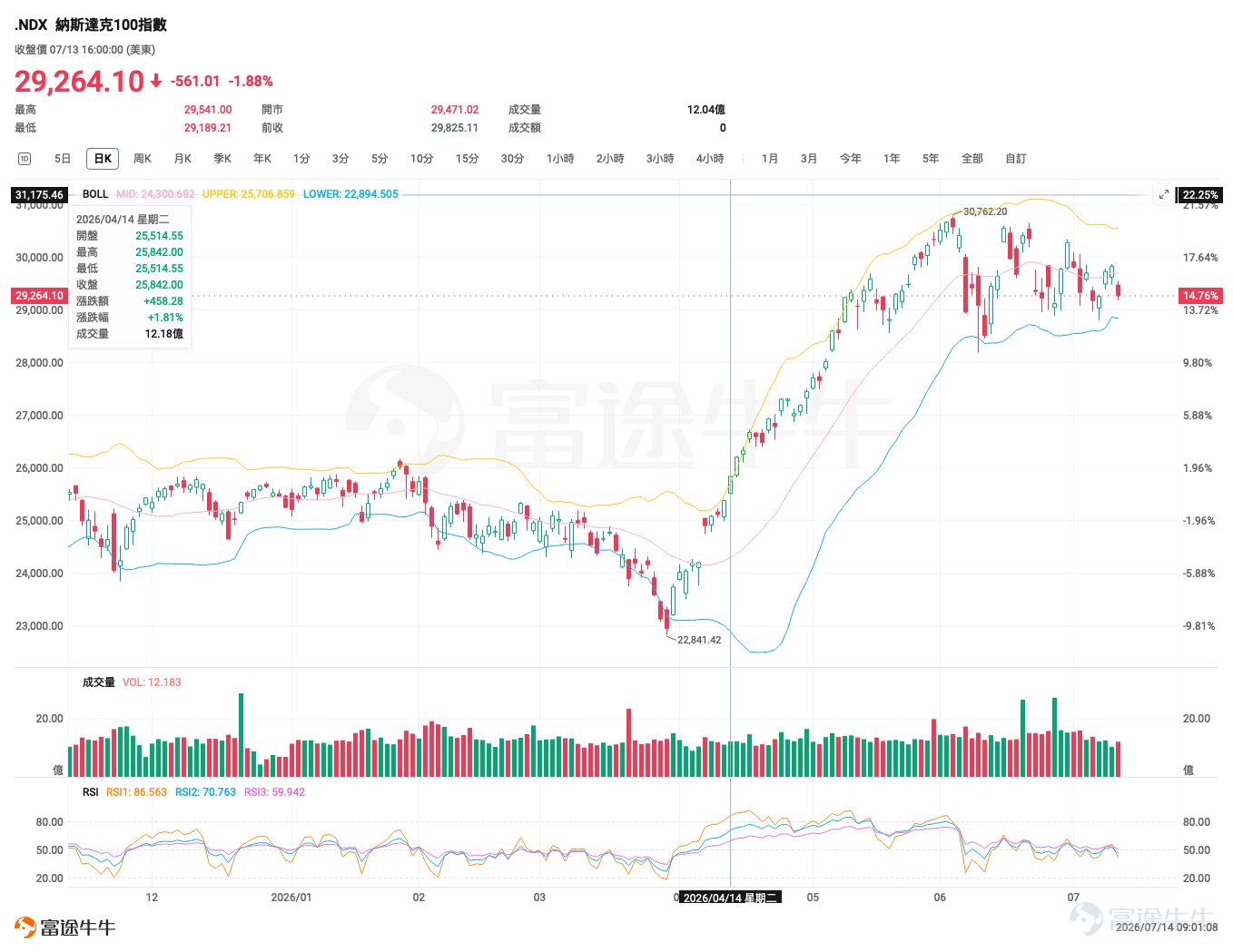
The Nasdaq-100 $NASDAQ 100 Index (.NDX.US)$ fell by about 1.9%, the S&P 500 $S&P 500 Index (.SPX.US)$ dropped roughly 0.8%, while the Dow Jones $Dow Jones Industrial Average (.DJI.US)$ only saw a minor pullback. All three remain at relatively elevated levels following the rebound from this year’s lows, though the Nasdaq has shown significantly higher volatility and is more prone to short-term reversals.
For investors using Hong Kong-listed products, our focus this time isn’t on 'which index fell the most,' but rather whether the existing terms of call warrants, put warrants, and bull/bear certificates can reasonably capture the next market move.
Nasdaq-100: Offers the widest product selection, but the terms behind high leverage are also the most stringent.
The Nasdaq-100 closed at approximately 29,264 points, down nearly 2% from its recent high of around 30,762 points. It has been trading mainly between 29,000 and 30,000 points recently, reflecting continued short-term volatility in tech stocks.
Currently, the Nasdaq-100 offers the most product choices among the three indices, but the terms vary significantly.
Bullish call warrants can generally be divided into two groups:
– Products closer to the current price or even slightly in-the-money, with strike prices around 28,800 to 28,944 points, offering effective leverage of approximately 9x to 10x and delta around 64%, exhibiting relatively normal sensitivity.
– More aggressive out-of-the-money products, with strike prices ranging from about 32,000 to 35,800 points (7% to 20% out-of-the-money), delivering effective leverage of roughly 12x to 21x, but with delta only around 16% to 42%.
For those merely expecting a short-term rebound in the Nasdaq, the second group appears highly leveraged. However, the issue is that the index must rise quickly and substantially for these products to become truly responsive. If the Nasdaq continues to trade sideways within its range, the degree of being out-of-the-money, daily time decay, and changes in implied volatility could offset some directional gains.
A similar situation applies to bearish puts. Near-the-money put warrants have strike prices around 29,000 points—only about 3% out-of-the-money—with effective leverage of approximately 9x and delta around 37%. For more downside exposure, strike prices drop to 27,000–28,000 points (6% to 10% out-of-the-money), offering leverage of roughly 11x to 14x.
As for puts with strikes more than 20% out-of-the-money, although some show leverage of around 12x, their delta is only about 4% to 6%, and daily time decay can exceed 4%. These products are closer to 'bets on a sharp crash' and are unsuitable for investors merely anticipating a mild Nasdaq correction.
Regarding bull certificates, the series closest to the current price has knock-out levels around 28,400 points—about 4.8% below spot—with leverage of approximately 19x. Products with knock-out levels between 27,500 and 28,000 points (roughly 6% to 8% below spot) offer leverage of about 12x to 15x.
The trade-off between these two groups is clear:
– Bull certificates with a distance of about 5% are most sensitive to short-term rebounds, but it’s not uncommon for the Nasdaq to swing several hundred points in a single night, resulting in high knock-in risk.
– Bull certificates with a distance of approximately 7% to 8% have their leverage reduced to around 12x, but offer significantly more room for error.
If investors already expect the Nasdaq to stabilize in the near term, we would not solely chase the closest-to-spot knock-in level. The Nasdaq is still trading within a relatively high range; maintaining a slightly wider knock-in buffer is generally more practical than gaining a few extra multiples of nominal leverage.
S&P 500: Trending more steadily, but existing warrant terms are somewhat uneven
The S&P 500 closed at around 7,515 points, not far from its recent high of approximately 7,621 points, and overall remains more stable than the Nasdaq.
In terms of call warrants, market terms are quite polarized.
One group has strike prices around 7,200 to 7,236 points—already about 4.5% to 5% in-the-money—with delta levels of roughly 73% to 76% and effective leverage of only about 12x. These products don’t offer dramatic leverage, but they track the index’s actual movements more closely.
Another group features strike prices as high as 9,000 points—nearly 19% out-of-the-money—with effective leverage of approximately 20x to 21x, but deltas of only about 8% to 9%, and daily time decay exceeding 2%.
For investors bullish on the S&P 500 continuing its upward trend, we clearly favor the former group. Given that the S&P typically exhibits lower volatility than the Nasdaq, expecting the index to rise nearly 20% in the short term—a prerequisite for deep out-of-the-money products to become effective—is an extremely aggressive assumption.
Even with a bearish outlook, caution is still warranted. The nearest put warrants have strike prices around 6,600 to 6,700 points, still about 12% out-of-the-money, with effective gearing of approximately 9x to 10x and delta values of only around 17% to 18%. Warrants with more distant strikes near 6,000 points are over 20% out-of-the-money, suffering daily time decay of nearly 5%.
In other words, Hang Seng Index (HSI) put warrants aren't unusable right now—but even the closest-to-the-money options require a relatively noticeable market correction before the products start reacting more sharply.
For bull certificates, the nearest knock-out levels are around 7,200 points—about 5% away—with gearing of roughly 15x; those with knock-out levels near 7,000 points are about 7.6% away and offer gearing of approximately 11x; and those further out at 6,900 points are nearly 9% away with gearing around 9.5x.
For investors who prefer a steadier HSI trend, knock-out distances of roughly 7% to 9% may better align with the index’s current pace. Although the closest-to-the-money products offer higher gearing, they could be knocked out prematurely during normal pullbacks from elevated levels.
Dow Jones: Most stable in trend, yet its products aren’t necessarily the easiest to select
The Dow closed around 52,499 points, slightly below its recent high of approximately 53,289 points—marking only a modest pullback. Among the three major indices, the Dow remains the closest to exhibiting strong consolidation for now.
For call warrants, the strike prices closest to the current level range from about 55,000 to 55,275 points—roughly 4.5% to 5% out-of-the-money—with effective gearing of around 6x and delta values of approximately 27% to 30%.
Moving one step further out, strike prices between 58,000 and 60,000 points are about 10% to 14% out-of-the-money, offering higher gearing of roughly 12x to 16x, though delta values drop to around 16% to 25%.
The Dow typically exhibits lower daily volatility than the Nasdaq, so we adopt a more conservative stance toward deep out-of-the-money Dow call warrants. Even if the directional view is correct, insufficient upside movement in the index may result in only sluggish price changes in these products.
The nearest put warrants have strike prices around 48,000 points—about 9% out-of-the-money—with effective gearing of approximately 10x and delta values around 22%. Many other put warrants are already 14% to 22% out-of-the-money.
This reflects that Dow Jones put warrants are currently positioned far out-of-the-money. Merely observing the Dow consolidating at elevated levels may not be sufficient to justify holding these products; unless a more substantial corrective wave in the index is anticipated, the time decay risk of deep out-of-the-money puts cannot be ignored.
For bull certificates, the nearest call price is around 50,000 points—approximately 5% away from the current level—with leverage of about 15x. Call prices around 49,000 to 49,100 points are roughly 7% away, offering leverage of about 11x to 12x. These terms are relatively clear and well-aligned with the current backdrop of the Dow still trading near highs.
For bear certificates, the nearest call price is around 55,000 points—about 4.5% above the current level—with leverage of approximately 27x. Call prices near 56,000 points are roughly 6.4% away, providing leverage of about 19x to 21x.
Investors bearish on the Dow should take special note: while at-the-money bear certificates offer highly attractive leverage, the Dow remains close to all-time highs. If the market suddenly rebounds by a few percentage points, these products could quickly enter the call range. Such terms are better suited for short-term trades with clearly defined entry points and stop-loss arrangements, rather than for patiently waiting for a trend reversal.
How should one differentiate among the three indices?
In simple terms:
– Nasdaq 100Offers the widest product selection, suitable for capturing larger volatility—but avoid being lured by the high leverage of deep out-of-the-money products.
– S&P 500Exhibits relatively stable price action; in-the-money or near-the-money call warrants reflect index movements more effectively than deep out-of-the-money structures.
– Dow Jones Industrial AverageRemains relatively strong, with bull certificate terms being comparatively clear; bearish products generally require a more significant index correction to perform effectively.
Being right on direction is only the first step. When it comes to actual Hong Kong-listed structured products, investors must also consider moneyness, delta, time decay, and the knock-in distance for bull/bear certificates. Especially in a high-level consolidation market, slightly reducing leverage and preserving more room for error is often more practical.


Risk Disclaimer: The above content only represents the author's view. It does not represent any position or investment advice of Futu. Futu makes no representation or warranty.Read more

Comments
to post a comment
1