
Bessent interprets signals from US-Iran talks, oil prices plunge

Week Ahead | Rate hike expectations rise as AI-driven stocks rebound against the broader trend
![Helping you understand this week’s U.S. and Hong Kong market strategies: With hawkish Fed minutes and escalating U.S.-Iran tensions, how will rate hike expectations reshape market dynamics? Hong Kong tech stocks have begun rebounding, with southbound funds recording nearly HK$40 billion in net inflows this week—how much room is left for further recovery? [I. Macro Outlook] 1.1 International Macroeconomic: Hawkish Fed minutes combined with renewed escalation in U.S.-Iran conflict—how far can rate hike expectations go? The June meeting minutes revealed that9 out of 18 participants now expect at least one rate hike by year-end,compared to none in March; only one participant anticipated a rate cut this year, down sharply from 12 in March.AI investment expansion, Middle East conflicts, and tariff policies were collectively identified as key factors that could keep inflation elevated and prompt further rate hikes.Although the labor market is no longer a clear source of inflationary pressure, it has also failed to drive inflation lower. Meanwhile, Trump announced that the U.S.-Iran ceasefire "has ended," and Iran's Revolutionary Guard declared the closure of the Strait of Hormuz,Escalating tensions between the U.S. and Iran are once again driving oil prices higher.Tariffs, rising oil prices, and the AI investment boom are generating successive waves of price shocks, continuously testing the Federal Reserve's policy framework of 'ignoring one-off price increases,'Overall market expectations for interest rate hikes continue to rise. Implied market interest rate for rate cuts Crude oil prices 1.2 Domestic Macroeconomics: AI-driven inflationary transmission is emerging—why has the expectation for monetary easing failed to materialize? JuneCPI rose 1.0% year-over-year,down 0.3% month-over-month, of which transportation-relatedenergy prices rose 5.9% month-over-month,rent declined 0.5% month-over-month, with price levels still driven by...](https://nnqimage.futunn.com/sns_client_feed/988889/20260713/web-1783907476387-QNb7sb0oOM.png/big?area=1&is_public=true&imageMogr2/ignore-error/1/format/webp)
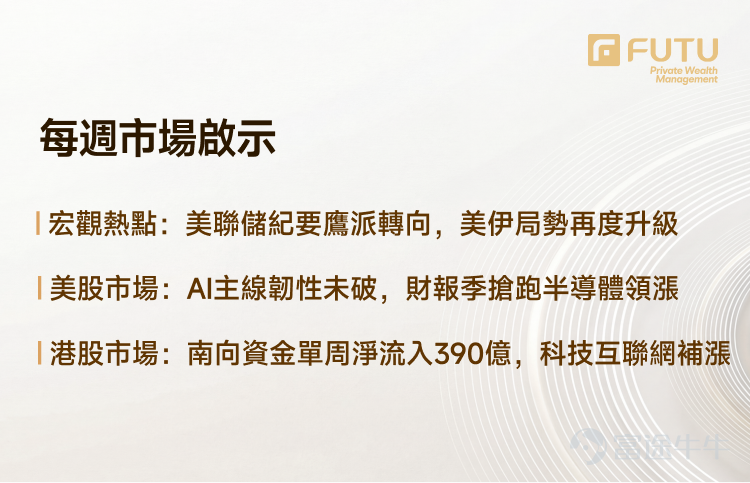
Helping you understand this week’s U.S. and Hong Kong market strategies:
With hawkish Fed minutes and escalating U.S.-Iran tensions, how will rate hike expectations reshape market dynamics?
Hong Kong tech stocks have begun rebounding, with southbound funds recording nearly HK$40 billion in net inflows this week—how much room is left for further recovery?
[I. Macro Outlook]
1.1 International Macroeconomic:
Hawkish Fed minutes combined with renewed escalation in U.S.-Iran conflict—how far can rate hike expectations go?
The June meeting minutes revealed that9 out of 18 participants now expect at least one rate hike by year-end,compared to none in March; only one participant anticipated a rate cut this year, down sharply from 12 in March.AI investment expansion, Middle East conflicts, and tariff policies were collectively identified as key factors that could keep inflation elevated and prompt further rate hikes.Although the labor market is no longer a clear source of inflationary pressure, it has also failed to drive inflation lower.
Meanwhile, Trump announced that the U.S.-Iran ceasefire "has ended," and Iran's Revolutionary Guard declared the closure of the Strait of Hormuz,Escalating tensions between the U.S. and Iran are once again driving oil prices higher.Tariffs, rising oil prices, and the AI investment boom are generating successive waves of price shocks, continuously testing the Federal Reserve's policy framework of 'ignoring one-off price increases,'Overall market expectations for interest rate hikes continue to rise.
Implied market interest rate for rate cuts

Source: Fed Watch, July 11, 2026
Crude oil prices

Source: Business Insider Markets, July 11, 2026
1.2 Domestic Macroeconomics:
AI-driven inflationary transmission is emerging—why has the expectation for monetary easing failed to materialize?
JuneCPI rose 1.0% year-over-year,down 0.3% month-over-month, of which transportation-relatedenergy prices rose 5.9% month-over-month,rent declined 0.5% month-over-month, with price levels still driven upward by energy, while real estate remains a drag.PPI rose 4.1% year-over-year, consumer electronics pricesup 0.7% month-over-month, mobile phone prices under the CPI measurerose 7.6% year-over-year, hitting a record high,The inflationary transmission of AI to the consumer side is accelerating and materializing.
Although the central bank’s Q2 Monetary Policy Committee meeting acknowledged weakening economic momentum and soft domestic demand, its statement indicateda lack of willingness in the near term to implement large-scale, broad-based monetary easing, making market expectations for imminent RRR cuts or rate cuts unlikely to materialize soon.
China's June CPI

Source: National Bureau of Statistics, July 11, 2026
China's June PPI

Source: National Bureau of Statistics, July 11, 2026
[II. Market Outlook]
2.1 US Stock Market
The S&P rose 1.23% and the Nasdaq gained 1.74% for the week—how should investors position themselves for earnings season now that concerns around the AI theme have moderated?
$S&P 500 Index (.SPX.US)$ gained 1.23% for the week, $NASDAQ 100 Index (.NDX.US)$ the Nasdaq rose 1.74%, while the Dow edged down 0.5%. Capital has refocused on the AI supply chain, semiconductors, and mega-cap tech stocks.Overall market risk appetite continues to recover, supported by heavyweight tech stocks, and Q2 earnings season has already begun.
Key View:Bias remains bullish,as market concerns over the AI theme have marginally eased. Typical 'front-run then verify' behavior is likely during the earnings season in mid-to-late July.As long as earnings expectations are not disproven and cloud providers’ capital expenditure (capex) guidance does not see material downward revisions, indices are likely to continue trending upward, with semiconductors leading the rally. However, if earnings merely meet expectations without raising profit or capex outlooks, the market could quickly shift from valuation recovery back to heightened volatility.
The S&P 500's forward 12-month price-to-earnings ratio stood at 20.8x (as of July 9), with the market expecting strong earnings growth for Q2.22%-24%range.SK Hynix's ADR listing saw oversubscription exceeding six times, reflecting global investors' continued willingness to pay a premium for the most critical and scarce AI hardware assets.10-year U.S. Treasury yieldrose to 4.559%, long-end rates remain elevated but have not triggered another round of systemic valuation compression in tech stocks.
S&P 500 forward 12-month P/E ratio at 20.8 (July 9)

Source: Bloomberg, compiled by Futu Wealth Management
Stock Spotlight – $Applied Materials (AMAT.US)$ : The world’s second-largest semiconductor equipment manufacturer, with a 17.8% share of the WFE market, benefiting from the AI-driven upcycle in wafer fab equipment.
From 2026 to 2027, WFE growth will be primarily driven by leading-edge logic/foundry, DRAM/HBM, and advanced packaging, with over 80% of year-over-year WFE growth by 2026 coming from these three segments.AMAT holds stronger market share and broader tool coverage in deposition, etch, DRAM, and advanced packaging, positioning it to outperform peers in GAA logic and stacked memory architectures. Management explicitly views 2027 as another robust year.
Demand is shifting significantly toward AMAT’s areas of strength., Advanced packaging continues to expand its product portfolio through NEXX and EPIC, driving growth that stems not only from sector-wide tailwinds (beta) but also from tool-level alpha. The company amplifies industry momentum into dual leverage on profitability and valuation through product mix optimization, market share gains, and service expansion.
AMAT exhibits characteristics of concentrated exposure within its segment, clear realization of operating leverage, and a valuation discount that is expected to continue narrowing. Its current valuation still has room for further convergence relative to peers.
AMAT Valuation

Source: Bloomberg, compiled by Futu Wealth Management
Breakdown of AMAT's Profit Margin Upside Over the Next Two Years

Source: Bloomberg, company announcements, Goldman Sachs research report, compiled by Futu Wealth Management
2.2 Hong Kong Stock Market
Hang Seng Index rose 3.53% for the week, with net southbound inflows of RMB 39.1 billion—can the tech rebound continue?
$Hang Seng Index (800000.HK)$ For the full week,up 3.53%, average daily trading volumeRMB 345.4 billionHKD, compared to last weekincreased by HK$20.9 billionHKD (+6.4%). Southbound net inflows via Stock Connect totaled HK$39.055 billion, the highest weekly net purchase since April. Leading contributors included Tencent (HK$7.2 billion), Alibaba (HK$6.0 billion), and Zhipu AI (HK$5.9 billion),showing a tech-sector rebalancing rebound amid amplified liquidity.
Key View:Short-term recovery is already underway, driven by a marginal easing of Fed tightening expectations, rotation of capital from high- to low-valued segments into Hong Kong internet and tech stocks, and concentrated southbound and ETF fund inflows at low valuation levels.However, the Hong Kong market tends to shift quickly from one-sided rebounds into volatile consolidation. Investors should watch for lock-up expirations totaling approximately HK$275 billion in July and HK$400 billion in September, equity issuance and follow-on financing drawdowns, and heightened sensitivity to U.S. tech earnings reports. Currently, the probability of gains outweighs the extent of payoff realization; near-term rebound dynamics remain intact, but the medium-term trend still hinges on confirmation from both earnings and policy developments.
Rationale:This round of Hong Kong market rebound essentially reflects a confluence of eased external USD liquidity pressure and improved domestic policy expectations.Externally, weaker-than-expected nonfarm payroll data has pushed market expectations for the next Fed rate hike to December, alleviating liquidity pressure on Hong Kong markets. Domestically, the People’s Bank of China explicitly stated its support for strengthening Hong Kong’s role as an international financial center through enhanced connectivity mechanisms, enriched financial services offerings, and expanded RMB funding arrangements. Notably, lock-up expirations amounting to roughly HK$275 billion in July and HK$400 billion in September represent the most immediate funding constraint over the next two months.Even if the broader index receives support from southbound and passive funds, differentiation across individual stocks and themes will be extremely pronounced.
The Hang Seng Index’s forward 12-month P/E ratio stood at 10.9x (as of July 10), remaining in a historically low valuation range, offering significant allocation appeal.
Hang Seng Index forward 12-month P/E ratio: 10.9 (July 10)

Source: Bloomberg, compiled by Futu Wealth Management
Stock Spotlight – $TENCENT (00700.HK)$ In the short term, it remains a stock under profit pressure, with weak earnings expectations and awaiting catalysts; in the medium term, it is a core business-stable, AI-enabled asset with genuine execution capabilities and low valuation, suitable for strategic allocation. Medium-term upside hinges on whether a closed-loop ecosystem—comprising WorkBuddy, HunYuan, and WeChat—can take shape and transform AI from a cost center into a revenue driver.
WorkBuddy’s key differentiation lies in its cross-IM and Tencent ecosystem integration capabilities—it connects to QQ and WeCom, reaches Feishu and DingTalk, and uniquely enables remote PC control via WeChat along with native integrations with Tencent Docs, Tencent Meeting, and IMA.Monthly active users reached tens of millions in May、Daily active users in the millions, indicating thatChinese users have genuine demand for task-execution AIOn July 1, the individual plan was expanded into three tiers—Standard, Advanced, and Flagship—at RMB 99, 199, and 999 per month, respectively. The enterprise plan saw its price increase from RMB 78 per user per month to RMB 198 per user per month (a 153.8% hike) starting May 15, establishing the earliest monetization path for AI.
The market currently prefers to value models directly and has not yet fully priced in the pathway of 'ecosystem plus applications achieving commercial viability first.'Although Tencent's large language model is not in the top tier, real-world complex office scenarios will continually expose its shortcomings in long-context handling, tool calling, document comprehension, error recovery, and task decomposition—providing high-quality training directions for HunYuan’s iteration and potentially transforming AI from a cost center into a revenue driver.If WorkBuddy’s commercialization metrics continue to validate this thesis, the expectation gap—where the model lags but application scenarios lead—could become a key catalyst for the stock price.
[III. This Week’s Focus]
![Helping you understand this week’s U.S. and Hong Kong market strategies: With hawkish Fed minutes and escalating U.S.-Iran tensions, how will rate hike expectations reshape market dynamics? Hong Kong tech stocks have begun rebounding, with southbound funds recording nearly HK$40 billion in net inflows this week—how much room is left for further recovery? [I. Macro Outlook] 1.1 International Macroeconomic: Hawkish Fed minutes combined with renewed escalation in U.S.-Iran conflict—how far can rate hike expectations go? The June meeting minutes revealed that9 out of 18 participants now expect at least one rate hike by year-end,compared to none in March; only one participant anticipated a rate cut this year, down sharply from 12 in March.AI investment expansion, Middle East conflicts, and tariff policies were collectively identified as key factors that could keep inflation elevated and prompt further rate hikes.Although the labor market is no longer a clear source of inflationary pressure, it has also failed to drive inflation lower. Meanwhile, Trump announced that the U.S.-Iran ceasefire "has ended," and Iran's Revolutionary Guard declared the closure of the Strait of Hormuz,Escalating tensions between the U.S. and Iran are once again driving oil prices higher.Tariffs, rising oil prices, and the AI investment boom are generating successive waves of price shocks, continuously testing the Federal Reserve's policy framework of 'ignoring one-off price increases,'Overall market expectations for interest rate hikes continue to rise. Implied market interest rate for rate cuts Crude oil prices 1.2 Domestic Macroeconomics: AI-driven inflationary transmission is emerging—why has the expectation for monetary easing failed to materialize? JuneCPI rose 1.0% year-over-year,down 0.3% month-over-month, of which transportation-relatedenergy prices rose 5.9% month-over-month,rent declined 0.5% month-over-month, with price levels still driven by...](https://nnqimage.futunn.com/sns_client_feed/988889/20260713/web-1783907083506-BJ264dCSs0.png/big?area=1&is_public=true&imageMogr2/ignore-error/1/format/webp)
[IV. Views from Major Banks]
US Stock Summary:Tech growth stocks have stabilized again, and concerns around the AI theme are marginally easing,The market may front-run earnings season initially and then validate afterward.。Cloud vendors have already priced in the recent cooling of capex expectations and remain uniquely positioned for upside within the AI supply chain,We are bullish on cloud vendors and semiconductors in the near term; current market pricing remains overly aggressive on rate hike expectations,Biotech offers an exceptionally attractive risk-reward profile.。
Hong Kong Stock Summary:Near-term recovery is driven by the marginal easing of Federal Reserve tightening expectations and concentrated southbound capital inflows into Hong Kong equities at low valuation levels; the fundamental support for the MSCI HK Index remains intact.Various short-term signals still point to a positive upward trend.Following the capital inflow, investors are repositioning in Hong Kong-listed internet and technology stocks via the southbound channel, and the medium- to long-term trend of net southbound inflows is expected to continue.Currently undervalued tech stocks still have room for catch-up gains.
![Helping you understand this week’s U.S. and Hong Kong market strategies: With hawkish Fed minutes and escalating U.S.-Iran tensions, how will rate hike expectations reshape market dynamics? Hong Kong tech stocks have begun rebounding, with southbound funds recording nearly HK$40 billion in net inflows this week—how much room is left for further recovery? [I. Macro Outlook] 1.1 International Macroeconomic: Hawkish Fed minutes combined with renewed escalation in U.S.-Iran conflict—how far can rate hike expectations go? The June meeting minutes revealed that9 out of 18 participants now expect at least one rate hike by year-end,compared to none in March; only one participant anticipated a rate cut this year, down sharply from 12 in March.AI investment expansion, Middle East conflicts, and tariff policies were collectively identified as key factors that could keep inflation elevated and prompt further rate hikes.Although the labor market is no longer a clear source of inflationary pressure, it has also failed to drive inflation lower. Meanwhile, Trump announced that the U.S.-Iran ceasefire "has ended," and Iran's Revolutionary Guard declared the closure of the Strait of Hormuz,Escalating tensions between the U.S. and Iran are once again driving oil prices higher.Tariffs, rising oil prices, and the AI investment boom are generating successive waves of price shocks, continuously testing the Federal Reserve's policy framework of 'ignoring one-off price increases,'Overall market expectations for interest rate hikes continue to rise. Implied market interest rate for rate cuts Crude oil prices 1.2 Domestic Macroeconomics: AI-driven inflationary transmission is emerging—why has the expectation for monetary easing failed to materialize? JuneCPI rose 1.0% year-over-year,down 0.3% month-over-month, of which transportation-relatedenergy prices rose 5.9% month-over-month,rent declined 0.5% month-over-month, with price levels still driven by...](https://nnqimage.futunn.com/sns_client_feed/988889/20260712/web-1783867718788-gQKbcz8cj2.jpeg/big?area=1&is_public=true&imageMogr2/ignore-error/1/format/webp)
[5. Simulated Portfolio]
Weekly performance for May 1st
![Helping you understand this week’s U.S. and Hong Kong market strategies: With hawkish Fed minutes and escalating U.S.-Iran tensions, how will rate hike expectations reshape market dynamics? Hong Kong tech stocks have begun rebounding, with southbound funds recording nearly HK$40 billion in net inflows this week—how much room is left for further recovery? [I. Macro Outlook] 1.1 International Macroeconomic: Hawkish Fed minutes combined with renewed escalation in U.S.-Iran conflict—how far can rate hike expectations go? The June meeting minutes revealed that9 out of 18 participants now expect at least one rate hike by year-end,compared to none in March; only one participant anticipated a rate cut this year, down sharply from 12 in March.AI investment expansion, Middle East conflicts, and tariff policies were collectively identified as key factors that could keep inflation elevated and prompt further rate hikes.Although the labor market is no longer a clear source of inflationary pressure, it has also failed to drive inflation lower. Meanwhile, Trump announced that the U.S.-Iran ceasefire "has ended," and Iran's Revolutionary Guard declared the closure of the Strait of Hormuz,Escalating tensions between the U.S. and Iran are once again driving oil prices higher.Tariffs, rising oil prices, and the AI investment boom are generating successive waves of price shocks, continuously testing the Federal Reserve's policy framework of 'ignoring one-off price increases,'Overall market expectations for interest rate hikes continue to rise. Implied market interest rate for rate cuts Crude oil prices 1.2 Domestic Macroeconomics: AI-driven inflationary transmission is emerging—why has the expectation for monetary easing failed to materialize? JuneCPI rose 1.0% year-over-year,down 0.3% month-over-month, of which transportation-relatedenergy prices rose 5.9% month-over-month,rent declined 0.5% month-over-month, with price levels still driven by...](https://nnqimage.futunn.com/sns_client_feed/988889/20260712/web-1783867719068-KvIynM3Gqu.jpeg/big?area=1&is_public=true&imageMogr2/ignore-error/1/format/webp)
5.2 Profit and loss attribution
![Helping you understand this week’s U.S. and Hong Kong market strategies: With hawkish Fed minutes and escalating U.S.-Iran tensions, how will rate hike expectations reshape market dynamics? Hong Kong tech stocks have begun rebounding, with southbound funds recording nearly HK$40 billion in net inflows this week—how much room is left for further recovery? [I. Macro Outlook] 1.1 International Macroeconomic: Hawkish Fed minutes combined with renewed escalation in U.S.-Iran conflict—how far can rate hike expectations go? The June meeting minutes revealed that9 out of 18 participants now expect at least one rate hike by year-end,compared to none in March; only one participant anticipated a rate cut this year, down sharply from 12 in March.AI investment expansion, Middle East conflicts, and tariff policies were collectively identified as key factors that could keep inflation elevated and prompt further rate hikes.Although the labor market is no longer a clear source of inflationary pressure, it has also failed to drive inflation lower. Meanwhile, Trump announced that the U.S.-Iran ceasefire "has ended," and Iran's Revolutionary Guard declared the closure of the Strait of Hormuz,Escalating tensions between the U.S. and Iran are once again driving oil prices higher.Tariffs, rising oil prices, and the AI investment boom are generating successive waves of price shocks, continuously testing the Federal Reserve's policy framework of 'ignoring one-off price increases,'Overall market expectations for interest rate hikes continue to rise. Implied market interest rate for rate cuts Crude oil prices 1.2 Domestic Macroeconomics: AI-driven inflationary transmission is emerging—why has the expectation for monetary easing failed to materialize? JuneCPI rose 1.0% year-over-year,down 0.3% month-over-month, of which transportation-relatedenergy prices rose 5.9% month-over-month,rent declined 0.5% month-over-month, with price levels still driven by...](https://nnqimage.futunn.com/sns_client_feed/988889/20260712/web-1783867718492-hBmcJUbfs1.jpeg/big?area=1&is_public=true&imageMogr2/ignore-error/1/format/webp)
5.3 Portfolio adjustment strategy
![Helping you understand this week’s U.S. and Hong Kong market strategies: With hawkish Fed minutes and escalating U.S.-Iran tensions, how will rate hike expectations reshape market dynamics? Hong Kong tech stocks have begun rebounding, with southbound funds recording nearly HK$40 billion in net inflows this week—how much room is left for further recovery? [I. Macro Outlook] 1.1 International Macroeconomic: Hawkish Fed minutes combined with renewed escalation in U.S.-Iran conflict—how far can rate hike expectations go? The June meeting minutes revealed that9 out of 18 participants now expect at least one rate hike by year-end,compared to none in March; only one participant anticipated a rate cut this year, down sharply from 12 in March.AI investment expansion, Middle East conflicts, and tariff policies were collectively identified as key factors that could keep inflation elevated and prompt further rate hikes.Although the labor market is no longer a clear source of inflationary pressure, it has also failed to drive inflation lower. Meanwhile, Trump announced that the U.S.-Iran ceasefire "has ended," and Iran's Revolutionary Guard declared the closure of the Strait of Hormuz,Escalating tensions between the U.S. and Iran are once again driving oil prices higher.Tariffs, rising oil prices, and the AI investment boom are generating successive waves of price shocks, continuously testing the Federal Reserve's policy framework of 'ignoring one-off price increases,'Overall market expectations for interest rate hikes continue to rise. Implied market interest rate for rate cuts Crude oil prices 1.2 Domestic Macroeconomics: AI-driven inflationary transmission is emerging—why has the expectation for monetary easing failed to materialize? JuneCPI rose 1.0% year-over-year,down 0.3% month-over-month, of which transportation-relatedenergy prices rose 5.9% month-over-month,rent declined 0.5% month-over-month, with price levels still driven by...](https://nnqimage.futunn.com/sns_client_feed/988889/20260712/web-1783867718233-YxQvOTwqJk.jpeg/big?area=1&is_public=true&imageMogr2/ignore-error/1/format/webp)
May 4 Portfolio Holdings
![Helping you understand this week’s U.S. and Hong Kong market strategies: With hawkish Fed minutes and escalating U.S.-Iran tensions, how will rate hike expectations reshape market dynamics? Hong Kong tech stocks have begun rebounding, with southbound funds recording nearly HK$40 billion in net inflows this week—how much room is left for further recovery? [I. Macro Outlook] 1.1 International Macroeconomic: Hawkish Fed minutes combined with renewed escalation in U.S.-Iran conflict—how far can rate hike expectations go? The June meeting minutes revealed that9 out of 18 participants now expect at least one rate hike by year-end,compared to none in March; only one participant anticipated a rate cut this year, down sharply from 12 in March.AI investment expansion, Middle East conflicts, and tariff policies were collectively identified as key factors that could keep inflation elevated and prompt further rate hikes.Although the labor market is no longer a clear source of inflationary pressure, it has also failed to drive inflation lower. Meanwhile, Trump announced that the U.S.-Iran ceasefire "has ended," and Iran's Revolutionary Guard declared the closure of the Strait of Hormuz,Escalating tensions between the U.S. and Iran are once again driving oil prices higher.Tariffs, rising oil prices, and the AI investment boom are generating successive waves of price shocks, continuously testing the Federal Reserve's policy framework of 'ignoring one-off price increases,'Overall market expectations for interest rate hikes continue to rise. Implied market interest rate for rate cuts Crude oil prices 1.2 Domestic Macroeconomics: AI-driven inflationary transmission is emerging—why has the expectation for monetary easing failed to materialize? JuneCPI rose 1.0% year-over-year,down 0.3% month-over-month, of which transportation-relatedenergy prices rose 5.9% month-over-month,rent declined 0.5% month-over-month, with price levels still driven by...](https://nnqimage.futunn.com/sns_client_feed/988889/20260712/web-1783867718709-66MBQlqD03.jpeg/big?area=1&is_public=true&imageMogr2/ignore-error/1/format/webp)
[Investment Advisory Information]
Yu Shilin, Licensed Representative, Central Entity Number: ATQ882
Yang Yi, Licensed Representative, Central Entity Reference Number: BUR210
Sun Bihan, Licensed Representative, Central Entity Reference Number: BWS708
[Disclaimer]
This report has been prepared by Futu Securities International (Hong Kong) Limited (“Futu Securities”). Without the prior written consent of Futu Securities, this report and the information contained herein may not be (i) reproduced, copied, or stored in any form, or (ii) distributed or transmitted directly or indirectly to any other person for any purpose. The information contained in this report is derived from sources that Futu Securities believes to be accurate and reliable as of the date of publication. However, this report is not intended to contain all information necessary for investor decision-making and may be affected by factors such as delivery delays, disruptions, or interception. Futu Securities makes no express or implied representation or warranty regarding the adequacy, accuracy, completeness, reliability, or fairness of any such information or opinions. Accordingly, neither Futu Securities nor its affiliates (collectively, the “Futu Group”) shall bear any liability for any losses of any kind (including, without limitation, direct, indirect, or consequential losses) arising from actions taken by any third party relying on the contents of this report. The views, recommendations, suggestions, and opinions expressed in this report do not necessarily reflect the positions of Futu Securities or its affiliates and are subject to change without notice. Futu Securities undertakes no obligation to update any information or opinions contained herein. This report is provided for general informational purposes only and is intended solely for general reading by clients of Futu Securities, without regard to the specific investment objectives, financial situation, or particular needs of any individual recipient. Nothing contained herein constitutes or should be construed as an offer, recommendation, or solicitation by any member of the Futu Group to buy or sell any securities, investments, or other financial instruments. It should not be interpreted as an offer or invitation to purchase or sell securities. Any decision to purchase securities mentioned in this report should take into account publicly available information, including any applicable prospectuses relating to such securities. The products referenced in this report may not be suitable for all investors. Readers should fully consider relevant factors and seek professional advice before making any investment decisions. This report is provided to each recipient on the basis that such recipient is deemed capable of independently evaluating investment risks and exercising independent judgment in making investment decisions. In certain jurisdictions or countries, the distribution, issuance, or use of this report may contravene local laws, regulations, rules, or other registration or licensing requirements. This report is not intended for distribution to, or use by, any person or entity in such jurisdictions or countries. Hong Kong investors with any questions regarding Futu Securities’ research reports should contact Futu Securities directly. The Central Entity Number of the author’s license issued by the Hong Kong Securities and Futures Commission is disclosed next to the author’s name on the front page of this report. The analyst primarily responsible for preparing this report confirms that: (i) the views expressed herein accurately reflect his or her personal views about the listed corporation(s) covered in this report; and (ii) none of the compensation he or she has received, is receiving, or will receive—directly or indirectly—is linked to any specific recommendations or views expressed in this report. The analyst further confirms that neither the analyst nor any of his or her associates have traded in the securities of the listed corporation(s) covered in this report or related securities during the 30-day period preceding the publication of this report or within three business days following its publication. Neither the analyst nor any of his or her associates serve as senior management of the listed corporation(s) covered in this report, nor do they hold any financial interest in such corporation(s). In this report, Futu Securities holds no financial interest amounting to 1% or more of the market capitalization of the issuer, and has had no investment banking relationship with the company in the past 12 months. None of the employees of Futu Securities are employees of the issuer.
Risk Disclaimer: The above content only represents the author's view. It does not represent any position or investment advice of Futu. Futu makes no representation or warranty.Read more

Comments
to post a comment
3
5