
SpaceX's second wave of lock-up expirations is here; how should investors position themselves in spa

Key milestones of SpaceX's $10 billion passive buying wave and lock-up expiration surge: How to effectively hedge against a highly volatile market environment?

$SpaceX (SPCX.US)$It will be officially added to the Nasdaq-100 Index before the market opens on July 7, Eastern Time.From its Nasdaq debut on June 12 to inclusion in this flagship tech index, less than a month has passed—SpaceX has set the record for the fastest inclusion since the inception of the Nasdaq-100 Index.
This accelerated inclusion stems from Nasdaq’s index rule changes implemented on May 1 this year.Under the new rules, newly listed large-cap stocks ranked among the top 40 by market capitalization can apply for inclusion after just 15 trading days, replacing the previous requirement of a minimum three-month waiting period. Additionally, Nasdaq revised several other inclusion criteria, including eliminating the 10% minimum free-float requirement, aggregating market capitalization across different share classes, and shifting the update frequency for total shares outstanding to quarterly. Market participants widely view these revisions as largely tailored to attract SpaceX.
Unlike the S&P 500, the Nasdaq-100 employs a purely rules-based selection mechanism; constituent adjustments do not require committee voting and are primarily driven by market capitalization rankings. Annual rebalancing occurs every December, with quarterly weight adjustments thereafter.
Beyond the passive inflows triggered by index inclusion, the timing of SpaceX’s lock-up expirations is also drawing significant market attention:
Staggered lock-up expirations will gradually increase the supply of tradable shares post-listing.
Due to the full exercise of the over-allotment option during SpaceX’s IPO,the initial free float stood at approximately 639 million shares, representing about 4.86% of total shares outstanding.Following this, as lock-up shares are released in batches, the actual tradable supply will progressively rise.
Ordinary employees and early institutional investors
Expected initial lock-up expiration date:Late July to early August 2026 (mandatory trigger mechanism; first tranche eligible for sale)
Broadly expected by Wall StreetSpaceX is widely expected to release its second-quarter financial results between late July and early August (specifically between July 25 and August 5). At that time, regular employees and early institutional investors will be permitted to sell 20% of their holdings.
Additionally, SpaceX has implemented a rolling, phased lock-up expiration schedule tied to fixed days following the IPO:
– Day 70 post-IPO: August 21, 2026 (7% unlocked)
– Day 90 post-IPO: September 10, 2026 (7% unlocked)
– Day 105 post-IPO: September 25, 2026 (7% unlocked)
– Day 120 post-IPO: October 10, 2026 (7% unlocked)
– Day 135 post-IPO: October 25, 2026 (7% unlocked)
Final comprehensive lock-up expiration milestone:Ordinary insiders will have an additional 28% of shares unlocked following the release of third-quarter earnings. By the 180th day post-listing (December 9, 2026), all remaining shares will be fully unlocked, and the lock-up periods for ordinary employees and early institutional investors will fully expire.
Elon Musk and core major shareholders—subject to a one-year lock-up
Elon Musk and core founding institutional investors are not entitled to any tiered early release provisions,and are uniformly subject to a 366-day lock-up period. The final unlock date will be June 13, 2027 (i.e., one year and one day after listing),marking the largest single-window share release event in the market.
All things considered,The initial unlock in late July will significantly expand the market’s freely tradable supply, creating a critical window of short-term downward pressure on the stock price. Conversely, the extended one-year-plus lock-up imposed on Elon Musk substantially reduces market expectations of concentrated near-term selling pressure.
Verifiable passive buying demand is estimated at USD 11.3 billion, with potential upside under broader assumptions.
Given SpaceX’s initially low free-float ratio, its weighting varies significantly across different index methodologies. The Nasdaq-100 employs a modified market-capitalization weighting approach, capping the effective float of low-free-float stocks at three times their actual free float, resulting in an estimated weighting of approximately 0.6% to 0.7%—one of the primary sources behind the passive demand estimate. The Nasdaq Composite Index uses a methodology closer to full market-cap weighting, yielding an estimated weighting of roughly 3.0% to 4.0%, though the assets tracking this index are significantly smaller than those tracking the Nasdaq-100. Based on publicly verifiable data regarding the total assets under management of ETFs, mutual funds, and certain overseas UCITS (Undertakings for Collective Investment in Transferable Securities) products,the potential passive buying demand triggered by SpaceX’s inclusion in major indices is estimated to reach USD 11.3 billion.
In terms of timing, passive buying flows will be phased in, initially representing approximately 10% to 15% of the free-float market capitalization ahead of the first batch of lockup expirations, and eventually stabilizing at around 2% to 3% once all shares are fully unlocked. Of this, Nasdaq-100-related products account for roughly $4 billion, making them the single largest source of incremental inflows; Nasdaq Composite-related products correspond to about $1.6 billion.
Selling Call Options Strategy
On the options data front,The implied volatility of the contracts expiring on July 17 is as high as 114.33%, implying an expected price swing of approximately ±24.67% by expiration. The put/call open interest ratio has risen to 0.81, indicating growing divergence among market participants and accumulating bearish sentiment.
Covered Call Strategy Reference
Reference contract:July 17, 2026, $180 CALL
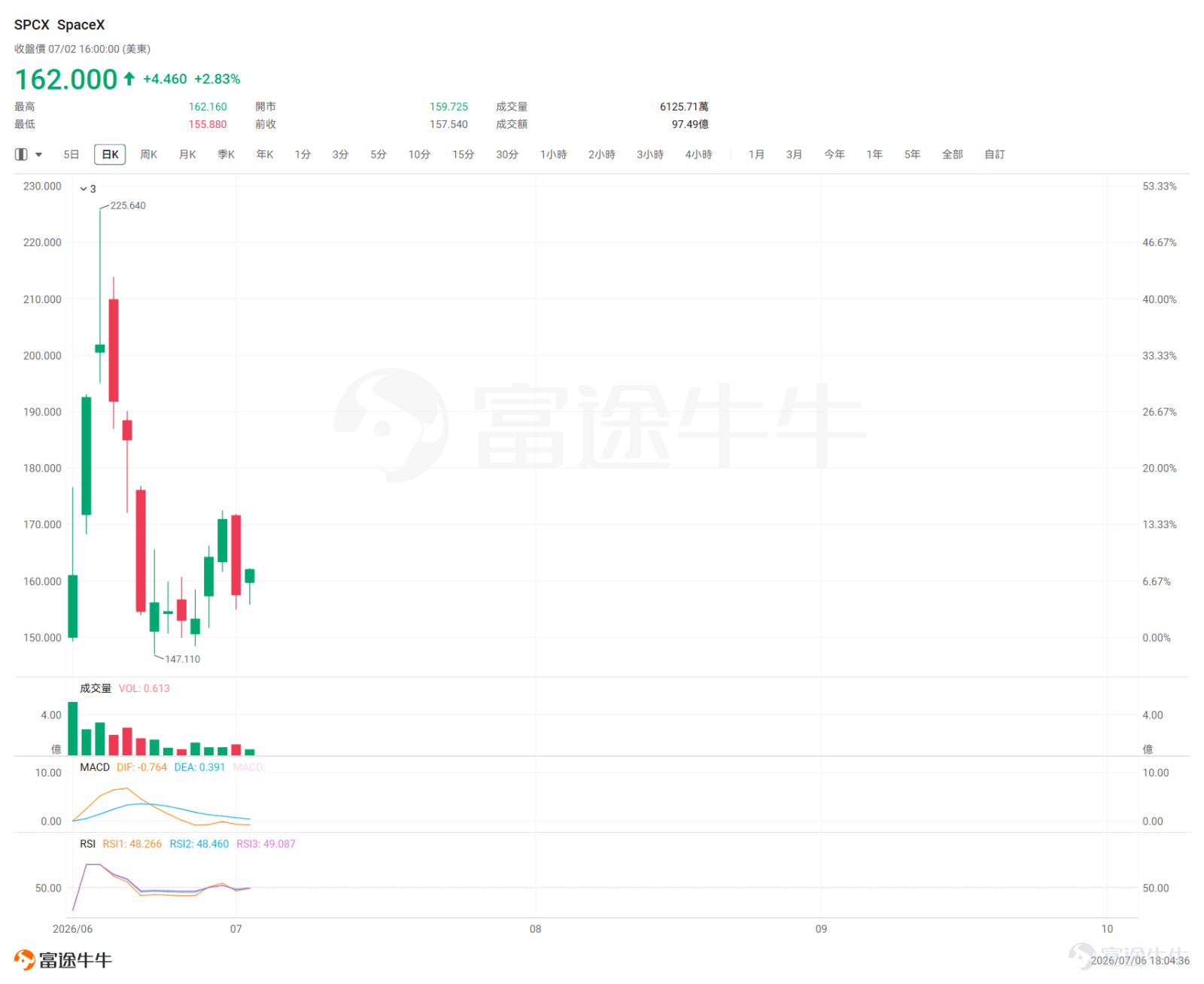
Opportunity Screening LogicFor investors who already hold SPCX and are facing floating gains subject to volatility,The stock may face 'buy the rumor, sell the fact' pressure in the short term following the realization of the Nasdaq-100 inclusion catalyst.The sector as a whole is under pressure due to slower-than-expected progress on reusable rockets, compounded by dense overhead resistance in the $170–$180 range, which may limit upside potential. Susquehanna’s $170 price target also reflects institutional caution regarding near-term valuation. Investors who remain bullish on the company’s long-term growth thesis but are concerned about post-catalyst volatility could consider selling call options. If the share price consolidates sideways in the current range, premium income can gradually lower their cost basis; if subsequent catalysts—such as Starship test flights—drive the price up toward the strike price and result in assignment, it would effectively lock in profits at a key technical resistance level.
Cash Secured Put strategy reference
Reference contract: July 17, 2026, $140 PUT
Opportunity Screening LogicFor investors who believe in SpaceX’s long-term narrative around commercial spaceflight and AI infrastructure but have not yet established a position,The current share price is experiencing sharp volatility due to the offsetting effects of sector-specific headwinds and the positive catalyst of index inclusion, posing a risk of pullback for those chasing short-term gains.However, passive buying demand triggered by inclusion in the Nasdaq-100, combined with potential catalysts such as Starship test flights, provides support for the long-term investment thesis. By selling put options, investors can collect elevated option premiums in this high-volatility environment if the stock stabilizes or rebounds from current levels; should the share price decline further toward the strike price due to negative sector sentiment, they would also have the opportunity to establish a position at a more prudent cost basis.
 Finally, here's a small perk for fellow investors. Welcome, fellow investors, to claim your benefit.Options Beginner Pack
*This event is exclusive to invited HK users. Click to learn more.Detailed event rules>>

Risk Warning
An option is a contract that gives the holder the right, but not the obligation, to buy or sell an asset at a fixed price at any time on or before a specific date. The price of an option is influenced by various factors, including the current price of the underlying asset, the strike price, the time to expiration, and implied volatility. Implied volatility reflects the market's expectation of the option’s volatility over a certain period in the future. It is derived inversely from the Black-Scholes (BS) pricing model and is generally considered an indicator of market sentiment. When investors expect greater volatility, they may be more willing to pay higher prices for options to help hedge risks, leading to higher implied volatility. Traders and investors use implied volatility to evaluate.Option priceto enhance attractiveness, identify potential mispricing, and manage risk exposure.
Disclaimer
This content is for reference only and should not be considered as an offer, solicitation, invitation, or advice to buy or sell any investment product or make any investment decision. It should also not be interpreted as professional advice. Options contracts are derivative products and may not be suitable for all investors. You should carefully consider your own investment experience, investment objectives, financial resources, and other relevant conditions before deciding whether to participate in such transactions. The risk of loss in trading options contracts can be substantial. In some cases, losses may exceed the initial margin deposited. Even if you have set contingent orders, such as 'stop-loss' or 'limit' orders, they may not prevent losses. Market conditions may render such orders unexecutable. You may be required to deposit additional margin within a short period. If you fail to provide the required amount within the specified time, your open positions may be liquidated. However, you will still be responsible for any shortfall in your account resulting from such liquidation. Therefore, before trading, you should study and understand index options and carefully consider whether such trading is suitable for you based on your financial situation and investment objectives. If you trade options, you should be familiar with the procedures for exercising options and the rights and obligations upon expiration.
Risk Disclaimer: The above content only represents the author's view. It does not represent any position or investment advice of Futu. Futu makes no representation or warranty.Read more


Comments (10)
to post a comment
64
180