
The storage sector's big three report earnings next week! Can their high momentum continue?

Options Sir Breaks Down the Hot Topic | Behind Micron’s Post-Earnings Surge: How to Interpret Its $100 Billion in Long-Term Agreements and Future Profit Growth Potential?
Leading memory chipmaker $Micron Technology (MU.US)$ Last night, it delivered another explosive earnings report: EPS for the third fiscal quarter surged more than 12-fold, and both EPS and revenue exceeded market expectations by 22% and 16%, respectively. Gross margin reached 84.9%, more than double that of a year ago, setting new all-time highs for a single quarter. As of now, the stock has risen approximately 18% in after-hours trading.
This article will focus on unpacking the implications behind the significantly better-than-expected guidance: How should Micron’s long-term customer agreements be interpreted, and do they carry sufficient enforceability? Will the expansion in capital expenditures increase supply and thereby pressure valuations? And what is Micron’s competitive positioning in the emerging HBM4 landscape?
Long-term customer agreements matter more than the earnings themselves
In this earnings release, Micron disclosed that it has signed 16 strategic customer agreements covering data centers, consumer electronics, and automotive markets.The company stated that these agreements typically span 2026–2030 and cover approximately 20% of DRAM shipments and one-third of NAND shipments.These signed agreements correspond to roughly $100 billion in remaining performance obligations (RPO) and are expected to generate $22 billion in customer deposits and related commitments, of which approximately $18 billion represents cash deposits.
The biggest issue with memory stocks in the past was that profits would collapse rapidly as soon as prices dropped.Now, if long-term agreements can lock in supply, price floors, and customer prepayments, Micron’s earnings visibility will significantly improve—effectively putting a 'floor' under a portion of its revenue.
How enforceable are these long-term agreements?
These agreements carry strong enforceability because they are not ordinary letters of intent but rather"take-or-pay"binding multi-year supply contracts under which customers commit to purchasing specified volumes and secure supply through price floors, cash deposits, and financial commitments.
Large-scale agreements typically set price ceilings for existing products close to Q2 2026 market prices, along with price floors that apply throughout the contract term; a small number of agreements use fixed pricing or pricing tied to market conditions. For next-generation products such as HBM4 and DDR6, premiums will continue to be renegotiated based on cost and value going forward.The price floor still enables Micron to achieve strong gross margins.
Although revenue amounts to only tens of billions of U.S. dollars,However, this figure is based on minimum committed volumes and minimum pricing,and reflects a conservative assumption,and does not represent the upper limit of future total revenue.
This does not mean the memory cycle has disappeared entirely, but it could reduce the volatility traditionally associated with Micron as a cyclical stock and raise the trough of the cycle.Alleviating market concerns about profits collapsing once the memory cycle turns is central to a potential valuation reassessment.
Both Q3 and Q4 guidance significantly exceeded expectations, with nearly all price increases flowing directly to the bottom line.
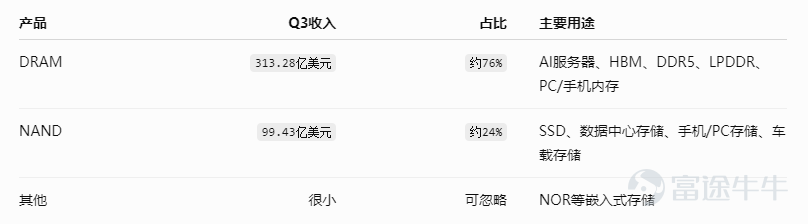
According to Q3 financial results,Micron’s core revenue still comes from DRAM and NAND, with DRAM accounting for approximately 76%.Among these, HBM has drawn the most market attention, though the company has not disclosed HBM’s total revenue contribution separately.

Micron’s product mix by revenue share
In the third quarter,NAND’s revenue growth is even more impressive.DRAM: USD 31.3 billion,up 67% quarter-over-quarter, with more than 60% of the increase driven by higher pricing; NAND: USD 9.9 billion,up 99% quarter-over-quarter, with average selling prices surging approximately 85%.
Long-term contracts are also more favorable for NAND,Existing agreements already cover approximately one-third of NAND output. Q3 revenue was $41.456 billion, Non-GAAP EPS was $25.11, and Non-GAAP gross margin was 84.9%. The Q4 guidance calls for revenue of $50 billion ± $1 billion, Non-GAAP EPS of $31 ± $1, and a gross margin of approximately 86%. Revenue, gross margin, and EPS all exceeded Wall Street expectations.
When memory industry prices rise, costs do not increase in tandem, so price increases flow almost directly to gross profit and EPS.Compared to a 74% quarter-over-quarter revenue increase, expense growth was minimal. R&D expenses—the largest cost component—rose only 5% quarter-over-quarter, while sales and administrative expenses increased by 18%.
More importantly, the company provided Q4 guidance for revenue of $50 billion ± $1 billion, Non-GAAP EPS of $31 ± $1, and a gross margin of approximately 86%., which even matches the most optimistic guidance currently held by the buy side.
The strong guidance indicates that near-term fundamentals remain robust, and the earnings upgrade cycle is not yet over.However, management also noted that the Q4 gross margin outlook reflects 'a significant slowdown in the pace of price increases.'Gross margin increased by about 10 percentage points sequentially in Q3, but is only expected to rise by another ~1 percentage point in Q4, indicating that pricing tailwinds persist, albeit with less acceleration than in Q3.
HBM4 continues to ramp up volume and could challenge SK Hynix’s leadership position.
Micron disclosed that its HBM4 12-high ramp-up speed is twice that of HBM3E 12-high, and HBM4 revenue has already exceeded $1 billion.. Mass production of HBM4E is expected to begin in 2027.
This means Micron isn't just benefiting from DRAM/NAND price increases—it's also moving into the core value chain of AI servers. As HBM's share grows, Micron's overall earnings quality will improve further.
The competitive issue today is no longer just whether Micron can participate in the HBM market, but whether Micron and Samsung can capture market share during the transition from the previous generation to the next.SK Hynix led during the HBM3E era, particularly due to its deep integration with NVIDIA's platform. In Q4 2025, SK Hynix held a 57% share of the global HBM market, followed by Samsung at 22% and Micron at 21%.
However, in the HBM4 generation, neither Samsung nor Micron are merely 'also-rans' anymore.Samsung has begun mass production of HBM4 and has HBM4E samples, while Micron is already generating HBM4 revenue and ramping up faster—giving both companies a real opportunity to gain share during the HBM4 transition window. According to Yonhap News Agency, Samsung’s HBM4 sales surpassed $1 billion just four months after launch.
This does not yet prove that SK Hynix is losing its leadership position, but it does indicate that HBM4 could be a critical window for Samsung and Micron to close the gap and reshape the allocation of next-generation AI memory orders.
How should we view future capital expenditures and capacity expansion?
The market worries that this round of aggressive memory capacity expansion could erode trough-cycle discipline, and is therefore highly concerned about the rapid rise in capital spending.Once this new capacity comes online in 2027–2028, the market will anticipate rising supply in advance, potentially pressuring memory stock valuations downward.
Micron’s Q3 capital expenditures were $7.1 billion, with Q4 expected to reach approximately $10 billion, bringing full-year FY2026 capex to around $27 billion. More importantly,the company explicitly stated that its quarterly capital expenditures in FY2027 will exceed Q4 levels, signaling a clear capacity expansion cycle. It’s not just Micron— the entire industry is accelerating equipment purchases and ramping up capacity.
Then why hasn’t the market immediately de-rated it yet?
Micron emphasized that in its planned increase in capital expenditures for FY2027, more than half will come from construction-related capex,That is, cleanrooms, factory buildings, and infrastructure cannot immediately be converted into equipment capacity for shipments.
Building a new fab, installing tools, testing, and ramping up production typically takes more than two years. Micron’s new Idaho facility in the U.S. won’t produce its first wafer until mid-2027, and the second plant won’t come online until end-2028; its HBM packaging capacity in Singapore will only start contributing in the first half of 2027.This means new supply will indeed begin coming online in 2027, but it usually takes additional time—through production ramp-up, yield improvements, customer qualification, and mass delivery—before it can materially impact market pricing.
This also implies stronger tailwinds for upstream semiconductor equipment stocks, as Micron explicitly stated in this earnings report that it has $ASML Holding (ASML.US)$ signed long-term agreements for EUV tools with suppliers.

How much further upside remains in the stock price?
The market broadly expects tight memory supply-demand conditions to persist through 2027.Further EPS growth will depend on 'continued increases in CSP cloud vendors’ AI-related capex + rising DRAM prices + catch-up gains in HBM pricing + further gross margin expansion.'
Standard DRAM prices have already risen significantly,The top three suppliers use an annual pricing mechanism for HBM, causing HBM contract prices to lag behind quarterly market price increases.As a result, standard DRAM now delivers higher profitability per wafer than HBM. With negotiations for HBM4 supply set to begin in 2027, memory manufacturers have stronger incentives to seek repricing for HBM. The faster HBM capacity expands, the tighter the supply of standard DRAM becomes.
Long-term agreements (LTAs) have thus become the catalyst for valuation reassessment.Currently, LTAs cover approximately 20% of DRAM volume and one-third of NAND volume, with the future target being to place more than half of revenue under long-term contracts.Based on Micron's Q4 EPS guidance of $30 per share, its current forward P/E ratio is around 10x.If more than half of its revenue becomes recurring under framework agreements, a further upward valuation re-rating could occur.
(1) If investors are bullish but consider current prices elevated and wish to buy at lower levels,
investors willing to buy the underlying stock on a pullback can also sell puts near their target entry price, provided they hold sufficient cash to cover the position.The strike price should be set at a level where you are genuinely comfortable owning the underlying shares; do not select an excessively high strike merely to collect premium. This strategy is essentially a 'cash-secured short put.'
If, at expiration, the stock price is above the strike price, the put option will not be exercised, and you keep the entire premium. If the stock price falls below the strike price, you acquire the shares at your pre-determined price. Using Micron as an example:
(The chart below illustrates the simulated profit and loss profile of this strategy at expiration. The displayed graphic is for illustrative purposes only, does not constitute investment advice or guarantees of any kind, reflects non-real-time data, and the prices shown do not represent actual market conditions.)

(2) For opening a new long position, prioritize using a call spread.
This earnings report has strengthened Micron's valuation logic, but it has also made the trade more crowded. If you remain bullish on Micron’s continued upside, buying short-dated options outright isn’t optimal. The reason is simple: implied volatility may still be relatively expensive post-earnings, and a single-leg call option can suffer from 'being right on direction but not gaining enough momentum quickly enough to profit.' This strategy suits those who are still bullish but don’t want to overpay for extremely high implied volatility. If Micron moves higher in a choppy or sideways-upward manner going forward, a call spread typically performs more steadily than buying a naked call.
This approach reduces premium costs but sacrifices some of the upside potential in extreme rallies. The strike price of the long leg determines your 'entry point' for participating in the upside, while the strike price of the short leg should be set near your view of a reasonable near-term price target. Using Micron as an example:
(The chart below illustrates the simulated profit and loss profile of this strategy at expiration. The displayed graphic is for illustrative purposes only, does not constitute investment advice or guarantees of any kind, reflects non-real-time data, and the prices shown do not represent actual market conditions.)

Risk Disclaimer: The above content only represents the author's view. It does not represent any position or investment advice of Futu. Futu makes no representation or warranty.Read more


Comments (5)
to post a comment
25
83