
Baoji Pharma's globally first-in-class low-immunogenicity IgG-degrading enzyme Ricefidase (KJ103) Phase II clinical data for anti-GBM disease presented at the ERA Congress
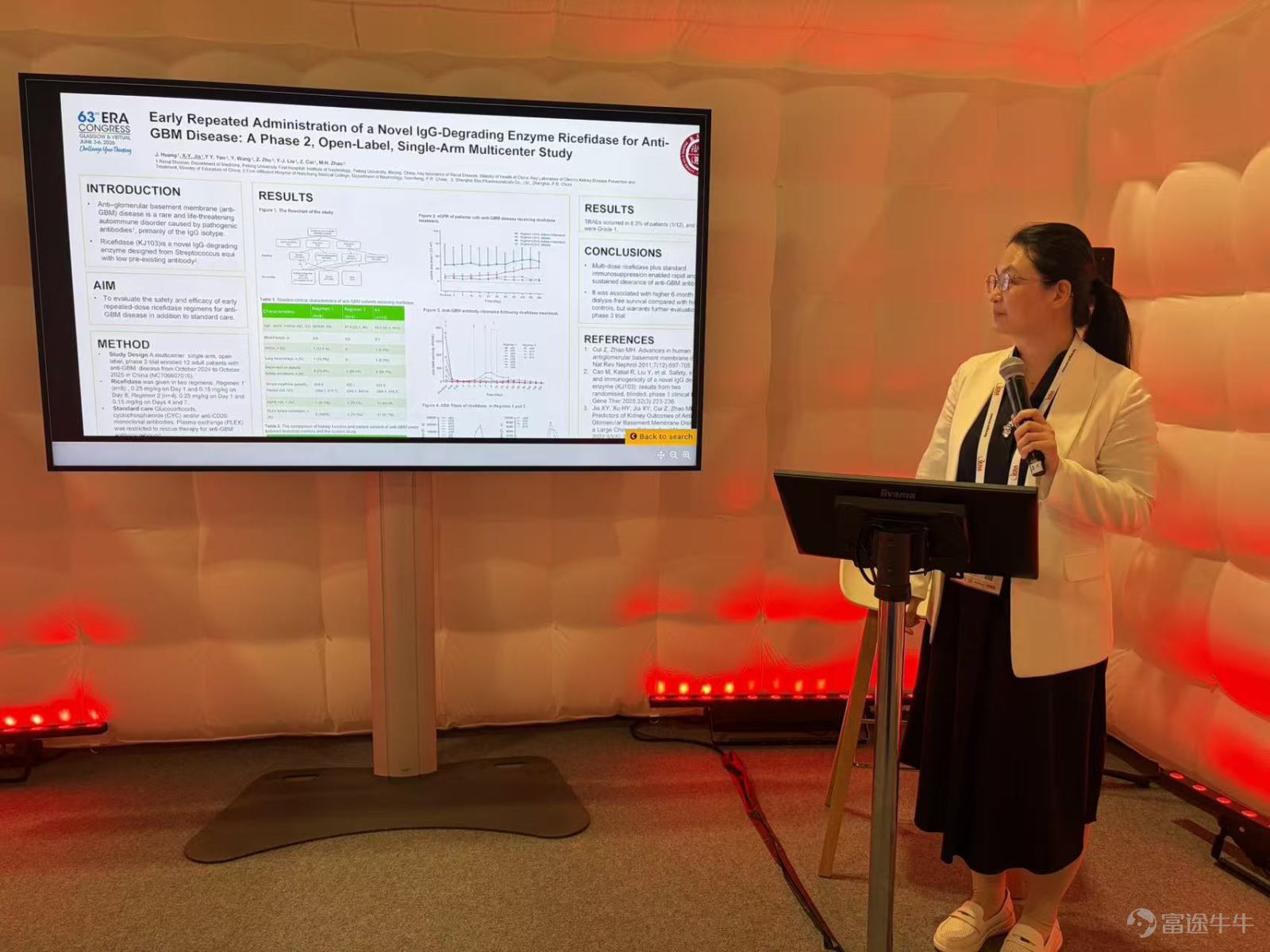
[Glasgow, United Kingdom, June 5, 2026] At the 63rd European Renal Association (ERA) Congress, results from the Phase II, open-label, single-arm, multicenter study titled 'Early Repeated Administration of the Novel IgG-Degrading Enzyme Ricefidase (KJ103) in Anti-GBM Disease,' led by Professor Zhao Minghui's team from Peking University First Hospital and sponsored by Baoji Pharma, were officially unveiled, drawing significant attention from the international nephrology community.
The study demonstrated that Ricefidase combined with standard immunosuppressive therapy enabled rapid and sustained clearance of anti-GBM antibodies and suggested potential clinical benefits in key outcome measures, offering a new therapeutic direction for this life-threatening rare autoimmune disease.
![[Glasgow, United Kingdom, June 5, 2026] At the 63rd European Renal Association (ERA) Congress, results from the Phase II, open-label, single-arm, multicenter study titled 'Early Repeated Administration of the Novel IgG-Degrading Enzyme Ricefidase (KJ103) in Anti-GBM Disease,' led by Professor Zhao Minghui's team from Peking University First Hospital and sponsored by Baoji Pharma, were officially unveiled, drawing significant attention from the international nephrology community. The study demonstrated that Ricefidase combined with standard immunosuppressive therapy enabled rapid and sustained clearance of anti-GBM antibodies and suggested potential clinical benefits in key outcome measures, offering a new therapeutic direction for this life-threatening rare autoimmune disease. Debuting on a major international nephrology academic platform The European Renal Association (ERA) Congress is one of the premier global academic conferences in nephrology, standing alongside the ASN Kidney Week as a leading forum for international scholarly exchange in the field. The congress brings together nephrologists and researchers worldwide to showcase the latest advances in nephrology. The presentation of Ricefidase’s Phase II clinical data marks a significant step in bringing these research findings into the global academic spotlight. Anti-GBM disease: A highly fatal rare condition with substantial unmet treatment needs...](https://nnqimage.futunn.com/sns_client_feed/40001564/20260622/web-1782107979032-ZCvq7M5yIC.jpeg/big?area=1&is_public=true&imageMogr2/ignore-error/1/format/webp)
Debuting on a major international nephrology academic platform
The ERA Congress (European Renal Association Congress) is one of the leading academic conferences in global nephrology, standing alongside ASN Kidney Week as a premier international platform for scholarly exchange in the field. The congress brings together nephrology experts and researchers worldwide to showcase the latest advances in the discipline. The presentation of Phase II clinical data for Ricefidase at this congress marks a significant step toward broader recognition of these research findings within the international academic community.
Anti-GBM disease: A highly fatal rare disorder with substantial unmet treatment needs
Anti-GBM disease is a rare but rapidly progressive autoimmune disorder mediated by anti-glomerular basement membrane antibodies (predominantly IgG), which can lead to rapidly progressive renal failure and pulmonary hemorrhage. Patients suffer from low long-term survival rates, severely impaired quality of life, and high mortality, imposing a heavy disease and economic burden on families and society.
Currently, patients with anti-GBM disease still lack standardized treatment approaches, and no therapy has been formally approved. Existing clinical strategies fail to achieve rapid clearance of anti-GBM antibodies, resulting in poor overall prognosis. Most patients ultimately progress to end-stage renal disease and derive limited clinical benefit from current treatments.
Ricefidase: Exploring the mechanism of a novel IgG-degrading enzyme
Ricefidase is a novel IgG-degrading enzyme developed by Baoji Pharmaceuticals through engineering a protein derived from Streptococcus. It specifically cleaves and clears circulating IgG antibodies, thereby rapidly reducing pathogenic antibody levels.
Its characteristics include low pre-existing antibody levels and the potential to support repeated dosing at short intervals, enabling flexible multi-dose regimen design.
Phase II study results suggest potential clinical benefit
Study results showed that, when added to standard immunosuppressive therapy, multiple doses of Ricefidase led to rapid reduction and sustained control of anti-GBM antibodies, with an observed trend toward improvement in key endpoints such as six-month dialysis-free survival.
Moreover, patients receiving the three-dose regimen did not require plasmapheresis during the study period, suggesting this approach may reduce reliance on conventional antibody-clearance methods.
These results provide a critical foundation for further Phase III confirmatory clinical studies.
Baoji Pharmaceuticals will continue collaborating with clinical research centers such as the First Hospital of Peking University to accelerate the subsequent clinical development of Ricefidase in the anti-GBM disease area.
Risk Disclaimer: The above content only represents the author's view. It does not represent any position or investment advice of Futu. Futu makes no representation or warranty.Read more
Comment (1)
to post a comment