
Daily Options Outlook | $1,500 Price Target Ignites Micron Technology, Intel's 18A-P Breakthrough, AMD Doubles Down on MEXT Acquisition
Today's Options Market Outlook
After a pullback in tech stocks yesterday, pre-market capital is flowing back into the semiconductor sector today.
$Micron Technology (MU.US)$ The stock rose 3.81% in pre-market trading. The immediate catalyst stems from Wall Street continuing to raise earnings expectations for the memory sector, with TD Cowen and Cantor Fitzgerald both issuing $1,500 price targets. The market remains focused on pricing around HBM and DRAM supply-demand tightness, as well as long-term AI data center contracts.
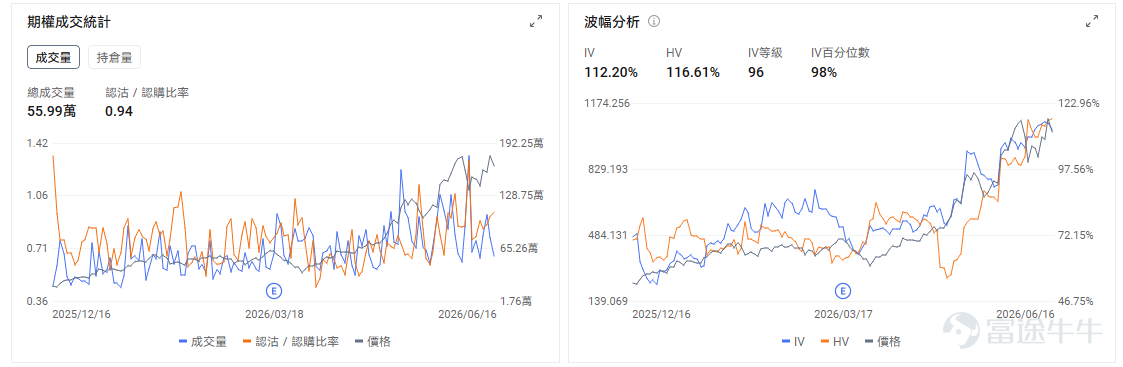
Micron is currently trading on whether the earnings baseline for the memory industry can sustain further upside. Options data shows active bullish positioning alongside increasing demand for protective strategies following the recent surge. Current implied volatility (IV) stands at 112.20%, with an IV rank of 96 and IV percentile at 98%, indicating option premiums are at historically elevated levels. For the June 18 expiration, call open interest significantly exceeds put open interest, and near-term contracts exhibit strong gamma effects. If the stock holds its pre-market highs after the open, call-side gains could amplify further. However, directly chasing long calls carries significant risk from potential volatility contraction; position sizing control or using call spreads would be more prudent.

$Intel (INTC.US)$ The stock rose 4.55% in pre-market trading. The company announced that its 18A-P process node has entered risk production, signaling that the technology has progressed beyond R&D validation into customer qualification and initial manufacturing—providing a new inflection point signal for its long-unprofitable foundry business.
The market’s next focus is whether Intel’s 18A-P process can attract external customers and ultimately translate into orders, improved capacity utilization, and gross margin expansion. In options data, Intel saw total volume of approximately 649,000 contracts, with a put/call volume ratio of just 0.60, indicating notably stronger bullish sentiment on the call side. Current implied volatility (IV) stands at 89.61%, with an IV percentile of 97%, reflecting that the market has already priced in a significant premium for a potential breakout. The $125 level is today’s clearest directional pivot—if the stock breaks above this level on strong volume and holds steady, existing call positions could reinforce short-term upside momentum; if it repeatedly fails to break through, call premiums may quickly erode in the current high-IV environment.

$Advanced Micro Devices (AMD.US)$ The stock rose 3.13% in pre-market trading. The company acquired MEXT, gaining memory tiering and predictive scheduling technology that shifts some data from expensive DRAM to NAND flash storage, aiming to alleviate memory capacity and cost pressures in AI data centers.
While the deal size may be modest, its strategic significance lies in AMD’s continued expansion from a CPU and GPU supplier toward a full-stack AI computing platform. As inference model sizes grow, memory costs and access efficiency are becoming critical factors affecting AI economics, and MEXT enhances AMD’s competitiveness in offering integrated data center solutions. On the options front, AMD recorded total volume of about 300,600 contracts, with a put/call ratio of 0.94, indicating relatively balanced bullish and bearish activity. Implied volatility (IV) stands at 75.33%, below the 83.45% historical volatility, suggesting recent actual price swings have exceeded what options pricing implies. However, with an IV rank of 91 and IV percentile of 96, absolute option premiums remain expensive. Today’s key level to watch is $530—if the stock breaks above it convincingly after the open, the market may continue pricing in post-acquisition platform potential; if it repeatedly stalls near this level, the rally may remain confined to event-driven recovery.

Review of yesterday's options market
Index Options
On June 16 (Eastern Time), U.S. equity index options volume increased, with a total of 6.73 million contracts traded. The put/call volume ratio declined to 0.94.
As the upcoming expiration date approaches, $S&P 500 Index (.SPX.US)$ Options volume distribution shows the following characteristics: peak put volume occurred at the 7,400 strike, while peak call volume was at the 7,600 strike.

Single Stock Options
$SpaceX (SPCX.US)$ The stock closed up 4.83%, with 1.7226 million options contracts traded and a put/call volume ratio of 0.77. SpaceX announced a $60 billion acquisition of Anysphere, the developer of the popular AI coding assistant Cursor.
$Intel (INTC.US)$The stock closed down 8.45%, with 649,000 options contracts traded and the put/call volume ratio dropping to 0.60. Intel announced that its 18A-P process has entered risk production phase, progressing on schedule.

Top list of options trading volume
Among the top 10 stocks by options trading volume,$Micron Technology (MU.US)$Micron Technology had the highest put/call volume ratio, reaching 0.94. Micron Technology will report earnings on June 24, with analysts expecting EPS of $19.63 and revenue of $34.43 billion.

Implied volatility rankings (underlying market cap > $10 billion and options trading volume > 100,000)
$AMC Entertainment (AMC.US)$Implied volatilityImplied volatility was highest at 129.95%, up 0.31% from the previous trading day. AMC Entertainment completed a $150 million equity financing, issuing approximately 105.3 million new shares.

$NEBIUS (NBIS.US)$ NEBIUS saw the largest increase in implied volatility, reaching 116.29%, up 2.25% from the prior session. NEBIUS completed its acquisition of Eigen AI and will join the Nasdaq 100 Index on June 22.

Risk Warning
An option is a contract that gives the holder the right, but not the obligation, to buy or sell an asset at a fixed price on a specific date or before that date. The price of an option is influenced by various factors, including the current price of the underlying asset, the strike price, time to expiration, and implied volatility.
Implied volatility reflects the market's expectation of the option's volatility over a certain period in the future. It is derived inversely from the BS pricing model of options and is generally considered an indicator of market sentiment. When investors anticipate greater volatility, they may be more willing to pay higher prices for options to hedge risks, resulting in higher implied volatility.
Traders and investors use implied volatility to assessOption priceto enhance attractiveness, identify potential mispricing, and manage risk exposure.Disclaimer
This content does not constitute any offer, solicitation, recommendation, opinion, or guarantee of any securities, financial products, or tools. The risk of loss in trading options can be substantial. In some cases, losses may exceed the initial margin deposited. Even if you set contingent orders such as 'stop-loss' or 'limit' orders, these may not prevent losses. Market conditions may make such orders unexecutable. You may be required to deposit additional margin within a short period. If you fail to provide the required amount within the specified time, your open positions may be liquidated. However, you will still be responsible for any shortfall in your account. Therefore, before trading, you should study and understand options and carefully consider whether such trading is suitable for you based on your financial situation and investment objectives. If you trade options, you should be familiar with the procedures for exercising options and the rights and obligations upon exercise and expiration. Options trading carries extremely high risks and is not suitable for all investors. Investors should carefully readCharacteristics and Risks of Standardized Options。
This content does not constitute any offer, solicitation, recommendation, opinion, or guarantee of any securities, financial products, or tools. The risk of loss in trading options can be substantial. In some cases, losses may exceed the initial margin deposited. Even if you set contingent orders such as 'stop-loss' or 'limit' orders, these may not prevent losses. Market conditions may make such orders unexecutable. You may be required to deposit additional margin within a short period. If you fail to provide the required amount within the specified time, your open positions may be liquidated. However, you will still be responsible for any shortfall in your account. Therefore, before trading, you should study and understand options and carefully consider whether such trading is suitable for you based on your financial situation and investment objectives. If you trade options, you should be familiar with the procedures for exercising options and the rights and obligations upon exercise and expiration. Options trading carries extremely high risks and is not suitable for all investors. Investors should carefully readCharacteristics and Risks of Standardized Options。
Risk Disclaimer: The above content only represents the author's view. It does not represent any position or investment advice of Futu. Futu makes no representation or warranty.Read more


Comments
to post a comment
13
7