
Supply shortages and upstream price hikes drive semiconductor materials and equipment stocks sharply

ASML Holding and Applied Materials soar to new highs! The capacity expansion wave has ignited a supercycle in semiconductor equipment— who will be the next hidden champion?
Recently, the global memory chip industry has entered a new round of capacity expansion. With Samsung Electronics and SK Hynix successively raising their capacity targets, and Micron Technology pushing large-scale expansions across multiple global locations, the sector’s high momentum is being further validated.
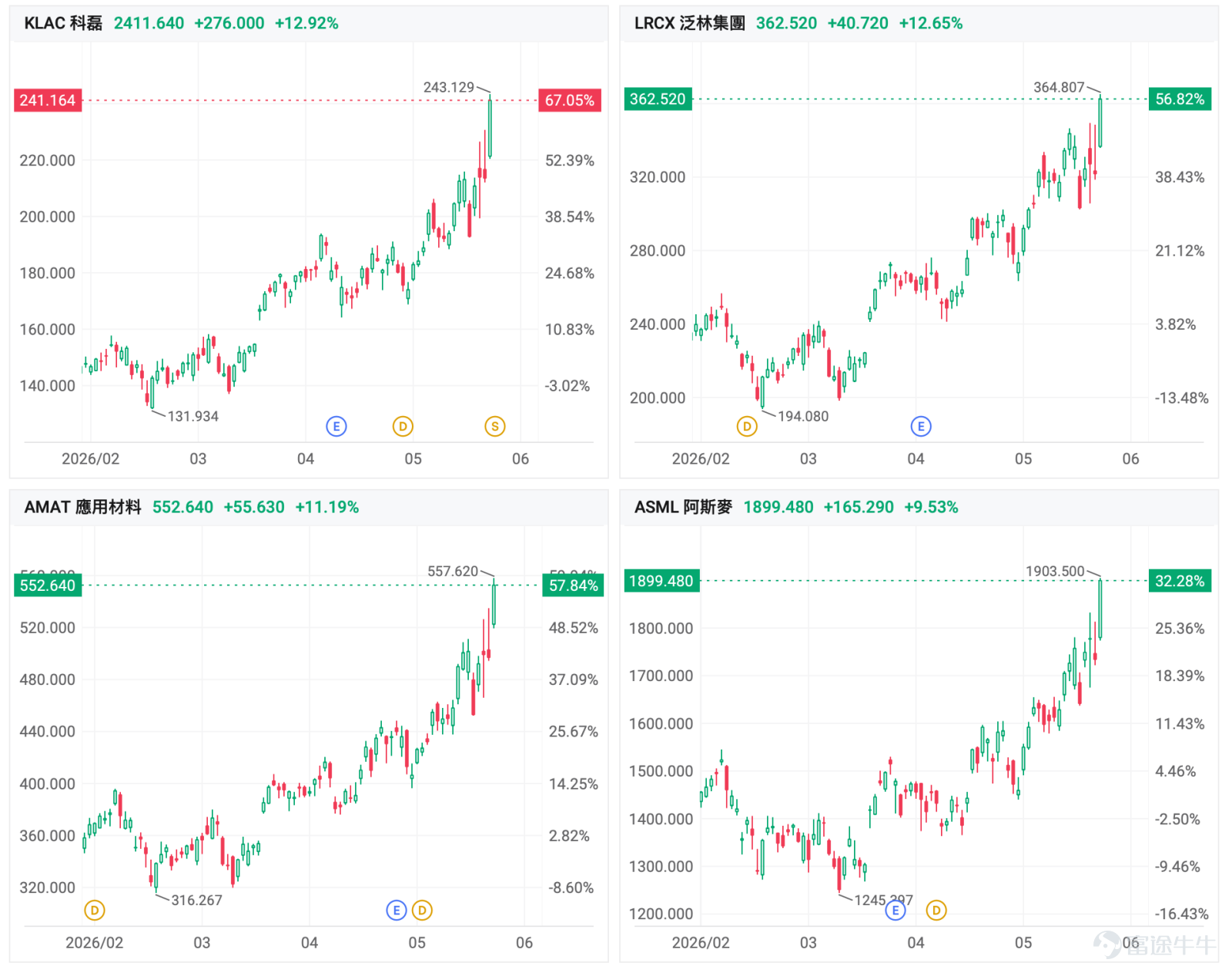
Judging from recent market performance, semiconductor equipment stocks have shown exceptional strength, $KLA Corp (KLAC.US)$ 、 $Lam Research (LRCX.US)$ 、 $Applied Materials (AMAT.US)$ 、 $ASML Holding (ASML.US)$ all reaching record highs.

So,what is the underlying logic behind the recent collective rally in semiconductor equipment stocks? Among the vast supply chain, which 'hidden champions' deserve fellow investors’ closest attention?Next, this article will provide fellow investors with an in-depth breakdown of the core drivers and promising stocks.
What is the cause of this latest surge?
Amid this wave of capacity expansion, $SK Hynix (000660.KR)$ SK Group's moves have drawn particular attention. SK Group Chairman Chey Tae-won recently revealed to the media that, in order to precisely meet the strong demand from the AI industry for advanced memory chips, SK Hynix plans to double its wafer production capacity within the next five years and has set a long-term goal of tripling total capacity by 2034.
In reality,The effects of this capacity expansion have already quickly rippled through to upstream suppliers.。According to reports,Several Tier-1 equipment suppliers to SK Hynix have recently requested price increases of 3% to 4%. SK Hynix has now asked these suppliers to submit detailed cost justifications for careful evaluation of the proposed adjustments.
UBS Group analysts also noted that as major memory manufacturers such as Micron Technology, Samsung, and SK Hynix bring new wafer fabs online,the global semiconductor equipment market is entering the 'early stage of a supercycle,' with related revenue projected to reach as high as $250 billion by 2028.
Arcuri stated,customers of semiconductor manufacturing equipment suppliers have already provided demand visibility extending up to eight quarters.In his nearly 30-year career studying the industry, this is 'unprecedented.'
UBS Group forecasts that total WFE (Wafer Fab Equipment) revenue will grow by 27% this year to $147 billion. Revenue from DRAM and NAND equipment is expected to surge by 50%, driven by memory chip capacity expansions, while logic chip equipment revenue—spearheaded by companies like Taiwan Semiconductor and Intel—is projected to increase by 12%. By 2027, total WFE revenue could rise another 35%, surpassing the $200 billion mark.
Additionally, Arcuri has raised next year’s memory WFE revenue forecast by $10.5 billion, reflecting accelerated DRAM spending as most new capacity additions are concentrated in the DRAM segment. NAND-related cleanroom utilization is expected to significantly increase starting in the second half of 2028.
Which companies in the supply chain deserve attention?
Overall, as global semiconductor capacity expansion accelerates across the board,the 'lead times' and 'supplier responsiveness' for core equipment have become critical variables constraining major chipmakers’ production schedules.
Currently, price increases are spreading forcefully from basic materials upstream to core equipment. Industry leaders such as Applied Materials (AMAT) and Tokyo Electron (TEL) have already signaled clear intentions to raise prices on certain equipment by 5% to 10%, highlighting the strong 'seller's market' dynamics prevailing in today’s equipment sector.
Before diving into representative companies, let’s first introduce the two core segments of semiconductor equipment:
– Front-end equipment (wafer fabrication): This is akin to 'building a house' in the microscopic world. It includes lithography, etching, and thin-film deposition tools, which precisely pattern complex nanoscale circuits onto bare silicon wafers.
– Back-end equipment (packaging and testing): This refers to the 'packaging and quality control' of chips. It includes dicing, wire bonding, packaging, and testing equipment, responsible for cutting wafers into individual chips, encasing them in protective shells, connecting wiring, and finally performing performance tests to ensure yield.

Now that you understand the broader industry trends, the next step is to explore related concept stocks. Fellow investors, here’s the latest list of semiconductor equipment concept stocks compiled for you:
This article will focus on introducing core listed companies in the Hong Kong and U.S. markets:

I. Front-end equipment: The core of wafer manufacturing
Front-end processes involve highly precise physical and chemical engineering, presenting extremely high technical barriers. The market has long been dominated by a few major equipment giants from Europe and the U.S.
1. Lithography equipment
$ASML Holding (ASML.US)$ is the undisputed global leader in the lithography equipment market.Its extreme ultraviolet (EUV) technology is the only solution available for wafer fabs to advance to 7-nanometer and below advanced nodes, giving it exceptional pricing power and irreplaceability.
$Veeco Instruments (VECO.US)$ focuses on compound semiconductor processes and advanced packaging technologies.Its core products include metal-organic chemical vapor deposition (MOCVD) and laser annealing equipment, giving it a distinct market share advantage in power devices and micro-display technologies.
2. Etching and Thin Film Deposition
$Applied Materials (AMAT.US)$ It is the world's largest semiconductor equipment manufacturer by revenue.It offers a highly comprehensive product portfolio covering thin film deposition (CVD/PVD), etching, ion implantation, and chemical mechanical planarization (CMP), playing a critical role in multi-material engineering for advanced processes.
$Lam Research (LRCX.US)$ It is one of the dominant global oligopolists in etching and thin film deposition equipment.Its technology holds an industry-leading position in processing high-aspect-ratio 3D NAND flash memory and advanced logic chips with complex 3D structures.
$Nordson (NDSN.US)$ It specializes in high-precision fluid dispensing and surface treatment equipment.Its technology is widely used for precise application of chemicals and adhesives in semiconductor manufacturing and packaging processes.
$CVD Equipment (CVV.US)$ It is a specialized equipment vendor focused on customized chemical vapor deposition (CVD) systems,primarily serving niche markets with specific material and specialty coating requirements.
3. Metrology and Inspection Equipment
$KLA Corp (KLAC.US)$It is the global leader in wafer process control and yield management equipment.It provides optical and electron-beam inspection solutions and is a key supplier for wafer fabs to manage nanoscale defects during process scaling.
$Nova (NVMI.US)$ It specializes in advanced dimensional metrology and material analysis.Its metrology tools deliver precise data on complex 3D structures, helping wafer fabs optimize their processes.
$Onto Innovation (ONTO.US)$& $Camtek (CAMT.US)$: Both companies are major players in the process control segment and have recently benefited from demand for AI chip advanced packaging (such as CoWoS and HBM), leading to significant growth in shipments of their high-precision inspection equipment for wafer-level packaging.
$Bruker Corp (BRKR.US)$: Originally founded as a manufacturer of high-performance scientific instruments, it now offers automated X-ray metrology and atomic force microscopy (AFM) solutions in the semiconductor industry for advanced analysis of microscopic crystal structures.
$Keysight Technologies (KEYS.US)$It provides comprehensive electronic design and test solutions,A key provider of critical testing services across the semiconductor lifecycle, from early chip design verification to post-manufacturing high-frequency circuit testing.
4. Cleaning and Ion Implantation
$ACM Research (ACMR.US)$ Focuses on semiconductor cleaning equipment.Leveraging its proprietary megasonic cleaning technology, it effectively addresses complex 3D structure cleaning challenges and is gradually expanding into advanced packaging.
$Axcelis Technologies (ACLS.US)$ Focuses on ion implantation equipment.Benefiting from rising demand for third-generation semiconductors such as silicon carbide (SiC) driven by the electric vehicle and green energy sectors, its ion implantation equipment revenue has shown strong growth.
II. Back-End Equipment: Packaging and Testing
As the cost of advancing Moore's Law escalates, advanced packaging has become essential to sustain chip performance improvements, significantly boosting capital expenditures on back-end equipment.
1. Packaging Bonding and Advanced Packaging
$ASMPT (00522.HK)$ As a global leader in semiconductor packaging and surface mount technology (SMT) equipment,Its business covers traditional wire bonding equipment and is actively expanding into advanced packaging equipment such as thermocompression bonding (TCB) and hybrid bonding, making it a core indicator stock in the Hong Kong market for tracking advanced packaging trends.
$Kulicke & Soffa Industries (KLIC.US)$ It is a traditional global leader in wire bonding equipment.Its products are primarily used in mature packaging processes for automotive electronics, industrial control, and mass-market consumer electronics, providing stable cash flow.
2. Testing Equipment and Probe Cards
$Teradyne (TER.US)$ It is one of the two global giants in automated test equipment (ATE).(the other being $Advantest (6857.JP)$ )。responsible for functional and performance testing of system-on-chip (SoC), AI accelerators, and memory chips before they leave the factory.
$Cohu Inc (COHU.US)$ specializes in test handlers, temperature control subsystems, and test contactors.ensuring testing stability and handling efficiency for chips under extreme temperature conditions.
$FormFactor (FORM.US)$is a global leader in advanced probe cards.Probe cards are a critical consumable in the wafer testing phase, with demand highly correlated to chip shipment volumes and design complexity.
Summary
In summaryDriven robustly by the AI wave and memory chipmakers' capacity expansions, the global semiconductor equipment industry is entering an unprecedented 'super cycle,' offering investors an excellent opportunity to uncover 'hidden champions' in the supply chain.
However,Opportunities come hand-in-hand with risks.While capitalizing on the sector's strong tailwinds, fellow investors should remain vigilant about potential risks such as geopolitical uncertainties, a reversal in end-market demand, and slower-than-expected fab capacity ramp-ups. It is advisable to closely monitor companies’ earnings delivery, stay rational, and position portfolios prudently.
Risk Disclaimer: The above content only represents the author's view. It does not represent any position or investment advice of Futu. Futu makes no representation or warranty.Read more


Comments (8)
to post a comment
141
468