
English
Back
Open Account
Cloud giants are snapping up long-term contracted capacity—will the 'inventory is king' narrative co
AceCamp本营
joined discussion · Jun 8 11:58

South Korea's stock market isn't expensive, but it's somewhat fragile

I. Valuation Levels and Earnings Performance
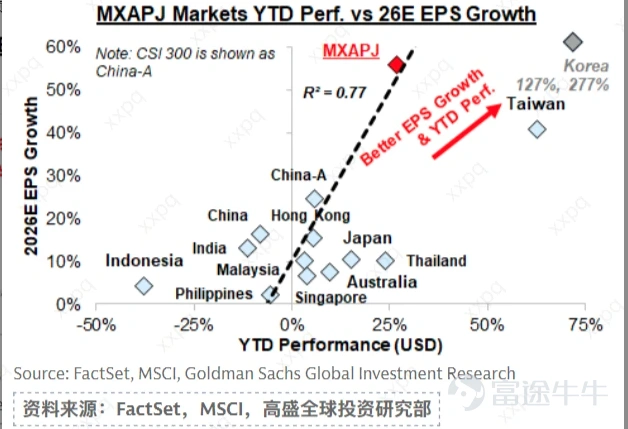
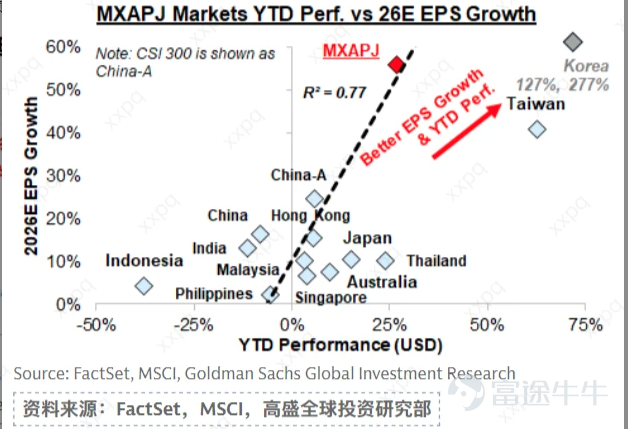
The KOSPI has doubled this year. Its current forward P/E ratio stands at around 8.2x. By comparison, the S&P 500 trades at 22x, the Nikkei 225 at 18x, and MSCI Asia Pacific ex-Japan at roughly 14x. At 8.2x, the KOSPI looks cheap by any standard. However, historically, the KOSPI’s cyclically adjusted peak P/E has only been around 10x. The market’s valuation ceiling has traditionally been low—due to chaebol governance issues, poor shareholder returns, and geopolitical risks. This so-called 'Korea discount' is nothing new. At 8.2x, we’re only about 20% away from that 10x historical peak.
Earnings are genuinely strong. Consensus forecasts from major international banks for KOSPI earnings growth this year have been revised upward from 48% to 277%. Q1 actual growth came in at 218%.
I. Valuation Levels and Earnings Performance The KOSPI has doubled this year. Its current forward P/E ratio stands at around 8.2x. By comparison, the S&P 500 trades at 22x, the Nikkei 225 at 18x, and MSCI Asia Pacific ex-Japan at roughly 14x. At 8.2x, the KOSPI looks cheap by any standard. However, historically, the KOSPI’s cyclically adjusted peak P/E has only been around 10x. The market’s valuation ceiling has traditionally been low—due to chaebol governance issues, poor shareholder returns, and geopolitical risks. This so-called 'Korea discount' is nothing new. At 8.2x, we’re only about 20% away from that 10x historical peak. Earnings, however, are genuinely strong. Major international banks have revised their consensus forecast for KOSPI earnings growth this year upward—from 48% to 277%. Actual Q1 earnings growth came in at 218%.  The main driver is memory chips. The four largest U.S. cloud providers plan $640 billion in capital expenditures this year, up 70% year-over-year. South Korea accounts for roughly 90% of global HBM production and 70% of memory chips overall. Excluding Samsung and SK Hynix, the rest of the market is expected to deliver earnings growth of 57% this year. Samsung (36%) and SK Hynix (29%) together account for 65% of the index’s gains, leaving the remaining 800 stocks to split the other 35%. All this apparent cheapness rests on a single assumption: that the memory chip supercycle will continue. If that assumption holds, the market truly is undervalued. But if AI-related capex unexpectedly slows down, what looks cheap today could quickly become expensive. II. Who’s Buying and Who’s Selling? ...
The main driver is memory chips. The four largest U.S. cloud providers plan $640 billion in capital expenditures this year, up 70% year-over-year. South Korea accounts for 90% of global HBM supply and 70% of memory chips. Excluding Samsung and SK Hynix, the rest of the market is expected to see earnings growth of 57% this year. The rally in the KOSPI has been driven primarily by Samsung (36%) and SK Hynix (29%)—together accounting for 65%. The remaining 800 stocks share the other 35%.
All this apparent cheapness rests on a single assumption: that the supercycle in memory chips will continue. If this assumption holds, valuations are indeed attractive. But if AI-related capex unexpectedly slows, what looks cheap could quickly become expensive.
II. Who’s buying and who’s selling?
Foreign investors have net sold about USD 50 billion year-to-date, with 90% of those sales concentrated in Samsung and SK Hynix. Yet counterintuitively, foreign ownership of the KOSPI has actually risen from 36% to 39%—a 3-percentage-point increase since the start of the year. Despite heavy selling, their holdings have grown heavier—because the unsold portions of these two stocks appreciated so rapidly that the market value increase outpaced the amount sold.
I. Valuation Levels and Earnings Performance The KOSPI has doubled this year. Its current forward P/E ratio stands at around 8.2x. By comparison, the S&P 500 trades at 22x, the Nikkei 225 at 18x, and MSCI Asia Pacific ex-Japan at roughly 14x. At 8.2x, the KOSPI looks cheap by any standard. However, historically, the KOSPI’s cyclically adjusted peak P/E has only been around 10x. The market’s valuation ceiling has traditionally been low—due to chaebol governance issues, poor shareholder returns, and geopolitical risks. This so-called 'Korea discount' is nothing new. At 8.2x, we’re only about 20% away from that 10x historical peak. Earnings, however, are genuinely strong. Major international banks have revised their consensus forecast for KOSPI earnings growth this year upward—from 48% to 277%. Actual Q1 earnings growth came in at 218%.  The main driver is memory chips. The four largest U.S. cloud providers plan $640 billion in capital expenditures this year, up 70% year-over-year. South Korea accounts for roughly 90% of global HBM production and 70% of memory chips overall. Excluding Samsung and SK Hynix, the rest of the market is expected to deliver earnings growth of 57% this year. Samsung (36%) and SK Hynix (29%) together account for 65% of the index’s gains, leaving the remaining 800 stocks to split the other 35%. All this apparent cheapness rests on a single assumption: that the memory chip supercycle will continue. If that assumption holds, the market truly is undervalued. But if AI-related capex unexpectedly slows down, what looks cheap today could quickly become expensive. II. Who’s Buying and Who’s Selling? ...
Why are foreign investors selling?
The primary reason for foreign selling isn’t bearish sentiment—it’s regulatory compliance. Strong price appreciation has triggered rebalancing-driven divestments to avoid excessive concentration in specific sectors and countries. This implies that if prices pull back, foreign investors could become buyers again. However, another signal warrants attention: according to UBS Group, allocations to South Korea by emerging-market active funds have dropped to 'near historic lows.' Passive funds (ETFs) are adding exposure, while active managers are retreating. These two investor types operate under different logics: passive ETFs chase momentum, whereas active funds make judgment-based decisions.
Who’s stepping in?
Retail investors have absorbed USD 32 billion, and domestic institutions have taken USD 21 billion. With 15 million people trading stocks in a population of 51 million, roughly one in three individuals participates in the market. There are 105 million active trading accounts—an average of more than two per person. Minor accounts surged tenfold year-over-year in Q1. Brokerage-cash balances jumped from KRW 89.5 trillion to KRW 119.5 trillion in just two months. Assets in leveraged ETFs now total USD 35 billion, representing 1.2% of free-float market capitalization (Goldman Sachs).
U.S. equity exposure
In 2025, Korean retail investors net bought $73.6 billion of U.S. equities, ranking third globally. U.S. stocks account for 63% of Korea’s overseas investment portfolio—far exceeding the 25% average among advanced economies. Retail investors are simultaneously heavily positioned in Korean semiconductors and U.S. tech stocks, creating strong correlation between the two. If the AI narrative falters, both sides will suffer losses.
III. Leverage Levels: Structural Vulnerability
Let’s start with a counterintuitive fact: margin debt in Korea accounts for only 0.5% of total market capitalization, and this ratio has been declining—because the market has risen faster than borrowing. However, leverage risk cannot be assessed by looking at a single metric; it must be unpacked across four layers, which leads to a completely different conclusion.
Stock Leverage — How much borrowed money is in the system
I. Valuation Levels and Earnings Performance The KOSPI has doubled this year. Its current forward P/E ratio stands at around 8.2x. By comparison, the S&P 500 trades at 22x, the Nikkei 225 at 18x, and MSCI Asia Pacific ex-Japan at roughly 14x. At 8.2x, the KOSPI looks cheap by any standard. However, historically, the KOSPI’s cyclically adjusted peak P/E has only been around 10x. The market’s valuation ceiling has traditionally been low—due to chaebol governance issues, poor shareholder returns, and geopolitical risks. This so-called 'Korea discount' is nothing new. At 8.2x, we’re only about 20% away from that 10x historical peak. Earnings, however, are genuinely strong. Major international banks have revised their consensus forecast for KOSPI earnings growth this year upward—from 48% to 277%. Actual Q1 earnings growth came in at 218%.  The main driver is memory chips. The four largest U.S. cloud providers plan $640 billion in capital expenditures this year, up 70% year-over-year. South Korea accounts for roughly 90% of global HBM production and 70% of memory chips overall. Excluding Samsung and SK Hynix, the rest of the market is expected to deliver earnings growth of 57% this year. Samsung (36%) and SK Hynix (29%) together account for 65% of the index’s gains, leaving the remaining 800 stocks to split the other 35%. All this apparent cheapness rests on a single assumption: that the memory chip supercycle will continue. If that assumption holds, the market truly is undervalued. But if AI-related capex unexpectedly slows down, what looks cheap today could quickly become expensive. II. Who’s Buying and Who’s Selling? ...

Source: JPMorgan, Goldman Sachs
Who is borrowing and where the money is going
Underlying data obtained by the office of National Assembly member Kang Min-guk from the Financial Supervisory Service shows that individuals aged 50 and above hold over 60% of margin financing balances. Those aged 50–59 hold KRW 9.06 trillion, up 85% year-over-year. Those aged 60–69 hold KRW 6.17 trillion, up 118% YoY. Those aged 70 and above hold KRW 2.13 trillion, doubling YoY. This is not disposable income for young people—it’s retirement savings and nest eggs, representing a systemic shift from bank deposits into risky assets. When a 65-year-old uses margin to buy Samsung shares, a margin call isn’t just a loss—it wipes out their pension.
Dynamic Leverage — What happens when markets fall
Indicator Source: KOSPI2-linked Short Gamma exposure (JPMorgan: USD 4.3 billion, equivalent to 15% of average daily futures volume). On June 4–3, during the Hormuz crisis, the index dropped 18% in two days, triggering circuit breakers (publicly available information).
Market makers of leveraged ETFs are forced to buy more as prices rise and sell more as prices fall. The more the market rises, the larger the gamma position accumulates—and then reverses entirely during a downturn. A crash doesn’t require margin balances to hit regulatory limits; even a 5% pullback can trigger $4.3 billion in passive selling, not counting additional forced liquidations from margin calls. The circuit breakers in March and May have already demonstrated this mechanism operating twice.
IV. Concentration: A Market Held Hostage by Two Stocks
Samsung Electronics and SK Hynix together account for 53% of the KOSPI index weight—Samsung at 29% and SK Hynix at 24%. Their market capitalizations have already reached USD 1.4 trillion and USD 1.1 trillion, respectively. By comparison, the top three stocks in the S&P 500 combined represent only about 15%. The concentration in the Korean market isn’t just high—it’s on a completely different scale.
In the MSCI Korea Index, Samsung and SK Hynix together make up roughly 60%. In the KOSPI 200, the top ten constituents account for 76% to 80%. In foreign investors’ Korean equity portfolios, these two stocks often dominate to the point of hitting regulatory ownership limits.
Sector concentration is equally extreme. Semiconductors alone represent about half of the KOSPI’s total market capitalization. Automobiles account for 4% to 5%, financials 3% to 5%, and internet firms 3% to 4%. All other sectors combined amount to less than 30%. While the KOSPI is nominally a broad-market index, it effectively functions as a single-sector semiconductor index. This year, the KOSPI has risen approximately 109%—with Samsung contributing 36 percentage points and SK Hynix adding 29. Together, they account for 65% of the gain. Excluding them, the index’s rise shrinks to around 30%.
Market breadth tells a more honest story. On May 27, the KOSPI rose 2.56%, yet only 8% of stocks advanced while 87% declined. Year-to-date, roughly half of all stocks are up and half are down. The index is making new highs, but the market is sharply diverging.
What does this imply?
First, buying the KOSPI essentially means betting on the memory chip businesses of just two companies. Memory contributed 94% of Samsung’s Q1 profits, and SK Hynix is even more concentrated. Any negative shock to AI capital spending, memory pricing, or supply cycles would simultaneously erode both companies’ earnings and valuations. The index offers no diversification protection whatsoever.
Second, the leverage issue discussed in Chapter Three is in fact an extension of this concentration problem. Capital is being funneled through leveraged instruments toward the two largest names—not dispersed across the market.
Third, risk transmission doesn’t require multiple triggers. Just one crack in the memory chip narrative—a downward revision in earnings expectations for Samsung and SK Hynix—would trigger a straight-line cascade: index decline → forced futures selling by leveraged ETF market makers → accelerated selloff → margin calls on leveraged positions. No detours, no bends.
In other words, the 2026 Korean bull market represents a massive, highly concentrated, and increasingly leveraged one-way bet by global investors—placed via index funds and ETFs—on HBM memory chips.
V. Risks
Viewed separately, each of the first four chapters has a reasonable explanation. But when pieced back together, these dimensions do not operate independently.
Once earnings expectations are revised downward, foreign investors’ technical selling can turn into directional selling. UBS Group data shows that active emerging market funds’ allocation to Korea is already at a historic low, leaving little resistance for a selloff. After retail investors fail to absorb the selling pressure, market makers of leveraged ETFs will be forced to sell futures to hedge gamma exposure, triggering margin calls on leveraged positions, ultimately concentrating all pressure on the two stocks that account for 53% of the index. The March and May circuit breakers have already demonstrated how this chain reaction unfolds.
Risk Warning:
Leverage-driven sell-off spiral: A 5% to 10% pullback triggers margin calls, and forced liquidations amplify the decline further.
Reversal of the AI capital expenditure narrative: Cloud service providers (CSPs) cut Capex guidance, collapsing the 'memory supercycle' thesis and driving both earnings and valuations lower simultaneously.
Erosion of retirement savings for middle-aged and older investors: Those aged 50 and above account for over 60% of total margin financing. Sustained declines aren’t just ‘losses’—they represent the disappearance of retirement funds. Normalization of the semiconductor cycle: New capacity coming online drives memory prices down, shifting market pricing from a ‘supercycle’ framework back to a ‘normal cycle’ framework.
The 2026 Korean bull market isn’t a bubble in the traditional sense. Valuations were supported by earnings, foreign outflows had technical drivers, and leverage wasn’t extreme at the aggregate level. Yet all correct assessments pointed in the same direction, and all hedging mechanisms were simultaneously absent. This isn’t a question of ‘whether it will fall,’ but rather ‘what happens once it starts falling.’
Risk Disclaimer: The above content only represents the author's view. It does not represent any position or investment advice of Futu. Futu makes no representation or warranty.Read more
Thumbs Up
5
709K Views
Report
Comment (1)
Write a Comment...
1
5