
Hong Kong Monetary Authority establishes expert panel on tokenized bonds; Stripe, Visa, and Mastercard jointly prepare stablecoin platform
This week’s report covers the period from May 29, 2026, to June 5, 2026.
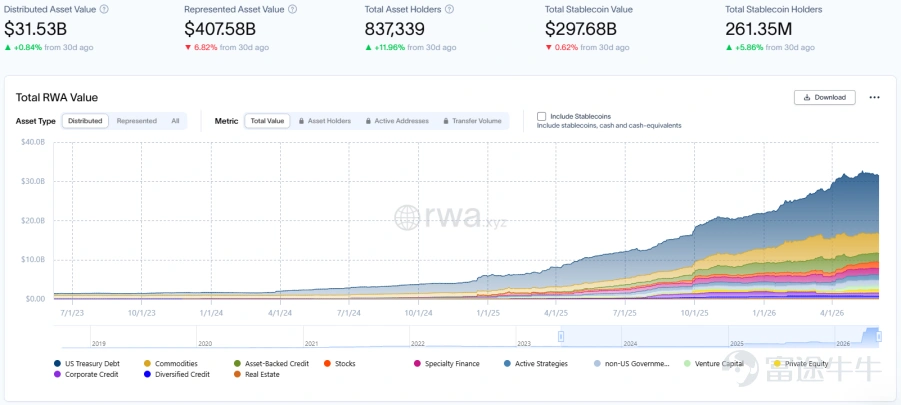
This week, the total on-chain market capitalization of real-world assets (RWA) slightly increased to USD 31.53 billion, while the number of holders surged nearly 12% to 837,000. However, stablecoin market cap has declined for three consecutive months, monthly transaction volume plummeted by 40%, and monthly active addresses also dropped, indicating heightened retail allocation interest but institutional large-value settlement demand has hit rock bottom—marking a phase of 'user consolidation and waning activity.'
On the regulatory front, the Hong Kong Monetary Authority established an expert panel on tokenized bonds; the U.S. SEC delayed its tokenized asset exemption program due to third-party issuance risks; the compromise draft of the FISA bill proposes advancing the CBDC ban to mid-2029; NYDFS and the European Banking Authority reached cooperation on stablecoin regulation; the UK House of Lords urged the central bank to ease holding restrictions; Japan’s Liberal Democratic Party pushed for crypto ETF legislation and cross-border use of yen-denominated stablecoins; meanwhile, Russia’s Ministry of Finance leaned toward excluding U.S. dollar stablecoins.
At the project level, JPMorgan, Citi, and two other major banks plan to co-build a shared tokenized deposit network; Goldman Sachs launched a tokenized real estate fund; Visa, Mastercard, and Stripe are jointly preparing a stablecoin platform; Robinhood previewed new cross-border asset and tokenized finance products launching in July; Aleo released a privacy-focused stablecoin whitepaper; MoneyGram launched the Stellar-based stablecoin MGUSD; Ripple expanded RLUSD to Turkey.
On the financing front, WasabiCard has completed its Pre-A round, raising nearly USD 10 million in cumulative funding.
RWA Track Overview
According to the latest data from RWA.xyz, as of June 5, 2026, the total on-chain market capitalization of RWA reached USD 31.53 billion, a modest 0.84% increase from the same period last month, maintaining slight growth. The total number of asset holders rose to approximately 837,300, up sharply by 11.96% month-over-month, indicating that new inflows are primarily driven by retail investors with significantly stronger allocation intent.
Stablecoin Market
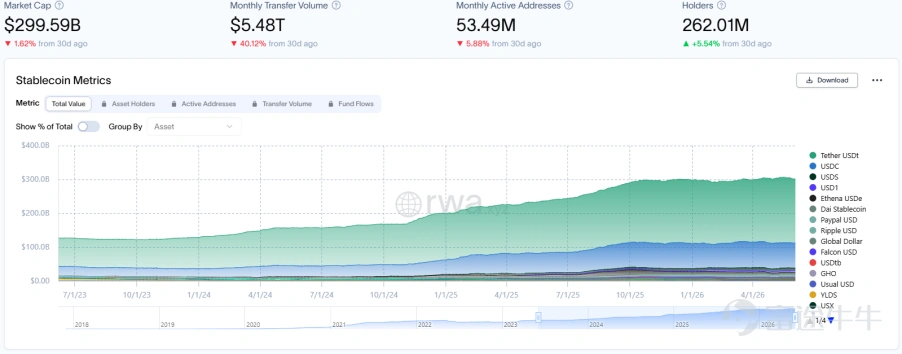
The total market capitalization of stablecoins declined to USD 299.59 billion, down 1.62% from the same period last month, marking a third consecutive monthly drop and reflecting continued contraction in liquidity pools. Monthly transfer volume plummeted to USD 5.48 trillion, a staggering 40.12% decline month-over-month—the largest single-month drop on record—suggesting institutional demand for large-value settlements and arbitrage has reached a standstill.
The total number of monthly active addresses fell to 53.49 million, a 5.88% decrease from the same period last month, while the total number of holders expanded counter-trend to 262 million, up 5.54% month-over-month. This growing divergence indicates that although retail allocation demand continues to rise, on-chain transaction participation is rapidly diminishing, resulting in a market structure characterized by 'user accumulation but activity depletion.'
The leading stablecoins remain USDT, USDC, and USDS. Among them, USDT’s market cap declined 1.8% month-over-month; USDC’s market cap dropped 3.21% month-over-month; and USDS’s market cap saw a slight increase of 0.17% month-over-month.
HKMA establishes tokenized bond expert panel
The Hong Kong Monetary Authority (HKMA) announced today the establishment of an expert panel on tokenized bonds, bringing together industry representatives with relevant experience and a strong interest in the development of Hong Kong’s tokenized bond market to further advance the application and expansion potential of tokenized bonds in Hong Kong. Panel members include representatives from industry associations, financial institutions, legal advisory firms, and financial infrastructure and technology providers. Building upon the progress achieved by the HKMA in tokenized bond initiatives to date, the expert panel will jointly explore policy measures, market practices, and innovative solutions.
The New York Department of Financial Services (NYDFS) partners with the European Banking Authority to jointly regulate stablecoins.
According to Decrypt, the New York Department of Financial Services (NYDFS) has entered into a cooperation agreement with the European Banking Authority (EBA) to jointly regulate stablecoins. In a 22-page memorandum of understanding (MoU), both parties outlined procedures designed to facilitate regulatory coordination and confidential information exchange related to the USD 314 billion stablecoin industry. NYDFS stated the move aims to strengthen oversight, identify market trends and risks, and promote market integrity. In emergencies—such as when a regulated entity faces severe operational or financial distress—the two sides will promptly notify each other and coordinate responses, and share information related to civil or criminal investigations upon request. This coordination comes as European Central Bank officials express caution toward stablecoins, warning they pose run risks and could erode European monetary sovereignty and economic control. NYDFS noted that virtually all stablecoins currently in circulation are denominated in U.S. dollars, underscoring the critical importance of international coordination in the digital asset space. The MoU is non-binding.
The final compromise text of Section 702 of the U.S. FISA Act proposes moving forward by six months the termination date of the CBDC ban.
According to crypto journalist Eleanor Terrett, the final compromise text of Section 702 of the Foreign Intelligence Surveillance Act (FISA), introduced by Senate Intelligence Committee Chairman Tom Cotton, includes a Federal Reserve CBDC ban originally contained in a housing bill. The text is expected to become law. Notably, the ban’s expiration date has been moved forward from December 31, 2030, to June 12, 2029.
UK House of Lords committee urges Bank of England to reconsider proposed stablecoin holding limits
According to CoinDesk, the House of Lords’ Financial Services Regulation Committee has called in its latest report for the Bank of England to reconsider its proposed stablecoin holding limits. The committee recommended monitoring market growth instead of imposing holding caps upfront, and only implementing restrictions if clear financial stability risks emerge. The Bank of England had previously proposed individual holding limits of GBP 20,000 per stablecoin and GBP 10 million for businesses. The report also questioned reserve asset rules, stating they could significantly impact the commercial viability of UK-based stablecoin issuers. Last month, the Bank of England’s Deputy Governor acknowledged that the central bank’s proposed holding limits and reserve requirements were 'overly conservative' and indicated that alternative approaches to managing stablecoin-related risks are under review.
Additionally, according to Reuters, a Bank of England spokesperson said the final policy and draft rules on systemic stablecoins will be published in late June.
Japan's Liberal Democratic Party pushes for legislation on crypto ETFs and cross-border payments using yen-denominated stablecoins
According to Cryptopolitan, Japan’s Liberal Democratic Party (LDP) submitted a proposal to Finance Minister Satsuki Katayama calling for the establishment of a legal framework for cryptocurrency ETF trading and promoting the use of yen-denominated stablecoins in Asian payment systems. The LDP’s Blockchain Promotion Task Force considers crypto ETFs a simpler investment vehicle than direct holdings of crypto assets and believes they should gain formal recognition in the Japanese market. The task force also urges the government to promote yen stablecoins as a payment gateway for Asian markets. JPYC launched Japan’s first licensed yen stablecoin in October 2025, with over 1 billion yen already issued. Japan’s three major banks—Mitsubishi UFJ, Sumitomo Mitsui, and Mizuho—are jointly conducting stablecoin experiments.
Russia’s Ministry of Finance does not wish to allow trading of dollar-denominated stablecoins
According to Bits.media, Russian Deputy Finance Minister Ivan Chebeskov stated that if foreign stablecoins are permitted for trading in Russia, their issuers could directly freeze them in users’ wallets—a concern particularly targeting USDT and USDC. He noted that once these wallets begin transacting with platforms authorized by the country’s central bank, holders would face sharply elevated risks. There have already been cases of Russian legal entities having their dollar-denominated stablecoins frozen, whereas Bitcoin and Ethereum have not yet been subject to such freezes due to the lack of technical mechanisms enabling it.
The Russian Ministry of Finance believes it is necessary to enact dedicated legislation for stablecoins, prioritizing tokens pegged to the ruble and currencies of friendly nations, with the central bank retaining the right to adjust the approved list independently. The question of admitting foreign stablecoins into a 'regulated Russian framework' has sparked market controversy, as the Ministry of Finance and the central bank initially advocated excluding stablecoins entirely from the scope of legal investment instruments.
Ether.fi allocates $100 million to Plume’s RWA vault to provide users with RWA yields
According to The Block, on-chain vault management platform Plume has partnered with Ethereum liquid restaking protocol Ether.fi to launch an interest-bearing RWA vault, into which Ether.fi has 'exclusively' allocated $100 million. The capital comes from Ether.fi’s liquidity providers and managed assets from its existing liquidity vaults. The new vault is directly accessible to users via the ether.fi application, aiming to enable ether.fi users to earn yields from tokenized real-world assets (RWAs).
Symbiotic launches Liquid Lane network to provide instant redemption liquidity for RWAs
According to CoinDesk, Symbiotic has launched a new liquidity network called Liquid Lane, offering nearly instant stablecoin redemptions for real-world assets (RWAs) such as funds and private credit—addressing current redemption delays that can stretch up to approximately 180 days. The product routes investor redemption requests through an RFQ mechanism to a network of compliant market makers; the winning bidder initially takes delivery in USDC, while the issuer settles the transaction in the background. Redemption spreads and lending yields accrue to a shared collateral pool. Initial participants include Fasanara Capital, manager of mGLOBAL (serving as one of the vault curators), and issuer Midas, among others. Symbiotic states its infrastructure currently secures over $550 million in assets.
Major U.S. banks including JPMorgan and Citi plan to jointly build a shared tokenized deposit network
According to Cryptopolitan, major U.S. banks including JPMorgan, Citigroup, Bank of America, and Wells Fargo & Co are building a shared tokenized deposit network via clearinghouses, targeting a launch in early 2027. The system enables real-time, 24/7 settlement of deposits on blockchain while keeping funds within the regulated banking system. Unlike stablecoins, tokenized deposits represent actual bank deposits recorded on-chain rather than standalone digital assets, preserving existing credit risk profiles and regulatory and accounting frameworks. Shahmir Khaliq, Head of Citi Services, stated that this network is another step toward strengthening banks’ position in capital markets and financing.
Goldman Sachs partners with Apex and Archax to launch tokenized real estate fund
According to CoinDesk, Goldman Sachs has partnered with fund services giant Apex Group and digital asset exchange Archax to launch a tokenized real estate fund. Infrastructure provider Ownera and real estate investment manager LRC Group are also involved. The fund combines blockchain-native issuance with established fund structures to enhance operational efficiency and transparency, enable future transferability, and maintain governance and regulatory oversight. Fund shares are tokenized on Goldman Sachs’ blockchain platform GS DAP, with LRC Group serving as fund manager, Archax acting as the regulated digital securities custodian and inaugural distribution partner, and Ownera facilitating connectivity among participants and distribution channels. Goldman Sachs’ Global Head of Digital Assets noted that issuing blockchain-native fund shares on GS DAP enables precise investment exposure to real estate assets.
Franklin Templeton has integrated its tokenized money market fund BENJI with MoonPay Trade.
According to The Defiant, Franklin Templeton has integrated its tokenized money market fund BENJI with MoonPay Trade, allowing institutional users to directly swap supported stablecoins on-chain for shares in Franklin Templeton’s U.S. Government Money Fund—and vice versa. This integration links Franklin Templeton’s Benji technology platform with MoonPay Trade’s institutional quoting, routing, and execution engine. Franklin Templeton stated that BENJI holders will be able to convert into stablecoin liquidity via MoonPay and use the fund in on-chain workflows such as treasury management, portfolio rebalancing, and collateralization.
Securitize launches tokenized offering of Hamilton Lane’s private credit fund HLSCOPE on TRON
According to The Block, Securitize announced the launch of Hamilton Lane’s Senior Credit Opportunities Fund (HLSCOPE) on the TRON blockchain through its compliant tokenization structure, marking the first Securitize-issued asset on TRON. HLSCOPE provides accredited investors with on-chain exposure to Hamilton Lane’s opportunistic senior credit perpetual fund, leveraging TRON’s network of over 383 million accounts, approximately $90 billion in stablecoin circulation, and high-frequency settlement infrastructure.
Backpack launches Backpack Securities, a new platform blending traditional and on-chain stock trading
According to The Block, Backpack has launched a new platform, Backpack Securities, which simultaneously offers regulated U.S. equities brokerage services and stock tokenization capabilities. Users can buy, hold, and sell actual U.S. stocks through the platform, receiving dividends, corporate actions, and entitlements under systems like ACATS and DTCC. Additionally, they can convert holdings into tokenized securities that are freely transferable and tradable 24/7 on public blockchains such as Solana. Backpack is currently collaborating with Sunrise, a tokenization protocol in the Solana ecosystem, and expects to roll out related brokerage services starting in June. The platform was founded by the former FTX team and the team behind Mad Lads NFT, and raised $17 million in Series A funding in 2024.
Robinhood teases a 'new era of crypto,' potentially unveiling new cross-border asset and tokenized finance products on July 2
Robinhood announced it will host a product launch event titled 'The World is Flat' at the Old Royal Naval College in London, UK, at 2:00 AM Beijing time on July 2, 2026 (July 1, 19:00 BST / 14:00 EDT), where co-founder and CEO Vlad Tenev will personally unveil its latest offerings.
Robinhood is using 'A new era of crypto is on the horizon' as its core tagline, emphasizing 'Markets Beyond Borders' and 'new products reshaping the financial landscape.' Market observers widely speculate that the event may feature tokenized equities, on-chain securities, a global asset trading network, stablecoin payments, or cross-border investment products. Notably, Robinhood has recently intensified its focus on crypto and RWA (real-world assets), with the UK emerging as a key hub for its international expansion. The choice of London for this global launch is seen as a significant signal of its strategy to advance global financial services.
OSL Becomes Exclusive Distributor of CSOP's First Tokenized Money Market Fund Product
Global stablecoin payments and trading platform OSL Group (863.HK) today announced it has become the exclusive distributor of the first tokenized money market fund product issued by CSOP Asset Management, Hong Kong’s largest ETF issuer, and has signed a memorandum of understanding with CSOP.
The product is a tokenized, non-listed class of the 'CSOP HKD Money Market ETF' (3053.HK), primarily investing in short-term HKD-denominated deposits and high-quality money market instruments. Investors can hold fund units directly via tokens and are supported in direct subscription and redemption. OSL will serve as the exclusive distributor for the next six months, while HSBC acts as the tokenization agent, trustee, and transfer agent for the product.
Kevin Cui, Executive Director and CEO of OSL Group, stated: 'The launch of this product further enriches OSL’s offering for clients and reaffirms Hong Kong’s immense potential in nurturing a tokenization ecosystem. Leveraging OSL’s unique strengths in digital asset distribution and liquidity, we are excited to partner with CSOP and HSBC to open broader investment channels into tokenized assets for investors. Our collaboration with CSOP goes beyond launching a single product—we look forward to exploring new opportunities together with our partners and bringing more innovative products to the market.'
Binance has opened access to over 7,000 U.S. stocks and ETFs for non-U.S. users, with a minimum investment of $5
According to Fortune, Binance has announced that it is opening trading access to over 7,000 U.S. stocks and ETFs for non-U.S. users, supporting commission-free fractional shares with a minimum investment of $5. Users can purchase these assets using cryptocurrencies such as USDC, USDT, and BNB. Trades are executed by brokerage firm Nest Trading, while brokerage custody and dividend services are handled by New York-based Alpaca. Binance also plans to launch 'bStocks' on the BNB Chain, enabling users to convert their stock holdings into on-chain tokenized assets for instant settlement and potential DeFi use cases—such as lending and liquidity provision—further bridging traditional equities with on-chain assets.
X Layer and xStocks Enter Strategic Partnership; OKX Wallet to Integrate Tokenized Equity Assets
According to an official announcement, X Layer has entered into a strategic partnership with xStocks, a regulated tokenized equity issuance platform. The two parties will jointly drive the integration of tokenized equity assets into the X Layer ecosystem and offer related trading services to OKX Wallet users. In the future, users will be able to trade xStocks-related assets 24/7 within OKX Wallet, benefiting from X Layer’s settlement, liquidity, and distribution capabilities. Both sides will also introduce a fast-track listing mechanism to accelerate the tokenization and trading availability of popular equities and thematic ETFs within a compliant framework.
It is reported that X Layer is actively building on-chain infrastructure for financial assets, covering key components such as settlement, liquidity, and distribution. xStocks has previously facilitated over $31 billion in cumulative tokenized equity trading volume and has become the first major issuer to commit to providing asset depth on X Layer, driving scale expansion for tokenized equities.
Stripe, Visa, and Mastercard are jointly preparing a stablecoin platform, and Coinbase may participate.
According to CoinDesk, global payment networks Stripe, Visa, and Mastercard are preparing to launch a new stablecoin platform, with the three companies nearing an official release. Sources familiar with the matter revealed that U.S.-listed exchange Coinbase is considering participation in the platform. The current total market capitalization of stablecoins stands at approximately $325 billion, with Tether’s USDT accounting for roughly $115 billion and dominating the market. In 2024, Stripe acquired stablecoin infrastructure firm Bridge for $1.1 billion, while Mastercard acquired BVNK this year and plans to expand its '24/7' stablecoin settlement services. Coinbase launched white-label stablecoins and Coinbase Business payment services last year and agreed with Circle, the issuer of USDC, to split USDC yields 50/50 in both over-the-counter and DeFi ecosystems.
Coinbase announces investment in ProShares money market ETF IQMM to advance stablecoin cash management
Coinbase has announced an investment in ProShares’ GENIUS Money Market ETF (ticker: IQMM) to advance stablecoin cash management. This product is among the first money market ETFs designed under the GENIUS Act for use in stablecoin reserves. IQMM primarily holds U.S. Treasury securities and cash equivalents with maturities of up to 93 days, aiming to meet the reserve requirement under Section 4 of the GENIUS Act for a 1:1 backing by 'high-quality, highly liquid assets.'
Visa and Brale Explore Institutional Settlement Network Based on Private Stablecoins
According to Business Wire, Visa announced a collaboration with stablecoin infrastructure platform Brale to conduct a proof-of-concept on the Canton Network, testing institutional settlements using Brale’s U.S. dollar-denominated stablecoin SBC. The initiative aims to evaluate how privacy-enhancing blockchain infrastructure can support faster and more programmable settlement while controlling the visibility of sensitive settlement data. Since 2021, Visa has supported settling VisaNet obligations with stablecoins, and this new initiative will assess SBC as an additional settlement option and test the applicability of its privacy architecture within real-world institutional payment flows.
MasterCard expands on-chain settlement, betting on stablecoins and 24/7 finance.
According to CoinDesk, Mastercard is expanding its settlement network to support regulated stablecoins, planning to offer stablecoin settlement, intraday settlement, and weekend and holiday settlement services to meet the demand for real-time fund movement. The new framework will run in parallel with existing fiat settlement processes, aiming to provide financial institutions with more flexible liquidity management. Mastercard will initially support Circle’s USDC, Paxos-issued PYUSD, USDG and USDP, Ripple’s RLUSD, and SoFiUSD, covering blockchain networks including Ethereum, Solana, Polygon, Base, Arbitrum, and XRPL. Financial institutions such as Cross River, Lead Bank, CBW Bank, ARQ, and Nuvei will be among the first participants.
Ripple expands its stablecoin RLUSD into Turkey through partnerships with three companies
According to Cointelegraph, Ripple has expanded its U.S. dollar-backed stablecoin RLUSD into Turkey through partnerships with BiLira, Bitexen, and Bitlo, offering enterprise-grade U.S. dollar liquidity to Turkish institutions.
MoneyGram has launched its U.S. dollar stablecoin MGUSD on the Stellar blockchain.
According to CoinDesk, MoneyGram announced the launch of its U.S. dollar stablecoin MGUSD on the Stellar blockchain. The stablecoin will be integrated into MoneyGram’s official app, enabling users to hold U.S. dollar-denominated balances in self-custodial wallets and send cross-border transfers via its global network. MGUSD is issued by Bridge, a subsidiary of Stripe, with smart contracts provided by M0 and wallet infrastructure by Fireblocks. The product has launched initially in the U.S. and will subsequently roll out globally to MoneyGram’s approximately 60 million users and nearly 500,000 physical locations, serving as a core component of MoneyGram’s cross-border payments infrastructure.
Stablecoin payments infrastructure provider OpenPayd plans to list on Nasdaq via a SPAC merger at a valuation of $1.145 billion
Stablecoin payments infrastructure platform OpenPayd announced it has entered into a definitive business combination agreement with special purpose acquisition company (SPAC) Titan Acquisition Corp. Upon completion of the transaction, OpenPayd will list on Nasdaq under the ticker symbol “OP,” with the combined entity valued at approximately $1.145 billion. OpenPayd currently offers stablecoin trading services and counts eToro, Kraken, and OKX among its clients. If Titan shareholders do not redeem their shares, OpenPayd is expected to receive up to $276 million in financing, which will be used to strengthen its balance sheet and expand its financial infrastructure capabilities.
Ondo’s perpetual futures platform, Ondo Perps, will launch on June 9
Ondo Perps, a perpetual futures platform under Ondo Finance focused on real-world assets (RWA), announced it will officially launch on June 9, 2026, aiming to expand perpetual futures trading from crypto assets to equity-like assets such as stocks.
Aleo releases whitepaper on privacy-focused stablecoins, proposing a permissionless, institutional-grade private stablecoin architecture
Aleo released a privacy stablecoin whitepaper titled 'Stablecoin Privacy,' stating that a privacy layer is the critical missing infrastructure needed for mainstream institutional adoption of blockchain-based payment rails. Aleo noted that despite the GENIUS Act creating opportunities for widespread stablecoin adoption, the permanent public visibility of transaction data on public blockchains could still hinder institutional use cases such as payroll disbursements, treasury management, and supplier payments.
Aleo stated that existing solutions still fail to adequately meet institutional requirements for privacy protection and risk management. The whitepaper proposes a permissionless private stablecoin architecture built on Aleo that leverages zero-knowledge technology and programmable smart contracts to protect transaction privacy while introducing programmable risk mitigation mechanisms, enabling institutions to conduct private transactions without compromising compliance or risk controls.
According to reports, the team behind the white paper has long been engaged in interdisciplinary research at the intersection of cryptography, policy, and financial systems. Yaya J. Fanusie, Aleo’s Global Head of Policy; Valerie-Leila Jaber, a member of the Crypto Innovation Council and former Global Head of Financial Crime Compliance at Coinbase; and Matthew Green, cryptographer and professor of computer science at Johns Hopkins University, bring rare hands-on experience in private payments, financial regulation, and zero-knowledge cryptography.
U.S. equity token trading platform Metronome (MSX) has added multiple new listings in AI hardware and defense sectors, including related ETFs.
U.S. equity token trading platform Metronome (MSX) has listed Hewlett Packard Enterprise ($HPE.M), a key player in enterprise AI infrastructure; Marvell Technology ($MRVL.M), a semiconductor company specializing in AI-customized chips and data infrastructure; and TTM Technologies ($TTMI.M), a manufacturer of high-end PCBs and provider of electronics for defense and aerospace. Also newly listed are the world’s first actively managed pure photonics-themed ETF ($FOTO.M); 2x leveraged daily ETFs on SanDisk ($SNXX.M), Micron ($MUU.M), Lumentum ($LITX.M), Applied Optoelectronics ($AAOX.M), and Coherent ($COHX.M); the world’s first pure memory-chip-themed ETF ($DRAM.M); and the world’s largest space-themed ETF ($NASA.M).
Stablecoin payment infrastructure platform WasabiCard has completed its Pre-A funding round, bringing its total raised capital to nearly USD 10 million.
According to an official announcement, global stablecoin payment infrastructure platform WasabiCard has completed its Pre-A funding round, with participation from Vision Plus Capital and 01VC. Combined with its earlier Seed round led by Vernal Capital and co-invested by Avenir Group, WasabiCard has now raised nearly USD 10 million in total. The new funds will primarily support global payment infrastructure expansion, stablecoin card issuance and payout capabilities, enterprise client acquisition, and compliance and product development. WasabiCard also plans to further advance AI Agent payments and programmable global payment workflows.
WasabiCard is dedicated to bridging stablecoins with real-world financial use cases, offering infrastructure services—including global card issuance, corporate payouts, multi-currency settlement, and stablecoin payments—to enterprises, platforms, and internet-native companies. To date, the company has served over 500 enterprise clients, issued more than 500,000 cards, processed transaction volumes exceeding USD 1 billion, integrated multiple blockchains including Avalanche, Arbitrum, and BNB Chain, and recently joined the Circle Alliance Program.
Citi forecasts that the tokenized securities market will reach $5.5 trillion by the 2030s.
According to a CoinDesk report, Citi has released a forecast predicting that the tokenized real-world assets market will grow from its current USD 17 billion to USD 5.5 trillion by the 2030s, potentially reaching USD 8.2 trillion under an optimistic scenario. The three main drivers include: traditional market infrastructures such as DTCC, Nasdaq, and NYSE embedding tokenization into their core trading systems; the stablecoin market expanding to an estimated USD 1.9 trillion, generating roughly USD 1 trillion in new demand for U.S. Treasuries; and the advancement of the U.S. CLARITY Act, which would provide a clearer regulatory framework. Citi assumes that by 2030, 10% of the U.S. Treasury market and 3% of the U.S. equity market will be tokenized. If 10% of U.S. investors shift to digital trading platforms, this would create USD 2.6 trillion in demand for digital equities. The legacy and emerging financial systems will operate in parallel for years, and 'structural orchestrators' controlling asset and payment rails will gain significant advantages.
Report: Russian ruble-pegged stablecoin A7A5 accounts for approximately 43% of the global non-USD stablecoin market.
Web3 security firm CertiK recently released its '2026 Stablecoin Threat Report,' highlighting dual challenges facing the stablecoin ecosystem: technical security vulnerabilities and regulatory compliance risks. The report notes that since the beginning of 2026, cross-chain bridge-related security incidents have resulted in losses exceeding USD 328 million, including a single USD 291 million loss from the Kelp DAO wallet breach—underscoring that cross-chain bridges, custody systems, and payment infrastructure have become prime targets for hackers.
Meanwhile, the report provides an in-depth analysis of the Russian ruble-pegged stablecoin A7A5. On-chain data shows that since its launch in 2025, A7A5 has processed cumulative transaction volumes exceeding USD 110 billion, capturing approximately 43% of the global non-USD stablecoin market. The report suggests that A7A5 exemplifies a new model for building cross-border settlement networks using stablecoins and has become a focal point for global regulators. Despite ongoing rounds of sanctions from the U.S. and Europe, the number of A7A5 holder addresses continues to grow, reflecting new challenges faced by traditional sanction regimes when confronting on-chain financial networks. CertiK states that stablecoin risks have expanded beyond smart contract vulnerabilities to encompass financial infrastructure and geopolitical dimensions, making them a critical issue in global financial risk management.
Gateway capabilities determine the winners: Looking at the next fifty years of tokenized finance through the lens of the 1968 paper crisis—from a $4 billion 'paper crisis' to $5.5 trillion in tokenized finance
PANews Summary: Looking back, the 1968 'paper crisis' spurred the creation of DTCC and ignited the dematerialization revolution in securities. Today, the financial system is undergoing another systemic infrastructure upgrade: asset tokenization. In 2026, DTCC announced plans to tokenize and bring on-chain its $114 trillion in custodied assets, while Citi forecasts the tokenized securities market will reach $5.5 trillion by 2030.
With regulatory tailwinds such as the U.S. federal GENIUS Act stablecoin legislation gradually taking effect, traditional giants like Blackrock and Goldman Sachs are accelerating their entry with real capital. On-chain asset migration has become an irreversible trend. The core competitive battleground in tokenized finance will no longer be 'which assets can go on-chain,' but rather 'who can build a compliant and trusted on-chain financial gateway.' This gateway will sit at the intersection of real-world assets (RWA), regulated exchanges, and stablecoin settlement.
CertiK 2026 Report: Behind $328 Million in Losses, Stablecoins Are Becoming a New Battleground in Geopolitical Conflict
PANews Summary: Stablecoins now face dual evolutionary challenges—technical attacks and geopolitical pressures. On one front, hackers have shifted focus from protocol vulnerabilities to infrastructure; since 2026, cross-chain bridge-related security incidents have caused losses exceeding $328 million, with wallet and private key compromises emerging as primary risks. On another front, stablecoins are increasingly becoming a new arena for geopolitical competition. The Russian ruble-backed stablecoin A7A5 has accumulated over $110 billion in trading volume since launch, capturing 43% of the global non-dollar stablecoin market, and is building a Western-independent cross-border settlement and sanctions-resistant system via the A7 network. Despite joint sanctions imposed by the U.S. and Europe, on-chain holder addresses continue to grow and are rapidly expanding into Africa.
Risk Disclaimer: The above content only represents the author's view. It does not represent any position or investment advice of Futu. Futu makes no representation or warranty.Read more

Comments
to post a comment
1