
Focus on COMPUTEX 2026! Will the entire AI supply chain ignite?

Breaking Down Jensen Huang's Taipei Keynote: From NVIDIA's DSX Computing Ecosystem to AI PC 2.0, Which Companies Deserve Close Attention?
Today, $NVIDIA (NVDA.US)$ Founder and CEO Jensen Huang delivered a keynote speech at the GTC conference in Taipei. Addressing the current global AI boom, Huang stated that the AI era has truly arrived.
Notably, during this keynote, Huang highlighted several new products and platforms, including the Vera Rubin architecture, the CPU Vera designed for AI Agents, the AI model Nemotron 3 Ultra, and the AI factory platform DSX. Meanwhile, NVIDIA further signaled its push into the next-generation AI PC market, targeting the entire Windows ecosystem.
Behind this keynote, what keytrading opportunitiesshould not be missed? This article will deeply unpack the core takeaways from the keynote and identify the companies most worth tracking for the long term!
What are the key highlights of this keynote worth paying attention to?
In this keynote, Huang primarily outlinedsix key points:
01 Tokenomics
Jensen Huang stated that, from an industry perspective, tokens are assets—they have become revenue-generating units because they can produce profits. AI companies will want to build more tokens, generate more tokens, and construct more AI factories, which is why computing demand here (in Taiwan) has skyrocketed like a rocket.
02 Five Core Components of Agent Architecture
Huang Renxun systematically outlined the architectural definition of AI Agents: large language models serve as the 'reasoning core,' responsible for thinking, reasoning, and planning; an external orchestration engine (Harness), acting like an operating system, connects the model with tools such as spreadsheets, browsers, and databases, and manages both working memory and long-term memory.
He demonstrated three AI Agent use cases on stage: generating complete application code directly from natural language; creating dynamic particle animations from a text description; and, after taking a photo of a missing battery compartment in a remote control, the Agent automatically invoked CAD tools to generate a replacement part file ready for immediate 3D printing.
03 Vera Chip Enters Mass Production, Adopted Early by OpenAI and Others
NVIDIA announced that the Vera Rubin architecture has fully entered mass production, with Vera CPUs scheduled to begin volume production in Q3 this year. Initial customers include OpenAI, Anthropic, xAI (SpaceX’s AI division), Dell, Oracle, and CoreWeave.
Vera is NVIDIA’s first standalone microprocessor specifically designed for data centers, directly competing with Intel’s Xeon series, AMD’s Epyc series, and cloud vendors’ in-house chips like Amazon’s Graviton. Huang Renxun stated that Vera delivers 1.8x the performance of Intel’s x86 architecture chips on core AI workloads—marking the first time NVIDIA has directly benchmarked its CPU performance against current industry standards.
04 Entering the PC Market: RTX Spark Directly Challenges Intel
NVIDIA announced the launch of the RTX Spark super chip, marking its official entry into the PC processor market, with initial availability planned for high-end laptops and desktops this fall.
The chip was co-developed by NVIDIA and MediaTek and manufactured by Taiwan Semiconductor using its 3N process. It integrates a CPU with up to 20 cores and a Blackwell-architecture GPU with 6,144 cores. Both share memory and are interconnected via an NVLink interface, running Microsoft’s Windows for Arm operating system. PC brands participating in the initial product launch include Dell, Lenovo, HP Inc, ASUS, Acer, and Microsoft, with an initial focus on the premium segment targeting AI developers, creators, and gamers.
Jensen Huang stated that NVIDIA and Microsoft are about to redefine the personal computer. 'This will be a completely new PC. We’ll reveal more details tomorrow evening. Microsoft and NVIDIA have spent the past three years thoroughly rearchitecting how PCs operate.'
05 NVIDIA officially announced the launch of the 'NVIDIA DSX™️ platform'
NVIDIA launched DSX, a data center software platform offered under an open-source model that provides infrastructure operators with a complete suite of tools for planning, deployment, and monitoring, allowing users to select components as needed.
According to NVIDIA,A key advantage of DSX is its ability to significantly enhance data center power management efficiency, enabling operators to deploy up to 40% more NVIDIA accelerator chips within the same power budget.—a particularly significant benefit for large-scale data centers constrained by power capacity. Jensen Huang noted that with DSX, users can simulate an entire facility without spending a single dollar, validating performance before installing any racks.
NVIDIA also introduced the DGX Station for Windows high-end workstation product line, developed in collaboration with PC manufacturers such as Dell, with sales scheduled to begin in Q4 of this year, targeting enterprise users developing and deploying AI software on Windows systems.
06 Robotics and Autonomous Driving
NVIDIA announced a collaboration with Unitree, a Chinese robotics startup, to launch the Isaac GR00T humanoid robot reference platform for universities and academic institutions.
Additionally, at the event, NVIDIA further disclosed commercial deployment progress for its DRIVE Hyperion autonomous driving platform. NVIDIA stated that leading Chinese automakers and autonomous driving companies—including BYD, Geely, Zeekr, Xiaomi, and Pony AI—have already adopted or are developing intelligent driving systems based on the NVIDIA Hyperion platform. Furthermore, NVIDIA introduced Alpamayo 2, a super open inference model specifically designed for autonomous ride-hailing scenarios, further expanding its software footprint in the mobility sector.
What opportunities should not be missed?
This article will focus on introducing fellow investors to'NVIDIA DSX™️ platform'—investment opportunities as NVIDIA enters the PC market. Specifically,
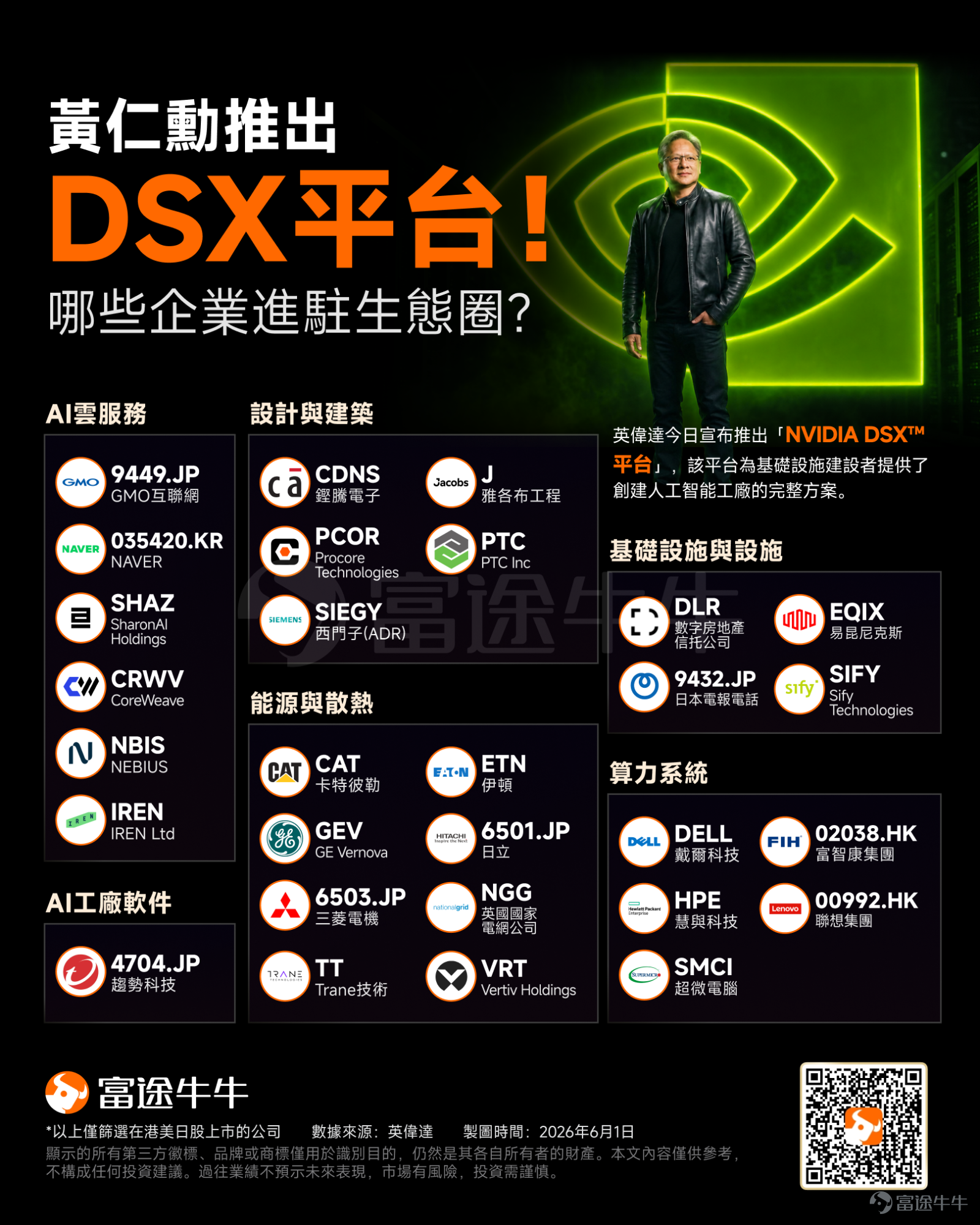
01 'NVIDIA DSX™️ platform'
'We're not just shipping chips.'—At the GTC event in Taipei, Jensen Huang used this statement to set the tone for the new NVIDIA DSX platform.
This signifies a transformative evolution in NVIDIA’s business model. DSX is essentially a 'playbook for AI factories'—extending NVIDIA’s control beyond individual chips, systems, and software all the way down to power delivery, liquid cooling, and even physical data center infrastructure.

1. AI Clouds: The 'new disruptors' reshaping the traditional landscape
At the top of this ecosystem map, we don’t see AWS, Google Cloud, or Azure. Instead, a new group of cloud providers deeply aligned with NVIDIA has emerged.
Core holdings: $CoreWeave (CRWV.US)$ 、 $NEBIUS (NBIS.US)$ 、 $IREN Ltd (IREN.US)$ 、 $SharonAI Holdings (SHAZ.US)$ 、 $NAVER (035420.KR)$ 、 $GMO Internet group (9449.JP)$ and other AI computing infrastructure operators.
This indicates that NVIDIA is backing its own 'trusted allies' to break the monopoly held by the traditional big three cloud giants. These AI-native cloud providers are receiving priority allocation of NVIDIA’s chips.
2. AI Factory Software: The Neural Network for Compute Orchestration
Hardware alone cannot power a super-factory; it must be supported by a robust underlying software architecture for data storage, cluster orchestration, and resource scheduling.
Core holdings: $Trend Micro (4704.JP)$ , Red Hat (acquired by $IBM Corp (IBM.US)$ ) and other companies.
As GPU clusters scale to tens of thousands of units, delivering data to models without latency becomes critical. High-performance file systems (such as VAST and WEKA) and open-source infrastructure software vendors will see an explosion in enterprise-grade orders during this wave of AI adoption.
3. Design and Construction: The Invisible Winners of Digital Twins
Before breaking ground on physical facilities, NVIDIA emphasizes completing the simulation and testing of an entire factory in the virtual world 'without spending a dime,' marking AI investment’s deep penetration into Industry 4.0.
This is a highly defensive segment with exceptionally high gross margins. Market leaders providing EDA tools, industrial design software, and digital twin technologies benefit not only from the semiconductor design boom but will also directly capture early-stage software planning opportunities arising from global AI data center construction.
4. Energy and Cooling: The 'Shovel Sellers' Solving the Compute Bottleneck
'At the end of compute lies power.' One of DSX platform’s core advantages is optimizing power management. As highly energy-intensive architectures loom ahead, traditional air cooling will become entirely inadequate, making energy and thermal solutions an absolute focal point for capital allocation.
This is a highly certain 'shovel-selling' business. Suppliers of liquid cooling systems, microgrid management solutions, and high-efficiency UPS (uninterruptible power supply) systems are entering a golden window of simultaneous volume and price growth, making them compelling investment targets.
5. Infrastructure and Facilities: The Super Landlords of the AI Era
AI servers impose extremely stringent physical requirements on floor loading capacity, power supply, and fiber-optic network connectivity. Without these high-standard 'shells,' even the most powerful compute capabilities have nowhere to reside.
Core Holdings: $Digital Realty Trust Inc (DLR.US)$、 $Equinix Inc (EQIX.US)$、 $NTT (9432.JP)$、 $Sify Technologies (SIFY.US)$and others.
Data center REITs (Real Estate Investment Trusts) are undergoing a revaluation. These 'landlords' that control critical global internet nodes and substantial power capacity possess strong pricing power over rents and inherent inflation-hedging characteristics, making them highly suitable for high-net-worth investors seeking stable returns.
6. Computing Power Systems: The hardware cohort with the fastest earnings realization
Computing power systems form the foundation of the entire ecosystem. These companies assemble NVIDIA’s chips into operational servers and racks.
Core holdings: $Dell Technologies (DELL.US)$ 、 $Hewlett Packard Enterprise (HPE.US)$ 、 $Super Micro Computer (SMCI.US)$ 、 $LENOVO GROUP (00992.HK)$ 、 $FIH (02038.HK)$ along with nearly the entire elite ** contract manufacturing group (including Foxconn, Wiwynn, Quanta Cloud Technology (QCT), GIGABYTE, and ASUS).
This segment is closest to NVIDIA chips and delivers the fastest earnings realization. As system complexity escalates from single servers to rack-level integration, original design manufacturers (ODMs) see a significant increase in average selling price (ASP) per unit. Monthly revenue data from the supply chain should be closely monitored to identify trading signals that exceed expectations.
02 Jensen Huang Announces a 'New PC Era,' Sparking a Race for the Next-Generation AI PC Gateway
On May 30, NVIDIA ignited market expectations ahead of Taipei’s Computex conference with just one phrase: 'A new era of PC.' Today, the mystery was officially unveiled—NVIDIA launched its RTX Spark Superchip, officially drawing its sword and entering the personal computer processor market!Core specifications and ecosystem moat:
Powerful partnership and cutting-edge manufacturing: Jointly developed by NVIDIA andMediaTekdeeply co-developed, and exclusively manufactured byTaiwan Semiconductor's 3N advanced processas the sole foundry.
Monster-grade performance architecture: Features up to a 20-core CPU and a 6,144-core Blackwell architecture GPU. Both share memory seamlessly via NVLink, perfectly optimized for Microsoft Windows for Arm at the ecosystem foundation level.
Full endorsement from major end-market giantsExpected to launch this fall, the initial batch of products will be introduced in collaboration with PC brands including Dell, Lenovo, HP Inc, ASUS, Acer, and Microsoft, initially targeting the high-end market for AI developers, creators, and gamers.
Overall, this move is expected to fundamentally dismantle the decades-long x86 duopoly held by Intel and AMD in the Windows PC market, triggering the most profound value chain restructuring in the history of the PC industry. Under the new AI PC 2.0 landscape, fellow investors have also compiled a list of related concept stocks for reference:

1. Semiconductors: The century-old battle between x86 and Arm—foundry and IP leaders stand to benefit handsomely
The emergence of RTX Spark signifies that the PC processor market has officially evolved from the traditional Intel-AMD duopoly into a multi-player competitive landscape.
Arm camp and emerging architecture players: NVIDIA, leveraging its Blackwell architecture, is aggressively entering the fray, and underlying architecture beneficiaries $Arm Holdings (ARM.US)$along with other Arm ecosystem players $Qualcomm (QCOM.US)$ will jointly capture shares of this new market opportunity.
Foundry and advanced process technology: Chips are manufactured by $Taiwan Semiconductor (TSM.US)$ Manufactured using the 3nm process, this positions Taiwan Semiconductoras the indispensable and absolute winner in this arms race; meanwhile, leading upstream semiconductor equipment suppliers $ASML Holding (ASML.US)$and back-end testing and packaging providers such as $Advantest (6857.JP)$ will see their long-term value further amplified.
Defense and counterattack by legacy x86 giants: traditional giants like $Intel (INTC.US)$ and $Advanced Micro Devices (AMD.US)$ are facing their most severe battle to defend market share in decades. The market will closely watch how they demonstrate their strength to fight back at this year's Computex.
2. PCs and OEMs: End-market reshuffling drives a profitability surge for high-end AI devices
NVIDIA announced that Dell, Lenovo, HP Inc, ASUS, Acer, and Microsoft will participate in launching the first products powered by RTX Spark.
The first wave of high-tech early adopters: $Dell Technologies (DELL.US)$ 、 $LENOVO GROUP (00992.HK)$ 、 $HP Inc (HPQ.US)$and $Microsoft (MSFT.US)$ Leading brands are initially targeting the high-end market (AI developers, creators, and gamers), which will directly boost their average selling price (ASP) and gross margins.
Potential ecosystem variables: $Apple (AAPL.US)$Although Apple remains committed to its in-house M-series chip ecosystem, the AI wave NVIDIA has ignited within the Windows camp will undoubtedly pressure Apple to accelerate monetization of its on-device AI capabilities. Likewise, it’s worth closely monitoring over the long term whether players like $XIAOMI-W (01810.HK)$ those with strong hardware ecosystem chains will eventually join this Arm PC boom.
3. Memory: The biggest beneficiary of 'shared memory' architecture and on-device large model execution
RTX Spark features a 'shared memory' design between the CPU and a Blackwell GPU with up to 6,144 cores. Smooth operation of on-device large models (e.g., Nemotron 3 Ultra) imposes extremely demanding requirements on memory chips—specifically in bandwidth, capacity, and low power consumption.Key focus areas: $Samsung Electronics (005930.KR)$、 $SK Hynix (000660.KR)$、 $Micron Technology (MU.US)$the big three.
AI PC 2.0 will directly drive mainstream PC DRAM capacity from 16GB to 32GB or even 64GB as standard, ushering in a robust structural upcycle for the memory industry characterized by rising volumes and prices. In addition, demand for high-capacity SSDs will also benefit $Western Digital (WDC.US)$ And, $Seagate Technology (STX.US)$ NAND Flash; AI PCs require high-capacity, high-speed NAND flash memory, and $SanDisk (SNDK.US)$ is one of the core chip and hardware suppliers in the market.
4. Electronic Equipment and Components: The 'Hidden Champions' Behind Power Efficiency and Signal Transmission Upgrades
The monstrous performance of a 20-core CPU paired with a Blackwell GPU means that the internal architecture of laptops and desktops requires a comprehensive upgrade—particularly in power management, signal transmission, and precision components.
Investors should closely monitor Japanese electronic component giants such as $Murata Manufacturing (6981.JP)$ 、 $TDK (6762.JP)$ 、 $Ibiden (4062.JP)$and $Socionext (6526.JP)$ . High-performance chips require more stable multilayer ceramic capacitors (MLCCs) and high-frequency, high-speed substrates. These behind-the-scenes component leaders stand to benefit most reliably as AI PC shipments scale up.
Summary
This keynote speech delivered by Jensen Huang essentially showcased NVIDIA'sstrategic expansion from supplying standalone computing chips to establishing system-level standards and ecosystem rules.Whether it’s the end-to-end integration of data center workflows through the DSX platform, or NVIDIA's entry into the personal computer market with the RTX Spark Superchip, will both profoundly impact the allocation of profits and the existing landscape across the global technology supply chain.
In summary, the AI industry is evolving from explosive growth at individual nodes to a coordinated upgrade across the entire supply chain. However, investors still need to objectively assess how market share shifts among segment leaders during technological iterations and evaluate their long-term core competitive moats.
Risk Disclaimer: The above content only represents the author's view. It does not represent any position or investment advice of Futu. Futu makes no representation or warranty.Read more


Comments (17)
to post a comment
372
1598