
Author: Claude, DeepTide TechFlow
Deep Tide Summary:On May 27, Jeff Sprecher, founder and CEO of Intercontinental Exchange (ICE), the parent company of the New York Stock Exchange, publicly praised Hyperliquid at the Bernstein investor conference, calling it 'bigger than Nasdaq' and saying, 'I really wish I were younger so I could jump in myself.' This statement came just 12 days after ICE jointly lobbied the CFTC with CME to 'crack down' on Hyperliquid. Sprecher also revealed that the NYSE has secretly integrated a blockchain settlement system. The HYPE token hit a record high of $64 this week, two spot ETFs raised over $100 million in just 10 days, and its DAT company PURR was added to the Russell 3000 Index.

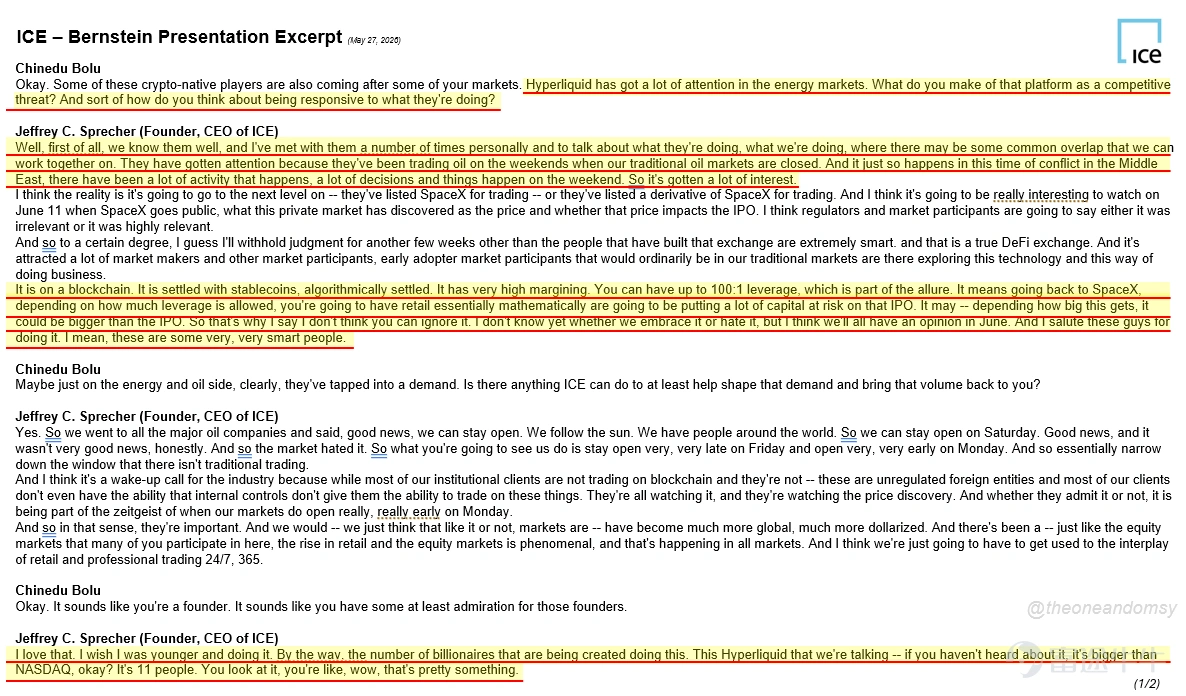
On May 27, Jeff Sprecher, founder and CEO of Intercontinental Exchange (ICE), gave a rare and emotionally charged assessment of Hyperliquid during an interview at Bernstein’s annual strategic decision-making conference.
"This Hyperliquid we’re discussing—if you haven’t heard of it yet, it’s bigger than Nasdaq, okay? Eleven people. When you see this, you’ll say, wow, that’s truly incredible," Sprecher said. He added immediately after: "I love this thing. I really wish I were younger so I could get in there and do it myself. By the way, billionaires are being minted en masse among the people doing this."
ICE is the parent company of the New York Stock Exchange and operates one of the world’s largest energy futures markets. Sprecher’s remarks represent the most direct public endorsement of Hyperliquid to date from the highest echelons of traditional finance.

Sprecher's praise caused a stir because of the timing.
On May 15, according to Bloomberg, executives from CME and ICE warned officials at the CFTC and Capitol Hill that Hyperliquid’s decentralized perpetual futures trading could pose risks of market manipulation and sanctions evasion, urging regulators to bring it under the traditional financial regulatory framework. Following the report, HYPE dropped nearly 9% at one point.
Just 12 days later, however, the head of ICE publicly expressed admiration at one of Wall Street’s most important investor conferences.
At the Bernstein conference, Sprecher directly addressed this apparent contradiction: 'There was an article with a headline that made it sound like we were terrified. We weren’t terrified. In fact, we’re talking to these people to understand what they’re doing. They’re learning about our world, and we’re learning about theirs. In that sense, there’s mutual admiration.'
He quickly pivoted to his core regulatory concern: 'What we’re telling regulators is, can we do this too? Why are you prohibiting us from doing it after it’s already happening? Can we have a level playing field? This administration strongly supports digitalization. If you think this is legal, then let us do it as well; if you think it’s illegal, why haven’t they received the same harsh letters you’ve sent us?'
This statement reveals ICE’s real lobbying logic with the CFTC: it’s not about shutting down Hyperliquid, but rather pushing regulators to loosen restrictions so traditional exchanges can also participate in on-chain derivatives markets.
Sprecher’s interest in Hyperliquid isn’t abstract—he has a very specific observation window: SpaceX is set to list on Nasdaq on June 12 at an estimated valuation of approximately $1.75 trillion, and Hyperliquid is already trading SpaceX derivatives.
'I think what really takes it to the next level is SpaceX. They’ve already launched trading in SpaceX derivatives. It’ll be very interesting on June 11, when SpaceX officially prices its shares, to see what price this private market discovers—and whether that price influences the IPO itself,' said Sprecher. 'Regulators and market participants will say it’s either completely irrelevant or highly relevant.'
He then outlined an extreme scenario: given that Hyperliquid allows leverage of up to 100:1, if retail traders flood into SpaceX derivatives, the nominal exposure on-chain 'could potentially exceed the size of the IPO itself.'
"So I said you can't possibly ignore it. I still don't know whether we should embrace it or hate it, but I think by June we’ll all have the answer."
Sprecher's remarks came at a pivotal moment as Hyperliquid undergoes intense mainstream adoption catalysts.
On May 12 and 15, 21Shares and Bitwise launched the first U.S. HYPE spot ETFs—THYP and BHYP—on Nasdaq and the New York Stock Exchange, respectively. According to bitcoin.com, the two funds attracted over $100 million in net inflows within their first 10 trading days, representing 1.04% of HYPE’s total market capitalization—an outperformance relative to Bitcoin and Ethereum ETF launches on a market-cap-adjusted basis. On May 27 alone, Bitwise recorded $19.05 million in net inflows, making it the world’s largest HYPE ETF.
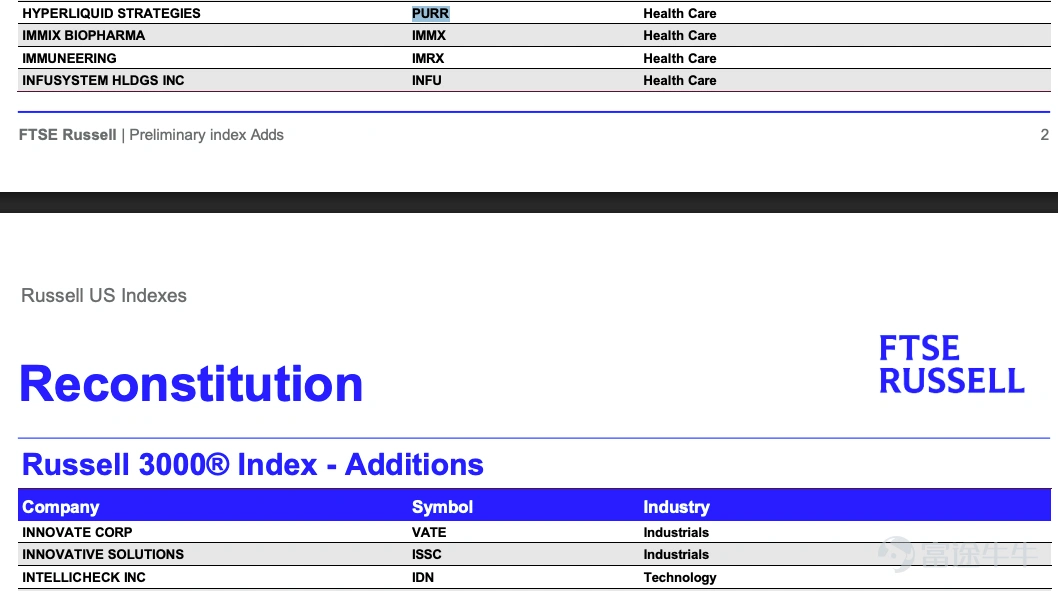
On May 22, FTSE Russell released its preliminary list for the 2026 Russell U.S. Index reconstitution, which included Hyperliquid Strategies (Nasdaq ticker: PURR) among the additions to the Russell 3000 Index, effective June 26.

PURR is currently the largest treasury company holding HYPE tokens, with approximately 20 million HYPE tokens (worth roughly $799 million as of April 29) and an additional $103 million in cash, with no debt. Inclusion in the Russell 3000 means passive funds tracking the index will be required to buy PURR shares, further strengthening the transmission channel from HYPE into traditional capital markets.
The HYPE token briefly surpassed $64 this week, hitting an all-time high, and has gained approximately 150% year-to-date—far outpacing Bitcoin’s performance over the same period. According to CoinGecko data, HYPE now has a market capitalization of around $12.7 billion, ranking tenth among crypto assets.
Facing lobbying pressure from CME and ICE, Hyperliquid has opted for a direct response.
On May 15, Hyperliquid founder Jeff Yan revealed that he and the Hyperliquid Policy Center (HPC) had already held meetings with policymakers in Washington. HPC is an independent research and advocacy organization established in February 2026, led by Jake Chervinsky—former head of policy at the Blockchain Association and former Chief Legal Officer at Variant—and initially funded with 1 million HYPE tokens granted by the Hyper Foundation.
Yan stated on platform X that the meeting discussed 'how on-chain trading, as a financial innovation, addresses clear global user demand' and 'the regulatory pathway for bringing on-chain derivatives markets to the U.S.'
In response to Bloomberg's report on lobbying by CME and ICE, HPC said that Hyperliquid offers markets 'more beneficial and less risky than traditional centralized exchanges' and expects the CFTC to establish a dedicated regulatory framework for on-chain derivatives platforms.
An interesting detail: CME and ICE themselves are currently under parallel investigations by the CFTC and the Department of Justice over 'well-timed' oil futures trades on their respective platforms just before federal policy announcements.
Risk Disclaimer: The above content only represents the author's view. It does not represent any position or investment advice of Futu. Futu makes no representation or warranty.Read more
Comments
to post a comment
3
4