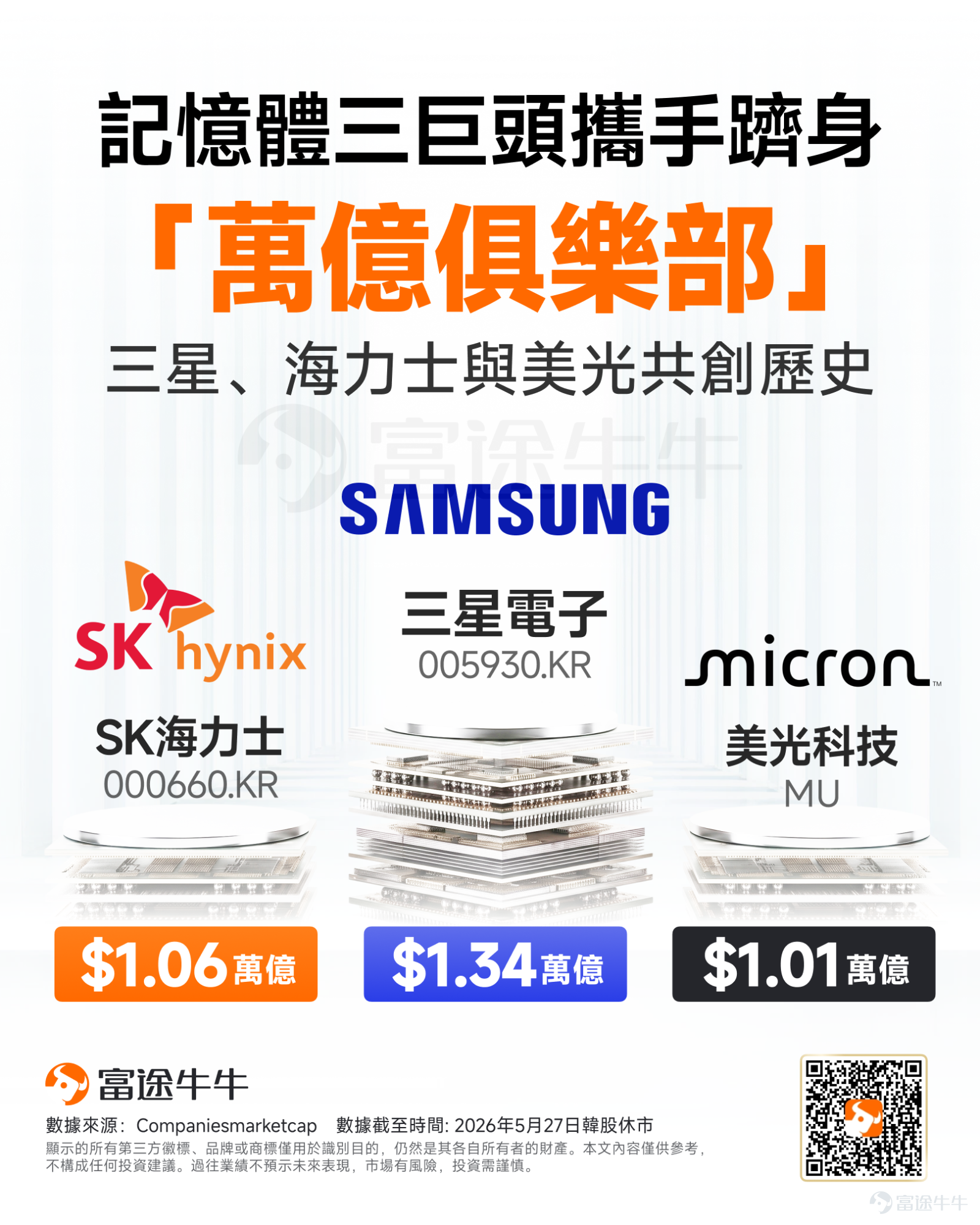

Breaking the cycle—'storage is king'! Memory chips become core AI assets

All three join the trillion-dollar club! Samsung, SK Hynix, and Micron Technology mark a historic milestone—how is the long-term agreement model reshaping industry valuation logic?
The global memory chip industry is witnessing a historic moment.
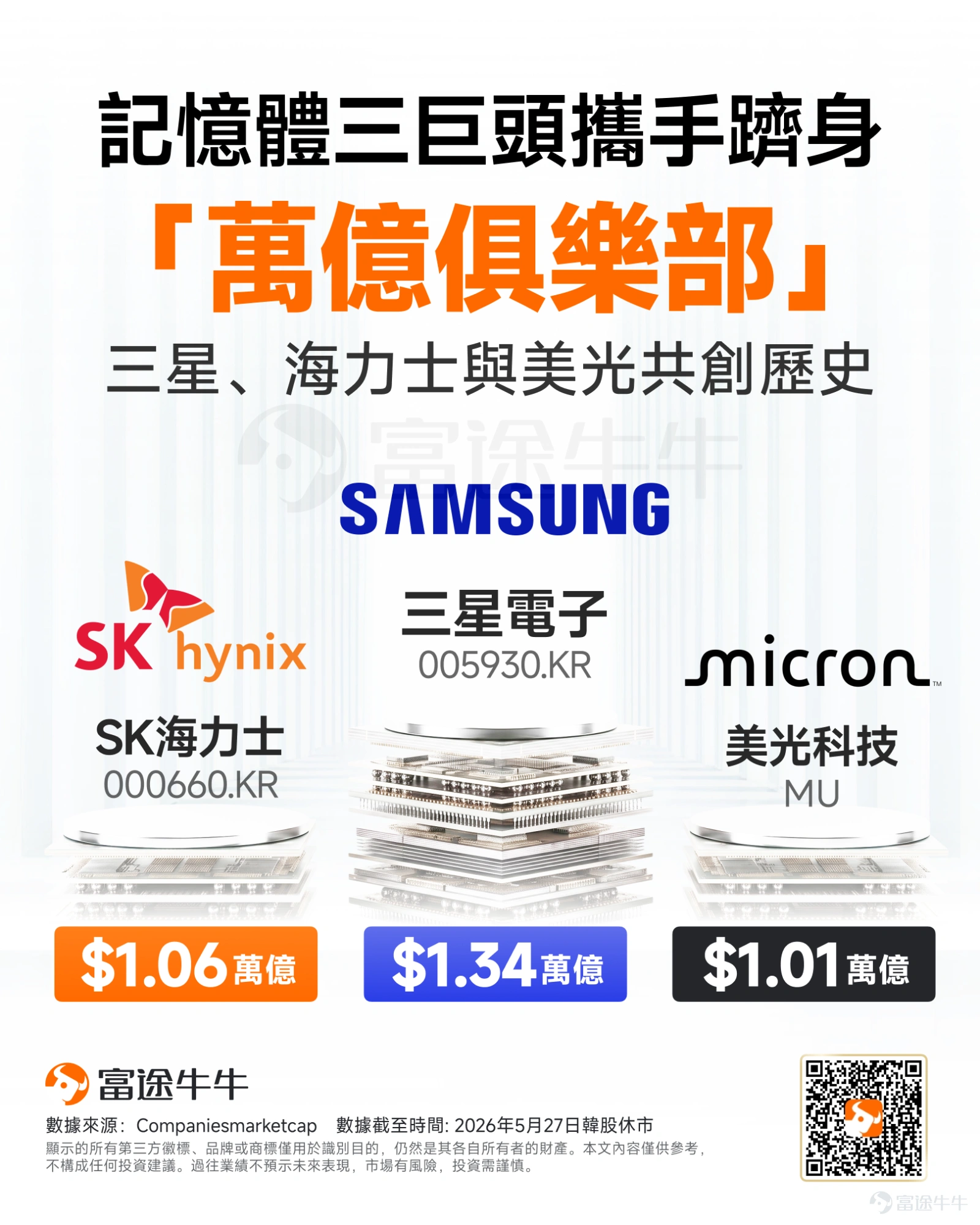
On May 26, $Micron Technology (MU.US)$ Surging more than 19% in a single day, becoming the second of the 'Big Three' memory chipmakers to reach a $1 trillion market cap after $Samsung Electronics (005930.KR)$ On the morning of May 27, $SK Hynix (000660.KR)$ jumped 9%, also surpassing a $1 trillion market cap. With this,All three global memory giants have now collectively joined the '$1 trillion market cap club.'
Micron Technology’s powerful performance that day was partly driven by UBS Group’s significant upward revision of its price target. UBS set Micron’s new price target at $1,625—the highest on Wall Street. In its report, UBS noted that the AI wave has structurally reshaped the memory market, providing Micron with greater demand visibility and paving a clear path for steady earnings growth.
At this point, many investors are likely wondering:What is the basis behind UBS Group's bold report calling for Micron’s stock to double? What disruptive structural shifts have recently occurred in the memory market? Beyond Micron Technology, which hidden-gem stocks are worth positioning into?This article will provide fellow investors with an in-depth breakdown of each point.
Behind UBS Group’s sky-high target price: A valuation reset—from 'cyclical stock' to 'growth stock'
On May 26, UBS Securities analyst Timothy Arcuri sharply raised Micron’s price target from $535 to $1,625 and maintained a 'Buy' rating. What truly sent shockwaves through Wall Street wasn’t the absolute magnitude of this target price, but rathera fundamental shift in valuation logic.
Past pain point: The 'cyclical curse' of extreme profit swings
Historically, the market has viewed memory as a highly cyclical industry. Its business model—characterized by high fixed costs and spot-market pricing—leads to exponential profit amplification during upcycles, while during downcycles, customer inventory drawdowns often trigger price collapses, where just six months of losses can erase an entire year’s profits.Consequently, the traditional market pricing logic focused on 'where we are in the cycle' rather than 'earnings expectations'—assigning low valuations at cycle peaks due to unsustainable profits, and similarly low valuations at troughs due to looming losses.
UBS Group’s breakthrough insight: New long-term agreements (LTAs) smoothing earnings volatility
In its report, UBS abandoned the traditional sum-of-the-parts valuation approach and instead adoptedA P/E framework based on discounted future earningsThe core assumption behind this is that earnings volatility in the memory industry is being significantly dampened by long-term agreements.
Data shows that, by 2027, approximately 20%–30% of the industry’s DDR bit shipments will be covered by 'enhanced' long-term agreements (LTAs) (about 20% for Micron Technology, 18% for SK Hynix, and 30% for Samsung). More importantly, roughly 60%–70% of the industry’s Server DDR5 capacity has already been locked in advance by hyperscale cloud providers through LTAs.

Deep alignment between buyers and sellers: Three disruptive features of the new LTAs
These contracts are not symbolic agreements like those in the past—specifying only volume while leaving pricing to market conditions—but rather a new mechanism with real binding power:
1. Longer contract duration: Terms typically span 3 to 5 years.
2. Locked-in volume and pricing: Part of the price is fixed (set slightly below current market prices), with the remainder subject to market fluctuations.
3. Extremely high cost of breach: Buyers must bear advance payments and commit to capital expenditure support, significantly raising the difficulty of unilaterally canceling orders.
This contractual structure means that even if the next industry downturn arrives, fixed-price orders have already established a solid 'profit floor' for the giants.
This is precisely the market's biggest perception gap right now:The market is still pricing manufacturers as 'cyclical stocks,' but major buyers are locking in supply with real money, while sellers are using this to reshape their earnings floor. If this mechanism takes hold, Micron, SK Hynix, and Samsung will experience not just another upcycle, but a structural re-rating of their entire valuation framework.
Has the memory market undergone recent changes again?
Notably, a major recent market rumor perfectly validates UBS Group's「contract restructuring」logic.
According to informed sources, Google, Microsoft, and Meta are aggressively offering SK Hynix investment packages worth tens of trillions of Korean won for new fab construction and equipment, but the South Korean chip giant has politely declined these proposals.
SK Hynix management’s calculation is that, given its strong cash flow and unshakable position in the supply chain, accepting capital from specific customers would force it into exclusivity obligations—ultimately doing more harm than good.
Leveraging its near-monopoly dominance in the high-bandwidth memory (HBM) market—with its entire production capacity for this year already fully booked by clients like NVIDIA—SK Hynix has turned tech giants’ 'AI compute anxiety' into a powerful negotiating chip. It is demanding:Ultra-long-term supply agreements (LTAs) of five years or more, coupled with higher advance payments and minimum price guarantee clauses.
This negotiation table standoff precisely reflects a profound power shift in supply-demand dynamics amid the AI infrastructure arms race:Tech giants wielding hundreds of billions of dollars in capital expenditure (CapEx) budgets now find themselves reluctantly surrendering pricing power in core chip supply chains, reduced to the humble role of 'vendors.'
Aside from Micron Technology, which other hidden-gem stocks are worth positioning in?
Previous article titled "Pricing power reversal! Memory sector enters a 'once-in-a-lifetime' super cycle. Who is reaping the AI红利?As analyzed in a previous article, this wave of memory demand is not benefiting just a few original equipment manufacturers (OEMs).From upstream wafer fabrication, midstream packaging, testing, and equipment, to downstream modules, controller chips, and system solutions, every link in the chain plays an indispensable role in this cycle, presenting unique investment opportunities.

1. Upstream wafer manufacturing: The most direct 'beneficiary' of price hikes
This is the segment with the greatest elasticity and at the core of this super cycle. The rise in both volume and price of memory wafers (DRAM, HBM, NAND) directly translates into substantial profits for manufacturers. $CSOP SK Hynix Daily (2x) Leveraged Product (07709.HK)$ 、 $CSOP Samsung Electronics Daily (2x) Leveraged Product (07747.HK)$ 、 $Micron Technology (MU.US)$ 、 $SanDisk (SNDK.US)$ 、 $Seagate Technology (STX.US)$ 、 $Western Digital (WDC.US)$
2. Midstream packaging, testing & equipment: The 'hidden winners' behind capacity expansion
Although wafer fabs are cautious about expanding production, yield ramp-ups and structural upgrades for high-end products like HBM have significantly driven growth in packaging, testing, and equipment segments. $Lam Research (LRCX.US)$ 、 $Applied Materials (AMAT.US)$
3. Downstream design & systems: The 'bridge' connecting chips to applications
Memory chips ultimately need to be transformed into usable products and systems. Companies in this segment occupy key positions in the industry chain by mastering core IPs or controller technologies. $Rambus (RMBS.US)$ 、 $Silicon Motion Technology (SIMO.US)$ 、 $Marvell Technology (MRVL.US)$
4. System solutions: The 'final realizer' of memory value
In the era of data explosion, standalone memory hardware can no longer meet demands; enterprise storage systems and software-defined storage have become new growth areas. $NetApp (NTAP.US)$ 、 $PURE BIOSCIENCE (PURE.US)$
5. Memory ETFs: One-click exposure to capture sector opportunities
For investors who prefer not to bet on individual stocks, ETFs offer the most efficient tool:
$Roundhill Memory ETF (DRAM.US)$ :The world’s first 'pure storage' ETF, which strictly selects companies deriving over 50% of their revenue from HBM, DRAM, or NAND. As of May 21, 2026, its top three holdings are SK Hynix, Micron Technology, and Samsung Electronics, collectively accounting for nearly 60% of the fund’s weight.
$iShares MSCI South Korea ETF (EWY.US)$ :Indirectly holding heavy positions in South Korea’s leading storage giants, Samsung Electronics and SK Hynix dominate the MSCI Korea 25/50 Index, together accounting for over 50% of EWY's weight consistently. Beyond these two memory giants, EWY’s top ten holdings also include Hyundai Motor, SK Square, Hanwha Aerospace, and others, offering exposure to the growth of Korea’s other pillar industries.
$Direxion Shares Etf Trust Direxion Daily So Korea Bull 3X Shs (KORU.US)$ :Triple-leveraged bet on 'South Korea = Storage', when a clear and strong short-term uptrend emerges in the Korean market—primarily driven by Samsung and SK Hynix—KORU can deliver exceptionally high returns, but investors must watch out for volatility decay, which can rapidly erode capital in choppy markets.
$VanEck Semiconductor ETF (SMH.US)$ :One-stop investment in the global semiconductor ecosystem, not solely betting on storage but comprehensively covering leading global companies across the semiconductor design, manufacturing, and equipment value chain, capturing overall growth dividends of the semiconductor industry.
In addition, Bull Bull has also mapped out Micron Technology’s supply chain and customer base. Micron’s trillion-dollar market valuation is firmly supported by an entire golden ecosystem. By following this list, we can uncover more investment opportunities with 'certainty.'
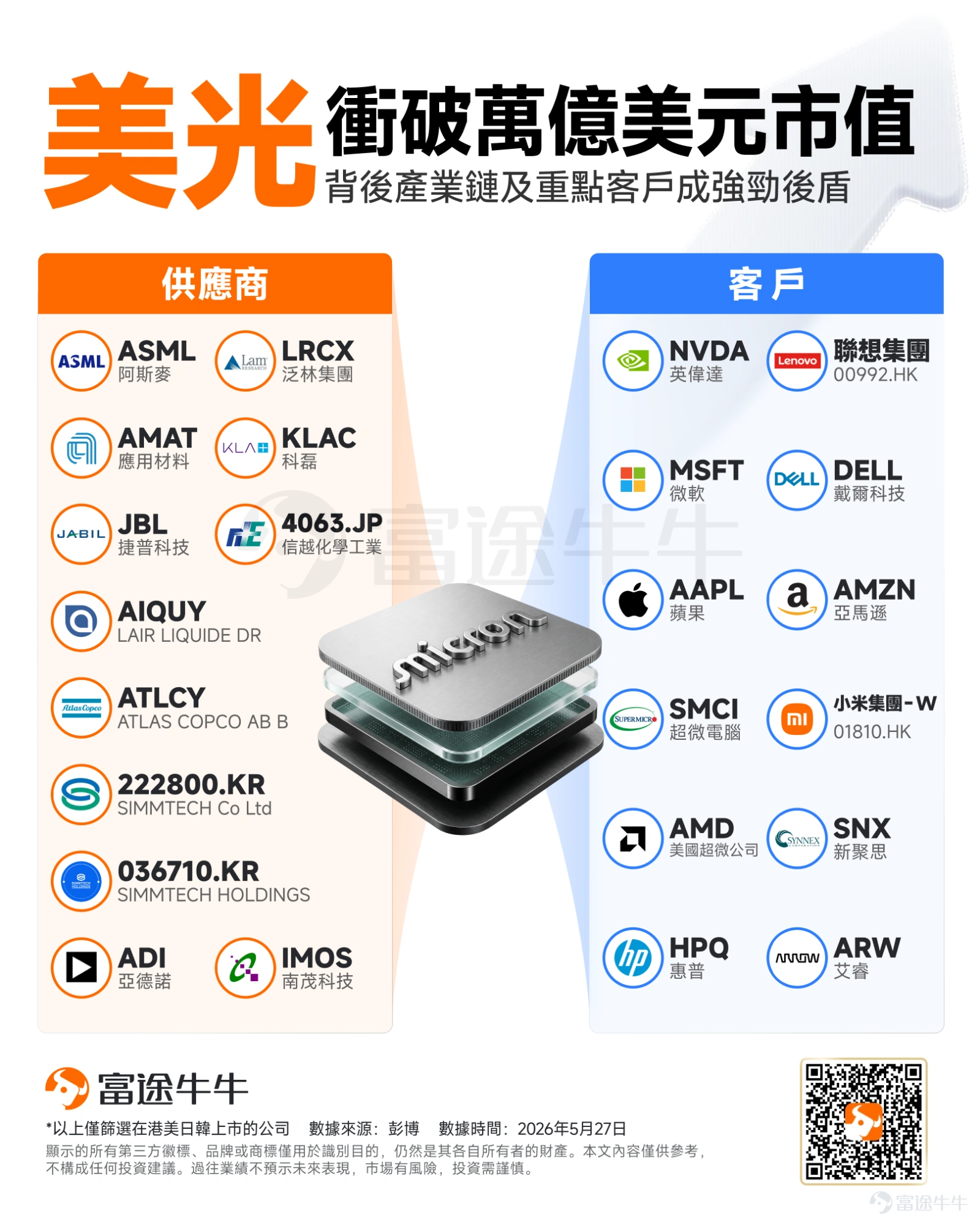
1. Upstream 'Shovel Sellers': Absolute beneficiaries of Micron’s capacity expansion and process upgrades
In the AI infrastructure arms race, regardless of how fiercely downstream chipmakers compete for market share, upstream 'shovel sellers'—those providing equipment and materials—are always the first to realize earnings. As Micron ramps up capital expenditures (CapEx) to meet long-term agreements (LTAs), investing heavily in advanced nodes and HBM capacity expansion, these suppliers are entering a golden period of explosive growth:
The Big Four semiconductor equipment makers: $ASML Holding (ASML.US)$ 、 $Lam Research (LRCX.US)$ 、 $Applied Materials (AMAT.US)$ And, $KLA Corp (KLAC.US)$ . From lithography exposure and etching to thin-film deposition and process control, these four companies virtually monopolize core equipment used in advanced memory manufacturing. Every new node advancement by Micron relies on purchasing their extremely expensive tools.
Critical consumables and specialty gases: Chip manufacturing is an art of precision chemistry. Japanese firms $Shin-Etsu Chemical (4063.JP)$ hold the lifeline for high-quality silicon wafers and photoresists; meanwhile, $Air Liquide SA Unsponsored ADR (AIQUY.US)$ provides ultra-pure electronic-grade gases essential to the manufacturing process; these materials are consumables and exhibit strong revenue stickiness.
Advanced Packaging and Substrates: The core technology of HBM lies in 3D stacking, which significantly boosts demand on the packaging and testing side. $SIMMTECH CO (222800.KR)$ As the leading memory PCB substrate manufacturer and a company focused exclusively on memory packaging and testing, $ChipMOS TECHNOLOGIES (IMOS.US)$ both will directly benefit from the added value driven by the increasing complexity of HBM.
2. Downstream 'Paying Customers': An all-star lineup spanning cloud computing and edge AI
Micron Technology's customer list reads like a chronicle of global tech giants' AI transformation. This roster reveals that Micron’s future revenue growth is not reliant on a single market but is instead powered by multidimensional drivers:
Compute Power Leaders and AI Servers: At the top of the list is $NVIDIA (NVDA.US)$ And, $Advanced Micro Devices (AMD.US)$ , the key driver absorbing the vast majority of Micron’s HBM capacity. Close behind areSuper Micro ComputerandDell TechnologiesAs a leading AI server integrator, it also requires massive volumes of Server DDR5 memory modules for assembly and shipment.
Deep-pocketed cloud giants: $Microsoft (MSFT.US)$ And, $Amazon (AMZN.US)$ These represent the buyers mentioned earlier who 'hold hundreds of billions in capital expenditure.' It is precisely these hyperscale cloud service providers that have established a solid profit floor for Micron Technology through long-term agreements (LTAs).
Edge AI and consumer device leaders: Beyond the cloud, AI is now moving down to end-user devices. $Apple (AAPL.US)$ 、 $LENOVO GROUP (00992.HK)$ 、 $XIAOMI-W (01810.HK)$ And, $HP Inc (HPQ.US)$ Their inclusion signals the upcoming wave of upgrades driven by 'AI smartphones' and 'AI PCs.' To run large AI models smoothly on end devices, doubling the DRAM content per box is an inevitable trend—this will serve as a powerful second growth engine for Micron Technology.
Conclusion: Capture structural revaluation opportunities while maintaining respect for market cycles
This trillion-dollar feast jointly created by Micron, SK Hynix, and Samsung marks an unprecedented golden era for the memory industry. From upstream equipment 'shovel sellers' to downstream system applications, AI compute anxiety has triggered long-term agreement (LTA) commitments and a shift in pricing power, clearly outlining a high-certainty investment theme.
However, in capital markets, opportunity always walks hand-in-hand with risk.Although Wall Street investment banks have painted a long-term blueprint of 'de-cyclicality' for the memory sector, historically it remains the most cyclical segment within semiconductors. Whether AI can permanently reshape this dynamic still requires validation across multiple cycles.
While embracing this optimistic trend, investors should closely monitor two key variables:1) Sustainability of buyer capital expenditures: Whether tech giants’ current high spending on AI infrastructure will be scaled back in the future due to macroeconomic headwinds or weaker-than-expected monetization;2) Enforceability of long-term contracts: In extreme market conditions, whether substantial advance payments and penalty clauses can truly prevent major customers from cutting orders.
Fellow investors should maintain discipline in actual trading and avoid blindly chasing rallies. By building positions gradually or using ETFs to diversify risk—and focusing on industry leaders with strong technological moats and contractual advantages—they can better capture and secure the AI-driven upside through upcoming cyclical volatility.
Risk Disclaimer: The above content only represents the author's view. It does not represent any position or investment advice of Futu. Futu makes no representation or warranty.Read more


Comments (24)
to post a comment
181
496