English
Back
Open Account
Hong Kong Market Barometer: Heavyweight Hang Seng Tech stocks rebound sharply!
易方达香港
joined discussion ·

AI Investment Outlook from NVIDIA's Q1 Earnings: Why iShares AI ETF (03489) Holds Significant Allocation

According to NVIDIA's Investor Relations website, the company reported Q1 FY2027 revenue of$81.6 billion, up 85% year-over-year and 20% quarter-over-quarter, setting another all-time high. Of this, theData Center segmentcontributed $75.2 billion, surging 92% year-over-year and accounting for 92% of total revenue, underscoring that AI infrastructure remains a powerful growth driver for the company.
Even more noteworthy is the company's optimistic guidance for the second quarter,forecasting revenue between $89.1 billion and $92.8 billion, once again exceeding market consensus. Blackwell platform shipments are progressing smoothly, and the new Vera CPU is unlocking additional demand, reflecting sustained explosive growth in AI training and inference needs and indicating that AI infrastructure build-out continues to accelerate.
$NVIDIA (NVDA.US)$ Q1's impressive results once again demonstrate its strong growth momentum in the AI sector. Beyond outstanding financial figures, the year’s most watched trend—Agentic AI—also drew significant attention during this earnings announcement. Quoting NVIDIA founder and CEO Jensen Huang from the earnings call: 'The construction of AI factories is accelerating at an astonishing pace—it’s the largest infrastructure expansion in human history.'Agentic AI has arrivedand is already creating tangible value across industries, rapidly gaining adoption.'

In fact, Huang had already stated in his bylined article earlier this year: "five-layer cake" as a metaphor for the current AI industry chain structure, which from bottom to top consists of:energy, chips, infrastructure, models, and applications. He pointed out that the topmost application layer is currently experiencing rapid adoption, and this momentum will strongly drive demand across the entire AI industry chain from top to bottom, creating comprehensive and sustained growth momentum.
NVIDIA's earnings also confirm this trend. Beyond headline figures, in its data center business details, NVIDIA’s Data Center Networking revenue reached $14.8 billion, up 199% year-over-year, while its core Compute segment rose 77% year-over-year to $60.4 billion. Both segments showed robust performance, but they indicate that the growth spotlight in the AI space has shifted from 'chip performance' to 'system-level efficiency.'
From the above perspective, it’s clear that beneficiaries in the AI race are no longer limited to chipmakers alone. As Jensen Huang noted with his 'five-layer cake' analogy, the entire industry chain can benefit simultaneously. In terms of AI positioning,using ETFs enables low-cost, direct investment across multiple sectors, allowing investors to capture growth opportunities across various segments simultaneously. For example, $E Fund (HK) FTSE AI Select Index ETF (03489.HK)$ this ETF closely tracks the FTSE Custom Artificial Intelligence Select Index, which includes 50 leading AI companies listed on both the Hong Kong and U.S. stock markets. According to Bloomberg data as of May 21, NVIDIA is the ETF’s largest holding at a weight of 9.17%, while also covering $Advanced Micro Devices (AMD.US)$$Broadcom (AVGO.US)$$Taiwan Semiconductor (TSM.US)$$Micron Technology (MU.US)$  、 $Lumentum (LITE.US)$$SanDisk (SNDK.US)$ global computing power leaders and semiconductor companies. In terms of applications and models, it also includes $Microsoft (MSFT.US)$$Apple (AAPL.US)$$Amazon (AMZN.US)$$Alphabet-C (GOOG.US)$ and $Apple (AAPL.US)$ And so on.
The reason for the ETF’s simultaneous exposure to both China and the U.S. is that the AI sector is equally significant in both markets. In the AI space, the U.S. leads in model development and computing chips but faces insufficient power generation, making data center expansion vulnerable to electricity shortages. China, on the other hand, dominates hardware manufacturing—such as optical modules and PCBs—and generates over one million terawatt-hours of electricity, giving it an energy advantage, though it still relies on imports for advanced semiconductor processes. Model innovation requires energy support, while computing capacity expansion depends on chip supply.The ETF enables investors to simultaneously invest in key leaders from both regions, capturing benefits across the entire AI value chain.. Regarding Hong Kong-listed stocks, these include $SMIC (00981.HK)$$HUA HONG SEMI (01347.HK)$$BABA-W (09988.HK)$$XIAOMI-W (01810.HK)$$TENCENT (00700.HK)$$HORIZONROBOT-W (09660.HK)$$UBTECH ROBOTICS (09880.HK)$$KINGBOARD HLDG (00148.HK)$ And so on.
According to NVIDIA's Investor Relations website, the company reported Q1 FY2027 revenue of$81.6 billion, up 85% year-over-year and 20% quarter-over-quarter, setting another all-time high. Of this, theData Center segmentcontributed $75.2 billion, surging 92% year-over-year and accounting for 92% of total revenue, underscoring that AI infrastructure remains a powerful growth driver for the company. Even more noteworthy is the company's optimistic guidance for the second quarter,forecasting revenue between $89.1 billion and $92.8 billion, once again exceeding market consensus. Blackwell platform shipments are progressing smoothly, and the new Vera CPU is unlocking additional demand, reflecting sustained explosive growth in AI training and inference needs and indicating that AI infrastructure build-out continues to accelerate. $NVIDIA (NVDA.US)$ Q1's impressive results once again demonstrate its strong growth momentum in the AI sector. Beyond outstanding financial figures, the year’s most watched trend—Agentic AI—also drew significant attention during this earnings announcement. Quoting NVIDIA founder and CEO Jensen Huang from the earnings call: 'The construction of AI factories is accelerating at an astonishing pace—it’s the largest infrastructure expansion in human history.'Agentic AI has arrivedand is already creating tangible value across industries, rapidly gaining adoption.'   In fact, Huang had already mentioned earlier this year...
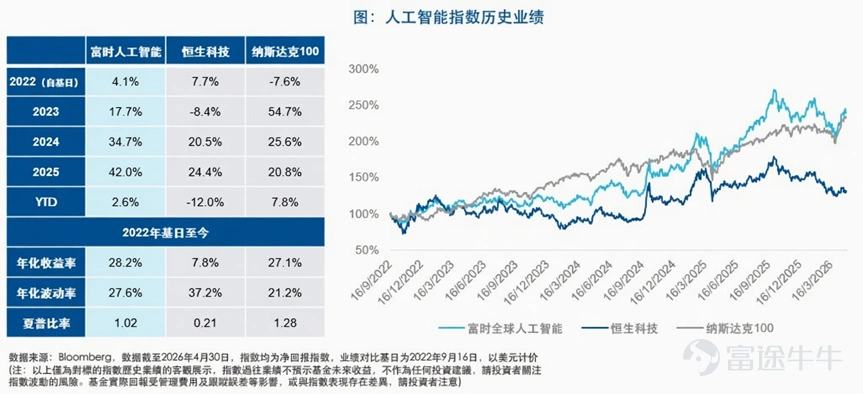
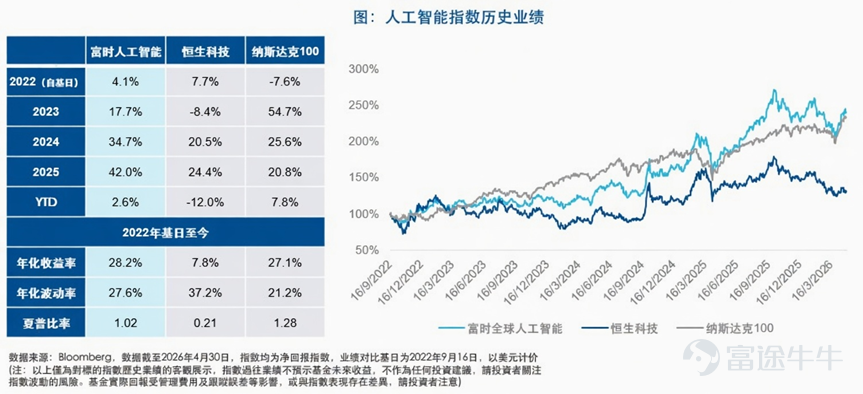
The FT Custom Global Artificial Intelligence Select Index tracked by the ETF demonstrates excellent balance. Since its base date in 2022, the index has achieved a Sharpe ratio of 1.02—above 1—indicating solid risk-adjusted returns with good value. $NASDAQ 100 Index (.NDX.US)$ , and has significantly outperformed the Hang Seng Tech Index. Compared to the Hang Seng Tech Index, it shows clear advantages in both total returns and Sharpe ratio.
According to Bloomberg data, as of May 21, 2026, the FTSE Custom Global Artificial Intelligence Select Index has delivered a return of 20.0% year-to-date in the second quarter.
(Note: The above information presents only the historical performance of the underlying index objectively. Past index performance does not indicate future fund returns and should not be construed as investment advice. Investors should be aware of the risks associated with index volatility. Actual fund returns may differ from index performance due to management fees, tracking error, and other factors.)
E Fund AI ETF (03489.HK)is a thematic ETF focused on the global AI industry chain, enabling investors to gain comprehensive exposure to the entire AI sector in a single investment, covering leading companies across both U.S. and Chinese markets. Investors don’t need to focus solely on $Hang Seng TECH Index (800700.HK)$ or $Nasdaq Composite Index (.IXIC.US)$ to broadly allocate across key AI segments such as computing power, models, infrastructure, and applications. Amid the AI boom, whether in $Hang Seng Index (800000.HK)$$S&P 500 Index (.SPX.US)$ or other major markets, semiconductor and AI-related companies are key beneficiaries, offering investors a balanced and efficient way to capture long-term AI growth opportunities.
Important Information
The issuer of this content is E Fund Asset Management (Hong Kong) Co., Ltd. This content is for reference only and does not constitute an invitation or recommendation to invest in fund units. This content is for display purposes only and should not be shown to any person for whom such display would be illegal. Investment involves risks, and you may lose a significant portion of your principal. Before investing, investors should carefully read the fund prospectus (including the "Risk Factors" section) to understand the investment risks associated with the fund. This content has not been reviewed by the SFC.
The E Fund (Hong Kong) FTSE Artificial Intelligence Select Index ETF (the “Sub-Fund”) is a sub-fund of the E Fund ETF Trust. The E Fund ETF Trust is an umbrella unit trust established under the laws of Hong Kong. The Sub-Fund is a passively managed ETF as defined under Chapter 8.6 of the Securities and Futures Commission’s (“SFC”) Code on Unit Trusts and Mutual Funds. Units of the Sub-Fund (“Fund Units”) are traded on The Stock Exchange of Hong Kong Limited (“HKEX”) like stocks. The investment objective is to provide investment returns that closely track the performance of the FTSE Custom Global Artificial Intelligence Select Index (the “Index”), before fees and expenses.
The constituent stocks of the index (and thus the investment targets of this Sub-Fund) may be concentrated in the technology sector and two geographic regions/countries (China and the United States). Compared to funds with more diversified portfolios, the value fluctuations of this Sub-Fund may be more pronounced and more susceptible to adverse economic, political, policy, foreign exchange, liquidity, tax, legal, or regulatory events related to the relevant industries.
For important notices and disclaimers regarding the above fund, please visit E Fund Hong Kong’s website.
Risk Disclaimer: The above content only represents the author's view. It does not represent any position or investment advice of Futu. Futu makes no representation or warranty.Read more
Thumbs Up
9
Heart
1
913K Views
Report
Comments
Write a Comment...
10
4