SMIC and Hua Hong Semiconductor surge sharply as domestic chips receive multiple tailwinds

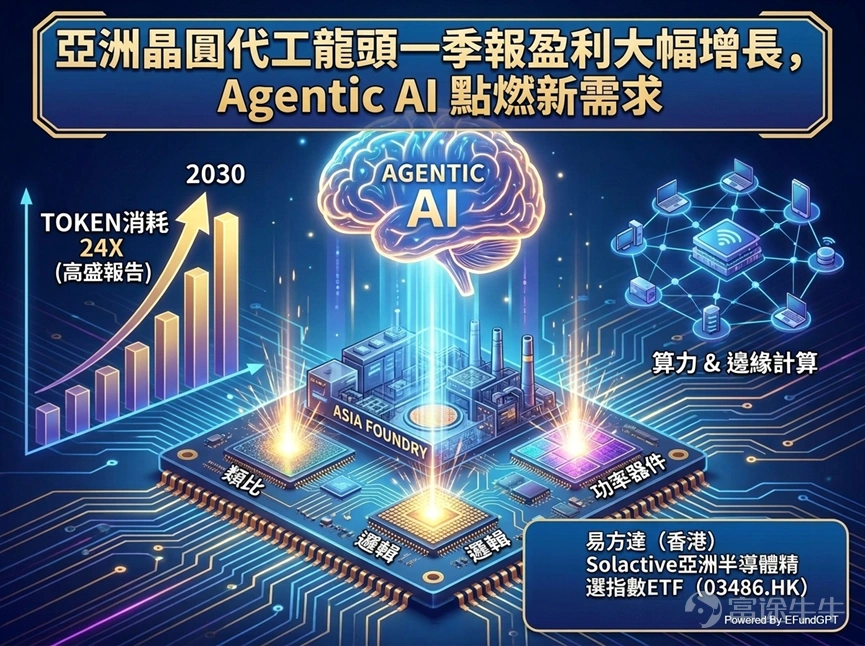
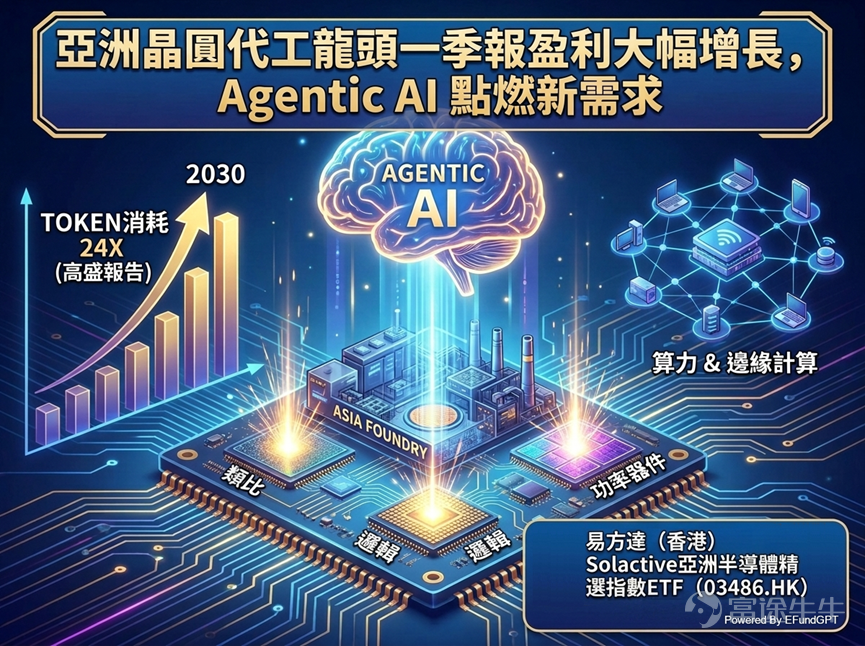
(The above graphic was generated by EfundGpt; token consumption estimates are excerpted from Goldman Sachs' research report <Decoding the Agentic Economy>)
In their Q1 2026 earnings reports, China's two leading foundries $SMIC (00981.HK)$ And, $HUA HONG SEMI (01347.HK)$ both delivered significantly higher profits. Although Hua Hong Semiconductor’s actual earnings were slightly below market expectations, both companies demonstrated strong resilience overall,primarily driven by robust demand for supporting chips fueled by the explosive growth of AI applications.。
We can first take note of their performance in the earnings reports:
Hua Hong Semiconductor (01347.HK)

(Source: HKEX announcement of Hua Hong Semiconductor, 01347.HK)
In the first quarter of 2026, the company reported revenue of approximately USD 661 million, an increase of 22.2% year-over-year, and net profit attributable to shareholders surged by over 458% year-over-year, primarily driven by strong demand for MCU, power devices, and specialty process products, higher average selling prices, and increased contributions from its 12-inch production line.
However, revenue rose only marginally by 0.2% quarter-over-quarter, and gross margin remained flat compared to the previous quarter, resulting in overall results slightly below market expectations. Notably, the company provided a relatively optimistic outlook for the second quarter, forecasting revenue between USD 690 million and USD 700 million and gross margin improving to a range of 14%–16%. In a report dated May 15, 2026, Bank of China International noted that price increases will gradually take effect in subsequent quarters, and supported by strong demand for AI and memory products, average selling prices for the full year are expected to rise by 10% to 15%. Accordingly, the firm raised its target price from HKD 116.5 to HKD 152.4 and maintained its 'Buy' rating.
SMIC (00981.HK)

(Source: HKEX announcement of SMIC, 00981.HK)
In the first quarter of 2026, SMIC reported revenue of USD 2.505 billion, up 11.5% year-over-year, with a gross margin of 20.1%.It achieved positive growth despite the traditional off-season, supported significantly by demand from domestic clients. According to the company's HKEX filing, its guidance for the second quarter is robust, with revenue expected to increase 14% to 16% quarter-over-quarter and gross margin projected in the range of 20% to 22%.
The standout feature of SMIC this quarter was 'a strong performance during the usual off-season.', not only reflecting the gradual recovery of its competitiveness in mature and specialty process technologies, but also highlighting AI infrastructure and localization demand as key growth drivers. Meanwhile, the company’s 8-inch wafer monthly capacity reached 1,078,250 wafers, accounting for 23.6% of total capacity—an increase of 0.8 percentage points quarter-over-quarter from Q4 2025.

(Source: HKEX announcement by SMIC, stock code 00981.HK)
Although Hua Hong Semiconductor and SMIC have delivered impressive individual stock performance, concentrating investments in a single stock still entails significant uncertainty and company-specific risks.。 In contrast, gaining exposure through a basket of leading Asian semiconductor companies offers a more comprehensive way to capture industry growth while effectively diversifying single-company and geographic risks.
Against this backdrop,E Fund (Hong Kong) Solactive Asia Semiconductor Select Index ETF (03486.HK)provides investors with a one-stop, convenient tool for accessing the Asian semiconductor sector. In addition to including the aforementioned SMIC and Hua Hong Semiconductor, the ETF also holds other leading names in the Asian market, such as $Taiwan Semiconductor (TSM.US)$ , Samsung, Hynix, $Tokyo Electron (8035.JP)$ 、 $ASMPT (00522.HK)$ core semiconductor companies across the industry, offering comprehensive exposure to multiple high-growth segments—including wafer foundry, packaging and testing, power devices, and memory—enabling investors to evenly participate in the long-term growth opportunities driven by the AI wave in Asia’s semiconductor industry. It is currently one of the preferred choices for investing in the Asian semiconductor sector.
Furthermore, note that the rapid advancement of Agentic AI this year is expected to serve as a significant catalyst, potentially propelling the industry into a new upcycle.
Agentic AI Drives Explosive Token Consumption, Positioning Asian Semiconductors at the Forefront
According to Goldman Sachs’ latest report, 'Decoding the Agentic Economy,' Agentic AI (agent-based AI) will evolve from single-turn chat interactions into autonomous, multi-step, continuously operating intelligent agent systems,Global token consumption is expected to grow 24-fold by 2030 compared to 2026, with enterprise-side agents contributing the most (projected to increase 55-fold).
This explosive demand is rapidly cascading into computing power, edge computing, power management, and storage chip sectors, with Asia—being the global hub of semiconductor manufacturing—emerging as the primary beneficiary.
Investment highlights from Goldman Sachs' report
Goldman Sachs emphasized in its report that the 'low-cost tokens + high token consumption' flywheel effect driven by Agentic AI will significantly boost capacity utilization and profitability for Asian semiconductor companies. With a positive inflection point in token economics (Margin Inflection) expected in the first half of 2026, Asian semiconductor firms are poised to benefit from both surging demand and improving gross margins.
A critical point not to overlook in this report is:Whoever can effectively reduce token costs will determine the pace of Agentic AI adoption. In the semiconductor space, NVIDIA, AMD, and Broadcom remain the clear leaders, and thus Goldman Sachs’ report specifically recommends these three companies.
However, further improvements in chip training and inference efficiency ultimately still hinge on breakthroughs in advanced process technologies.From this perspective, not only logic chips but also memory chips stand to benefit significantly,Leading Asian manufacturers such as Taiwan Semiconductor, Samsung Electronics, and SK Hynix will all be key beneficiaries.。
Moreover, although domestic Chinese chips are outside the scope of Goldman Sachs’ report, they similarly benefit from the aforementioned industry dynamics. In China’s AI development trajectory, performance enhancements in chips from companies like Huawei and Cambricon heavily rely on capacity expansions by SMIC and Hua Hong Semiconductor in both mature and advanced process nodes, as well as technical support from equipment suppliers such as ASMPT.
Against this backdrop, the outlook for the broader Asian semiconductor industry remains highly worthy of attention. And $EFund A SEMICON ETF (03486.HK)$ provides investors with an ideal, one-stop, diversified vehicle to gain exposure to leading Asian semiconductor companies, enabling them to efficiently capture opportunities from the sector’s upcycle without having to pick individual stocks.

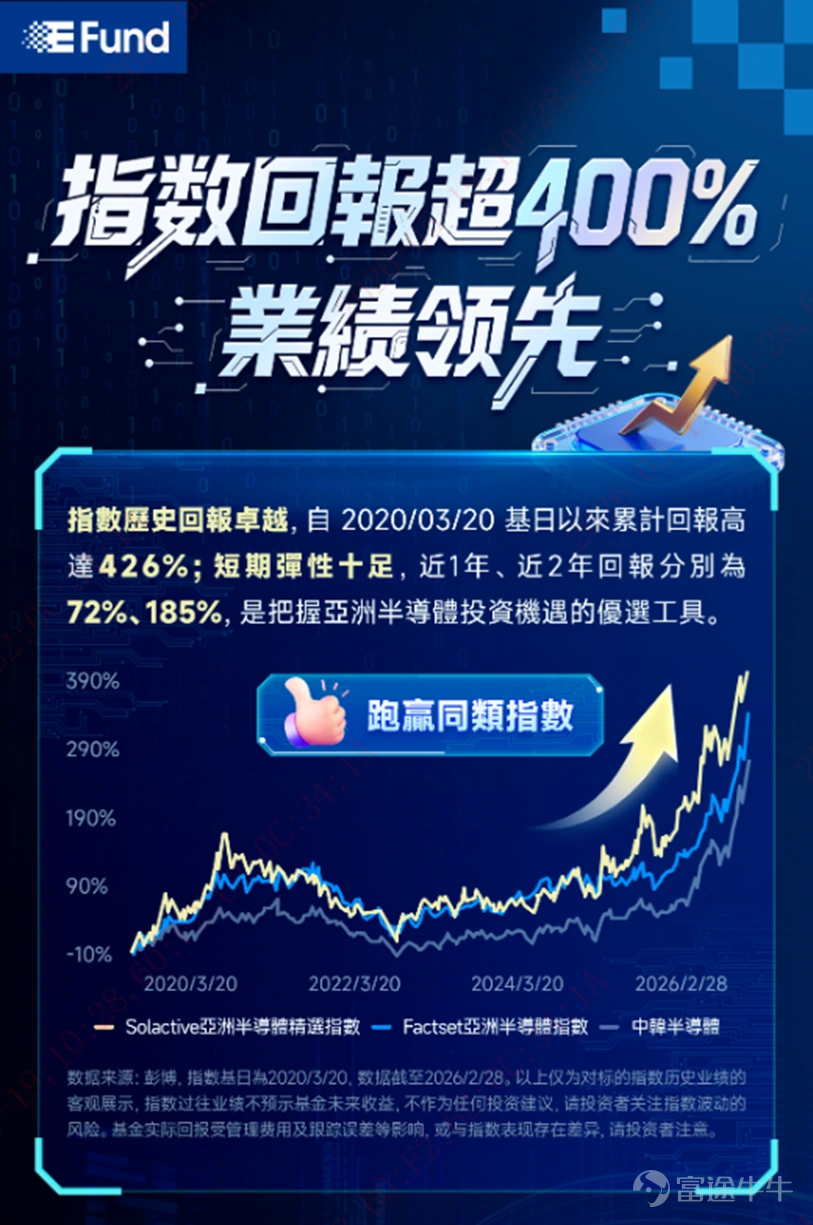
In 2026, driven by the rapid advancement of Agentic AI and continued expansion of AI infrastructure, the Asian semiconductor industry is entering a clear upcycle. Since its base date, the Solactive Asia Semiconductor Select Index has consistently outperformed several major peer indices, fully demonstrating its strength in capturing sector growth opportunities.
Whether it’s $Hang Seng Index (800000.HK)$ 、 $Hang Seng TECH Index (800700.HK)$ , or $S&P 500 Index (.SPX.US)$and$Nasdaq Composite Index (.IXIC.US)$ , have all clearly benefited from this wave of AI adoption. Meanwhile, semiconductors—as the core infrastructure of AI—are becoming increasingly critical. ThroughiShares (Hong Kong) Solactive Asia Semiconductor Select Index ETF (03486.HK), investors can gain one-stop exposure to leading semiconductor companies, effectively capturing this long-term trend while balancing risk diversification and growth potential—making it a compelling allocation choice worthy of close attention today.
Important Information
The issuer of this content is E Fund Asset Management (Hong Kong) Co., Ltd. This content is for reference only and does not constitute an invitation or recommendation to invest in fund units. This content is for display purposes only and should not be shown to any person for whom such display would be illegal. Investment involves risks, and you may lose a significant portion of your principal. Before investing, investors should carefully read the fund prospectus (including the "Risk Factors" section) to understand the investment risks associated with the fund. This content has not been reviewed by the SFC.
The E Fund (Hong Kong) Solactive Asia Semiconductor Select Index ETF (the “Sub-Fund”) is a sub-fund of the E Fund ETF Trust. The E Fund ETF Trust is an umbrella unit trust established under the laws of Hong Kong. The Sub-Fund is a passively managed ETF as defined under Chapter 8.6 of the Unit Trusts and Mutual Funds Code issued by the Securities and Futures Commission (“SFC”). Units of the Sub-Fund (“Units”) are traded on The Stock Exchange of Hong Kong Limited (“HKEX”) like stocks. The investment objective is to provide investment returns that closely track the performance of the Solactive Asia Semiconductor Select Index (the “Index”), before fees and expenses.
As the Sub-fund’s investments are concentrated in securities of companies primarily engaged in specific sectors within the Hong Kong and East Asian semiconductor industries, it may be particularly affected by certain factors, thus exposing the Sub-fund to industry and geographic concentration risks. Therefore, its net asset value may be more volatile compared to broadly diversified funds.
For important notices and disclaimers regarding the above fund, please visit E Fund Hong Kong’s website.https://www.efunds.com.hk/tc/products/53/important/
Risk Disclaimer: The above content only represents the author's view. It does not represent any position or investment advice of Futu. Futu makes no representation or warranty.Read more
Comments
to post a comment
7
2