English
Back
Open Account
Focus on the 'hidden gem' stocks unveiled at ComputeX 2026! What to invest in June?
Samsung ETF
joined discussion ·

NVIDIA Q1 earnings beat expectations, underscoring sustained AI compute demand

Earnings analysis: Beating expectations has become the 'norm'; structural trends are the real focus After U.S. market hours on May 20, $NVIDIA (NVDA.US)$ NVIDIA reported its fiscal Q1 2026 results. Both revenue and earnings per share exceeded market expectations, with Data Center revenue—continuing as the core growth engine—reaching $75.2 billion, also above forecasts. The company simultaneously raised its quarterly dividend from $0.01 to $0.25 and authorized an additional $80 billion in share repurchases. Its after-hours stock price reversed earlier losses to rise over 1% at one point.[1] Simply observing the 'double beat' (on both revenue and EPS) has nearly become routine for NVIDIA. Over the past ten quarters, NVIDIA’s actual revenue has consistently exceeded management’s guidance by approximately 7–8 percentage points on average.[2] Therefore, what deserves more attention from this earnings report isn’t whether the numbers beat expectations, but two deeper structural trends: AI workloads are shifting comprehensively from 'training' to 'inference,' and the ramp-up speed of Blackwell platform production is testing the limits of supply chain bottlenecks. Inference demand surges: From 'training arms race' to 'large-scale deployment' During the earnings call, NVIDIA management noted that AI workloads have shifted toward inference, and the construction of AI factories is driving significant revenue growth. Microsoft processed over 100 trillion tokens in Q1, a fivefold year-over-year increase; OpenAI, $Microsoft (MSFT.US)$ and Goog...
Earnings analysis: Beating expectations has become the 'norm'; structural trends are the real focus
After U.S. market hours on May 20, $NVIDIA (NVDA.US)$ NVIDIA reported its fiscal Q1 2026 results. Both revenue and earnings per share exceeded market expectations, with Data Center revenue—continuing as the core growth engine—reaching $75.2 billion, also above forecasts. The company simultaneously raised its quarterly dividend from $0.01 to $0.25 and authorized an additional $80 billion in share repurchases. Its after-hours stock price reversed earlier losses to rise over 1% at one point.[1]
Simply observing the 'double beat' (on both revenue and EPS) has nearly become routine for NVIDIA. Over the past ten quarters, NVIDIA’s actual revenue has consistently exceeded management’s guidance by approximately 7–8 percentage points on average.[2]
Therefore, what deserves more attention from this earnings report isn’t whether the numbers beat expectations, but two deeper structural trends: AI workloads are shifting comprehensively from 'training' to 'inference,' and the ramp-up speed of Blackwell platform production is testing the limits of supply chain bottlenecks.
Inference demand surges: From 'training arms race' to 'large-scale deployment'
During the earnings call, NVIDIA management noted that AI workloads have shifted toward inference, and the construction of AI factories is driving significant revenue growth. Microsoft processed over 100 trillion tokens in Q1, a fivefold year-over-year increase; OpenAI, $Microsoft (MSFT.US)$ and Google all witnessed exponential growth in token generation. Startups offering inference services using the B200 GPU (Graphics Processing Unit) saw their token generation rates—and corresponding revenues—triple. [3]
This trend has profound structural implications for the semiconductor industry. Unlike the training phase, which is heavily concentrated among a few hyperscale cloud service providers, the inference phase involves a much broader and more fragmented customer base—including enterprises, startups, and diverse end-use applications. This implies that demand for AI computing power will evolve from 'concentrated procurement' by a few large buyers toward 'sustained, steady consumption' across a wider range of customers. Against this backdrop, the momentum behind data center infrastructure expansion is likely to continue.
Moreover, inference workloads are more cost-sensitive, directly driving customers to seek solutions with better price-performance ratios and lower per-token inference costs—a dynamic that will continue to fuel iterative advancements in chip architecture.
Blackwell Ramp-Up: Supply Chain Bottlenecks and Capacity Challenges
The pace of Blackwell platform's volume production ramp-up is another key focus of this earnings report. Management stated that Blackwell is ramping faster than any previous product in the company's history, contributing nearly 70% of data center computing revenue this quarter, with the transition from Hopper nearly complete. Major hyperscale customers are each deploying, on average, nearly 1,000 NVL72 racks—or 72,000 Blackwell GPUs—per week, and production volumes are expected to increase further this quarter. GB200 NVL racks are now widely available for model builders, enterprises, and sovereign clients to deploy AI. [3]
However, this rapid ramp-up has also exposed supply chain bottlenecks. The cost share of HBM (High Bandwidth Memory) continues to rise, and constraints persist in advanced packaging capacity and the supply of critical components. The market will closely monitor whether NVIDIA can maintain stable gross margins while sustaining high growth.
Valuation and Stock Performance: Market Dynamics Beyond Earnings
NVIDIA's stock performance year-to-date has lagged behind Microsoft and the S&P 500 Semiconductor Sector Index. $PHLX Semiconductor Index (.SOX.US)$ Although NVIDIA continues to deliver earnings that exceed expectations, its stock price has shown relatively weak performance the day after earnings announcements. This outperformance may be triggering a 'sell-the-news' trading pattern.
From a valuation perspective, however, Bank of America Securities noted that NVIDIA trades at 26x and 19x forward P/E for fiscal years 2026 and 2027, respectively—significantly below the Mag 7 peer average of 49x and 42x, representing a discount of nearly 50%. BofA believes that if NVIDIA increases its shareholder returns (via dividends and share buybacks), it could attract more long-term capital and narrow this valuation gap. [2]
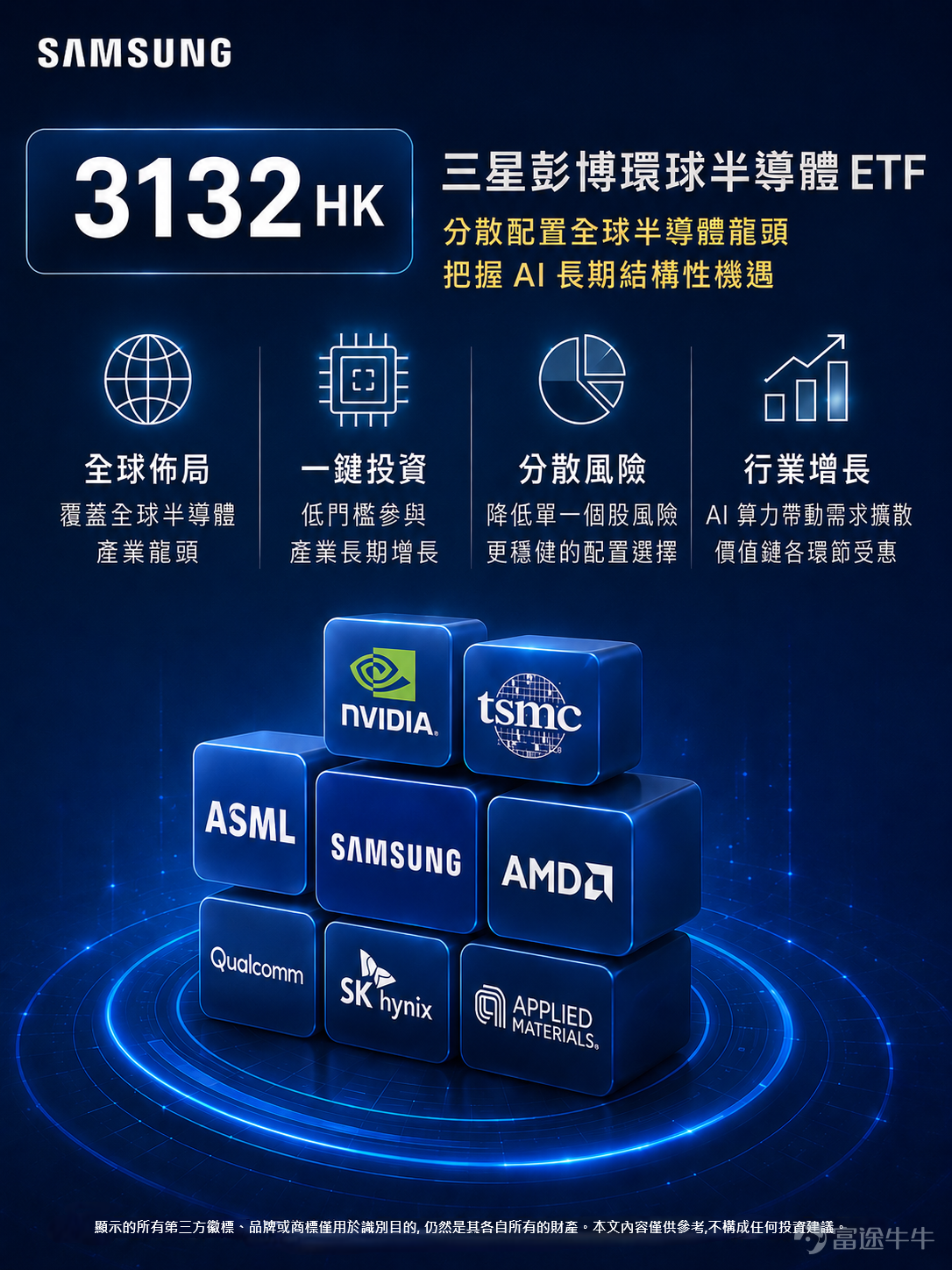
Achieving Global Semiconductor Diversification Through 3132 HK (Samsung Bloomberg Global Semiconductor ETF)
NVIDIA’s strong earnings once again reflect the growing demand for AI computing power, yet the stock still faces multiple uncertainties at the individual level, including supply chain bottlenecks, geopolitical risks, and valuation volatility. For investors seeking exposure to the long-term structural growth of AI semiconductors, $Samsung Bloomberg Global Semiconductor ETF (03132.HK)$ diversified allocation helps mitigate idiosyncratic risks associated with any single stock.
As AI computing demand structurally expands from training to inference, all segments of the semiconductor value chain stand to benefit. $Samsung Bloomberg Global Semiconductor ETF (03132.HK)$ Provides a one-click tool to gain exposure to global semiconductor leaders, enabling diversified investment in the long-term growth potential of AI infrastructure.
Data source:
[1] NVIDIA Fiscal Year 2026 First Quarter Earnings Announcement
[2] Commercial Times (20/5/2026)
[3] NVIDIA Management Earnings Conference Call
Disclaimer and Important Notice
• Investment involves risks. Past performance is not indicative of future results. The price of funds can go up as well as down, and investors may suffer all or substantial losses of their investments. Investors should not make investment decisions solely based on this material.
• The Samsung Bloomberg Global Semiconductor ETF may be exposed to key risk factors such as: investment risk, new index risk, stock market risk, concentration risk, semiconductor industry risk, emerging market risk, risks associated with depositary receipts, currency risk, securities lending transaction risk, other currency distribution risks, risks of distributions being paid from capital or effectively from capital, passive investment risk, trading risk, risks arising from different trading hours, reliance on market makers, tracking error risk, and termination risk.
• The above fund has been authorized by the Securities and Futures Commission of Hong Kong (SFC). Authorization does not imply official endorsement of the product. This material is for reference only and does not constitute an offer or solicitation to any person to buy, sell, or adopt any investment strategy.
• The Manager may, at its discretion, make cash distributions to unit holders from capital or total income (while charging all or part of the Fund's fees and expenses to the capital or paying them from the capital), thereby increasing distributable income for payment of distributions, which actually amounts to a distribution from capital.
• Distributions paid or effectively paid out of capital amount to a return of part of an investor's original investment or withdrawal of part of the original investment or capital gains attributable to that original investment. Any practice involving distributions being paid out of the capital of the product or effectively paid out of the capital of the product may result in an immediate reduction in the per-unit net asset value.
• This document has been prepared by Samsung Asset Management (Hong Kong) Limited (SAMHK) and has not been reviewed by the Securities and Futures Commission or any other regulatory authority. Investors should determine whether any investment product or strategy is suitable based on their individual financial situation, investment experience, and objectives. If you have any questions regarding the relevant information, you should seek advice from a professional advisor as needed.
• Certain information contained herein is compiled from third-party sources. SAMHK has made efforts to ensure the accuracy, completeness, and timeliness of such information and taken measures to verify and reproduce it accurately. However, SAMHK assumes no responsibility or liability for the accuracy of the data, any use thereof, or reliance on it. This content may contain forward-looking statements based on SAMHK’s opinions, expectations, and projections. SAMHK has no obligation to update or revise any forward-looking statements, and actual results may differ materially from those anticipated in forward-looking statements. All copyrights for the contents of this material (including all information, images, computer codes, text, logos, and designs) are owned by SAMHK. Without SAMHK’s consent, the information provided herein must not be reproduced or redistributed.
Risk Disclaimer: The above content only represents the author's view. It does not represent any position or investment advice of Futu. Futu makes no representation or warranty.Read more
Emm
2
187K Views
Report
Comments
Write a Comment...
2