
Baidu Surges 9%! Is the Autonomous Driving Sector Gaining Momentum Again?
I. Key Financial Highlights: Confirmation of a Structural Inflection Point
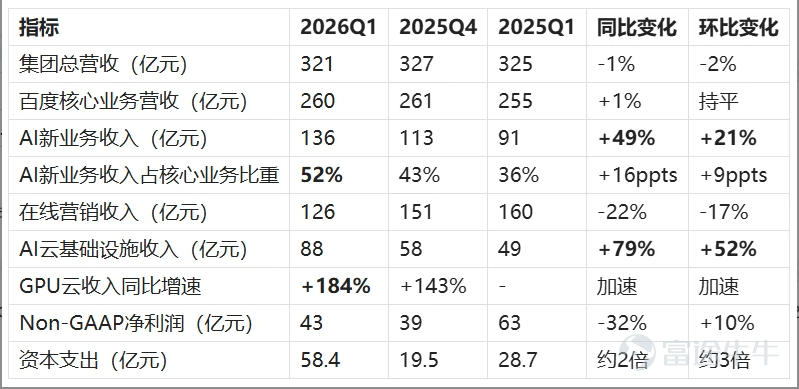
1.1 Core Financial Metrics
Baidu reported total revenue of RMB 32.1 billion for Q1 2026, down 2% quarter-over-quarter; Baidu Core revenue was RMB 26.0 billion, up 1% year-over-year, marking its first return to positive growth after several consecutive quarters of decline. According to Baidu’s financial report, this growth was primarily driven by its AI Cloud business.

Data source: Company financial reports
Core Assessment: Q1 2026 represents a strategic inflection point for Baidu—revenue from new AI-related businesses accounted for over 50% (reaching 52%) of Baidu Core revenue for the first time, signaling a formal shift in the company's valuation framework from an 'AI-enhanced search company' to an 'AI company with legacy businesses.'
1.2 Business Segment Performance
Strong-performing segment: AI Cloud infrastructure revenue reached RMB 8.8 billion, up 79% year-over-year. GPU cloud business growth accelerated further from 143% last quarter to 184%, becoming the primary growth driver. Apollo Go completed 3.2 million fully driverless rides in Q1, achieving breakeven in Wuhan alone.
Stable segmentAI application revenue reached RMB 2.5 billion, flat year-over-year. Daily active users of Wenxin Assistant doubled year-over-year, while Miaoda’s monthly active users grew 70% month-over-month. AI-native marketing services generated RMB 2.3 billion in revenue, up 36% year-over-year, though the scale remains relatively small.
Pressure-bearing sectorsStructural challenges facing traditional advertising business
Online marketing services revenue amounted to RMB 12.6 billion, down 22% year-over-year, with traditional search advertising declining 29% year-over-year. The core issue lies in how the rollout of AI-powered search is eroding ad monetization rates—generative AI responses are replacing traditional search ad slots, yet the AI-native advertising ecosystem remains immature. Although AI-native marketing services revenue grew 36% year-over-year, its RMB 2.3 billion scale is far too small to offset the impact of the RMB 10.2 billion traditional search advertising segment, which declined by 29%.
In the author’s view, the advertising decline has already been fully priced in. The key source of potential upside lies in whether the growth trajectory of AI-native marketing services can accelerate in the second half of the year—if advertisers widely adopt digital humans combined with AI agents after validating their ROI, this could offset the decline sooner than the market expects.
II. In-depth Analysis of AI Business: Three Growth Engines and Differentiated Advantages
2.1 Wenxin Large Models: Application-Driven Approach and Ecosystem Moats
Management emphasized that models create value through applications and reaffirmed their application-driven iterative development strategy. Wenxin 5.1 now ranks #1 on LM Arena’s Chinese-language text and search leaderboards. Core applications include AI search, digital humans (costs reduced by 80%, supporting 24 languages), and Miaoda, a no-code platform (monthly active users up 70% month-over-month).
Ecosystem barriersBaidu App’s monthly active users reached 679 million, with Wenxin Assistant exceeding 200 million MAUs, forming a flywheel effect: search generates data → data trains Wenxin → Wenxin enhances search → user retention improves → monetization strengthens → R&D investment increases. This synergistic layout of 'application entry point + cloud platform + model ecosystem' reinforces Baidu’s platform position in the AI industry.
2.2 Intelligent Cloud: Full-stack advantages driving dual improvements in growth rate and profitability
Cloud business acceleration rationaleAI cloud infrastructure revenue grew from RMB 4.9 billion in Q1 2025 to RMB 8.8 billion in Q1 2026, with growth accelerating from +34% to +79%. GPU cloud growth accelerated from +128% to +184%. Management noted that enterprise AI demand is shifting from training to large-scale inference deployment, and the compute density required for inference far exceeds that of the training phase, driving exponential revenue growth.
Full-stack four-layer architectureBaidu is one of the very few companies globally offering a complete four-layer AI full stack: cloud infrastructure (Kunlun Core) → deep learning framework (PaddlePaddle) → foundational large models (ERNIE + Qianfan) → AI applications. The core value of this architecture lies in inter-layer synergy, which creates a cost moat: running proprietary models on a proprietary framework powered by in-house chips amplifies efficiency gains at each layer, resulting in a cost structure advantage that competitors cannot easily replicate.
Kunlun Core differentiationA single AI computing cluster has deployed over 30,000 accelerators commercially at scale and is fully compatible with mainstream large models. Kunlun Core delivers triple value: internal cost reduction (providing compute power for ERNIE and Apollo), external differentiation (offering an alternative amid constrained GPU supply), and a clear expansion roadmap (planning to launch the M100 chip in 2026 and the M300 chip in 2027).
Qianfan MaaS platformThe platform supports mainstream models such as DeepSeek, Zhipu AI, and MiniMax, with external customers’ daily token consumption reaching nearly seven times that of the same period last year. Management emphasized that Baidu achieves higher throughput with equivalent compute resources through its full-stack AI capabilities, reflecting a fundamental lead in inference efficiency.
Path to margin improvementAn increasing share of GPU cloud (target gross margin: 35–40%), high-margin AI application subscriptions, and the replication of Apollo Go’s path to breakeven will structurally improve the overall profitability of the cloud business. This contrasts with Alibaba Cloud’s strategy of prioritizing growth over profitability ('profitability as the second priority').
Capital expenditure pressureQ1 capex reached RMB 5.92 billion (three times that of Q4), with a cash reserve of RMB 279.3 billion providing a margin of safety. However, sustained high capex will weigh on near-term EPS. Capex-related depreciation will start impacting costs in 2–3 quarters.
Management GuidanceFull-year growth will be no less than 40%. Long-term gross margin target is 25–30%, and operating margin target exceeds 20%.
2.3 Apollo Go: Transitioning from validation phase to scalable profitability
Completed 3.2 million rides in Q1 2026 (up 120% YoY), with cumulative rides exceeding 22 million across 27 cities globally. Wuhan has already achieved breakeven on a city-level basis. Overseas expansion progress includes Europe (testing in Switzerland; partnerships with Uber/Lyft in London), the Middle East (fully driverless operations and standalone app in Dubai), and domestic initiatives (airport shuttle services in Hainan).
Risks: Slower-than-expected regulatory progress overseas is the primary risk. The market continues to apply a valuation discount to Apollo (relative to Waymo), reflecting lingering skepticism about its commercialization path. Wuhan’s breakeven is a positive signal, but whether this can be replicated in more cities and whether overseas pricing environments are truly more favorable remain to be validated over time.
III. Comparison Among the Three Giants and Reasons Behind Baidu Cloud's Leading Growth Rate
3.1 Core Metrics Comparison

Data Source: Company financial reports and earnings call transcripts
3.2 Three Key Drivers Behind Baidu Cloud's Leading Growth Rate
Baidu AI Cloud infrastructure grew year-over-year by 79%, with GPU cloud services surging by 184%, significantly outpacing Alibaba Cloud's 38% and Tencent Cloud's 20%. This growth leadership stems from the convergence of multiple structural factors.
Driver 1: Differentiation on the supply side through Kunlun chips
Baidu is one of the very few domestic cloud providers that both develops large-scale proprietary AI chips and has achieved external commercialization. Kunlun chips deliver internal cost reduction, external product differentiation, and a clear path for future expansion. Amid tight supply-demand conditions, clients prioritize stability and are drawn to Baidu’s superior profitability.
The challenge lies in sustaining high-intensity R&D investment to maintain technological leadership. Alibaba’s Pingtouge will become competitive once its production capacity improves, and ByteDance is also ramping up its in-house chip development. The scale of Kunlun chips’ external commercialization still needs to expand further.
Driver 2: Shift in demand from training to inference benefits Baidu more
Enterprise AI demand is shifting from model training to inference, where compute intensity is substantially higher than during the training phase. Baidu holds a unique advantage: its Apollo autonomous driving platform operates in 27 cities globally, making it one of the largest inference demand sources itself. This internal demand is leveraged to showcase Baidu’s external inference capabilities, attracting clients in sectors like autonomous driving and embodied intelligence. This is further amplified by expanding AI deployment demands across industries such as finance, state-owned enterprises, and smartphone manufacturers.
Driver 3: Market share ceded by Tencent Cloud due to external supply constraints
Tencent's GPU resources are being allocated among multiple high-priority internal use cases (including HunYuan R&D, WeChat AI Agents, and AI for advertising and gaming), forcing its external cloud business to yield capacity and creating a market window for Baidu.
Tencent has explicitly stated that once domestic ASIC chip supply improves in the second half of the year, it will release more GPU computing capacity externally. Baidu is currently benefiting from Tencent’s temporary pullback, but competition is expected to intensify in the second half.
IV. Investment Value Assessment and Core Thesis
Baidu’s Q1 2026 earnings quality exceeded market expectations, with AI-driven revenue surpassing 50%—a structural inflection point. The leading growth in its cloud business stems from genuine competitive advantages derived from full-stack in-house development (Kunlun chips, PaddlePaddle, and ERNIE), rather than mere price competition.
In the near term, advertising headwinds will persist. AI-native marketing, at RMB 2.3 billion in scale, remains too small to offset the decline in traditional search revenue. The tripling of capital expenditures will translate into higher depreciation expenses over the next two to three quarters, posing notable pressure on margins.
Key metrics to monitor in the medium term include:
Progress on Kunlun Chip’s IPO (a primary catalyst for value unlock)
Whether AI cloud infrastructure revenue can sustain growth above 60% in Q2–Q3 2026 (validating that demand is not a one-time spike)
Quantitative data on gross margin improvement in GPU cloud services
Whether AI-native marketing services can account for over 20% of total advertising revenue by end-2026
Long-term (2–3 years): Baidu is one of the most distinctive investment opportunities in the global AI infrastructure transformation—possessing autonomous driving assets comparable to Waymo (Apollo has logged 2.2 billion kilometers), full-stack AI capabilities akin to Google, and a potential chip spin-off path similar to Arm. Its current valuation reflects the decline narrative of traditional internet advertising rather than the growth logic of a full-stack AI company, presenting a structural opportunity for valuation reassessment.
Risk Warning
The views expressed in this article represent solely the author’s personal research and analysis and do not constitute any investment advice. Company, industry, and market analyses referenced herein are based on publicly available information and reasonable assumptions, and may be subject to information lags or interpretive errors. Investing involves risks; please exercise caution.
Risk Disclaimer: The above content only represents the author's view. It does not represent any position or investment advice of Futu. Futu makes no representation or warranty.Read more
Comments
to post a comment
3
