
NVIDIA's earnings report is out! Can it reignite the AI rally?
Hello fellow investors, welcome to this week’s 'Playing Options with $100' opportunity pool! Each week we focus on clear market themes and highlight noteworthy low-barrier options opportunities. We don’t talk about once-in-a-lifetime windfalls; instead, we explain the rationale, whether it’s worth watching, and where the risks lie.
Market Focus This Week
This week’s information density is extremely high, $NVIDIA (NVDA.US)$ 、 $Tesla (TSLA.US)$ Two major heavyweight companies are making moves:
First storyline: The 'universal leading dragon,' NVIDIA, will unsheathe its sword on Wednesday.NVIDIA is set to release its fiscal year 2027 first-quarter earnings report after market close on Wednesday, May 20 (Eastern Time).As the world's largest publicly traded company by market capitalization, this is not just an earnings report; it is a major test for the entire AI industry chain.
Second storyline: SpaceX's largest IPO in history officially enters the countdown phase.According to multiple media reports, SpaceX is expected to file its prospectus with the SEC as early as Wednesday, May 20.The targeted valuation ranges from $1.75 trillion to $2 trillion, with an expected fundraising scale of $70 billion to $75 billion. If successful, it will surpass Saudi Aramco to become the largest IPO in human history.
Target One: $NVIDIA (NVDA.US)$ —— The ultimate leader of the universe is about to face its moment of truth
In the world of AI investment, all roads eventually lead to NVIDIA. This company has delivered better-than-expected results for every quarter over the past two years. And this Wednesday after the US stock market closes (early Thursday morning Beijing time), the Q1 data for the fiscal year 2027 will be announced.
But 'better-than-expected' itself has become the market's baseline expectation. The real focus isn't on whether NVIDIA can beat expectations —but on how much it beats by, how much next quarter’s guidance increases, and management’s answers to three core questions.
More importantly, NVIDIA’s earnings report doesn’t just affect itself—it is the pricing anchor for the entire AI sector.If NVIDIA provides strong guidance, the entire downstream supply chain of chip equipment, memory, servers, and cloud computing will benefit; conversely, if there is any disappointment, the valuation system of the AI sector will be re-evaluated.

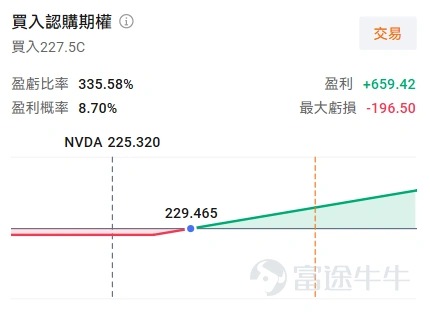
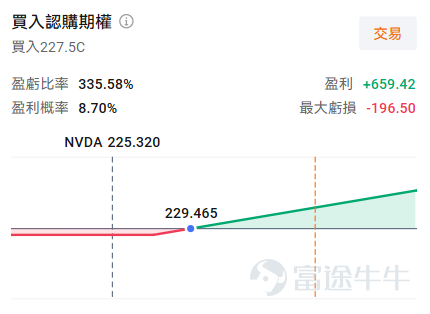
(The design images displayed on the screen are for demonstration purposes only and do not constitute any investment advice or guarantee; market conditions fluctuate frequently, and the option prices shown in the illustration do not represent actual situations. The filtering criterion is options with a unit price around 1 dollar.)
Bullish logic:
A trillion-dollar demand story. Jensen Huang explicitly stated at the GTC conference in March this year: By 2027, procurement orders for Blackwell and Vera Rubin will reach at least one trillion dollars—double what was projected a year ago. And this doesn’t even include new product lines like Rubin Ultra, Feynman, standalone CPUs, and Groq. When the CEO himself gives such specific demand figures, what the market is waiting for is the earnings report to 'validate' this story.
Capital expenditures by hyperscale cloud service providers are accelerating. Microsoft plans to invest $190 billion by 2026, Amazon around $200 billion, and Alphabet is expected to have capital expenditures of $180-$190 billion by 2027. All this money will eventually turn into GPU orders, with NVIDIA holding an overwhelming share of the AI chip market.
Growth engines beyond the data center. Robotics, autonomous driving (BYD, General Motors, Mercedes-Benz, and Volvo are all partners), sovereign AI projects, quantum computing toolchains — NVIDIA is evolving from an "AI chip company" into an "AI infrastructure platform company," breaking through a ceiling far higher than just data centers.
Is the valuation not expensive?It may sound counterintuitive, but NVIDIA's P/E ratio is actually lower than that of Broadcom, ASML, and AMD. For the AI infrastructure leader with the strongest cash flow and fastest growth, this multiple does not carry the scent of a bubble.
Downside risks:
"Exceeding expectations" not by enough → Good news fully priced in.The options market has already priced in a 7.56% earnings day fluctuation. If actual results only slightly beat expectations (for instance, revenue at $79 billion while the market whisper number has reached $80 billion), the stock price might fall due to being "not impressive enough." This is a classic case of "buy the rumor, sell the news."
Memory shortages may constrain shipments.The new generation of AI platforms has a huge demand for HBM4 high-bandwidth memory (with a single chip's HBM capacity reaching 288GB), but there is a continuing global shortage of memory chips. The CFO acknowledged last quarter that supply constraints impacted the shipment of the RTX 50 series. If memory bottlenecks lead to Q2 guidance falling short of expectations, market sentiment could quickly reverse.
Competitors are accelerating their catch-up efforts.Amazon and Google are developing their own chips; Cerebras just completed the largest IPO of 2026, raising $5.55 billion, with its stock surging on the first day. The AI chip market is transitioning from "NVIDIA dominance" to "a contest among many players."
It is worth noting that the premium for NVIDIA's stock options is not cheap at a share price of $225. To keep costs within a hundred-dollar range, one needs to choose out-of-the-money call options.These calls essentially bet on a 'rocket-like surge' following significantly better-than-expected earnings reports — either they multiply in value or go to zero.Position sizing is more important than choosing the right direction.
Target Two: $Direxion Daily TSLA Bull 2X Shares (TSLL.US)$ —— Hitching a ride on SpaceX, placing a hundred-dollar bet on Elon Musk
SpaceX has yet to go public, so you cannot directly buy its shares now. The only option is to invest through funds like DXYZ, which hold stakes in SpaceX, but frankly, such stocks are trading at astronomical premiums.
SpaceX is expected to officially list on the Nasdaq (ticker: SPCX) on June 12, and this Wednesday will be the earliest date for the public release of its prospectus. What other options do we have? Choose the most liquid publicly traded asset within Elon Musk’s empire — Tesla (TSLA).
The logic is simple: once SpaceX's S-1 filing becomes public, global media will flood with coverage of this space giant valued at nearly $2 trillion. Additionally, SpaceX completed a merger earlier this year with xAI, an artificial intelligence company under Musk, forming a dual strategy of 'space + AI.' This is not just an IPO; it represents a broader amplification of the 'Musk narrative.' And when markets buzz about the 'Musk Empire,' Tesla, as the most accessible Musk asset, often gets a 'spillover' boost from capital inflows.
But here comes the issue:Tesla’s share price is not low (over $400 per share), and its options are also expensive. This is where TSLL comes into play.
TSLLIt is an ETF that tracks Tesla stock with2x leverage。
Its mechanism is very straightforward:
If Tesla rises 3% in a day, TSLL aims to rise 6%; if Tesla falls 3% in a day, TSLL aims to fall 6%.
Pay attention to two key terms:"intraday" and "target"。
"intraday" means TSLL only seeksDailya 2x daily return, not a cumulative 2x return over the long term. Due to the mathematical characteristics of daily rebalancing, holding TSLL for more than one day will cause its returns to deviate from 'Tesla's return x 2'—this is calledVolatility decayThe more days Tesla trades sideways, the greater the long-term erosion of TSLL becomes.
Target Implies there may be a small tracking error in practice.
Why not just buy options on Tesla? Because TSLL's stock price is currently around $15, much lower than Tesla itself. This means:
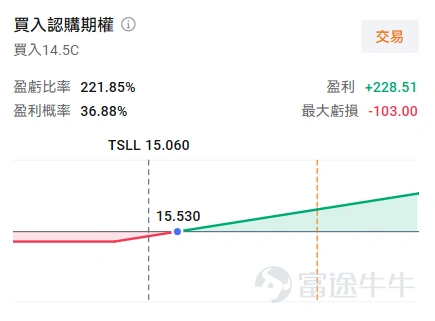
TSLL's option premiumLower absolute amount, making it more suitable for players at the hundred-dollar level; the built-in amplification effect of 2x leverage means adding another layer of leverage through options creates significant elasticity;But conversely, losses can also accumulate at double the speed.
All in all, TSLL is a 'cheaper entry, bigger bet' ticket to Tesla. Suitable for short-term event-driven trades, but not for long-term holding.If your budget is strictly limited to $100, TSLL is almost the only option. However, if the budget is slightly more flexible ($200-$500), you can consider deep out-of-the-money calls on Tesla itself—better liquidity and no additional volatility-related risks.

(The design images displayed on the screen are for demonstration purposes only and do not constitute any investment advice or guarantee; market conditions fluctuate frequently, and the option prices shown in the illustration do not represent actual situations. The filtering criterion is options with a unit price around 1 dollar.)
Bullish logic:
SpaceX's IPO prospectus = Musk's narrative megabomb.Once the prospectus is released, global investors will see SpaceX’s full financial data for the first time—including Starlink's revenue growth, Starship's R&D investments, and the AI business landscape following its merger with xAI. The underwriting syndicate is star-studded: Morgan Stanley, Goldman Sachs, JPMorgan, Bank of America, Citi... When this document is dissected line by line by global media and analysts, the 'Musk concept' will become the hottest market topic of the week—and Tesla is the most liquid asset tied to this theme.
"Can't buy SpaceX? Buy Tesla" effect.Historically, every time SpaceX hits a major milestone (successful launch, valuation hike, funding news), Tesla's stock experiences a brief correlated rise. The reason is simple: retail traders and some institutions treat Tesla as the 'liquid proxy for the Musk empire.' This IPO's scale (potentially the largest in human history) will only amplify this effect.
TSLL's 2x leverage amplifies short-term momentum.If Tesla rises 5% within 2-3 days due to SpaceX-related news, TSLL could rise approximately 10% (with minimal impact from short-term volatility decay). For slightly out-of-the-money calls, returns could be 2-5 times higher.This is precisely the allure of TSLL options in short-term event-driven plays.
Downside risks:
The prospectus may be delayed or its content may fall short of expectations. Although multiple media outlets have reported that the S-1 could be released as early as this Wednesday, sources also cautioned that 'the final date remains uncertain,' especially if significant events occur just before the IPO (such as the May 20 Starship test flight failure or regulatory intervention), which could lead to minor adjustments. If it does not come out as expected on Wednesday, market expectations will be disappointed, and Tesla and TSLL may give back their gains.
The 'double-edged sword' effect of TSLL.Twice the leverage acts as an accelerator in a rising market but turns into a meat grinder in a falling one. If Tesla drops by 3% due to a broader market pullback (for instance, NVIDIA’s earnings report falling short of expectations dragging down the entire tech sector), TSLL might plummet by 6%, and your out-of-the-money call options could go to zero.
Volatility decay is a silent killer.If Tesla stays range-bound this week—neither rallying from SpaceX-related news nor collapsing from a broad market downturn—TSLL will slowly erode in value due to the mathematical characteristics of daily rebalancing. Meanwhile, your call options will be doubly eroded by both Theta (time decay) and volatility decay.
Important Reminder
Major event pile-up.On May 20, after-hours earnings from NVIDIA and the potential release of SpaceX's prospectus could both explode on the same day, with the Fed minutes also coming out in the early morning hours. It is advisable to complete all position-building before the US market opens on Wednesday, avoiding last-minute chaos late at night.
A 'butterfly effect' exists between underlying assets.If NVIDIA's earnings report disappoints → AI narrative takes a hit → the entire tech sector comes under pressure → Tesla and TSLL will follow suit and drop. Conversely, if NVIDIA beats expectations significantly → the tech sector becomes exuberant → Tesla and TSLL will rise accordingly. Both calls may move up or down together; be cautious not to overexpose yourself in one direction.
TSLL call is purely event-driven short-term trading.Don't hold TSLL options long-term just because 'SpaceX's IPO is still months away' – volatility decay will quietly erode your premium during consolidation periods. If Tesla surges after the prospectus is released on Wednesday, consider taking profits either on the same day or the next day.
Both of these instruments represent high-elasticity, high-risk short-term plays. Be mentally prepared for the possibility that your premium could go to zero before entering. Use idle funds and test with small positions – this is the right way to approach hundred-dollar options. Manage your positions well, plan ahead, and let’s review on Friday.
Finally, here's a small perk for fellow Futubull investors, welcome to claim it.Options Beginner Pack~ *This event is only open to invited HK users, click to learn moreDetailed event rules>>

Risk Disclaimer: The above content only represents the author's view. It does not represent any position or investment advice of Futu. Futu makes no representation or warranty.Read more
Comments
to post a comment
17
21