
Big reveal of institutional holdings! What are the 'smart money' investors buying?

13F Big Reveal | The 'Post-Buffett Era' Begins! Berkshire Hathaway Increases Stake in Google, Builds Position in Delta Air Lines, and Exits Amazon in Q1
As Buffett officially steps down, $Berkshire Hathaway-A (BRK.A.US)$ Berkshire Hathaway delivered a sharp 2026 Q1 13F report, boldly ushering in the 'Abel (Greg Abel) Era'.
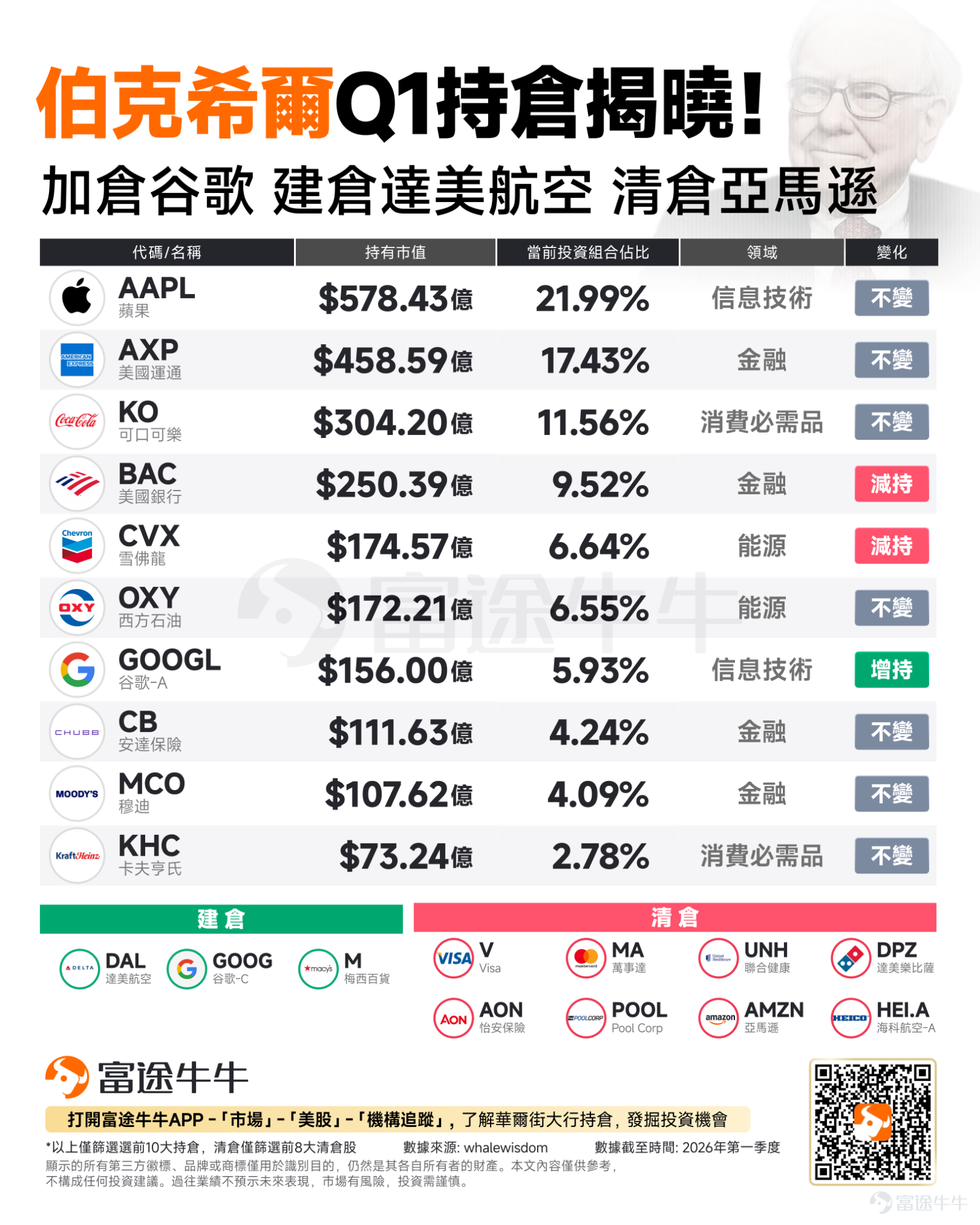
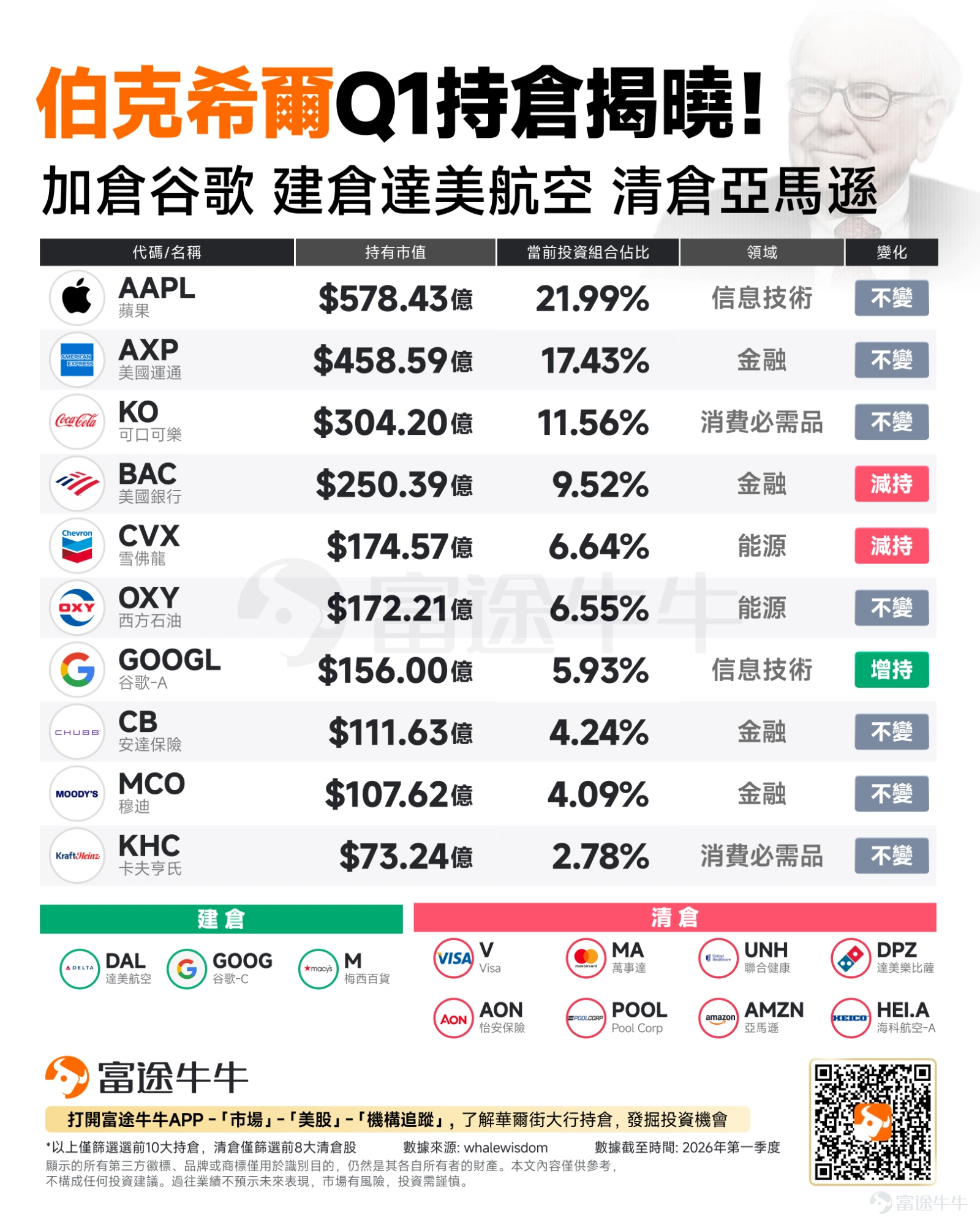
In the first quarter of 2026, Berkshire made significant adjustments to its investment portfolio: on one hand, it invested approximately $2.65 billion to build a position in $Delta Air Lines (DAL.US)$ , marking the first time Berkshire bet on airline stocks since liquidating its positions in the four major U.S. airlines during the 2020 pandemic; on the other hand, it further increased its stake in $Alphabet-A (GOOGL.US)$ , while completely exiting $Amazon (AMZN.US)$ 、 $Visa (V.US)$ 、 $MasterCard (MA.US)$ and several other consumer and fintech stocks.
Despite the flurry of activities, Berkshire's 'core holdings' remain as solid as ever. The top ten holdings are highly concentrated in leading technology, financial, and consumer companies: $Apple (AAPL.US)$ 、 $American Express (AXP.US)$ 、 $Coca-Cola (KO.US)$ 、 $Bank of America (BAC.US)$ 、 $Chevron (CVX.US)$ 、 $Occidental Petroleum (OXY.US)$ 、 $Alphabet-A (GOOGL.US)$ 、 $Chubb Ltd (CB.US)$ 、 $Moody's (MCO.US)$ 、 $The Kraft Heinz (KHC.US)$, among which$Alphabet-A (GOOGL.US)$Strongly climbed into the top seven.
Through this list of significant portfolio adjustments, we break down the four core trading strategies for the post-Buffett era:
1. Returning to the airline industry after six years
The most shocking market move this quarter was undoubtedly Berkshire's investment of approximately $2.65 billion to establish a new position of nearly 39.8 million shares. $Delta Air Lines (DAL.US)$ 。As soon as the position was established, Delta Air Lines immediately became the 14th largest holding.
In the early days of the 2020 pandemic, Buffett decisively liquidated his positions in the four major airlines. Now, six years later, he is betting again, which not only reflects approval of Delta Air Lines' fundamentals but also signals strong confidence in the recovery of U.S. consumer spending, the rebound in business travel, and the valuation repair of cyclical stocks.Combined with the newly established position in $Macy's (M.US)$ , this indicates a significant left-side allocation in the real economy.
2. 'Weeding out the weak and keeping the strong' in tech stocks, increasing stakes in core AI assets
In the technology sector, Berkshire's operations can be described as 'clear-cut':
Aggressively buying Google: Increase holdings $Alphabet-A (GOOGL.US)$ Exceeding 36.4 million shares, a surge of 204% quarter-over-quarter, becoming the seventh largest position; meanwhile, establishing new positions $Alphabet-C (GOOG.US)$ This indicates that institutions have placed a high valuation on Google's infrastructure moat and cash flow conversion capabilities in the era of large AI models.
After reading this, many fellow investors are curious as to why Berkshire Hathaway purchased both Class A and Class C shares of Google. First, let’s clarify Google's share structure: Class A shares carry voting rights, while Class C shares do not. There are three main reasons behind purchasing both classes:
First,Berkshire Hathaway's portfolio adjustments in the first quarter involved tens of billions of dollars. If they had only purchased Google's Class A or only Class C shares, it would have been easy todrain the liquidity of a single stockin a short period of time, causing significant 'market impact costs,' which would rapidly increase the cost of building the position.
Secondly,Since Class A shares carry voting rights, theoretically, GOOGL’s price is usually slightly higher than GOOG (enjoying a voting rights premium), but this price difference fluctuates with market sentiment.
Finally, In recent years, Google's management has conducted large-scale stock buybacks, often favoring repurchasing non-voting Class C shares, providing strong bottom support for the price of Class C shares. Institutional investors are simultaneously allocating to Class C shares to benefit from the rise in market value brought about by company buybacks.
Fully exited Amazon: Completely bid farewell to the holding of nearly seven years, $Amazon (AMZN.US)$ . Amazon was considered one of Berkshire Hathaway's rare internet e-commerce investment cases in recent years, but its position has never been particularly large. Now, with the complete exit, the market interprets this as Berkshire beginning to further focus its 'technology allocation,' i.e., concentrating bets on giants like Apple and Google, which have stronger platform moats and cash flow advantages.
3. 'Letting go' of the financial and payment sectors
The financial sector has always been a favorite of the Oracle of Omaha, but this quarter it underwent precise 'targeted slimming.'
Considering the current macro interest rate environment, clearing traditional credit card payment giants might be due to avoiding potential consumer credit bad debt risks or concerns about the impact of emerging payment systems on their long-term profitability.
4. Taking profits at highs, stockpiling defensive 'ammunition'
According to Bloomberg, Chevron's stock price hit a historic high in March this year amid US-Iran tensions and surging oil prices. Berkshire initially bought Chevron in the $65 range in 2020 and partially reduced its position in 2021; around the time of the Russia-Ukraine conflict outbreak in 2022, it significantly increased its stake again at an average price of $124. Based on the average selling price of $182.59 in this reduction, there has been approximately a 47% paper profit compared to the 2022 cost of adding positions.
This operation locked in substantial profits at the peak of oil prices and geopolitical maneuvering, reserving ample cash flow to deal with future market volatility.
Summary
Under the Abel era, Berkshire is transitioning from a pure 'buy and hold' strategy to a more aggressive 'industry trend rotation.' For investors, reviewing whether their tech stocks have real AI monetization capabilities and appropriately focusing on cyclically undervalued sectors that have been oversold by the market will be key to optimizing asset allocation in the next phase.
 Stay updated on institutional holdings to keep up with the latest investment trends: Market > US Stocks > Institutional Tracking
Risk Disclaimer: The above content only represents the author's view. It does not represent any position or investment advice of Futu. Futu makes no representation or warranty.Read more


Comments (9)
to post a comment
84
227