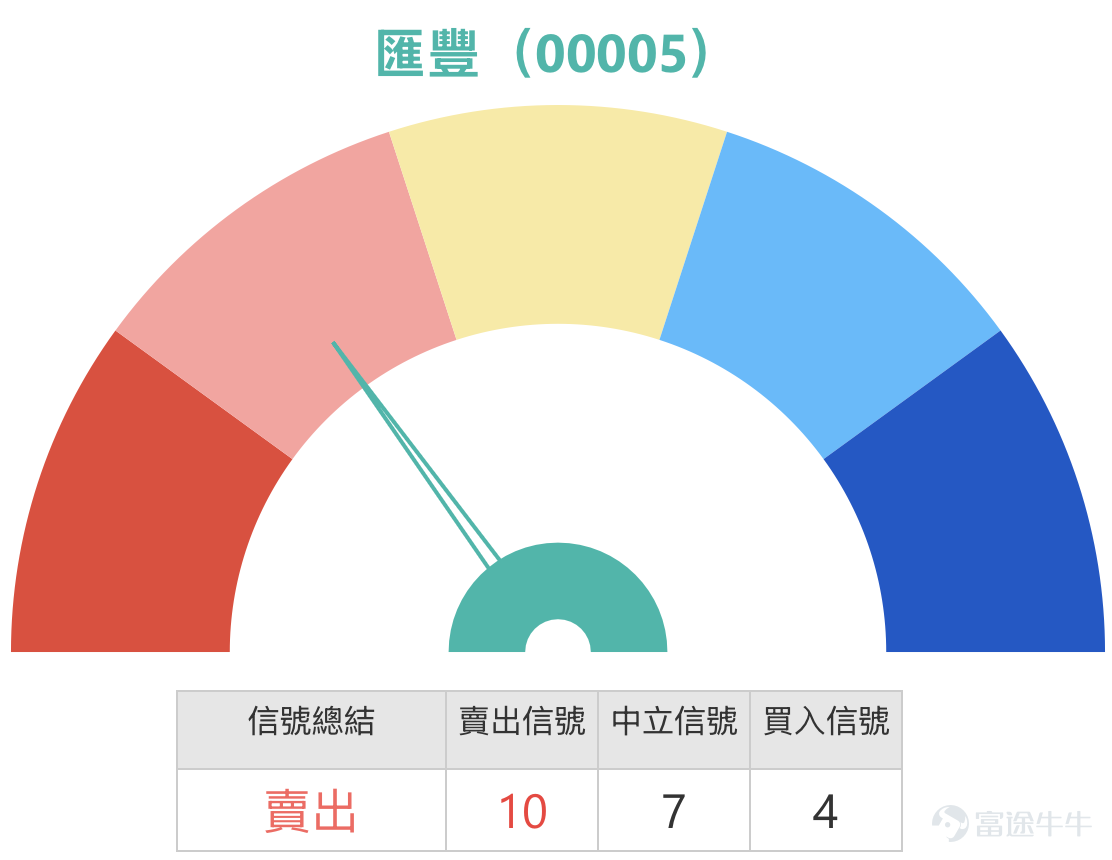

The 140 level is a key threshold for HSBC Holdings; it needs to hold above this level to have the potential to test resistance again.
HSBC Holdings is currently trading at approximately 141, with a decline of about 0.14% today. The short-term trend is recovering after a previous sharp drop. From the daily chart perspective, the price has regained its position above the 10-day moving average at around 140.49 and the 20-day moving average near 141.05, and is higher than the 30-day moving average at around 137.41, indicating that short-term buying support has improved. However, the current price has not yet broken through the previous high of 144.80, and it is also nearing the upper Bollinger Band at 144.73. Therefore, at this stage, it is more appropriate to define the movement as a 'rebound after consolidation at highs' rather than the start of another one-way upward trend.
Technically, the range between 140 and 141 is the most important short-term threshold. This area is close to both the 10-day and 20-day moving averages. If the stock price can stabilize here, it means that after the recent pullback, it has returned above the major short-term moving averages, leaving room for further upward recovery. The first support level below is at 140, with the next support at 137.41, which is near the 30-day moving average. If even 137.41 fails to hold, it would indicate that this rebound has failed, and the stock price may return to a weaker consolidation zone.
The upside resistance is very clear, with the first resistance at 144.80, the recent high. The upper Bollinger Band at approximately 144.73 is in the same region, making 144.7 to 144.8 a very significant pressure zone. Only by breaking through and stabilizing above this range can HSBC truly open up new upside space. Otherwise, even if the stock strengthens in the short term, it will remain in a tug-of-war between 141 and 145.

In terms of investor sentiment, bullish comments clearly carry the tone of heavyweight stocks regaining momentum. Remarks such as 'The Lion King roars,' 'Today we count on you to lift the Hang Seng Index,' and 'Starting a new round of highs' reflect that the market has once again regarded HSBC as a core stock supporting the broader market. This sentiment is not entirely baseless, as HSBC, being a heavy index-weighted stock, can indeed provide significant support to overall market sentiment when funds flow back.
However, one concern with the bullish sentiment is that the market seems to already expect HSBC Holdings to steadily rise, but the price is still below the resistance at 144.8. In other words, sentiment is moving faster than price. If the stock price fails to break through 144.8, the so-called 'new high' remains an expectation rather than a confirmation. This is also why it's not advisable to chase highs too early at this stage.
The core of bearish comments centers on 'limited upside' and 'fluctuations at highs.' Some believe the dividend yield is no longer attractive, and betting on further gains has limited potential, reflecting that the market is beginning to reassess HSBC's appeal as a high-dividend bank stock. When dividend expectations change or the market seeks higher growth stocks, valuation upside for mature financial stocks like HSBC will naturally be constrained. This doesn't mean the stock price will necessarily weaken, but it suggests every rise requires more capital confirmation.
Comments such as 'heavily suppressed today' and 'riding the wave up and down' reflect that HSBC's short-term trend is still not a smooth upward movement. Although the share price is rising, selling pressure persists during the process, indicating profit-taking or short-term liquidation above. This is common for stocks nearing their highs, especially when prices approach the 144 to 145 range, where holders are more likely to lock in profits early.
Observational comments best reflect the current market state. 'Stabilizing first' is actually HSBC’s most critical technical requirement right now. As long as it fails to stabilize between 140 and 141, the rebound cannot be considered secure; without breaking 144.8, the uptrend isn’t fully established. 'Low trading volume' is another key observation because if a price increase lacks trading volume support, its convincing power diminishes. Today's trading volume was approximately 9.07 million shares, noticeably lower than some earlier high-volume days, indicating capital inflow but not a full-scale buying spree.
Expressions like 'mysterious force' typically reflect investors sensing capital intervention or support but being unable to clearly determine its source. Such sentiment is common near critical market levels, especially for heavyweight stocks like HSBC, which can easily be seen as a tool to prop up the market when funds intervene. However, confirming whether capital inflows are sustainable still depends on whether the stock price can stabilize above 141 and further challenge 144.8, rather than just observing a single day’s gain.
Comments such as 'end-of-quarter volatility will be high' and 'exit first' reflect that some investors have begun considering risk management. For high-priced financial stocks, upward momentum may not suddenly end, but fluctuations often occur near resistance levels. It’s not entirely unreasonable for holders to lock in partial profits between 141 and 145, especially if they entered at lower prices, as this range offers sufficient profit-taking opportunities.
For short-term strategy, HSBC Holdings should use 140-141 as a defensive zone and 144.8 as the breakout level. Staying above 140-141 keeps the stock capable of maintaining a rebound; breaking and stabilizing above 144.8 would confirm a new upward trend. A drop below 140 would weaken short-term confidence, while falling below 137.41 would indicate renewed weakness.
To summarize, HSBC Holdings isn’t weak right now—it’s in a phase of reconfirming its highs. Bullish investors believe the 'Lion King' is regaining strength, but what truly determines whether the uptrend continues isn’t sentiment—it’s whether 144.8 can be broken and whether 140 can be defended.
Reply to Investor Inquiries
As a heavyweight stock, HSBC Holdings provided support to the Hang Seng Index today, but whether this support can be sustained depends on whether the 140 to 141 range can hold.
The premise of waiting calmly for an upward move is that the stock price must not fall below the short-term watershed of 140 to 141.
A decline in dividend yield attractiveness will limit valuation upside, so for HSBC Holdings to rise further, it needs to break through 144.8 to confirm strong capital inflow support.
HSBC Holdings is currently experiencing high-level volatility rather than a straight upward trajectory, with more short-term fluctuations expected.
HSBC Holdings (00005) Warrants and Bull/Bear Contracts: Top Picks
HSBC Holdings (00005) related warrants come with clear terms and diverse options, allowing flexible allocation based on bullish or bearish views while considering leverage, implied volatility, and premium. They are suitable for capturing short-term stock price fluctuations.
For bullish positions, call warrants worth noting include BOC Call Warrant 22630 and 26806, which have relatively lower implied volatility, offering leverage of 8.5x and 9.8x respectively, with strike prices at 145.1 and 148.98, balancing cost and efficiency. For bull contracts, UBS Bull Contract 54902 has a stop-loss level at 125, providing high actual leverage and low premium; UBS Bull Contract 54502 has a stop-loss level at 127, with even more prominent leverage performance, making it highly efficient for tracking rebounds in the underlying stock.$BI-HSBC@EC2609B.C (22630.HK)$$BI-HSBC@EC2609F.C (26806.HK)$
For bearish direction, recommended put warrants include UBS Group Put Warrant 25460 and Bank of China Put Warrant 25733, both with a leverage of 12.7 times and a strike price of HKD 126.56. They have relatively lower implied volatility, making them suitable for betting on stock price pullbacks. Bear contracts can consider UBS Group Bear Contract 62177 and 59897, both with a recovery price of HKD 150, the lowest premium, and actual leverage reaching 14.1 times, offering high sensitivity to capture downward movements. $UB-HSBC@EP2607B.P (25460.HK)$$BI-HSBC@EP2607B.P (25733.HK)$

Reminder: This article does not constitute any investment advice.
This article is for reference only and does not constitute any investment advice. The market data, views, and analysis contained herein may change at any time without prior notice. We are not responsible for any loss or damage caused by reliance on the information in this article. Technical analysis only shows whether certain technical conditions are met; asset performance should be comprehensively evaluated with other data. Trading decisions should not be made solely based on this article. Please note that past performance is not indicative of future results. Follow Jenny's HK Stock Warrants for more professional insights.
Risk Disclaimer: The above content only represents the author's view. It does not represent any position or investment advice of Futu. Futu makes no representation or warranty.Read more


Comments (2)
to post a comment
3