
English
Back
Open Account
胜利证券
wrote a post · May 11 15:43

The world's first AI drug delivery stock! Deep dive analysis | Research report | Pharmaceutical sector - JetTech重磅IPO

On May 5, the world's first AI drug delivery company $METIS TECHBIO-P (07666.HK)$ officially launched its IPO, planning to globally offer 201 million shares at a maximum offering price of HKD 10.5, expecting to raise over HKD 2.1 billion (excluding the greenshoe mechanism). This time, the cornerstone investor lineup made its first collective appearance, led by Blackrock with a $50 million commitment; total cornerstone subscriptions reached $148 million, setting a new record for AI pharmaceuticals in Hong Kong stocks this year. The cornerstone group brought together international asset management giants such as Blackrock and UBS Group, top-tier professional healthcare funds, AI technology funds, and even national-level funds like Guoxin and ICBC Credit Suisse, forming resonance across five dimensions of capital. Such a configuration is relatively rare in the Hong Kong primary market. Based on the indicative offer price, cornerstone investors subscribed for 47.71%-54.87% of the global offering, a significantly high proportion. This strong enthusiasm from capital stems from recognition of the company’s core value and reflects that, after industry consolidation, capital is reassessing and accelerating its embrace of AI-driven pharmaceuticals. The company is expected to further boost sector growth. $METIS TECHBIO-P (07666.HK)$ The world's first AI drug delivery company is about to go public, attracting top-tier institutional investments, and its prospects are capturing market attention.
The 'world's first AI drug delivery company'
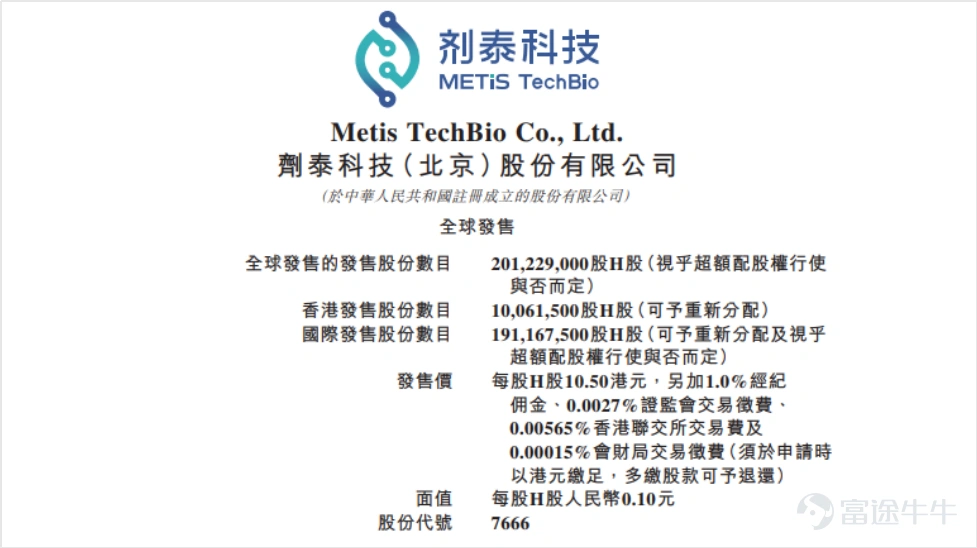
officially kicked off the Hong Kong stock listing process. On May 5, $METIS TECHBIO-P (07666.HK)$ $METIS TECHBIO-P (07666.HK)$ Announced the launch of its global offering and plan to list on the Main Board of the Hong Kong Stock Exchange. The total number of shares offered globally is 201,229,000 (depending on whether the over-allotment option is exercised), including 10,061,500 shares for the Hong Kong public offering, subject to reallocation, and 191,167,500 shares for international placement. As a biotech company driven by AI-powered nanomaterial delivery technology, $METIS TECHBIO-P (07666.HK)$ This IPO has garnered significant market attention, featuring a top-tier cornerstone investor lineup with 18 global leading institutions subscribing for a combined $148 million, setting new records in both the number of cornerstone investors and cumulative subscription scale for AI pharmaceuticals in Hong Kong stocks. The lineup is led by Blackrock with a $50 million subscription, joined by UBS Group, Mirae Asset, Isometry Capital, ORIX, and other globally renowned asset management giants and long-term funds; notably, the National Venture Capital Fund for Emerging Industries makes its first foray into AI pharmaceuticals through this cornerstone investment. Additionally, the lineup includes prominent healthcare-focused funds such as Deerfield, RTW, Lake Bleu Capital, Sage Partners, along with tier-one venture capital firms like Walden International, Hillhouse, IDG Capital, and top domestic mutual fund managers including GF Fund Management, ICBC Credit Suisse Fund, China AMC, and Fullgoal Fund.Prior to this IPO, $METIS TECHBIO-P (07666.HK)$ had already received early support from well-known industry and financial investors such as CICC Capital, Sequoia China, PICC Capital Equity, 5Y Capital, and China Life Equity.
Based on the indicative offer price range for this issuance, the proportion of cornerstone investors’ subscriptions corresponds to 47.71%-54.87% of the total number of shares offered globally, with the share lock-up ratio at a relatively high level within the industry. This strong enthusiasm from the capital markets stems not only from the recognition of the company's core technologies and commercial value but also reflects a reassessment of the long-term value of the AI pharmaceutical sector after an industry consolidation cycle, with capital increasingly flowing towards leading companies with core competitiveness. Meanwhile, $METIS TECHBIO-P (07666.HK)$ the successful listing of this company is expected to inject strong momentum into the industrial explosion of the entire AI pharmaceutical sector. $METIS TECHBIO-P (07666.HK)$
Figure 1:$METIS TECHBIO-P (07666.HK)$Global Offering Details
Source: Company’s prospectus
Pioneering Global Leader in AI Nanodelivery Backed by Prestigious Cornerstone Investors
$METIS TECHBIO-P (07666.HK)$ Founded in 2020 by Dr. Hongmin Chen, an academician of the US National Academy of Engineering, Dr. Caida Lai, and Dr. Wenshou Wang from MIT, this biotechnology company leverages artificial intelligence to drive innovation in nanomaterials. Its core focus is on breakthroughs in targeted drug delivery technology and the development of innovative therapies. It has been hailed as the 'world's first AI-driven nano-delivery stock' and is one of the fastest companies in China’s AI pharmaceutical sector to achieve the IPO milestone.
The company's core mission is to address the critical pain points of the global biopharmaceutical industry's 'delivery era.' As drug innovation reaches a bottleneck in target discovery, drug delivery capability has become the key barrier determining the druggability and clinical value of new therapies such as nucleic acid drugs and small-molecule drugs. Traditional nanomaterial development heavily relies on trial-and-error methods, which have inherent drawbacks such as long cycles, high costs, and low success rates. The company has achieved a paradigm shift in this field through AI technology. As of May 2026,The company has filed 224 patent applications and been granted 52 patents. It has assembled a cross-disciplinary R&D team of over 40 PhDs covering core areas such as nanomedicine, computational biology, quantum chemistry, and polymer science. Its technical capabilities have gained widespread recognition from top global pharmaceutical companies and investment institutions.
Figure 2:$METIS TECHBIO-P (07666.HK)$ Leading position in nanotechnology innovation
Source: Company prospectus
The prospectus shows that $METIS TECHBIO-P (07666.HK)$ The offering price for each H-share in this IPO has been set at HKD 10.50, with a planned global offering of 201 million H-shares. Excluding the over-allotment option (greenshoe mechanism), the fundraising size exceeds HKD 2.1 billion (approximately RMB 1.838 billion). Regarding the use of proceeds, approximately 50% will be allocated to core technology R&D for AI infrastructure and AI-driven nanomaterial platforms, 20% will be used to advance clinical trials of ongoing and planned drug pipelines, and the remaining 30% will be evenly distributed for expanding into animal health and anti-aging businesses, building a global nanomaterial ecosystem, and for working capital and general corporate purposes.
The top-tier institutional lineup for this IPO has drawn significant market attention. The joint sponsors are Jefferies Financial Group, Deutsche Securities Asia, and CITIC Securities (Hong Kong), representing top-tier investment banking resources from the US, Europe, and China respectively. This collaboration complements cross-border channels and global service capabilities, laying a solid foundation for the company's international development. The cornerstone investor lineup, the most notable aspect, covers five dimensions of top-tier institutions: international asset managers, specialized healthcare funds, AI tech funds, national-level funds, and Chinese public equity funds—far exceeding the average for AI pharmaceutical companies listed in Hong Kong. Among them, Blackrock leads the subscription with a USD 50 million commitment, while UBS Group, Mirae Asset, and ORIX also participate. Top-tier international healthcare funds Deerfield, RTW, and Lake Bleu Capital collectively endorse the company's pharmaceutical expertise. Leading AI-focused venture capitalists Walden International, Hillhouse, and IDG rarely align but recognize the company’s technological potential. The national-level fund Guoxin Fund makes its first foray into the AI pharmaceutical sector, highlighting the company’s strategic national importance. Meanwhile, top Chinese public funds ICBC Credit Suisse, China AMC, Harvest Fund, and E Fund also make appearances, marking the company as a core holding in the innovative drug sector for public funds.The collective bet by top-tier capital across different attributes forms a multi-layered consensus on the company’s technological scarcity, sector certainty, and strategic importance, bringing strong positive expectations for the company’s market performance post-IPO.
Industry Sector Analysis: Drug Delivery Enters a Golden Age Driven by AI
*Market Entry Scale: A blue ocean market worth hundreds of billions, with a compound growth rate leading the pharmaceutical sub-sector
The global biopharmaceutical industry has transitioned from the 'target discovery era' to the 'delivery era.' Traditional new drug development faces the 'double ten rule' (10 years of R&D cycle, $1 billion in R&D costs), and one of the core reasons for clinical failure is flaws in the drug delivery process. This is especially true for novel therapies like mRNA, siRNA, and gene editing, where the delivery system directly determines their drugability, safety, and therapeutic effects. Traditional nano-drug delivery systems heavily rely on trial-and-error methods, with three major drawbacks: first, development cycles can last 1-2 years, making it extremely inefficient; second, the range of lipid structures that can be explored is limited, restricting breakthroughs in targeting organs; third, achieving both delivery efficiency and safety is challenging, with off-target effects causing severe adverse reactions. The introduction of AI technology fundamentally reconstructs the logic of nanomaterial development, becoming the key to breaking through these industry barriers.
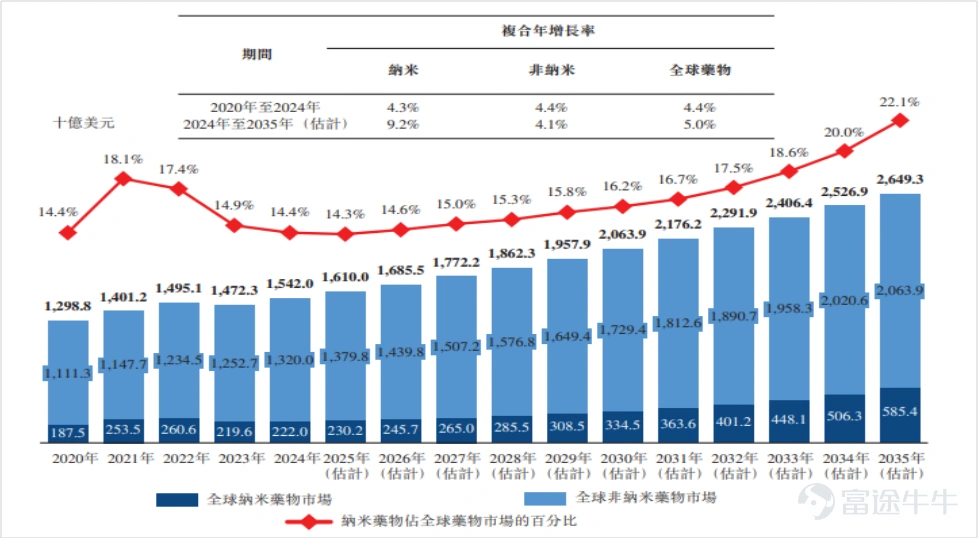
According to Frost & Sullivan data, the global market size for nanotechnology-based pharmaceuticals reached $222 billion in 2024 and is expected to grow to $585.4 billion by 2035, with a compound annual growth rate (CAGR) of 9%, significantly higher than the overall growth rate of the global pharmaceutical industry. Among this, the AI-driven nano-drug delivery segment is still in its early stages of development, with penetration below 5%.With the improvement of the global regulatory framework and continuous clinical validation, the next 10 years will see explosive growth. On the policy front, global regulatory systems are continuously supporting AI-driven pharmaceutical innovation. In January 2026, the FDA and EMA jointly released the 'Regulatory Guidelines for Using Artificial Intelligence in Drug Development,' establishing unified global standards for AI-driven drug research. Domestically, the Ministry of Industry and Information Technology and seven other departments have listed 'AI-driven new drug discovery and virtual screening platforms' as key development directions, with ongoing policy support.
Figure 3: Global market size and share of nanotechnology-based pharmaceuticals
Source: Frost & Sullivan
*Competitive Landscape: Significant first-mover advantage in the sub-sector, with leading companies solidifying their positions
The global AI pharmaceutical track, at the intersection of artificial intelligence and biopharmaceuticals, represents a golden opportunity. It currently focuses on two core technological directions: AI-driven drug discovery and AI-driven drug delivery. These two areas together form the backbone of the next-generation drug development process and are the focal points of current technical breakthroughs and capital investments in the global biopharmaceutical industry. The AI drug discovery sector started earlier, focusing on target validation, compound screening, and crystal form prediction—aiming to solve the industry pain points of 'high investment, long cycle times, and high failure rates' in traditional drug development. Notable companies such as XtalPi and Insilico Medicine have already achieved successful public listings, with commercialization paths and industrial value fully validated by the market. Meanwhile, the AI drug delivery sector, which determines the final drugability, targeting, and safety of drugs, is seen as the 'bottleneck' technology necessary for the industrial breakthrough of cutting-edge therapies such as nucleic acid drugs and gene therapy. $METIS TECHBIO-P (07666.HK)$This company is an absolute leader in the global space and is also the only enterprise in the industry that has achieved scalable implementation of an AI nanoparticle delivery platform and made breakthrough progress in multi-organ targeting technology, completely breaking the inefficient model of traditional delivery system development reliant on trial-and-error, and paving a new path for rational design and industrial application of AI-driven drug delivery systems.
In terms of the global competitive landscape, pharma giants like Moderna and Alnylam are investing heavily in LNP delivery system R&D, but their focus remains on the already proven liver-targeting pathway, with slow progress in cross-organ targeting. On the domestic competition front, most companies are still in the technology-following phase, lacking independent AI platforms and scalable lipid libraries. $METIS TECHBIO-P (07666.HK)$ It has established a significant first-mover advantage in three dimensions: technological maturity, pipeline progress, and commercial validation.
Figure Four: Competitive Landscape of Global Nanotechnology-Based Drug Development Companies
Source: Frost & Sullivan
*Four major barriers build a moat, leading the global AI delivery track
The company has built four irreplicable core moats in the AI drug delivery track:
First is the technology barrier. The company's self-developed NanoForge platform redefines the R&D paradigm for drug delivery. It has created the world’s first AI nanodelivery platform, NanoForge, which integrates AI large models, agents, quantum chemistry simulations, and high-throughput experimental systems to form an end-to-end closed loop of 'design-learn-validate-optimize,' completely disrupting the traditional development model of nanomaterials. Based on this platform, the company has developed three core technology solutions: The AiLNP platform features the world's largest library of over 10 million lipid structures, compressing LNP development cycles from 1-2 years to 2-3 months while achieving industry-leading delivery efficiency. It also achieves precise targeting of eight key organs, overcoming the challenge of cross-organ delivery in the industry.The AiRNA platform can complete full-process design optimization of mRNA sequences, synergizing with AiLNP. The AiTEM platform focuses on optimizing small molecule formulations; its core pipeline MTS-004 has completed Phase III clinical trials based on this platform.
Second is the pipeline barrier: Low-risk differentiated layout with core pipelines leading the industry. The company adopts a 'delivery-first' low-risk strategy, focusing on clinically validated targets and indications. Relying on proprietary technology, it breaks through the bottlenecks of traditional therapies, significantly reducing clinical failure risks. As of May 2026, the company has built a pipeline matrix covering areas such as oncology, central nervous system, and metabolic diseases, including one Pre-NDA product, three clinical-stage products, and four preclinical candidate drugs. Among them, the core pipeline MTS-004 is the first domestically AI-enabled innovative formulation drug to complete Phase III clinical trials in China, and also the first PBA treatment drug in the country to complete clinical trials, taking only 38 months from project initiation to completion of Phase III. It has already achieved out-licensing.Another core pipeline for weight loss, MTS-201, is currently in Phase I clinical trials, with two other pipelines in the IND preparation stage, one of which has received orphan drug designation from the U.S. FDA.
Third is the business model barrier: A dual-driven flywheel that has been commercially validated. The company has built a dual-driven business model of 'platform collaboration + product collaboration,' forming a positive innovation cycle of 'technology iteration-commercial application-data feedback-model optimization.'In terms of platform partnerships, collaborations have been established with over 30 top global pharmaceutical companies to provide customized technical services, with the highest value for a single-target collaboration contract reaching $109 million. Regarding product partnerships, external licensing of proprietary pipelines has successfully realized value monetization. The licensing of MTS-004 has fully validated the feasibility of this model, and subsequent pipeline progress will continue to contribute to commercial revenue.The two models complement each other, forming a self-reinforcing innovation loop.
Fourth is the team and shareholder advantage: a top-tier scientific team backed by world-class capital. The founding team comprises globally recognized experts in drug delivery and core talents with MIT backgrounds. Senior executives come from multinational pharmaceutical companies and leading biotech firms, possessing deep expertise in R&D, commercialization, and capital operations. Before the IPO, the company raised over $300 million in cumulative financing, with shareholders including top-tier institutions such as CICC Capital and Sequoia China.At the IPO stage, Blackrock and 17 other top-tier cornerstone investors were introduced, providing substantial capital and resources to support the company’s global expansion strategy.
Explosive revenue growth with notable improvement on the profitability side.
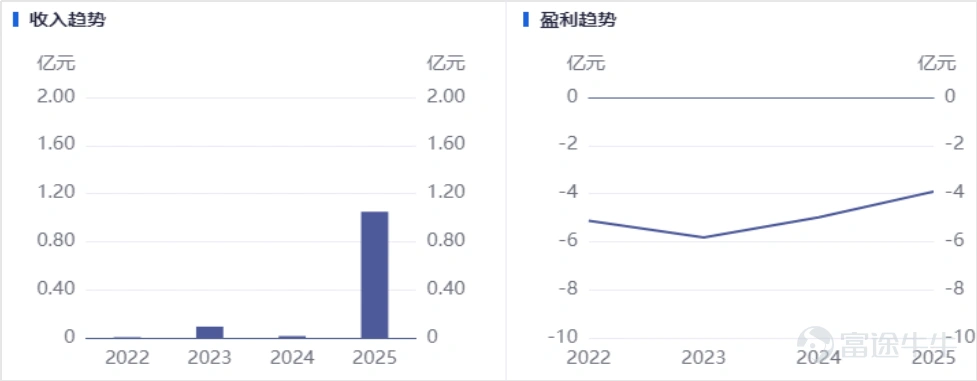
The company's revenue showed explosive growth, achieving operating revenues of 9.3 million yuan, 1.5 million yuan, and 105 million yuan in 2023, 2024, and 2025 respectively. Revenue in 2025 increased nearly 70-fold year-over-year, primarily driven by upfront payments from the external licensing of MTS-004, marking the company’s business model transitioning from the technology R&D phase to the commercial realization phase. In terms of revenue structure, 99% of the company’s 2025 income came from collaboration agreements, with both platform and product partnerships achieving breakthroughs. As milestone payments from ongoing projects materialize and core pipelines gain market approval, the revenue mix will further diversify, ensuring sustained growth. Profitability significantly improved, with gross margin increasing from 55.5% in 2024 to 98.2% in 2025, far exceeding industry averages. This was mainly due to the company’s focus on technology licensing and services, which benefit from strong marginal cost advantages. As revenue scales up, economies of scale will continue to manifest. On the loss side, net losses for 2023, 2024, and 2025 were 582 million yuan, 499 million yuan, and 392 million yuan respectively, showing a continuous narrowing trend.Adjusted net loss decreased yearly from 347 million yuan in 2023 to 180 million yuan in 2025, nearly halving over three years. Despite consistently high R&D investment, the significant narrowing of losses demonstrates strong cost control capabilities and an improving profit outlook.
Figure Five: $METIS TECHBIO-P (07666.HK)$ Financial Overview
Data Source: ifind
Data Source: ifind
Overall, the company is a leader in the AI-driven nanomedicine delivery space, founded by top scientists in the field of drug delivery. Its proprietary NanoForge end-to-end AI platform has achieved breakthroughs in precise targeting across eight key organs, establishing a robust technology and patent moat. The company adopts a low-risk differentiated pipeline strategy, with its core product MTS-004 being the first domestically developed AI-enabled formulation innovative drug to complete Phase III clinical trials. Multiple other clinical and IND-stage pipelines are progressing steadily, demonstrating strong commercial viability ahead of the industry. Additionally, the company employs a dual-driven business model of “platform partnerships + product licensing,” which has been commercially validated at scale. In 2025, revenue grew nearly 70-fold year-over-year, gross margin significantly increased to 98.2%, and adjusted net loss continued to narrow, creating a positive cycle of technological iteration and commercial monetization. This IPO brought in 18 top-tier global institutions, including Blackrock, as cornerstone investors, setting a record for proportion lock-ups in AI pharmaceutical IPOs on the Hong Kong Stock Exchange. Funds raised will be primarily allocated towards AI platform iteration, advancing core pipeline clinical trials, and building a global ecosystem.In terms of valuation, the company's PS for this offering is expected to be higher than that of comparable AI pharmaceutical companies in the Hong Kong stock market. However, its scarcity in the track, first-mover advantage in technology, certainty in pipeline implementation, and long-term growth potential can justify a premium valuation. After comprehensive consideration, we assign an IPO rating of 'Suggest to Subscribe.' Meanwhile, we remind investors to focus on key risks such as delays in core pipeline R&D and regulatory approvals, customer concentration in revenue, intensified industry competition, and short-term profitability uncertainties.
Disclaimer: The information provided in this report, or any investment or potential transaction related thereto, is subject to the applicable laws and regulatory requirements of your jurisdiction, and you are solely responsible for compliance with such laws and regulations. The content of this report is for reference only and does not constitute any investment advice. Our company has made every effort to ensure the accuracy of the financial information provided, but assumes no responsibility or provides any form of guarantee for the accuracy, completeness, or effectiveness of all or part of the content. We will not be liable for any errors or omissions. Please also note that securities and virtual asset prices can fluctuate, especially given the extremely high risks associated with virtual assets, and investors should exercise caution and assume investment risks on their own.
———————————————————————
About the author:
Victory Securities - Hong Kong's Leading Virtual Asset Broker
Victory Securities (08540.HK), with over 50 years of history in Hong Kong, is a comprehensive full-service licensed brokerage offering four main business services to retail investors, institutional investors, high-net-worth clients, and enterprises: wealth management, asset management, virtual assets, and capital markets. It has received numerous accolades and essential qualifications in the Asia-Pacific region. In 2023, Victory Securities became the first licensed brokerage in Hong Kong to hold licenses issued by the Securities and Futures Commission for virtual asset trading, advisory, and asset management services. It was also approved by the SFC to provide virtual asset trading and advisory services to retail investors, offering one-stop compliant and legal Bitcoin and Ethereum trading, exchange, and deposit/withdrawal services.
Risk Disclaimer: The above content only represents the author's view. It does not represent any position or investment advice of Futu. Futu makes no representation or warranty.Read more
Thumbs Up
3
332K Views
Report
Comments
Write a Comment...
3