

After AMD's massive gain of $680 billion, who are the beneficiaries and who is being marginalized in China's industrial chain?

Author: Lu Chunfeng,Phoenix News Technology's "Wind Eye Watch"
Editor: Dong Yuqing

Summary: An earnings report has ignited not only AMD’s stock price but also redrawn the 'alignment lines' of the global supply chain. As AI computing power becomes the most expensive and certain growth engine, some players in China’s supply chain are passively 'dividing the pie,' while others are beginning to be marginalized. The question isn’t whether opportunities exist, but rather — are you positioned on the computing power chain?
After the US market closed on May 5, semiconductor company AMD released its Q1 results for the fiscal year 2026, which directly ignited market sentiment — after-hours share prices surged over 20%, market capitalization onedaySoar1078Billion USD. The long-awaited moment of glory has returned, placing this once-suppressed chip giant back at the center stage of AI computing power.
At first glance, this is almost a flawless earnings report: total revenue of $10.253 billion, a year-over-year surge of 38%, surpassing Wall Street's previous expectation of $9.89 billion and setting a new record for the same period in history.
Net profit reached $1.383 billion, skyrocketing 95% year-over-year. This near-doubling growth rate directly shatters the growth ceiling for traditional hardware manufacturers; GAAP gross margin soared to 53%, up by three percentage points from the same period in 2025, driven by a significant increase in high-margin AI-related products, underscoring its strong profitability.
However, if we merely focus on the 'better-than-expected' aspect, we would miss the truly valuable insights in this earnings report. In fact, this isn't just a simple recovery in performance but a clear shift in trajectory.
For many years, AMD’s core label has been as a 'CPU vendor': fiercely competing with Intel in the PC and server CPU space, achieving market share gains through architectural innovation and outsourcing manufacturing. However, the latest earnings report reveals a different story — it is transitioning from a 'general-purpose computing supplier' to an 'AI computing power participant.'
This segment has always been the most expensive and crowded part of the entire semiconductor industry chain.
Around this time last year, AMD was still playing catch-up in the AI field, with the MI300 series ramp-up still in a challenging phase. However, this year’s earnings report tells a completely different story: data center business revenue hit $5.8 billion, surging 57% year-over-year, surpassing the combined revenue of PC and gaming businesses for the first time, accounting for 56.6% of total revenue.
In short, more than half of AMD's current revenue now relies on AI and data centers.
Lisa Su, Chairperson and Chief Executive Officer of AMD, delivered even more positive signals during the earnings call — AI inference and intelligent agent AI are driving strong demand for high-performance CPUs and accelerators. The midpoint of Q2 revenue guidance is set at $11.2 billion (market expectation at $10.5 billion), indicating a projected year-over-year growth rate of approximately 46%.
She significantly raised the company’s potential market size for server CPUs by 2030 to $120 billion, with the compound annual growth rate forecast increasing from 18% to over 35%. This represents one of the strongest bullish signals for the entire AI infrastructure cycle.
But the problem lies precisely here.
The impressive growth we see now is essentially tied to one variable: the AI capital expenditure cycle. From the earnings report, it's clear that almost the only driver of AMD's growth is AI-related business, with other segments growing significantly slower than the data center division. For example, PC demand is still recovering but lacks new breakout points, while the gaming segment remains weak without a new console cycle or high-growth narrative.
This means that this earnings report is essentially a 'single asset bet.' AMD isn't experiencing a full recovery but has instead placed all its bets on AI.
In just the past month, AMD has seen a record 12 consecutive days of gains, marking its longest streak of continuous increases since 2005. Over the past 30 days, its stock price has surged more than 106%, and its market cap has surpassed $687 billion.
A double-edged sword has quietly been taken hold of by AMD.
AMD's earnings report woke up the global computing power market. On May 6th, GPU stocks surged in China's A-share market. During trading, Hygon Information Technology once rose by 16.15%, surpassing a market value of 800 billion yuan; Cambricon Technologies increased by 7.32%. On May 7th, the computing power rally continued, with Cambricon opening higher, bringing its market cap above 784 billion yuan.
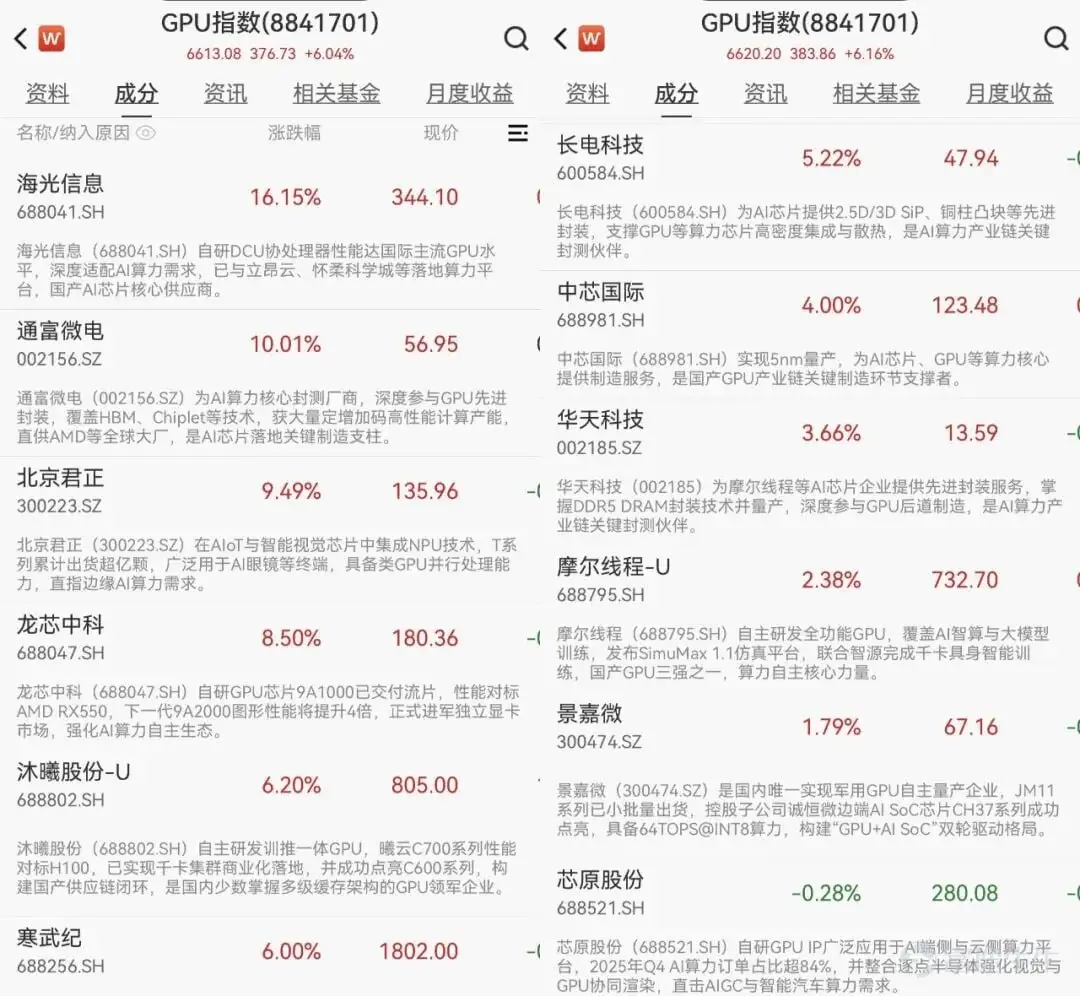
Image | Source: Wind
If we view this earnings report within a larger context, its significance goes beyond 'how much money AMD made.' Given AMD’s position in the global AI computing chain, it acts more like a high-frequency indicator during the diffusion phase of AI computing power. It may not be the origin of demand, but it is the first to feel changes in demand.
The core signal from this quarterly report is clear: the importance of CPUs in the AI market is continuously rising. As AI takes on increasingly complex tasks—both inference and task execution—it requires a significant number of CPUs for scheduling, moving data, and parallel processing. This directly shatters the previous ceiling for CPUs.
Lisa Su stated that in the deployment of AI infrastructure, the ratio of CPUs to GPUs is shifting from the past 1:4 or 1:8 towards nearly 1:1. In certain high-density scenarios, the number of CPUs may even surpass that of GPUs.
Combined with the business progress of GPU clients, AMD is highly confident in achieving tens of billions of dollars in annual data center AI revenue by 2027.
This also indicates that AMD's rise follows a path not entirely identical to NVIDIA's. It will also drive numerous opportunities within the Chinese supply chain.
If we break down AI computing power, it essentially becomes an 'infrastructure project': chips, servers, networks, connectivity, and cooling—all these areas need to expand.
In this chain, the role of Chinese companies is more concentrated on 'selling picks and shovels.'
The most directly benefited sectors are those related to computing infrastructure: optical modules (800G, evolving toward 1.6T), PCBs and high-speed connectivity, server contract manufacturing, and supporting production. The logic is simple—AMD’s ramp-up reflects not just one company's success but rather the overall upward trend in global computing demand.
For instance, when AMD’s GPU shipments double, orders for packaging and PCB suppliers grow in tandem. Tongfu Microelectronics is the sole and indispensable core target here. As AMD's largest global testing and packaging supplier, Tongfu Microelectronics handles over 80% of AMD's CPU/GPU/AI chip (MI300/400, EPYC) testing and packaging orders. This caused Tongfu Microelectronics to soar along with AMD on May 6, hitting the daily limit, and on May 7, Tongfu Microelectronics opened with another increase of over 6%.
The Chinese supply chain occupies the 'most predictable layer'—not determining the direction but ensuring orders whenever expansion occurs. Such opportunities are characterized by being unglamorous yet stable; not setting standards but tied to scale.
However, at the same time, some domestic GPU manufacturers may face pressure. In the past, AMD entered the inference market with better cost-performance and a more open ecosystem. Its MI300X accelerator, priced at $15,000 with 192GB of memory, offered significant price advantages compared to the H100, which has 80GB of memory and is priced at $32,000. Instinct MI450 directly competes with NVIDIA’s Rubin.
Notably, in the first quarter of this year, while Jensen Huang repeatedly emphasized that NVIDIA did not generate revenue in the Chinese market, third-party reports claimed that AMD sold approximately $100 million worth of MI308 products in China. This cost-performance offensive practically compressed the window for domestic GPUs to capture commercial market share in the context of localization.
But the question is, how long can this rally last?
The current market's frenzy over the AI computing power chain often brings to mind the 'chip shortage' of 2021-2022 — at that time, global production capacity was in short supply, prices of various chips skyrocketed, and companies along the industrial chain saw their performance and stock prices resonate, with the entire industry basking in the optimistic sentiment of undersupply.
However, the script took a sharp downturn afterward. As end-user demand receded and inventory reversed, prices of many chips plummeted, and companies in the supply chain faced a brutal cycle of inventory correction, with both earnings and valuations coming under pressure.
The difference between the current AI supercycle and the structural dynamics of that time lies in this: AI demand is not driven by short-term inventory replenishment, but rather supported by real workload migration and application explosions, theoretically giving it a deeper industrial foundation for sustainability. However, historical inertia cannot be ignored — cyclical expansion and capacity mismatches are enduring accompanying risks in every supercycle.
AMD currently relies almost entirely on data center and AI business to drive growth, while traditional businesses such as gaming and embedded systems continue to lag. This single-asset betting structure means that if AI capital expenditure slows down, the company's revenue growth and profit elasticity will decline far more sharply than those of traditional multi-engine growth companies.
For A-share markets, the logic chain is similarly fragile. The 'computing power chain' being hyped up today must withstand quarterly report validation; if excessive reactions fail to materialize into real performance improvements, valuation corrections will be inevitable. AI has not fizzled out, but the tech rally can no longer expect smooth sailing.
The impressive growth we see today in AMD is no longer about a robust recovery, but rather an extremely concentrated structural euphoria in a single niche track — which happens to be a double-edged sword, sharp and dangerous.
Risk Disclaimer: The above content only represents the author's view. It does not represent any position or investment advice of Futu. Futu makes no representation or warranty.Read more

Comments
to post a comment
3
2