
[Publishing orders] The market is ups and downs, did your options make or lose?

Option Sir Breaks Down Hot Topics | Software Stocks Rally as the Narrative of 'AI Disrupting the Software Industry' Sees a Reversal?
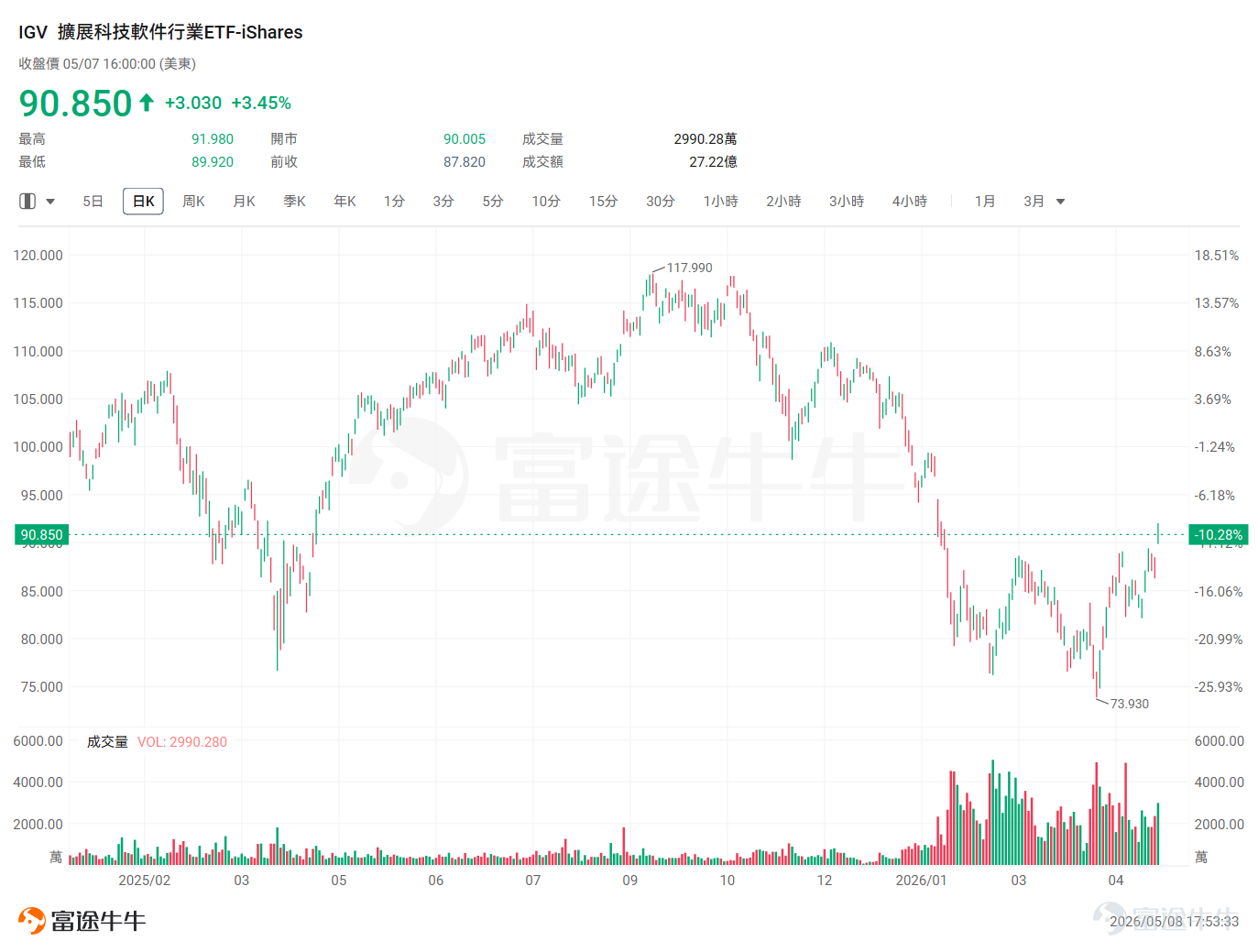
YesterdayAI application software stocks $Datadog (DDOG.US)$ Released its Q1 earnings report, with revenue growing 32% year-over-year, surpassing market expectations, and its stock price surged over 30% in one night. Similarly, $Fortinet (FTNT.US)$ Revenue increased by 20.13% year-over-year, net profit rose by 23.33% year-over-year, and the stock price surged by 20.03%. Feedback from senior management during the earnings call highlighted strong performance driven by artificial intelligence and across all business segments. These stable results alleviated market concerns about the previous 'AI impact on the software industry,' leading to a collective rise in software stocks. $Snowflake (SNOW.US)$Increase by 10%.$Palo Alto Networks (PANW.US)$ Up 7%, software ETF $iShares Expanded Tech-Software Sector ETF (IGV.US)$ Up 3.2%, cloud computing ETF $Wisdomtree Cloud Computing Fund (WCLD.US)$ Up approximately 3.2%.

Revision of pessimistic narratives: AI is a 'magnifier' for software, not a 'terminator'.
By late 2025 to early 2026, the dominant market narrative was 'AI impact on SaaS software.' The primary concern was that AI agents could directly write code and build processes, replacing current SaaS software functionalities and undermining the pricing power growth of related companies. However, the previous decline in software stocks was mainly driven by emotional panic. Although the risk of software being replaced by AI still exists, the short-term impact is limited.
The dominant market narrative logic has now reversed:The more AI is deployed, the greater the need for software tools.Due to the AI model itselfbeing a 'black box, highly complex, high computational power, high-risk' emerging phenomenon., after enterprises extensively adopt AI, not only will the reliance on traditional software not decrease, but there will also be a surge in demand for monitoring ( $Datadog (DDOG.US)$ ), security ( $Zscaler (ZS.US)$ ), data governance ( $Snowflake (SNOW.US)$ ), and DevOps ( $MongoDB (MDB.US)$ ).

Earnings reports have validated resilient demand, rather than just telling a story.
The most direct catalyst is the recent better-than-expected earnings performance of software stocks, which factually validates that AI development is driving an increased demand for software.
DDOG (Monitoring): Revenue up 32% year-over-year, net profit up 113%;
FTNT (Security): Revenue up 20.13% year-over-year, net profit up 23.33%;
PLTR (Big Data Platform): Revenue up 84.71%, net profit up 306.73%;
The market's favorite combination is when 'growth + upward guidance revisions + AI beneficiary narrative' converge, which will drive momentum for Snowflake, $Dynatrace (DT.US)$ 、 $Elastic (ESTC.US)$ , Zscaler, $Palo Alto Networks (PANW.US)$ and other related software/security stocks are being revalued together.
Valuation recovery after an oversold rebound
Taking DDOG as an example, from the end of 2025, AI's impact on software stocks caused its share price to be cut in half. However, after earnings were released, the narrative was somewhat updated. As the complexity and compliance risks of AI increase, demand for related software continues to grow, triggering short covering + capital rush-in, leading to a rapid valuation recovery.

Once the leading earnings reports prove that AI represents incremental demand rather than pure substitution, the 'AI eating SaaS' narrative may peak temporarily.The key is whether this evidence of 'AI-driven demand spilling over to software' can be continuously verified in the earnings reports of more companies such as Snowflake, CrowdStrike, Zscaler, and Salesforce.
Key dates to watch going forward:
ZS earnings report: May 26
SNOW earnings report: May 27
CRM earnings report: May 27
CrowdStrike Earnings Report: June 3rd
Options Strategy
If you believe the upcoming earnings report will validate further gains in software stocks, utilizing options to track the upside of the underlying stock at a lower cost would be more appropriate.
In the options market, we use the option with the highest trading liquidity as an example. $Palantir (PLTR.US)$ Following yesterday's significant rise in Datadog, the put/call ratio for Palantir reached 0.39,The market is generally betting that high expectations from the earnings report will drive software stocks higher.

1. If you are optimistic about future demand and upward trends for software-related stocks,
You can do so byBuying call optionsBetting on further validation of new narratives driven by subsequent software stock earnings reports, which could push related stock prices higher.

2. If you seek long-term growth and are concerned about time decay in short-term options
then you can sell a Call option above the one you bought, forminga Bull Call Spread, the premium collected from selling the higher strike Call can partially offset the time decay of the purchased Call, resulting in a more moderate profit and loss profile compared to buying a standalone option.

3. If you are concerned about a pullback or profit-taking after a rebound in the related stock,
then you canbuy a Put optionto hedge and protect your bullish position.

Finally, Option Sir brings a small perk for fellow investors, welcome to claim it.Options Beginner Pack
*This event is exclusive to invited HK users. Click to learn more.Detailed event rules>>
Market conditions are complex and volatile,Options StrategyOverwhelmed by choices? Futubull helps you build a portfolio in three steps.Options Strategymaking investing simple and efficient!

Option Risk Warning:An option is a contract that grants the holder the right, but not the obligation, to buy or sell an asset at a fixed price on a specific date or at any time before that date. The price of an option is influenced by various factors, including the current price of the underlying asset, the strike price, time to expiration, and implied volatility. Implied volatility reflects the market’s expectations for the level of volatility in the option over a future period. It is a data point derived inversely from the Black-Scholes option pricing model and is generally regarded as an indicator of market sentiment. When investors anticipate greater volatility, they may be more willing to pay a higher price for options to hedge risks, resulting in higher implied volatility. Traders and investors use implied volatility to assess the attractiveness of option prices, identify potential mispricings, and manage risk exposure.
Disclaimer:This content does not constitute any offer, solicitation, recommendation, opinion, or guarantee of any securities, financial products, or tools. The risk of loss in trading options can be substantial. In some cases, losses may exceed the initial margin deposited. Even if you set contingent orders such as 'stop-loss' or 'limit' orders, these may not prevent losses. Market conditions may make such orders unexecutable. You may be required to deposit additional margin within a short period. If you fail to provide the required amount within the specified time, your open positions may be liquidated. However, you will still be responsible for any shortfall in your account. Therefore, before trading, you should study and understand options and carefully consider whether such trading is suitable for you based on your financial situation and investment objectives. If you trade options, you should be familiar with the procedures for exercising options and the rights and obligations upon exercise and expiration. Options trading carries extremely high risks and is not suitable for all investors. Investors should carefully readCharacteristics and Risks of Standardized Options。
Risk Disclaimer: The above content only represents the author's view. It does not represent any position or investment advice of Futu. Futu makes no representation or warranty.Read more


Comments
to post a comment
28
21