
Has the rebound opportunity arrived? Hong Kong stocks welcome a strong start in May

The Hang Seng Index has risen back above the 26,200 level; is the real opportunity in the mismatch or the breakout?
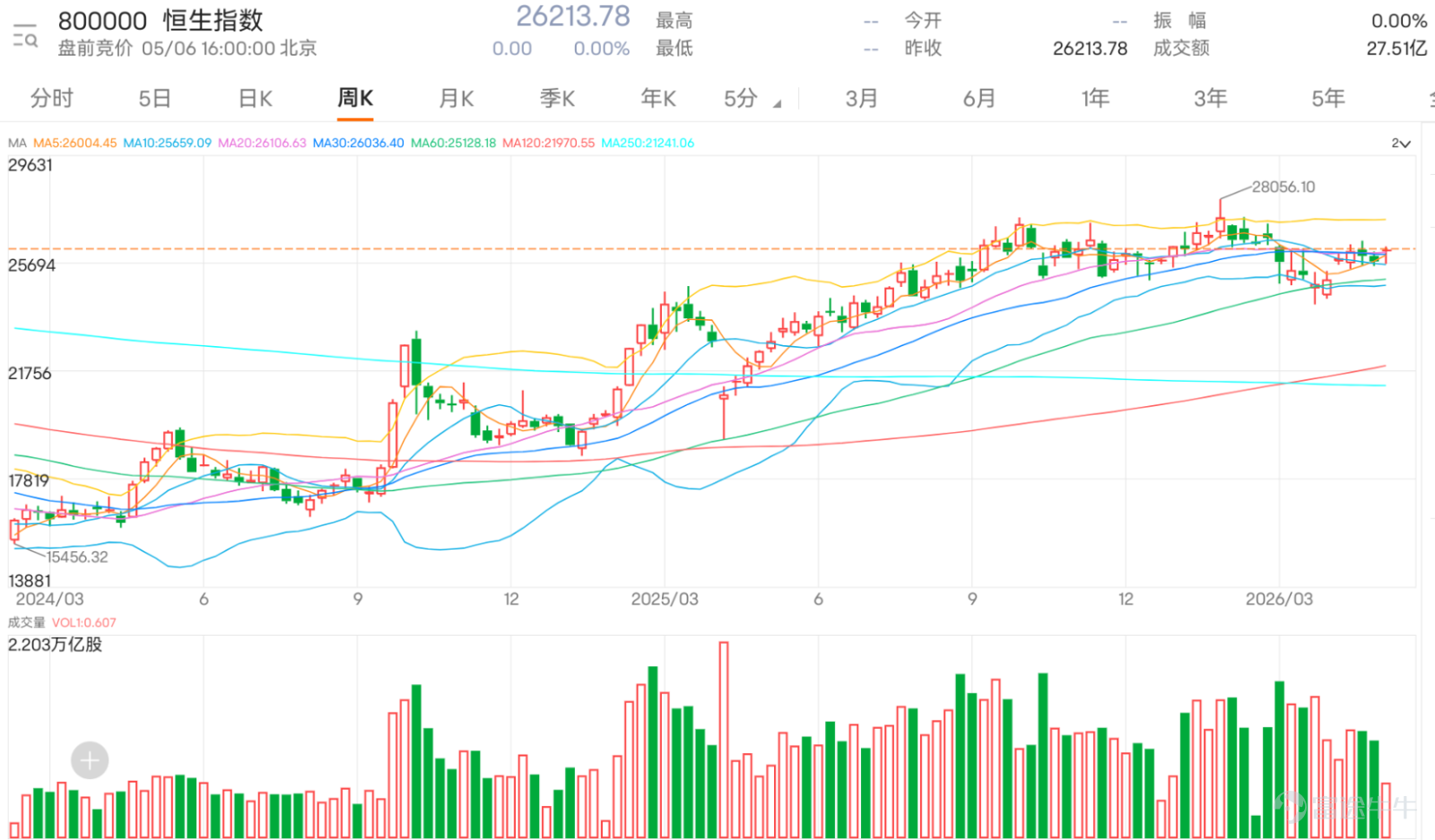
$Hang Seng Index (800000.HK)$ Yesterday's close at 26,213.78 already indicates that the market is in a critical but directionally unconfirmed range. Technically, the index has stabilized above the middle axis of the Bollinger Band at 26,009.06 and remains above both the 10-day and 30-day moving averages, suggesting short-term stability and even a strong consolidation after a rebound. However, what truly impacts short-term trading decisions is not 'how much it has risen,' but whether 'the current position still holds good value for betting.' This point precisely highlights a significant mismatch with many investors' comments in the market.
From a technical perspective, the most crucial watershed remains at 26,009.06. As long as this level holds, the entire short-term structure is still considered a strong consolidation. The most important observation point above is 26,464.19, the upper Bollinger Band. This is not an ordinary resistance level but a 'momentum confirmation level,' because once breached, it signals volatility expansion and willingness of capital to chase higher prices, shifting the market from consolidation to acceleration. However, before a breakout occurs, the overall trend remains a strong oscillation within a range, rather than a trending movement.
In terms of trading volume, an important signal has emerged: rising prices accompanied by increased volume. This indicates that the recent rebound is not merely a technical pullback but involves active capital participation. However, note that higher volume does not necessarily confirm a trend; it only suggests improved short-term support. What ultimately decides whether the upward move can continue is whether the 26,464 level can be broken.
The Relative Strength Index (RSI) is approximately 58, indicating moderate strength but not extreme levels. This is precisely the region most likely to cause retail investors to 'misjudge the position.' Since the market is neither overheated nor has it surged too far, there will be significant divergence between those who think a pullback is due and those who expect further gains, reflected in investor commentary.
Among the bullish comments, most are not based on structure but rather on sentiment and expectations. For example, 'It will continue to rise tomorrow,' 'Hong Kong stocks will soar in the second half of the year beyond belief,' and 'It should be going up now.' The common feature of these views is — no price levels, no triggering conditions, purely trend-following sentiment. This kind of sentiment is normal when the market has just turned strong, but when the index approaches the resistance zone, blindly chasing the uptrend can actually reduce the value-for-money ratio.
Relatively rational bullish comments are fewer. For instance, 'You need to take profits before exiting in a big upward wave.' This kind of thinking is actually closer to correct trading logic because it acknowledges the existence of the trend while emphasizing risk management. The issue is that such voices are a minority among overall comments.
On the other hand, bearish comments also reveal significant issues. Some investors choose to start shorting around the 26,200 to 26,300 level, for example, '26,300 is the peak' or 'Feel free to go bearish, targeting 25,500.' The biggest problem with these views is that they prematurely assume a top before any structural weakening appears. Technically, there hasn’t been a breakdown through key support levels, nor have we seen momentum weaken. This kind of 'predictive shorting' essentially goes against the prevailing trend.
Some bearish arguments stem from external factors, such as geopolitical tensions or pullbacks in other markets. While this information isn’t necessarily wrong, the issue lies in failing to connect it with the current technical structure of the index. The market doesn't just react to news itself but evaluates whether the news changes capital behavior. Currently, from both volume and structure perspectives, capital is still flowing in, not retreating.
Observational and sentiment-based comments are actually the most noteworthy group. A large number of comments focus on concerns like 'I’m worried,' 'I don’t know if it will rise or fall,' 'Waiting for the right position,' and 'Will there be an adjustment?' This reflects that the market hasn’t formed a consensus yet. When there's no consensus, it often indicates that the trend hasn’t ended, but it also means volatility will increase. This explains why some investors feel they are 'getting the direction wrong every day' — because the market is repeatedly testing positions within a volatile range.
Overall, at this stage, the market shows a typical mismatch: overly emotional bullishness, premature bearishness, and hesitation being trapped by volatility. Real trading opportunities lie not in 'guessing directions,' but in 'waiting for triggers.'
Short-term deployment should be very clear: as long as 26,009.06 holds, the overall situation can still be considered a strong consolidation. The strategy should primarily follow the trend, but one shouldn’t blindly chase gains near the 26,464 resistance level. The real high-value opportunity lies either in a breakout above 26,464 or a pullback to around 26,009 for support.
Conversely, if the index breaks below 26,009.06, the entire structure would turn weak, and then consider testing 25,975 or even 25,666. Only then would shorting have structural support, instead of entering now based on predictions.
The market never loses on direction; it loses on position and timing. At this stage, the Hang Seng Index’s direction isn’t clear yet, but the framework is very clear. Whoever follows this framework will avoid most mistakes.

Key strategy: Holding firm above 26,009.06 could extend the rebound and test 26,464.19; a breakout could be pursued. A drop below 26,009.06 would indicate weakness, watch for a retest of 25,975.86 to 25,666.61.
Strategy One | Follow the Breakout (Aggressive Bias)
$UB#HSI RC28126.C (65581.HK)$ | Recovery Price 25,638 | 43.7x leverage | Close to support level; once breaking above 26,464, momentum could quickly amplify, suitable for chasing the breakout instantaneously.
$MS#HSI RC2811J.C (66014.HK)$ | Recovery Price 25,630 | 43x leverage | Stable leverage, balanced volatility and risk, suitable for following up after confirming the breakout. $UB#HSI RC2810E.C (56201.HK)$ | Recovery Price 25,500 | 36.92x leverage | Longer-term structure, suitable for short-to-medium term deployment anticipating a sustained rise after the breakout.
Strategy Two | Reversal at the Top of the Range (Short-Term Trading)
$UB#HSI RP2811W.P (61982.HK)$ | Recovery Price 27184 | 23.2x Leverage | Close to the current price above, suitable for reversal near resistance at 26464, aiming to capture short-term pullback $SG#HSI RP28033.P (60624.HK)$ | Recovery Price 27178 | 23.0x Leverage | Slightly higher recovery price, larger room for error, suitable to wait for confirmation of resistance before entering $UB#HSI RP2803X.P (65225.HK)$ | Recovery Price 27150 | 23.2x Leverage | Slightly higher leverage, suitable for quick pullback trades, not recommended for long holding
Strategy Three | Breakdown and Weakness (Defensive / Momentum Short Selling)
$UB#HSI RP2804Q.P (66034.HK)$ | Recovery Price 27050 | 25.7x Leverage | Once跌破26009 (falls below 26009), momentum weakens, suitable for momentum-based short selling $SG#HSI RP2804H.P (67193.HK)$ | Recovery Price 27000 | 27.6x Leverage | Increased leverage, suitable for maximizing profits during an accelerated downtrend, but strict risk control is required $UB#HSI RP2811F.P (67880.HK)$ | Recovery Price 27000 | 28.5x Leverage | High-leverage aggressive type, suitable for short-term bursts after a confirmed breakdown
Reply to some investors' views:
@13049159: Simply predicting rises or falls has little meaning; the key is whether 26009 holds. If it holds, bias is towards upward consolidation; if breached, weakness sets in.
@股票股市: The mid-to-long-term story may still exist, but short-term movements are still suppressed by 26464, and these should not be conflated.
@過路人甲某The issue lies in not waiting for structural confirmation; one should wait until it breaks below 26,009 before considering going short.
@妖股達人Excessive anticipation of gains can easily lead to chasing highs; at this stage, the key resistance has not yet been broken.
@牛熊至尊At present, there is no sign of a forceful breakout; it is still operating within a normal range.
Reminder: This article does not constitute any investment advice.
This article is for reference only and does not constitute any investment advice. Market data, opinions, and analyses contained herein may change at any time without prior notice. We are not responsible for any loss or damage caused by reliance on the information in this article. Technical analysis only shows whether certain technical conditions are met, and asset performance should be comprehensively evaluated in conjunction with other information. Trading decisions should not be made solely based on this article. Please note that past performance is not indicative of future results. $Hang Seng TECH Index (800700.HK)$$Hang Seng China Enterprises Index (800100.HK)$
#HongKongStocks #RealTimeAnalysis #WarrantSelection #WarrantGuide #DerivativesHedging #HongKongWarrantsJenny #HangSengIndex #HangSengTechIndex #BlueChipStocks #TechnicalAnalysis
Risk Disclaimer: The above content only represents the author's view. It does not represent any position or investment advice of Futu. Futu makes no representation or warranty.Read more

Comments
to post a comment
3