
Is self-driving during the May Day holiday more cost-effective? No more worries about charging. Electric vehicle owners say that driving 1,000 kilometers costs only 300 yuan in electricity fees.
Source: The Times Weekly, Authors: Cao Yang, Song Ran
This year's 'extended' May Day holiday has arrived as expected, becoming an excellent travel opportunity that many tourism enthusiasts cannot miss.
However, rising in tandem with consumers' enthusiasm is the cost of travel. High-speed rail tickets for popular cities are hard to come by, airfares have risen, and refined oil prices, which have been raised multiple times since 2026, continue to climb.
In contrast, electric vehicle owners who planned their self-driving routes well in advance are free from travel cost anxiety.
We set off on April 30th, covering over 1,000 kilometers round trip, consuming approximately 200 kWh of electricity, costing around 300 yuan in electricity fees,” Wengu, an EV owner driving from Beijing to Taiyuan, Shanxi, told reporters at Time Weekly.
For the same mileage, switching to a gasoline-powered car would increase travel costs to six or seven hundred yuan.
Low self-driving costs for EVs
Following multiple domestic fuel surcharges in April, several domestic and international airlines once again raised fuel surcharges for May routes on April 28.
Among international carriers, Korean Air’s one-way fuel surcharge for May international routes ranges from 75,000 to 564,000 won (approximately 348 to 2,618 yuan), while short-haul routes like Qingdao will uniformly be 75,000 won (around 348 yuan) one way; starting May 1, All Nippon Airways increased fuel surcharges on routes between mainland China and Japan from 275 yuan to 441 yuan, marking a rise of 166 yuan, an increase of more than 60%.
Regarding domestic airlines, including Juneyao Airlines, Xiamen Airlines, Spring Airlines, and other carriers, have also successively increased fuel surcharges for international routes.
Data from the third-party platform Flight管家 shows that as of April 21, the average price of prepaid domestic economy class tickets including tax for the May Day holiday was 1,000 yuan, up 13.9% compared to the same period in 2025 and 25.9% higher than the same period in 2019.
In addition to rising airfare prices, refined oil prices have seen six consecutive increases in 2026. Despite a first drop this year on April 21, upward pressure remains significant. For example, the cumulative highest increase in No. 92 gasoline since the beginning of the year has exceeded 1.71 yuan per liter, reaching 8.46 yuan per liter in Beijing.
The simultaneous rise in airfares and oil prices has significantly increased travel costs for both those relying on public transportation and car owners planning road trips.
Under these circumstances, the low travel costs for new energy vehicle owners have once again sparked envy among many people.
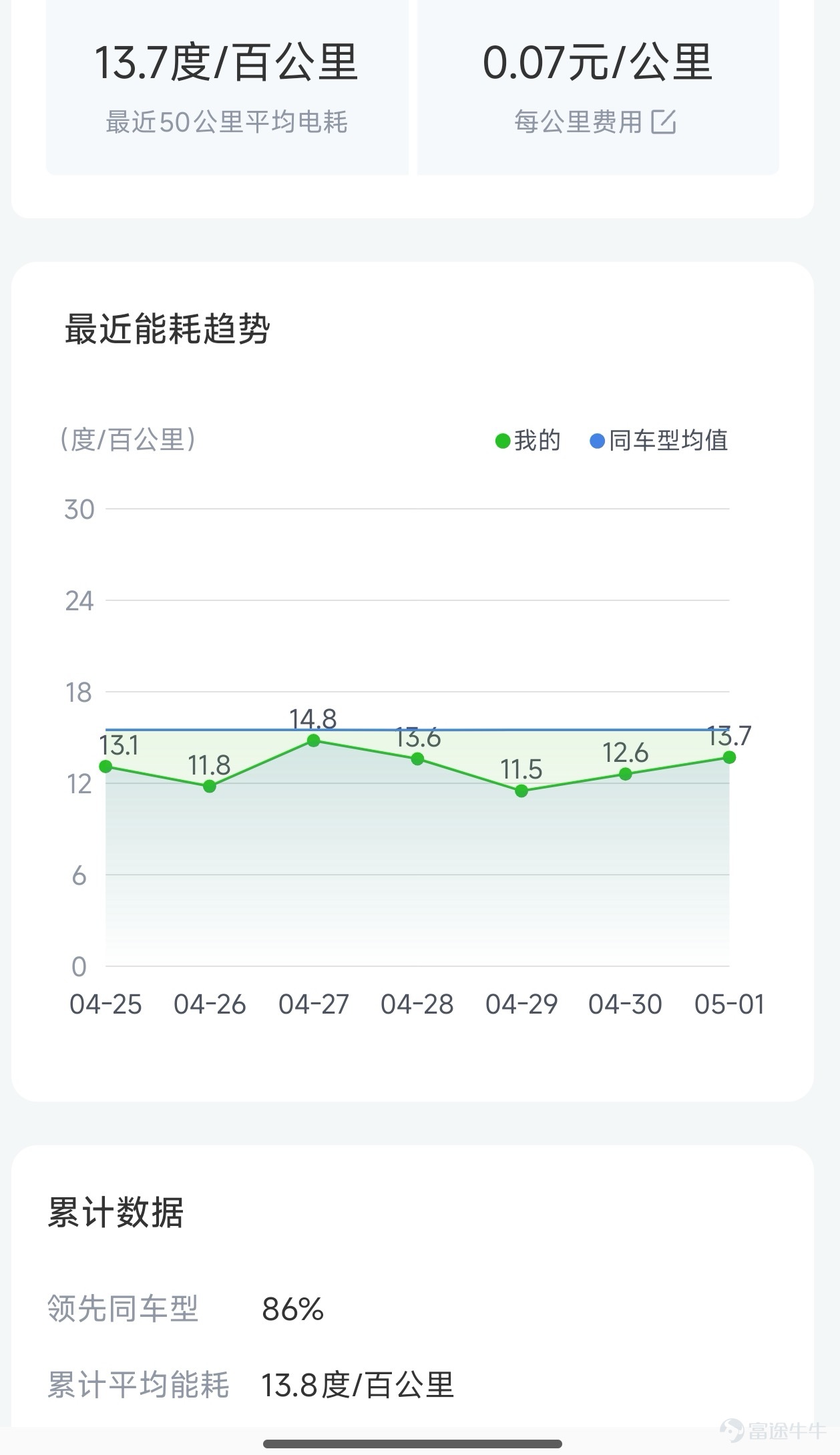
Wen Wu told reporters from the Times Weekly that due to consistently using air conditioning during his trip, the consumption of 200 kWh over more than 1,000 kilometers represents a relatively high level of electricity consumption. He noted, 'The average daily electricity consumption of mainstream new energy vehicles typically ranges between 11 to 15 kWh per 100 kilometers.'
According to a screenshot provided by another electric vehicle owner to reporters at the Times Weekly, their recent electricity consumption per 100 kilometers ranged between 11.5 to 14.8 kWh.
Image source: Provided by the interviewee
Regarding electricity costs, Wen Wu mentioned that charging with a home charging station is relatively cheap, with electricity priced at around 0.5 yuan per kWh, while current prices at public charging stations on highways are approximately 1.64 yuan per kWh.
Based on calculations by reporters from the Times Weekly, if all 200 kWh were charged at the highway public charging station rate of 1.64 yuan per kWh, the total electricity cost for 1,000 kilometers would amount to 328 yuan.
If calculated based on the industry’s mainstream average electricity consumption of 11 to 15 kWh per 100 kilometers, the total electricity consumption for a 1,000-kilometer journey would range from 110 to 150 kWh, costing between 180.4 and 246 yuan when charged entirely at highway public charging stations.
If the costs of home charging are averaged out or combined with current discounts or fast-charging benefits offered by some new energy vehicle manufacturers, the travel costs for electric vehicle owners would be even lower.
In comparison, the travel cost for gasoline car owners driving the same 1,000 kilometers is significantly higher.
According to calculations by reporters from the Times Weekly, based on a combined fuel consumption of 7.5 to 8.5 liters per 100 kilometers for household gasoline vehicles and the current price of 8.46 yuan per liter for Grade 92 gasoline in Beijing, the fuel cost for traveling 1,000 kilometers would be approximately between 637.5 yuan and 722.5 yuan, far exceeding the travel expenses for new energy vehicles covering the same distance.
Energy replenishment facilities are becoming increasingly complete.
Low travel costs are an inherent advantage of new energy electric vehicles.
In the past, constrained by the lack of supporting infrastructure such as charging piles, despite the low vehicle operating costs of electric cars, the actual travel experience was greatly compromised, with range anxiety and inconvenient charging becoming concerns for many owners.
Nowadays, with policy support and joint efforts from automakers and industry chain participants, the shortcomings of charging配套设施 have seen qualitative improvements.
The official website of Li Auto shows that currently, Li Auto has over 4,076 ultra-fast charging stations and has connected to 57,038 fast-charging stations; BYD announced on April 28 that it has cumulatively built more than 5,500 flash charging stations, covering 311 cities nationwide.
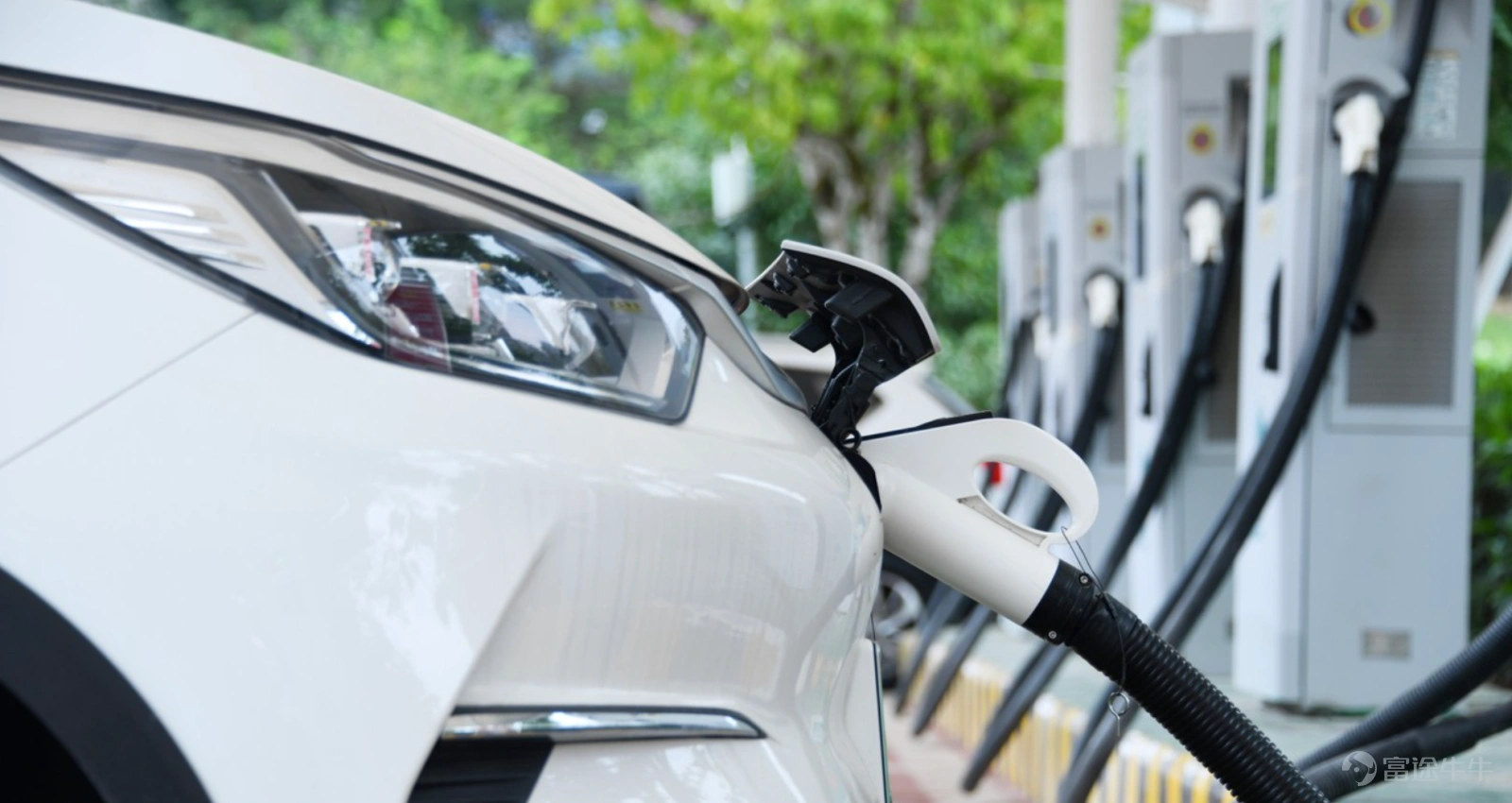
Image source: Tuchong Creative
Data disclosed by Nio shows that as of April 30, Nio has built 8,847 battery swap and charging stations nationwide. Among these, there are 3,838 battery swap stations (including 1,035 highway battery swap stations) and 5,009 charging stations, with 28,800 Nio charging piles deployed simultaneously.
According to data from the National Electric Vehicle Charging Infrastructure Monitoring and Service Platform, as of the end of March 2026, the total number of electric vehicle charging infrastructures (charging guns) in China reached 21.481 million units, representing a year-on-year increase of 46.9%.
Among these, there are 4.863 million public charging facilities (charging guns), marking a year-on-year increase of 28.1%. The total rated power of public charging piles has reached 234 million kilowatts, with an average power of approximately 48.06 kilowatts.
During this year's Spring Festival, an electric vehicle owner who drove 2,500 kilometers told reporters from the Times Weekly that throughout the entire 2,500-kilometer journey, they only had to queue for charging once, 'but the wait wasn't long, about 20 minutes.'
The car owner mentioned that there are accuracy issues with the number of charging stations displayed on current navigation maps. Many newly added charging stations on provincial highways, as well as some third-party charging stations, have not been synchronously marked on the map. 'The actual charging experience and speed were already very good.'
Another electric vehicle owner who drove from Beijing to Datong on May 1st this year told reporters from the Times Weekly that for this trip, which was approximately 360 kilometers one way, 'In fact, charging mid-journey wasn’t necessary, but due to avoiding traffic jams and taking a detour, I kept worrying that if we encountered another traffic jam, the battery might run out, so I charged it once along the way.'
'Perhaps because we charged early, not only was there no queue, but there were also some empty charging stations,' the car owner said, adding that later, when passing through service areas, they did see some queues.
Wenwu frankly admitted that queuing for charging at some service areas was still relatively severe.
With the development of new energy vehicles, the current cost advantage of electric cars extends far beyond just low energy consumption.
The sharp rise in hotel prices during holidays has long been a widely criticized pain point for travelers. The increasing 'room efficiency' of new energy vehicles allows many EV owners to choose to sleep directly in their cars.
'Last year during the National Day holiday, I went on a road trip and spent six nights, only staying in a hotel for one night, then spending one night at a campfire party in a campground, and the remaining four nights were spent sleeping in the car, saving quite a bit.'
(Wenwu is a pseudonym)
Risk Disclaimer: The above content only represents the author's view. It does not represent any position or investment advice of Futu. Futu makes no representation or warranty.Read more
Comments
to post a comment