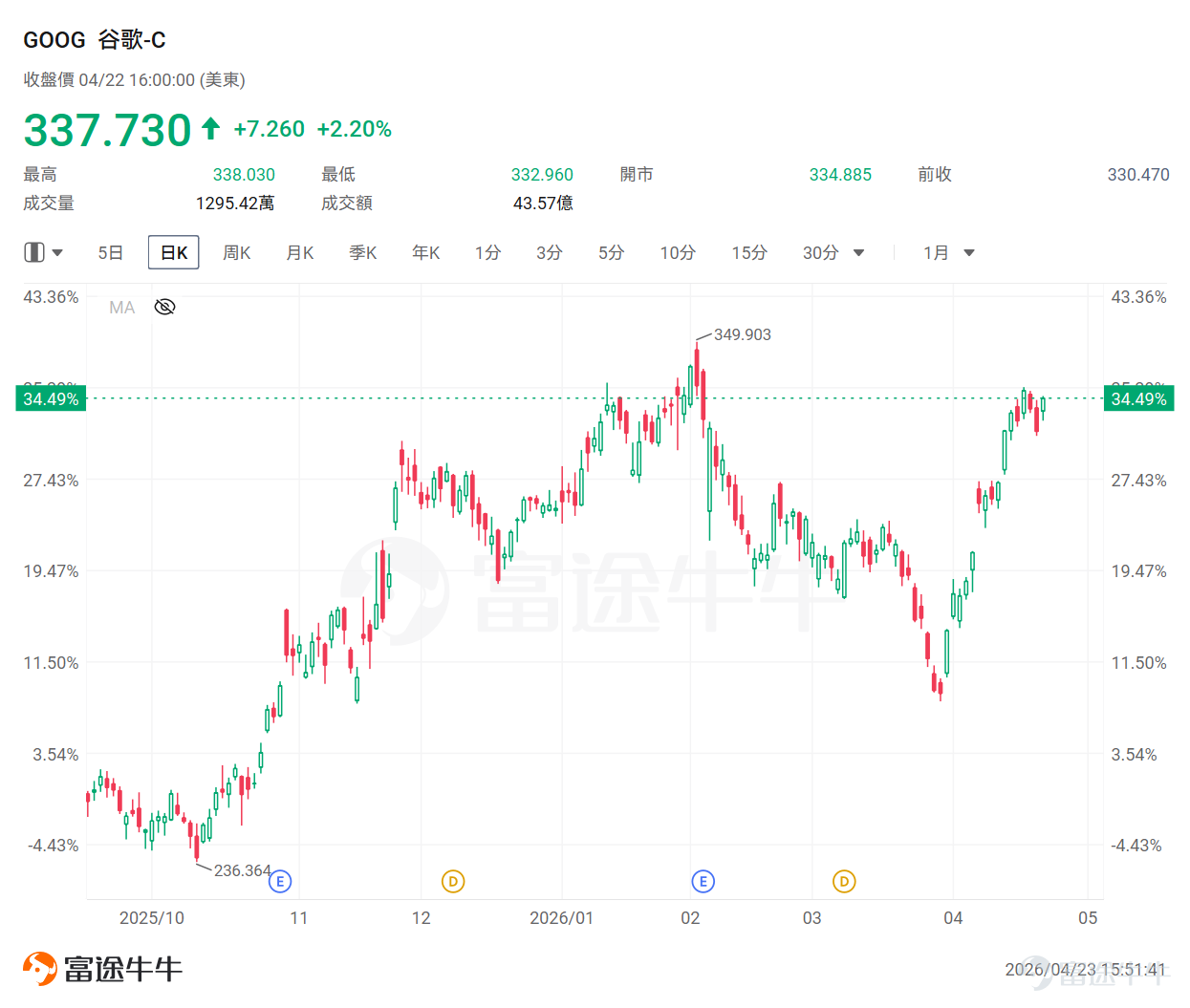
Focus on the Google Cloud annual conference, how will it impact market trends?

Google launches two new TPUs at once! With training and inference now separated, who will be the biggest winner?
$Alphabet-C (GOOG.US)$ Pushing its AI chip strategy into a new phase.
At the Google Cloud Next 2026 conference, Google officially announced that it is advancing its AI chip strategy to a new phase — unveiling its eighth-generation Tensor Processing Unit (TPU). This marks the first time Google has explicitly divided AI computing power intoTPU 8t, designed specifically for training,andand TPU 8i, optimized for inference.Marking a major shift in its AI hardware strategy.

--
--
--
Combined with the technical details released by Google, this article provides an in-depth analysis of the highlights of Google's eighth-generation TPU and which companies are expected to benefit.
Separation of training and inference leads to a significant leap in chip performance.
Google’s decision to split the eighth-generation TPU into two independent products is a direct response to the increasingly divergent trends in AI workloads — the TPU 8t focuses on training, while the TPU 8i specializes in inference.
Both chips are scheduled for official external supply later in 2026. Compared to the seventh-generation Ironwood TPU released in November last year,TPU 8t delivers a 2.8x performance boost at the same price point, while TPU 8i shows an 80% performance improvement;The per-watt performance of both chips has more than doubled compared to the previous generation, with TPU 8t achieving a 124% improvement and TPU 8i reaching 117%.

According to reports, Google has redesigned the tech stack with four key innovations to eliminate the 'waiting room' effect:
(1) Breaking through the 'memory wall':To prevent processor idle time, TPU 8i288 GBHigh-bandwidth memory and384 MBon-chip SRAM combined, up to three times the previous generation.
(2) Thanks to the Axion architecture, efficiency has significantly improved:Number of physical CPU hosts per serverDouble, using its custom CPU based on the Axion Arm architecturecustom CPU. Through the use ofNon-Uniform Memory Architecture (NUMA)Through isolation, Google has optimized the entire system.
(3) Expanding MoE models:For modern Mixture of Experts (MoE) models, Google has increased the interconnect (ICI) bandwidth1x,to reach19.2Tb/s. Its newBoardfly architecturehas reduced the maximum network diameter bymore than 50%, ensuring the system operates as a unified, low-latency unit.
(4) Eliminate Latency:Brand newOn-chip Collective Acceleration Engine (CAE)Can offload global operations, reducing on-chip latency by up to 5x, thereby minimizing delays.
To save data center power, Google has optimized efficiency across the entire stack and integrated power management features that dynamically adjust power consumption based on real-time demand. Through continuous innovation in both hardware and software, Google has increased the computational capacity per unit of power in its data centers to six times what it was five years ago.6 times. Both TPU 8t and TPU 8i adoptGoogle’s fourth-generation liquid cooling technology,, which can maintain performance density unachievable with air cooling.
Google's Eighth-Generation TPU Unleashes System-Level Benefits: A Guide to AI Supply Chain Core Advantages
Google has split the TPU into two (8t focused on training, 8i specialized in inference) and redefined the technical stack for AI data centers by breaking through memory walls, introducing custom Axion CPUs, doubling interconnect bandwidth, and fully upgrading liquid cooling. This shift directly catalyzes a full explosion of the four core underlying elements of AI: compute, storage, networking, and power.

--
--
--
I. Explosive Surge in Storage: Direct Winners Breaking Through the 'Memory Wall'
To eliminate the 'waiting room' effect during the inference process, Google has equipped the TPU 8i with up to 288GB of high-bandwidth memory (HBM) and 384MB of on-chip SRAM, tripling the capacity of the previous generation. This provides the strongest demand support for the storage sector.
HBM (High Bandwidth Memory) Trio:
$CSOP SK Hynix Daily Max (2x) Leveraged Product (07709.HK)$& $CSOP Samsung Electronics Daily Max (2x) Leveraged Product (07747.HK)$: As the undisputed leader in the global HBM market, the configuration of up to 288GB implies that Google’s procurement of HBM will grow exponentially.
$Micron Technology (MU.US)$: With improved yields of its HBM3E products, Micron is rapidly capturing market share and stands as a direct beneficiary of this capacity expansion.
NAND Flash:
$SanDisk (SNDK.US)$: Large-scale AI inference and training require massive data storage, driving a recovery in demand for high-capacity enterprise NAND SSDs, accompanied by rising volume and prices.
II. Big Leap in Computational Power: MoE Models Propel Ultimate 'Optical Interconnect'
Facing modern Mixture of Experts (MoE) models, Google doubled the system interconnect (ICI) bandwidth to 19.2Tb/s and adopted the new Boardfly architecture. This necessitates extensive high-speed data transmission, directly igniting sectors related to optical communications and high-speed interconnects.
Optical modules and high-speed interconnect chips:
Optical module systems: $Coherent (COHR.US)$ 、 $Lumentum (LITE.US)$ 、 $Applied Optoelectronics (AAOI.US)$and$CIG (06166.HK)$ . Doubling data transmission means the accelerated deployment of 800G and even 1.6T optical modules; these companies are core suppliers in the optical communication industry.
DSP and high-speed interconnect chips: $Marvell Technology (MRVL.US)$ 、 $Credo Technology (CRDO.US)$ . The DSP is the 'brain' for solving high-speed signal attenuation, with Marvell dominating the PAM4 DSP field, while Credo holds an advantage in the AEC (Active Electrical Cable) sector.
Analog optoelectronic chips: $Semtech (SMTC.US)$ 、 $MACOM Technology Solutions (MTSI.US)$ . Responsible for photoelectric signal conversion and amplification, they are indispensable upstream core components of optical modules.
Precision manufacturing and assembly: $Fabrinet (FN.US)$ 、 $FIT HON TENG (06088.HK)$ . Fabrinet is the leader in precision contract manufacturing of optical modules globally, closely tied to top customers utilizing silicon photonics technology.
OCS (All-Optical Circuit Switch):
Google's unique OCS architecture in its data center network can significantly reduce power consumption and latency. $Coherent (COHR.US)$ Providing core optoelectronic components; $Lumentum (LITE.US)$ Monopolized the crucial MEMS micro-mirror components in OCS; and $Fabrinet (FN.US)$ A type of extremely challenging precision assembly.
MPO and AOC (High-Density Interconnect Cables):
$Amphenol (APH.US)$ 、 $TE Connectivity (TEL.US)$ 、 $Corning (GLW.US)$ , as well as Hong Kong stocks, $TIME INTERCON (01729.HK)$ 、 $YOFC (06869.HK)$ . The high-density connections within and between cabinets have driven a huge demand for customized high-density cables.
III. Compute Power Base: The Victory of ASIC Customization and the Arm Architecture
Google has comprehensively optimized system latency, doubled the number of physical CPU hosts per server, and adopted a custom CPU based on the Axion Arm architecture.
CPU Camp:
$Arm Holdings (ARM.US)$: The full rollout of Google's Axion CPU marks a decisive victory for the Arm architecture in the data center field (compared to traditional x86), with Arm set to receive substantial IP licensing and royalty revenues.
ASIC Design and Wafer Manufacturing:
$Broadcom (AVGO.US)$: Traditional core design partner for Google's TPU. Broadcom’s ASIC design capabilities and SerDes IP are the cornerstone of TPU achieving such high-performance interconnects.
$Taiwan Semiconductor (TSM.US)$& $Amkor Technology (AMKR.US)$: Advanced process (3nm/4nm) wafer fabrication and advanced packaging capacity like CoWoS are the only physical guarantees for TPU implementation.
$FormFactor (FORM.US)$: As chip complexity, especially with Chiplet and HBM integration, rapidly increases, the demand and technical threshold for semiconductor wafer test probe cards have significantly risen.
System integration and EMS manufacturing: $Celestica (CLS.US)$ 、 $Jabil (JBL.US)$ 、 $Flex Ltd (FLEX.US)$ Responsible for assembling these expensive chips, coolers, and motherboards into final AI server racks.
IV. Power and Liquid Cooling: The Lifeline for Maintaining Computational Density
Both TPU 8t and 8i adopt Google's fourth-generation liquid cooling technology to address high thermal density that air cooling cannot solve, while integrating dynamic power management.
Liquid cooling sector:
$Vertiv Holdings (VRT.US)$ 、 $Modine Manufacturing (MOD.US)$ 、 $nVent Electric (NVT.US)$ As single-chip power consumption approaches or even exceeds a kilowatt, CDUs (coolant distribution units) and cold plate liquid cooling technologies have shifted from "optional" to "mandatory." These three companies are absolute leaders in global data center thermal management and liquid cooling infrastructure.
Server power supply and PCB sector:
Power management chips and modules: $Monolithic Power Systems (MPWR.US)$ Offering high-density core power management chips; $Vicor (VICR.US)$ The distributed power architecture effectively handles current surges; $Advanced Energy Industries (AEIS.US)$ and $INNOSCIENCE (02577.HK)$ Benefits are seen in the overall server power system and third-generation semiconductor (Gallium Nitride) power devices.
High-layer-count PCBs: $TTM Technologies (TTMI.US)$ 、 $VGT (02476.HK)$ AI server motherboards and OAM module boards require extremely high layer counts (24-30 layers or more) and very low transmission loss, driving both volume and price increases for high-end PCBs.
Summary
Google's stunning unveiling of its eighth-generation TPU has officially marked the competition in AI infrastructure moving from a singular focus on 'GPU computing power' to a substantive entry into a new era of 'system-level synergy.' ThroughCalculate(Arm CPUs and custom ASICs),Save(HBM breaking through memory bottlenecks),luck(Optical modules and OCS all-optical switching),ElectricityThe comprehensive restructuring of these four foundational elements (liquid cooling and high-density power supply) clearly indicates the main line of hardware upgrades for the next phase as outlined by Google.
In terms of investment positioning, the focus of capital is rapidly spreading along the industrial chain. The core logic of capturing AI dividends has extended to the entire 'system-level computing power network.' Supply chain companies with technological barriers at critical junctures such as breaking data transmission bottlenecks and resolving high-density heat dissipation crises are expected to gradually enter a phase of earnings realization. Seizing this wave of underlying architecture innovation-driven hardware diffusion trends is an important direction for positioning in the next phase of the AI industry trend.
Despite the clear long-term industry trend, rationality must still be maintained when positioning given the current market enthusiasm, while closely monitoring the following potential risks:
Valuation overextension and expectation gaps: Some popular targets in the AI supply chain (such as cooling, optical communication, and HBM sectors) have seen substantial accumulated gains in the early stages, with market expectations already highly elevated. It is necessary to guard against valuation pressure triggered if subsequent earnings guidance fails to exceed lofty market expectations during upcoming earnings seasons.
Fluctuations in tech giant capital expenditures: The prosperity of the hardware supply chain heavily relies on continuous massive capital investments from North American cloud giants. If the commercialization progress of downstream AI applications slows, it could force major firms to decelerate or reduce their subsequent data center procurement plans.
Technology implementation and production capacity bottlenecks: New-generation infrastructure (such as multi-layer PCBs, advanced packaging capacity, and liquid cooling components) features extremely high technical barriers. Caution is warranted regarding yield ramp-up falling short of expectations, shortages of key components, or substantive disruptions to global supply chain delivery schedules due to geopolitical factors.
Risk Disclaimer: The above content only represents the author's view. It does not represent any position or investment advice of Futu. Futu makes no representation or warranty.Read more


Comments (3)
to post a comment
75
267