
English
Back
Open Account
港股窩輪Jenny
wrote a post ·

The Hang Seng Index's recovery trend continues, with 26,300 points becoming a key short-term resistance level to break

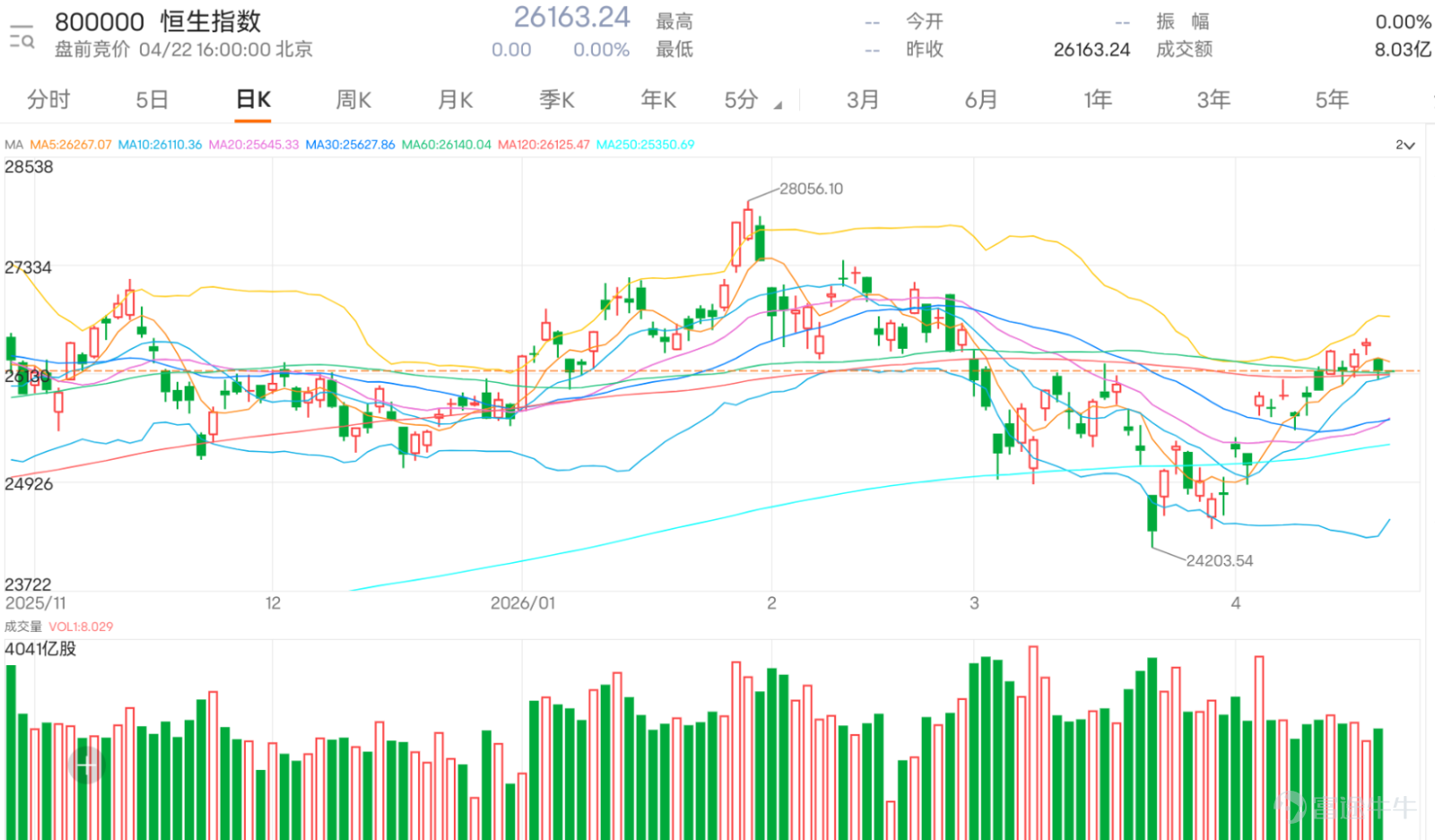
$Hang Seng Index (800000.HK)$ Last session closed at 26,163.24 points, overall still within the recovery structure after the rebound. After recovering from the low of 24,203.54 points, the index now stands firmly above the 10-day, 20-day, 30-day, 60-day, and 120-day moving averages, indicating that the medium- and short-term structure remains sound. However, it has yet to regain the 5-day line at 26,313.28, meaning the area around 26,300 points remains the most critical resistance in the near term.
$Hang Seng Index (800000.HK)$ Last session closed at 26,163.24 points, overall still within the recovery structure after the rebound. After recovering from the low of 24,203.54 points, the index now stands firmly above the 10-day, 20-day, 30-day, 60-day, and 120-day moving averages, indicating that the medium- and short-term structure remains sound. However, it has yet to regain the 5-day line at 26,313.28, meaning the area around 26,300 points remains the most critical resistance in the near term.   From the key points in the comments, market focus is mainly concentrated in three directions. First, whether the 26,000-point level can hold steady; many investors believe there is significant psychological support at 26,000 points, and if it breaks below this level, short-term sentiment would weaken. Second, whether the current upward trend represents a true breakout, consolidation, or a false rally followed by a downturn, reflecting caution among funds chasing higher levels. Third, whether bullish warrants should be held overnight, showing short-term capital’s anticipation of future direction while also worrying about risks brought by night trading and external factors. In terms of market sentiment, the overall mood is slightly bullish but not uniformly optimistic. Some investors believe buying power is strong, especially towards the end of the session, even expecting further upside the next day. Others are concerned about a possible bull trap, believing it unwise to chase highs. This divergence itself reflects that the current market is still in a tug-of-war stage before reaching resistance, without forming a one-sided consensus. Common questions mainly revolve around a few topics. First, whether the 26,000-point level is still safe; technically speaking, as long as the watershed at 26,147.07 points holds, the short-term outlook can remain cautiously optimistic. Second...
From the key points in the comments, market focus is mainly concentrated in three directions. First, whether the 26,000-point level can hold steady; many investors believe there is significant psychological support at 26,000 points, and if it breaks below this level, short-term sentiment would weaken. Second, whether the current upward trend represents a true breakout, consolidation, or a false rally followed by a downturn, reflecting caution among funds chasing higher levels. Third, whether bullish warrants should be held overnight, showing short-term capital’s anticipation of future direction while also worrying about risks brought by night trading and external factors.
In terms of market sentiment, the overall mood is slightly bullish but not uniformly optimistic. Some investors believe buying power is strong, especially towards the end of the session, even expecting further upside the next day. Others are concerned about a possible bull trap, believing it unwise to chase highs. This divergence itself reflects that the current market is still in a tug-of-war stage before reaching resistance, without forming a one-sided consensus.
Common questions mainly revolve around a few topics. First, whether the 26,000-point level is still safe; technically speaking, as long as the watershed at 26,147.07 points holds, the short-term outlook can remain cautiously optimistic. Second, whether it’s suitable to chase bullish positions at current levels; technically speaking, the current price is close to the resistance level, offering only neutral reward-risk potential, and unless an effective breakout above 26,303.60 points occurs, chasing higher levels wouldn’t be particularly advantageous. Third, whether the Hang Seng Index has formed a rounded bottom; for now, we can only say that the structure is continuously repairing, but a full confirmation of a stronger upward pattern cannot be made until breaking through the resistance zone between 26,303.60 and 26,781.42 points.
Technically, the 26,147.07-point level is the short-term watershed. Holding above this indicates buying pressure remains intact, with the next target potentially testing 26,303.60 points. A further breakout would open the door to a push towards 26,781.42 points. Conversely, if the 26,147.07-point level is breached, watch for a retest of 26,069.28 points; weaker sentiment might even lead to a test of the Bollinger Band midline at 25,556.29 points. The Relative Strength Index (RSI) stands at 55.442, indicating some improvement in momentum but not yet reaching a very strong level. Thus, the current reasonable assessment remains one of steady recovery without completing a decisive breakout. Strategically, it's unwise to treat resistance zones as areas for chasing lower prices.
Key strategy: 26,147.07 serves as the short-term watershed. If it holds firm, a rebound can be anticipated, and breaking through 26,303.60 could lead to another leg up towards 26,781.42. However, if 26,147.07 fails, adopt a defensive stance and monitor a potential retest of 26,069.28 or further downside exploration.
Call warrants: $UB-HSI @EC2606A.C (24012.HK)$ The strike price is set at 27,738 points, with relatively low implied volatility, making it suitable for investors who are bullish on the market outlook while aiming to control volatility risk. Another option is $HS-HSI @EC2606A.C (24099.HK)$ , which also has a strike price of 27,738 points. This product offers ideal leverage and implied volatility, balancing cost with return potential.
Put warrants: $CT-HSI @EP2607A.P (26040.HK)$ The strike price is 25,075 points, with both its premium and implied volatility being the lowest among similar products, making it suitable for bearish investors focused on cost-effectiveness. $UB-HSI @EP2607A.P (25463.HK)$ With a strike price of 25,074 points, this warrant is known for having ideal leverage and implied volatility, offering higher efficiency for bearish investors.
Bull certificate recommendation: $SG#HSI RC2809R.C (56364.HK)$ The recovery price is 25,208 points, featuring high actual leverage and low premium, making it suitable for investors optimistic about a short-term rebound and seeking high leverage. $UB#HSI RC2810A.C (56741.HK)$The recovery level is at 25,200 points, with the lowest premium in its category and relatively higher actual leverage, making it suitable for strategies that balance entry cost and leverage.
Bear certificate selection$BI#HSI RP2804W.P (65611.HK)$The recovery level is at 27,105 points, with relatively higher leverage pricing, making it ideal for investors who are bearish on the market outlook and seeking higher leverage benefits. Another option is...$BI#HSI RP28045.P (66209.HK)$The recovery level is at 27,150 points, also featuring relatively high leverage pricing, serving as an alternative for bearish positioning.
$Hang Seng Index (800000.HK)$ Last session closed at 26,163.24 points, overall still within the recovery structure after the rebound. After recovering from the low of 24,203.54 points, the index now stands firmly above the 10-day, 20-day, 30-day, 60-day, and 120-day moving averages, indicating that the medium- and short-term structure remains sound. However, it has yet to regain the 5-day line at 26,313.28, meaning the area around 26,300 points remains the most critical resistance in the near term.   From the key points in the comments, market focus is mainly concentrated in three directions. First, whether the 26,000-point level can hold steady; many investors believe there is significant psychological support at 26,000 points, and if it breaks below this level, short-term sentiment would weaken. Second, whether the current upward trend represents a true breakout, consolidation, or a false rally followed by a downturn, reflecting caution among funds chasing higher levels. Third, whether bullish warrants should be held overnight, showing short-term capital’s anticipation of future direction while also worrying about risks brought by night trading and external factors. In terms of market sentiment, the overall mood is slightly bullish but not uniformly optimistic. Some investors believe buying power is strong, especially towards the end of the session, even expecting further upside the next day. Others are concerned about a possible bull trap, believing it unwise to chase highs. This divergence itself reflects that the current market is still in a tug-of-war stage before reaching resistance, without forming a one-sided consensus. Common questions mainly revolve around a few topics. First, whether the 26,000-point level is still safe; technically speaking, as long as the watershed at 26,147.07 points holds, the short-term outlook can remain cautiously optimistic. Second...
Reply to some investors' views:
@年轻的The 26,000-point level is indeed a significant psychological threshold, but technically, the closer pivotal point is 26,147 points. If even this level is breached, caution should be heightened in the short term.
@保时捷666The current situation reflects only a partial stabilization and recovery, not a complete turnaround. The key remains whether there can be an effective breakout above 26,303 points; until then, it’s merely an improvement.
@Luck BabyIt’s still premature to talk about a rounded bottom. At this stage, it appears more like a rebound followed by stabilization. To confirm meaningful technical improvement, there needs to be a breakout above 26,303 points first, followed by testing whether 26,781 points can be reached.
@神秘力量動向知情者Such concerns in the market are normal since we’re currently facing resistance. If the market can break through 26,303 points and stabilize, the likelihood of a false breakout will significantly decrease.
@DeclanmarketwhizIf there is substantial capital pressure, short-term high-leverage positions should adopt a more conservative approach because the current pattern is one of recovery, not without pullback risks.
Feel free to share your insights in the comment section. For more market analysis, please continue following ‘Hong Kong Stock Warrants Jenny’ for daily updates!
Reminder: This article does not constitute any investment advice.
This article is for reference only and does not constitute any investment advice. Market data, opinions, and analyses contained herein may change at any time without prior notice. We are not responsible for any loss or damage caused by reliance on the information in this article. Technical analysis only shows whether certain technical conditions are met, and asset performance should be comprehensively evaluated in conjunction with other information. Trading decisions should not be made solely based on this article. Please note that past performance is not indicative of future results. $Hang Seng TECH Index (800700.HK)$$Hang Seng China Enterprises Index (800100.HK)$
#HongKongStocks #RealTimeAnalysis #WarrantSelection #WarrantGuide #DerivativesHedging #HongKongWarrantsJenny #HangSengIndex #HangSengTechIndex #BlueChipStocks #TechnicalAnalysis
Risk Disclaimer: The above content only represents the author's view. It does not represent any position or investment advice of Futu. Futu makes no representation or warranty.Read more
Thumbs Up
2
73K Views
Report
Comment (1)
Write a Comment...
1
2