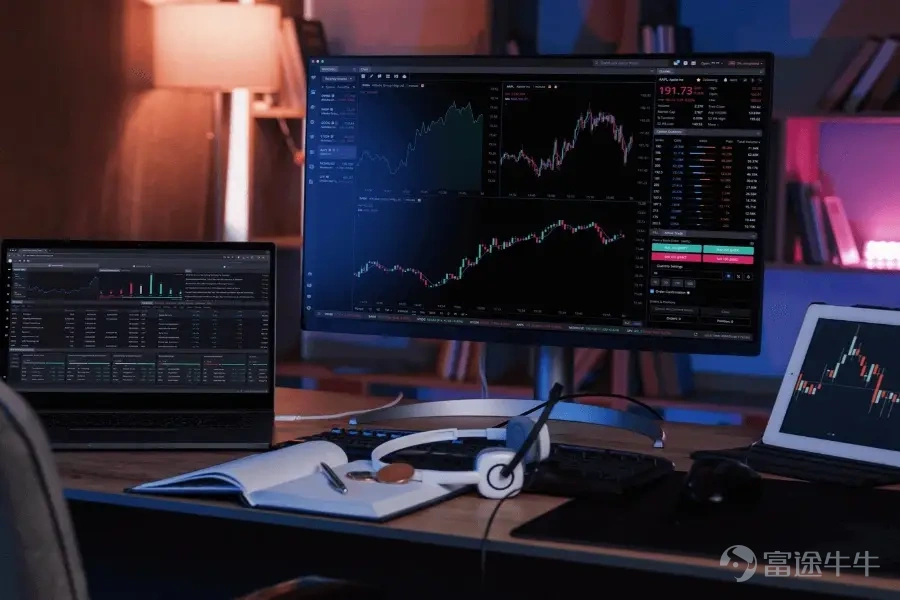

US relaxes restrictions, Webull seizes high-frequency trading
The US relaxes restrictions on small retail trading, and Webull takes the lead in compliance, aiming to boost platform trading volume

Key points:
* The US SEC cancels a 25-year-old restriction on retail trading (limiting the frequency of small retail trades), and Webull will introduce corresponding measures after the new rules take effect on June 4
* The US securities regulator approved this change last week, which is expected to help increase trading volume on the Webull app and drive growth in trading fee revenue
Article by author Liang Wuren
Chinese online brokerage firms$Webull (BULL.US)$is leveraging its usual advantage of acting faster than its peers to capitalize on a significant rule change that could boost revenue
Competitors such as$Robinhood (HOOD.US)$, may still be carefully reviewing the rule changes announced by the US SEC (Securities and Exchange Commission) last week, which abolished the 25-year-old 'Pattern Day Trader (PDT)' rule details. The original rule required leveraged retail traders to maintain at least $25,000 in their accounts to execute more than three day trades within a week. A day trade refers to buying and selling the same stock within the same trading day. This policy essentially restricted small retail trading activity, while these investors are among the most active buyers in the market.
Webull, whose founding team originated from the Chinese e-commerce giant Alibaba, quickly responded to this significant change with keen insight, being the first to announce its intention to leverage the situation.
Last Wednesday, the day after the SEC approved the reform, Webull immediatelystatedHigh-frequency trading functionality will be opened to all investors, and the new rule will be implemented immediately after it takes effect. The removal of this trading restriction will take effect on June 4, while brokers may have up to 18 months to fully implement the changes. Traditional institutions such as $Charles Schwab (SCHW.US)$ hope to use this period to upgrade their existing risk management systems.
Under the new framework, brokers must adopt real-time risk models to ensure that traders' intraday positions do not exceed their risk-adjusted capital levels. This requirement could give technology-oriented brokers like Webull a critical advantage, as they are already equipped with relatively advanced risk assessment systems. However, it may also make Webull a test case to examine the potential risks associated with increased trading volumes under the new rules.
Anthony Denier, President and CEO of Webull's US operations, stated in an announcement: 'Our top priority is to ensure that Webull clients can benefit from the new rules on the first day they take effect, while continuing to enjoy the advanced tools, real-time data, and full product functionality that are central to the Webull trading experience.'
The PDT rule originated during the dot-com bubble in 2001 and was designed to prevent inexperienced investors from overusing leverage. However, over the past 25 years, the $25,000 threshold has effectively excluded millions of small retail investors from high-frequency trading privileges available to institutional investors. The SEC has finally acknowledged that this threshold is outdated because modern real-time risk monitoring systems are more effective at maintaining market stability than arbitrary minimum capital requirements.
This rule change could further promote speculative trading patterns, which form the core revenue source for Webull. Similar to Robinhood, Webull does not charge commissions for US stock trades but instead routes orders to specific market makers and earns service fees from them. Additionally, the company charges customers for advanced features such as margin trading and short selling. These revenue streams depend on continuous and high-frequency trading turnover, making substantial trading volumes crucial for Webull.
Under the PDT system, an ordinary investor with an account holding only $5,000 represents a low-revenue client for the company. They can only execute three intraday trades per week, significantly limiting the order flow to market makers such as Citadel Securities or Virtu Financial. Now, if the same client can conduct 50 trades per day, it would mean generating hundreds of orders weekly for market makers.
Although Webull's revenue comes from numerous small fees, the company also invests heavily in marketing to continuously attract new traders. As a result, it recorded an operating loss in 2024. Despite successfully turning losses into profits last year, its gross profit margin was only about 10%.
High-frequency short-term trading
Given its reliance on a high-volume, low-margin business model, Webull has consistently sought opportunities to expand revenue by increasing trading frequency. As early as 2023, the company became the first to launch 24-hour trading for more than 500 US stocks and exchange-traded funds (ETFs), while actively promoting options products with same-day expiration.
Clearly, Webull is not the only one eyeing the benefits of relaxed regulations. Peers such as Robinhood have also been actively attracting retirement account funds and expanding credit card businesses over the past year, putting them in a similarly advantageous position to benefit.
Competitors targeting the Chinese market, such as $Futu Holdings Ltd (FUTU.US)$and$UP Fintech (TIGR.US)$, primarily serve Asian users and currently offer high-leverage, high-frequency US stock trading services, aligning their trading experience with the speed seen in other global markets.
Following the SEC's relaxation of rules, the share prices of these brokers generally rose last week, but Webull led the pack with an 11% surge. This indicates that investors are betting on the company becoming one of the main beneficiaries under the new regulatory environment.
However, Webull's share price still has considerable ground to recover. Since its listing a year ago through a merger with a Special Purpose Acquisition Company (SPAC), its share price has fallen by about a quarter. Even so, its current price-to-earnings (P/E) ratio remains high at 53 times, surpassing Robinhood's 45 times, and far exceeding Futu's 16 times and Tiger Brokers' 8 times.
With trading restrictions lifted, Webull does have the opportunity to benefit further. Its app interface is filled with technical indicators, deep market data, and complex options chains, traditionally catering to users who prioritize trading operations. This means its user base mostly consists of active traders willing to trade stocks frequently around the clock.
But as with any good opportunity, it often comes with risks. In fact, removing the $25,000 safety threshold also introduces significant financial risks for Webull. Without this capital buffer, small investors using leverage could quickly lose all their funds, or even face greater losses, during a sudden market downturn.
In extreme situations like these, even the fastest monitoring systems might not be able to close positions in time to cut losses, leading accounts to incur massive deficits rapidly and exposing platforms like Webull to the risk of unrecoverable bad debts from users. Given that the US stock market is currently at historical highs and a correction is widely anticipated, once the trend reverses, Webull could become a textbook example of how relaxed regulation backfires on brokers.
For now, investors remain focused on the positive factors. However, whether Webull can truly benefit from what appears to be a regulatory dividend, without suffering negative consequences, thanks to a sufficiently rigorous risk management system, remains to be seen over time.
Risk Disclaimer: The above content only represents the author's view. It does not represent any position or investment advice of Futu. Futu makes no representation or warranty.Read more


Comments
to post a comment
6
2